A summer rebound is stirring hopes the bear market in U.S. stocks has seen its lows, but a meeting of Federal Reserve policy makers this coming week might test the nerves of would-be bulls. “I expect we will continue to see market volatility until investors have seen more convincing evidence that this period of Fed hawkishness is behind us, and I do not expect that to be the message” when central bankers conclude a two-day meeting on July 27, said Lauren Goodwin, economist and portfolio strategist at New York Life Investments, in a phone interview. Disappointing results from social-media platform Snap Inc. SNAP, -39.08% trimmed a weekly rise in stocks on Friday, The bounce last week lifted the indexes off 2022 lows after the S&P 500 sank to a finish of 3,666.67 on June 16.The rebound has been fueled in part by a dynamic that’s seen investors treat bad news on the economic front as good news for stocks, said James Reilly, an economist at Capital Economics, in a Friday note. That may sound strange, but it likely reflects, in part, a view among investors that weaker economic data will lead the Fed to raise interest rates less than previously thought, Reilly wrote.
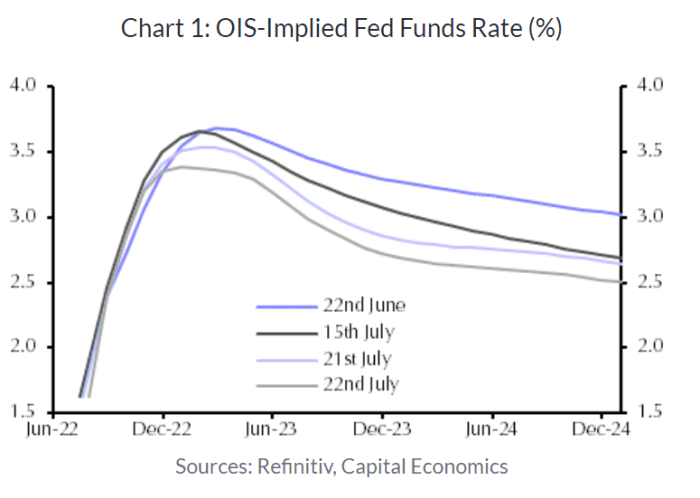
Market expectations are for the Fed to deliver a 75 basis point interest rate increase on Wednesday, matching the increase seen in June, which was the largest since 2002. The U.S. services purchasing managers index fell to a 26-month low of 47 in July from 51.6 in the prior month, based on a “flash” survey from S&P Global Market Intelligence. A reading of less than 50 signals a contraction in activity. On Thursday, weekly jobless claims rose to the highest level since November but remained historically low, the Philadelphia Fed manufacturing index unexpectedly fell deeper into negative territory, and the Conference Board said its leading economic index shows that a U.S. recession around the end of the year and early next is now likely. U.S. economic data due later this week include a first estimate of second-quarter gross domestic product, that’s expected to show a second straight contraction. While such an outcome is often described as a technical recession, a still strong labor market and other factors are seen making it unlikely the National Bureau of Economic Research, the official arbiter of the business cycle, will declare one.
Reilly said he doubts slowing activity will slow the Fed’s roll.
“Our central forecast is that U.S. economic growth will remain weak, but not so weak as to deter the Fed from hiking aggressively over the rest of this year. Such an outcome would probably mean rising discount rates and disappointing growth in corporate profits, which would be a fairly toxic combination for equity prices,” he wrote. Many Fed watchers, including some ex-policy makers, see a Fed intent on convincing market participants of its desire to snuff out inflation.
Former Richmond Fed President Jeffrey Lacker on Friday said policy makers would need to keep raising interest rates even if there is a recession. “To let your foot up off the brake before inflation has come down” is just a “recipe for another recession down the road,” Lacker said,
Even if the economy slowed fast enough to cause Fed policy makers to back off, it probably wouldn’t be great news for equities, Reilly argued. That’s because corporate earnings would weaken further than the firm already expects, he said. It’s also unlikely that the support equities have seen as expectations for the fed-funds rate have moderated would continue in a severe slowdown, with history showing that valuations have tended to fall during such periods as appetite for risk deteriorated. Markets have been dominated by worries over red-hot inflation and the threat of recession, so a “somewhat more sanguine” read from companies so far was a dose of good news, Goodwin said. Indeed, investors have seemed to cycle between fears over inflation and recession, market watchers said. Red-hot inflation was the dominant worry as stocks tumbled and Treasury yields soared in the first half of 2022. More recently, market action indicates investors have focused more on the prospect of recession as the Fed aggressively tightens policy. Goodwin said inflation will remain a primary consideration when it comes to portfolio positioning because recession-resilient assets, such as cash, Treasurys and high-grade corporate bonds that worked in the last cycle can create a significant drag on wealth creation. NN: Our buddies that run the wall street conspiracy are hurting. Losses are significant and they are in trouble. So they have a solution… Its right out of the fuck your client playbook. Namely they are spinning FED tightening is coming to a end and the inflation fears are overblown. If you follow THEIR logic its time to be a buyer of beaten down “bargain” stocks. Hence the bear market rally back they are trying to get going. In essence they are going to throw their clients under the bus….. I am a seller here and now….