The pace of the stock market’s rise as it continues a bounce off the June lows is nearing a magnitude that’s preceded “huge” moves in the past. The dilemma for investors is that those moves can be in “either direction,” analysts at Jefferies observed in a weekend note. Through Friday, the S&P 500 SPX, -0.12% had bounced more than 13% off its 2022 closing low of 3,666.77, set on June 16. While the S&P 500 remains in a bear market, having tumbled more than 20% from its Jan. 3 record close, the Dow Jones Industrial Average DJIA, +0.09% traded above the threshold — 32,877.66 — that would mark its exit from a market correction, before trimming early gains on Monday. The Nasdaq Composite COMP, -0.10% temporarily traded above the level — 12,775.32 — that would signal an exit from its brutal bear market. The Dow eked out a small gain Monday, while the S&P 500 and Nasdaq ended 0.1% lower.
But it’s the large-cap benchmark S&P 500’s more-than-7% rise over the past four weeks that is “dangerously close to extremely interesting from a signal perspective,” wrote Jefferies strategists, including Andrew Greenebaum, in a Sunday note.
A rise of just more than 8% over four weeks would mark a two-standard deviation for S&P 500 rallies, they observed, based on data going back to 1990, which means the market won’t need “much more juice” to hit statistically significant territory. And in the 17 times the S&P 500 has hit that threshold, the subsequent performance “looks massive,” they wrote, averaging 9% over the next six months.
But there’s a notable caveat in that there were also several instances that saw double-digit negative returns. And when the prior six months were negative —
And when the prior six months were negative — as would be the case this time around — “the likelihood of positive returns drops precipitously,” they wrote (see chart and table below).
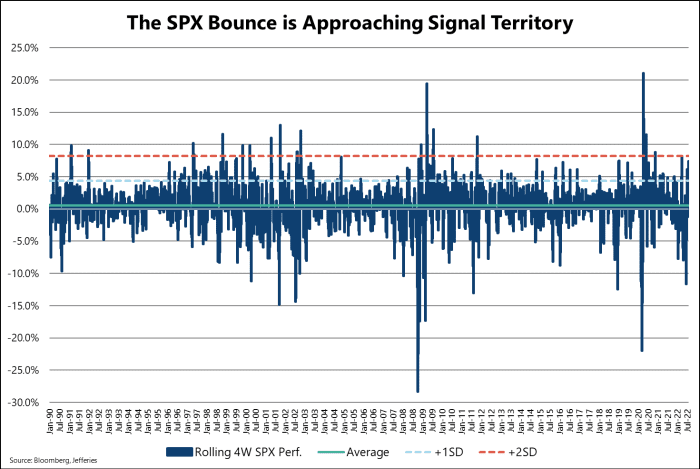
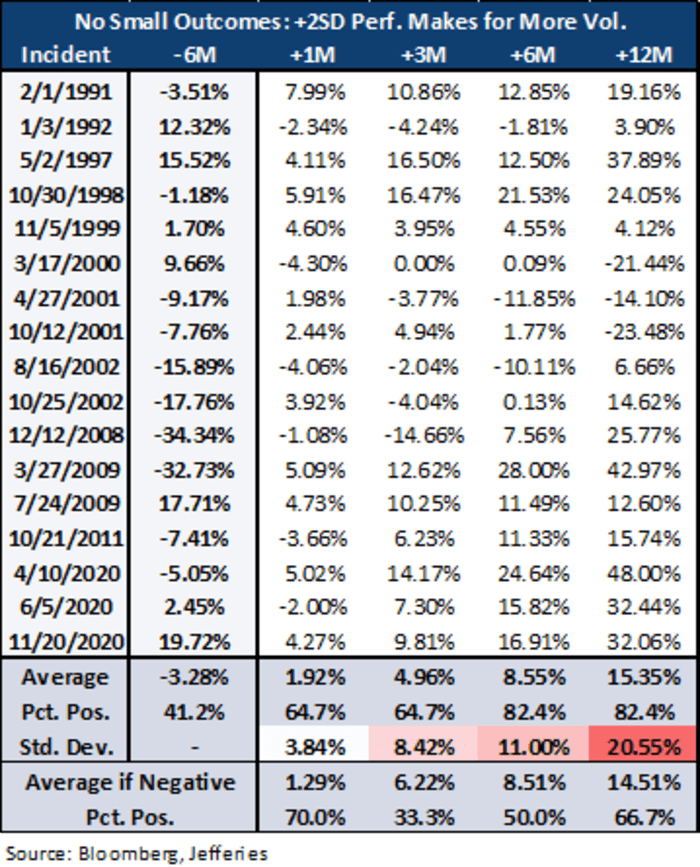
The takeaway, they said, is that “while the seemingly unstoppable bounce may lure folks in, there is still a strong chance it’s just a (quite tradeable) bear market rally.” NN: When i consider the run away inflation even if it moderates somewhat, The inverted yield cure, the 2 quarters of negative GDP growth AND energy prices that are still at record highs…..And i know that in order to stop inflation the central bank has got to get Fed Funds rate above the PCE inflation rate that means the FED still has to raise rates at least 3% MORE TO at least 5%. See Chart below of core market based PCE data that the FED watches like a hawk:
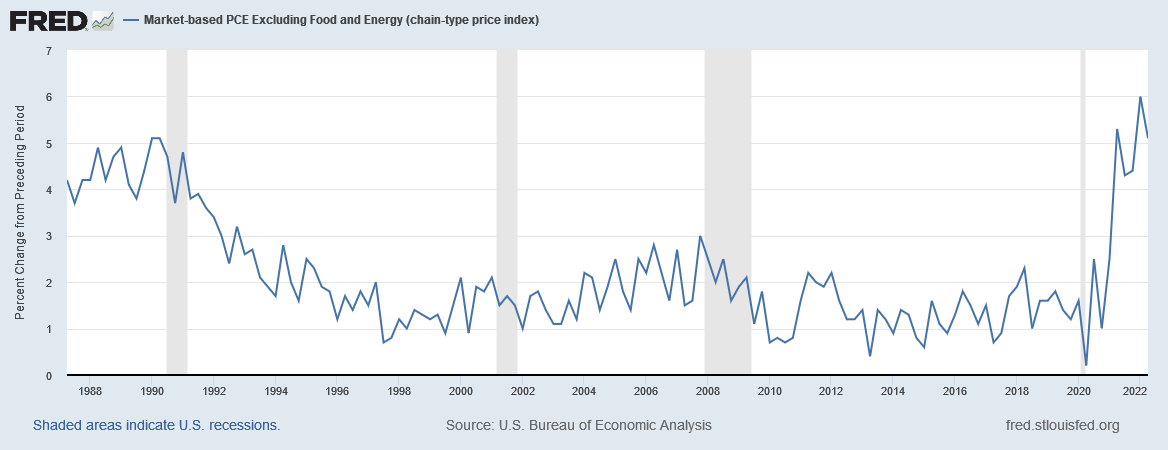
My calculations and proof: ( current FED FUNDS rate 2,32% current PCE is 8.1% excluding food and energy (core) its 5.1%) I use the data i know for a fact the FED watches that is: Gross Domestic Product > Release Tables > SECTION 2 – PERSONAL INCOME AND OUTLAYS > Table 2.3.7. Percent Change from Preceding Period in Prices for Personal Consumption Expenditures by Major Type of Product. I put a active link below to the chart so you can see for yourself
Table 2.3.7. Percent Change from Preceding
My conclusions: The FED has no choice they HAVE to continuing raising rates. Do not fight the FED. reality is they have NO choice. They have to throw the economy into a recession at least. I am of the opinion a 5% FED FUND (a doubling from here) is a must. That will collasp the stock market. This is a inflation crises of epic proportions. Requiring emergency action by the FED. Remember i am using their numbers i know they live and die on. The PCE understates inflation that is why they use it. Inflation at the core assuming the temporary reprieve on energy prices is running over 10%. Past central banks have gotten them into the same data traps. Unfortunately the people crunching the numbers the FED uses for it decisions live in a world of alter reality….. And every time we have been at this point they fuck up. Lest you forgot the transitory trap they fell into last year. This year its wishfull thinking and to little to late