-
OPEC+ production cuts have driven up crude oil prices
-
End-user demand for transport fuels remains very subdued
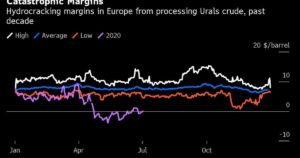
Crude oil is the world’s most important commodity, but it’s worthless without a refinery turning it into the products that people actually use: gasoline, diesel, jet-fuel and petrochemicals for plastics. And the world’s refining industry today is in pain like never before. “Refining margins are absolutely catastrophic,” Patrick Pouyanne, the head of Europe’s top oil refining group Total SA, told investors last month, echoing a widely held view among executives, traders and analysts. What happens to the oil refining industry at this juncture will have ripple effects across the rest of the energy industry. The multi-billion-dollar plants employ thousands of people and a wave of closures and bankruptcies looms. “We believe we are entering into an ‘age of consolidation’ for the re?ning industry,” said Nikhil Bhandari, refining analyst at Goldman Sachs Inc. The top names of the industry, which collectively processed well over $2 trillion worth of oil last year, are giants such as Exxon Mobil Corp. and Royal Dutch Shell Plc. There are also Asian behemoths like Sinopec of China and Indian Oil Corp., as well as large independents like Marathon Petroleum Corp. and Valero Energy Corp. with their ubiquitous fuel stations. A refinery’s economics are ultimately simple: it thrives on the price difference between crude oil and fuels like gasoline, earning a profit that’s known in the industry as a cracking margin. The industry’s most rudimentary measure of refining profit, known as a 3-2-1 crack spread (it assumes three barrels of crude makes two of gasoline and one of diesel-like fuels), has slumped to its lowest level for the time of the year since 2010. Summer is normally a good period for refiners because demand rises with consumers hitting the road for their vacations. This time, however, some plants are actually losing money when they process a barrel of crude. Just a few weeks ago, the outlook appeared to be improving for the world’s biggest oil consumers. Demand in China was almost back to pre-virus levels and U.S. consumption was gradually rebounding. Now, a second wave of infections has prompted Beijing to lock down hundreds of thousands of residents. Covid-19 cases are also on the rise in Latin America and elsewhere.
With demand in the U.S. now showing signs of heading south again as coronavirus cases flare up in top gasoline-consuming regions including Texas, Florida and California, the margins are at risk of deteriorating in America, which accounts for nearly two in each ten barrels of oil refined worldwide.
“The worst fear for refiners is a resurgence of the virus and another series of lockdowns around the world that would again significantly impact demand,” said Andy Lipow, president of Lipow Oil Associates in Houston. Another problem is that — where it has been recovering — the demand pickup has been uneven from one refined product to the next, creating significant headaches for executives who need to select the best crudes to purchase, and the right fuels to churn out. Gasoline and diesel consumption has surged back, in some cases to 90% of their normal level, but jet-fuel remains nearly as depressed as at the nadir of the coronavirus lockdowns, running at just 10% to 20% of normal in some European countries.
“Right now gasoline demand is barely keeping some plants alive,” said Stephen Wolfe, head of crude oil at consultant Energy Aspects Ltd. “And with jet production shifting over to diesel and gasoline production, that puts even more strain on product supply,” he added.
Ultimately, if refiners don’t make money, they buy less crude, potentially capping the oil-price recovery of the past few months for Brent and other benchmarks.
“Refinery margins in the next five years are going to be worse than the average for the last five years, and particularly bad in Europe,” said Spencer Welch, vice president of oil markets and downstream consulting at IHS Markit. “We already thought that refining was in for a tough time, even more so now.” Nick Note: No matter how much shit the throw at the wall REALITY is planes they don’t fly do not burn jet fuel. And as who out of work and on lock down don’t drive as much. And here is one for you people who are not going into those death chambers the work cubical do not use death cars called public transportation. All that means fuel demand is going to hell in the coronation hand basket. and and that means the shit they use to make all that motion lotion crude oil is seeing demand to continue to plunge.