- With sell signals in place, volume rising, and breadth weak, a retest of the 50-dma early next week will not be a surprise.
- Deutsche Bank’s strategists ‘expect an imminent correction’ even though they see the S&P 500 rising back around current levels by year-end.
- With supply chain disruptions looking to last longer than expected, the Fed is trapped between supporting a slowing economy and fighting inflation.
The downturn started on Monday with the week ending in 5 straight down days which is the worse slide since February. The total decline for the week was just -1.69%. Yes, that’s it, less than 2%. Robin Hood traders who have never seen such a things were sacrificing rabbits and drinking chicken blood begging the FED to interveneNI.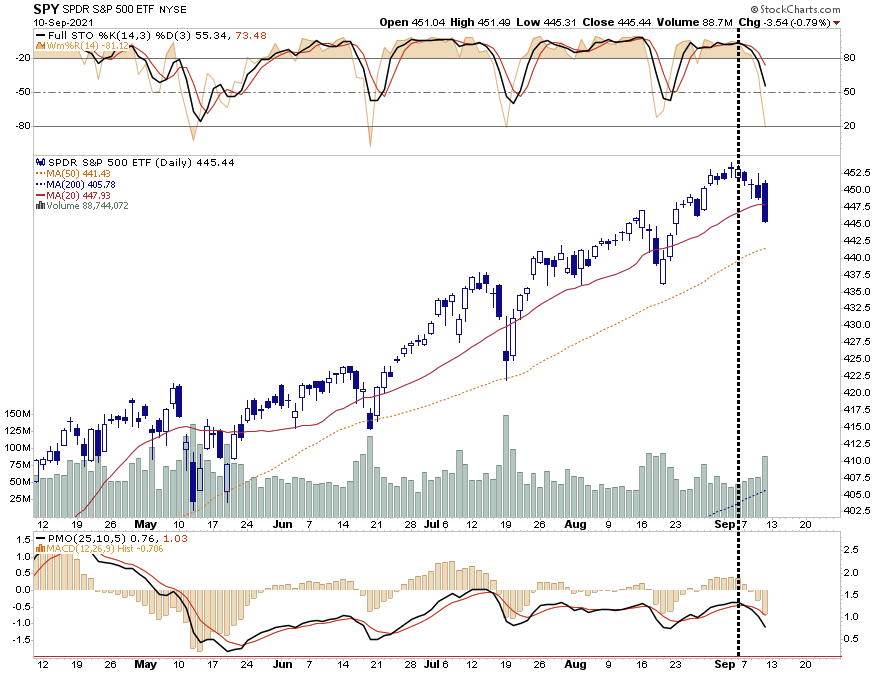
With sell signals in place, volume rising, and breadth weak, a retest of the 50-dma early next week will not be a surprise. Before I jump I want to see if the buy on the dip traders show up again, as they have done every other time over the last 6 months. As shown, the market remains well confined to its rising trend with support sitting at the 50-dma. Volatility did pick up late last week as volume spiked suggesting more selling pressure on Monday. As you can see by the chart below the Bull channel remains in tact. As long as this downward move stay in this channel we will continue to wait…..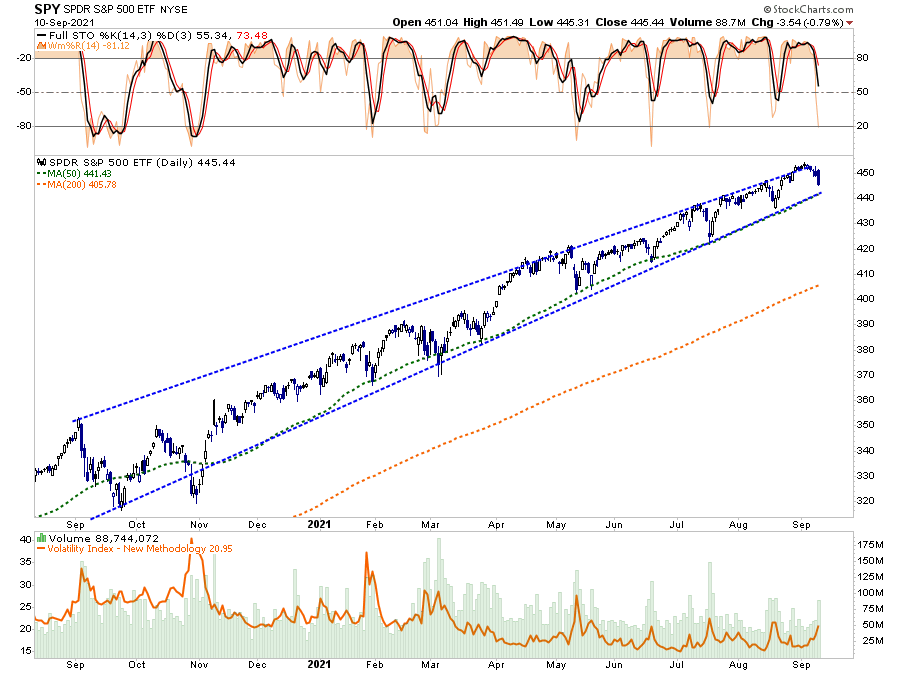
The question is will the market hold the 50-dma again, or has the risk of a more substantial correction finally caught up with investors. Although 5-10% corrections are absolutely normal in any given market year. I would like to catch this move if i can.
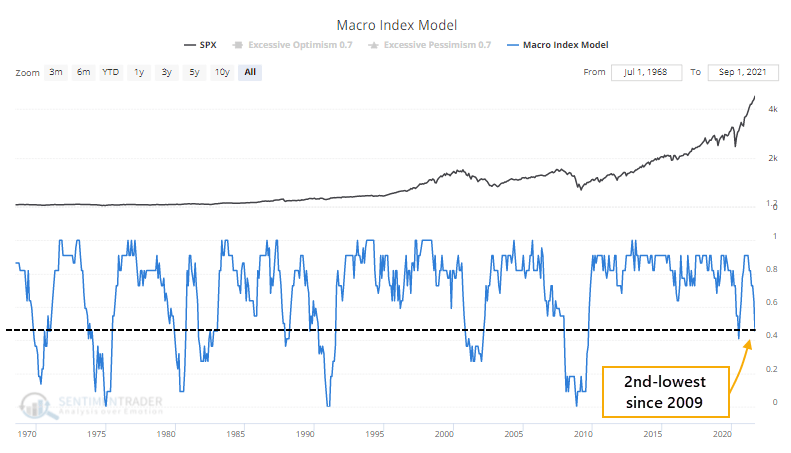
Over the last couple of weeks, I have seen weakening breadth, lower participation, and negative divergences. But we have also seen lower volume and considering its the end of vacation season some market softness is to be expected. The Macro Index Model combines 11-diverse indicators to determine the state of the U.S. economy. Once the final reports were in for August, the model plunged below 46%, the 2nd-lowest reading of the past decade.“
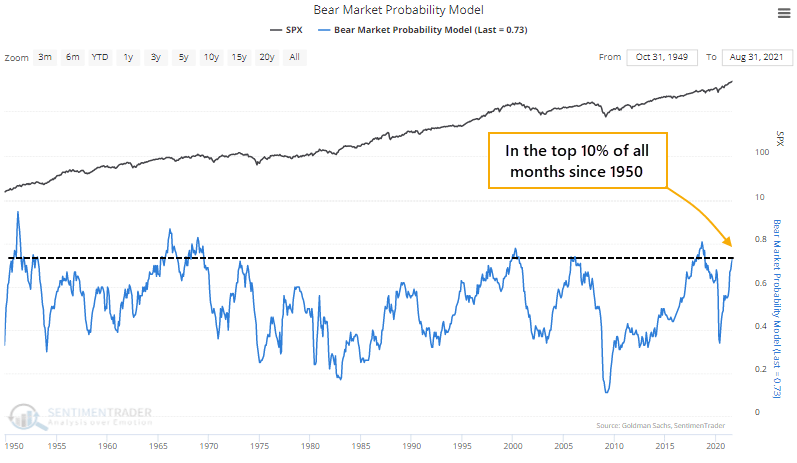
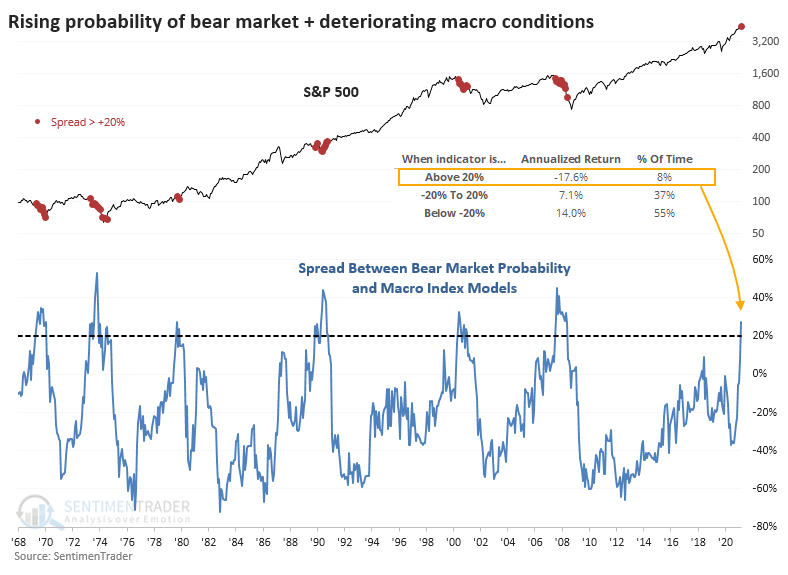
At the same time, Sentiment Trader noted their Bear Market Probability Indicator also jumped. This model has 5 inputs, namely the unemployment rate, ISM Manufacturing index, yield curve, inflation, and valuations.
“The chart below shows the spread between the Bear Market Probability and Macro Index models. The higher the spread, the higher the probability of a bear market. The chart shows that the S&P 500’s annualized return is a horrid -17.6% when the spread is above 20% like it is now.”
The point here is that while the market remains exceedingly bullish, there are signs of trouble brewing beneath the surface. Such is why we suggested raising cash levels, adding non-correlated assets, and reducing overall risk. Without any concern for corrections, individuals have increased equity risk levels relative to their overall net worth. BUT remember they have the highest saving rate ever and the millennial traders have no fear because they have not been fucked by Wall Street just yet…… 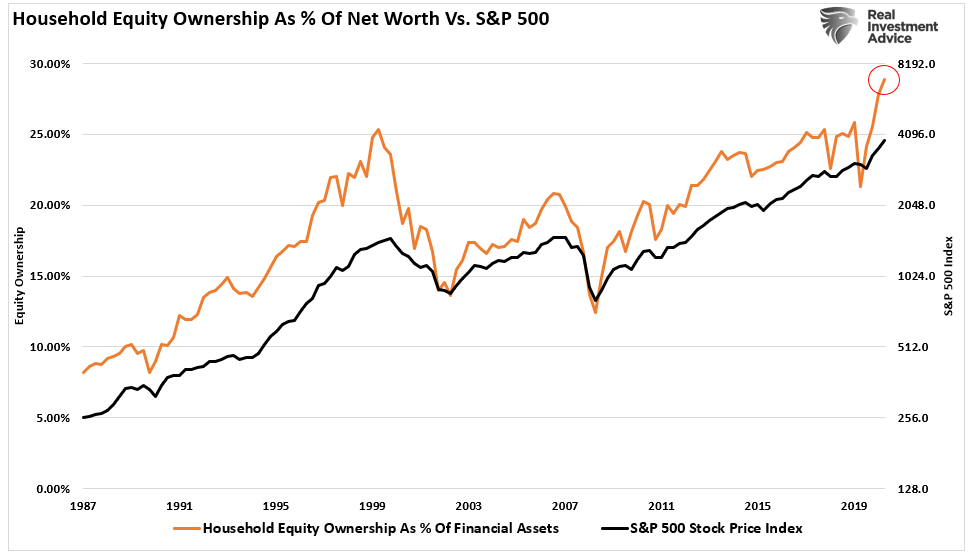
We see the same overvaluations when we analyze their equity allocations as a percentage of their overall financial assets. They are all in… But not necessary One and done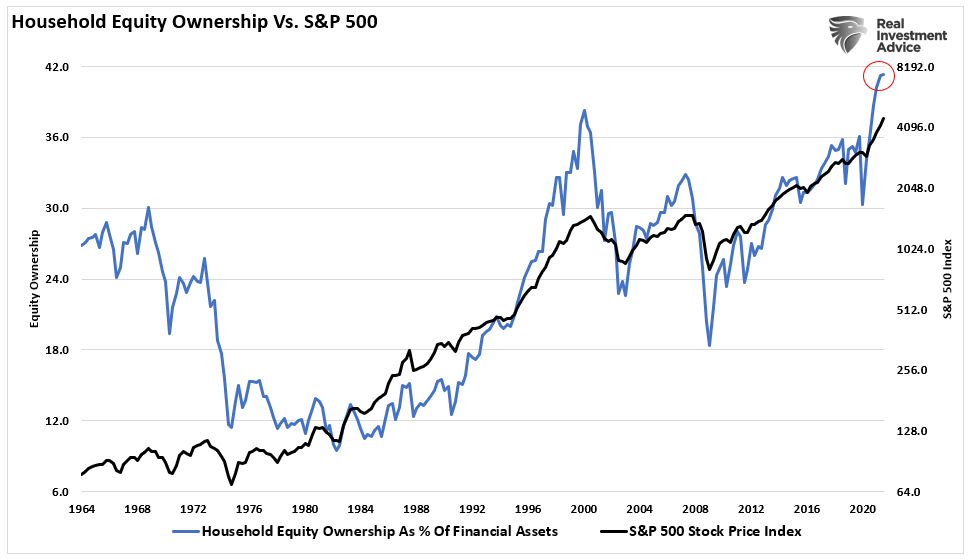
The two charts above clearly show the market is a bubble. without a doubt. BUT with unprecedented FED stimulus and realizing we came out of a shutdown induced by the pandemic you can see why newbee investors are throwing caution to the wind.. Old rules really do not necessarily apply. At the moment investors are incredibly confident that markets can only go higher as long as the “Fed” remains accommodative. While there is undoubtedly a substantial argument as to the ability of the Fed to keep markets inflated, there are other “risks” present that could lead to a short-term correction.
Record leverage in the market, economic growth slowing, and rising inflationary pressures, numerous issues could disrupt the high levels of market complacency
The bullish argument is that such a correction will force the Fed’s hand. As Morgan Stanley aptly concluded: “Even the smallest market hiccup will prompt a furious response at the Marriner Eccles (FED RESERVE) building, because we are now well beyond the point of no return and Jerome Powell and company simply can not afford even the smallest drop in stocks without risking a full-blown market meltdown, much to the chagrin of the banks above who are predicting just that.”
The most significant risk for the market is a change in investor psychology. As long as nothing disrupts that bullish bias, investors will continue to aggressively “buy dips.” However, that psychology is directly linked to the Fed’s ongoing balance sheet expansion. Thus, the potential problem for investors is inflation.
The Fed’s Beige Book is a summary of economic conditions in the 12 Federal Reserve Districts.
- Boston: “Inability to get supplies and to hire workers.”
- New York: “Businesses reporting widespread labor shortages.”
- Philadelphia: “Labor shortages and supply chain disruptions continued apace.”
- Cleveland: “Staff levels increased modestly amid intense labor shortages.”
- Richmond: “Many firms faced shortages and higher costs for labor and non-labor inputs.”
- Atlanta: “Wage pressures more widespread.”
- Chicago: “Wages and prices increased strongly”
- St. Louis: “Contacts continued to report labor and material shortages.”
- Minneapolis: “Hiring demand outstripped labor response by a wide margin.”
- Kansas City: “Wages grew at a robust pace.”
- Dallas: “Wage and price growth remained elevated amid widespread labor and supply chain shortages.”
- San Francisco: “Hiring activity intensified further, as did upward pressures on wages and inflation.”
Inflation is becoming a BIG problematic for the Fed.
Rising producer prices were initially good for profit margins. But we will soon be at the point where these inflation driven price increases cannot get passed along to consumers. we are at a historical spread between PPI and CPI.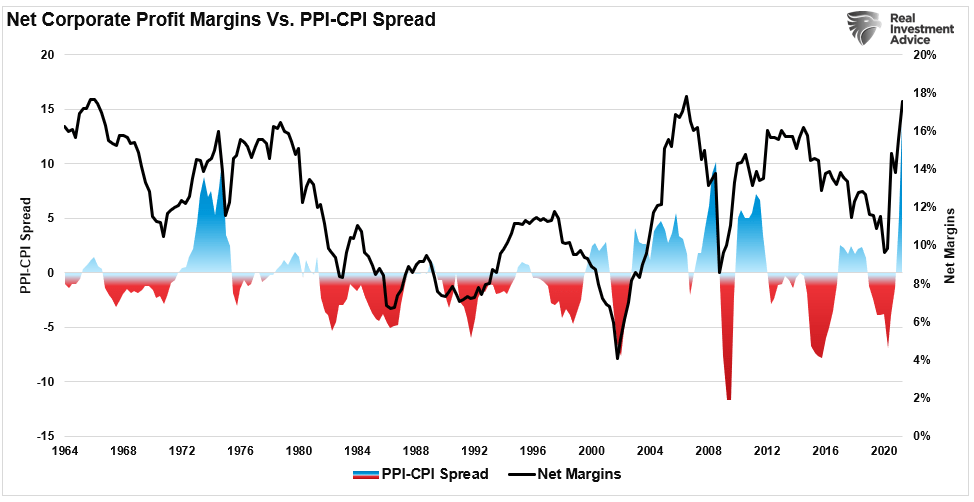
With supply chain disruptions looking to last longer than expected, the Fed is trapped between supporting a slowing economy and fighting inflation. It’s a battle they will eventually lose, no matter what they choose. So yes a epic crash is coming. No doubt about it. And its could be up to a 50% correction. BUT BUT their is still enough gas left in the tank for this market to still rally. Nick