- The S&P 500 is trading at $4,725.79 to close 2021 – up 28% YTD.
- With the Federal Reserve planning to raise interest rates in 2022, investors are expecting more moderate gains than the rise seen in 2021.
- There are two major policy decisions to follow in the first quarter of 2022. 1.) The outcome of the Biden spending package 2.) The Federal Reserve raising interest rates
Typically, the common barometer of if a stock performed well in a given year is how it’s done relative to its peers. The S&P 500 is a popular index to use in these situations. This past year, beating the S&P was harder than it’s ever been. Comparing the performance of the index to years past, it may be time to adopt a more conservative perspective on the 2022 outlook of the 500 companies included within Standard & Poor’s stock market index. To put it plainly, interest rates were low in 2021. More specifically, the federal funds rate was low. This is the interest rate that banks use to lend money to each other overnight. A look behind the curtain would show you that banks are constantly lending money back and forth to each other in order to keep the required percentage of their customer’s money on reserve.The federal funds rate is used to control the supply of money as a way to manage inflation. When the Federal Reserve raises the fund’s rate, like they’re expected to do shortly, it becomes more expensive to borrow. When rates are low, as they have been through all of 2021, investors are more likely to acquire risk assets such as stocks to take advantage of the cost of borrowing. With economic stimulus and low rates, Americans were throwing money into a variety of risk assets such as stocks, cryptocurrency, and NFT’s.
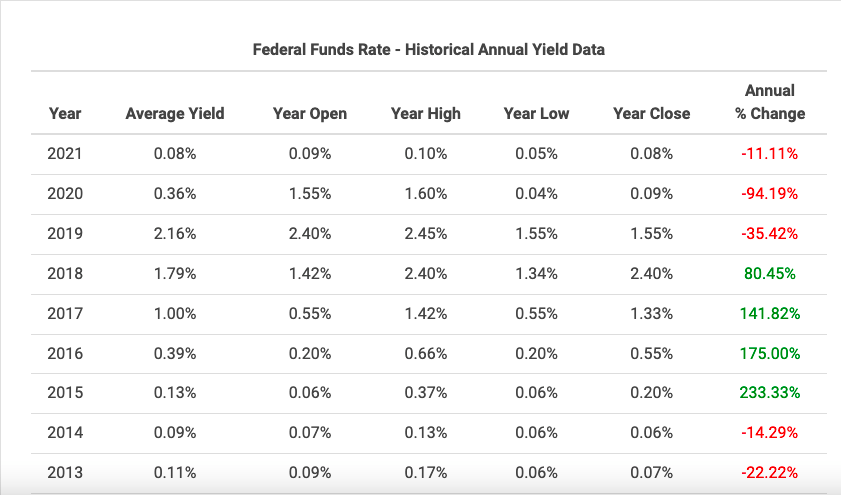
Source: Macro Trend
Looking ahead, the Federal Reserve has already announced that it will begin tapering interest rates to address inflation acceleration. Higher interest rates devalue the future projected earnings of companies and, in turn, negatively impact their share prices. Interest rates were at a bottom in early 2020, largely due to the pandemic and economic stimulus efforts in both fiscal and monetary policy. With Wall Street expecting interest rates to increase in the near term, the question becomes, how soon do portfolio managers and investors as a whole begin selling off their risk? Once these initial sell-offs happen and the idea of interest rate hikes becomes more of a reality, the S&P will suffer a blow.
As excerpted by Karen Langley of the Wall Street Journal,
“We know there’s going to be a rate hike,” said Tiffany Wade, senior portfolio manager at Columbia Threadneedle Investments. “How soon before that do you start to position around valuations maybe coming off?”
Karen continues in her article,
“The S&P 500 has averaged an annual gain of 8.4% from 1957, the year it was introduced, through last year. But it is coming off three much stronger years. The index jumped 29% in 2019, even more than its advances in 2020 and so far in 2021.
While it’s not going to be the popular opinion, being realistic about the market outlook in 2022 is going to pay investors’ dividends. The gains recognized by the market in the years following the introduction of COVID-19 to the global economy were being propped up by stimulus packages and government spending, loan forbearance, and near-zero interest rates across the board. To adopt a term currently being used by the National Basketball Association to describe cases in which unforeseen events occur, we can refer to these policies as “hardship policies”. These hardship policies are not sustainable policies for a country of any size – let alone the United States. If not at its boiling point already, inflation will become a major priority to address and interest rates will have to be raised as a means to curb spending and the output of money.
Per Nick Timaraos of the Wall Street Journal,
Fed officials are facing two opposite risks. One is that they tighten monetary policy that causes the economy to slow on top of a sharp drop in the rate of inflation next year. The other is that inflation stays higher and households and businesses come to expect prices to keep rising, leading to a wage-price spiral.
The economy is in a period of really high growth, strong demand, and high incomes. The issue is, these have all been manufactured. Normally, after a downturn akin to the one we faced at the start of the pandemic, the economy takes longer to return to normalcy. The aggressive monetary and fiscal policies initiated in 2019 have caused the Federal Reserve to become stuck between a rock and a hard place. Their alternatives are to tighten up monetary policy to address inflation or allow prices to keep rising and handle the future ramifications as they present themselves. At the end of the day, investors in ETFs that track the performance of the S&P 500 (SPY) can rest easy at night with ~28% YTD returns on their investments. With so much uncertainty at both the fiscal and monetary levels, there is a legitimate concern for the valuation of the index’s companies moving forward. Some of these companies are trading at abnormal P/E ratios. The stocks that comprise the S&P 500 trade at high multiples. Microsoft (NASDAQ:MSFT), Apple (NASDAQ:AAPL), and Tesla (NASDAQ:TSLA) are all trading above 30 Trail PE. This is a valuation multiple that is based on the last 12 months of actual earnings. By taking the current stock price and dividing it by the trailing EPS for the past 12-months. Tesla, in fact, is trading at 289.59 Trailing Price-to-Earnings. It seems inevitable that a correction is coming, regardless of whether or not the Fed raises rates tomorrow or in six months. That reality, coupled with the sky-high valuations of the major players in the S&P 500, should be reason enough to adopt a conservative outlook on 2022 performance. Something just has to give…and soon.