Federal Reserve Chair Jerome Powell gave his most explicit acknowledgment to date that steep rate hikes could tip the US economy into recession, saying one is possible and calling a soft landing “very challenging.” “The other risk, though, is that we would not manage to restore price stability and that we would allow this high inflation to get entrenched in the economy,” Powell told lawmakers on Wednesday. “We can’t fail on that task. We have to get back to 2% inflation.” The Fed chair was testifying before the Senate Banking Committee during the first of two days of congressional hearings. In his opening remarks, Powell said that officials “anticipate that ongoing rate increases will be appropriate,” to cool the hottest price pressures in 40 years. “Inflation has obviously surprised to the upside over the past year, and further surprises could be in store. We therefore will need to be nimble in responding to incoming data and the evolving outlook,” he said. Powell’s remarks reinforced comments at a press conference last week after he and his colleagues on the Federal Open Market Committee raised their benchmark lending rate 75 basis points — the biggest increase since 1994 — to a range of 1.5% to 1.75%. While Powell told reporters then that another 75 basis-point increase, or a 50 basis-point move, was on the table for the next meeting in late July, Wednesday’s text made no reference to the size of future rate hikes. Fed Governor Christopher Waller said Saturday that he would support a 75-basis-point rate increase in July should economic data come in as he expects. “We understand the hardship high inflation is causing,” Powell said Wednesday. “We are strongly committed to bringing inflation back down, and we are moving expeditiously to do so.” Investors expect the US central bank to keep raising rates to a peak around 3.6% by the middle of next year, according to interest-rate futures. “Financial conditions have tightened and priced in a string of rate increases and that’s appropriate,” Powell said in response to a question following his opening remarks. “We need to go ahead and have them.”
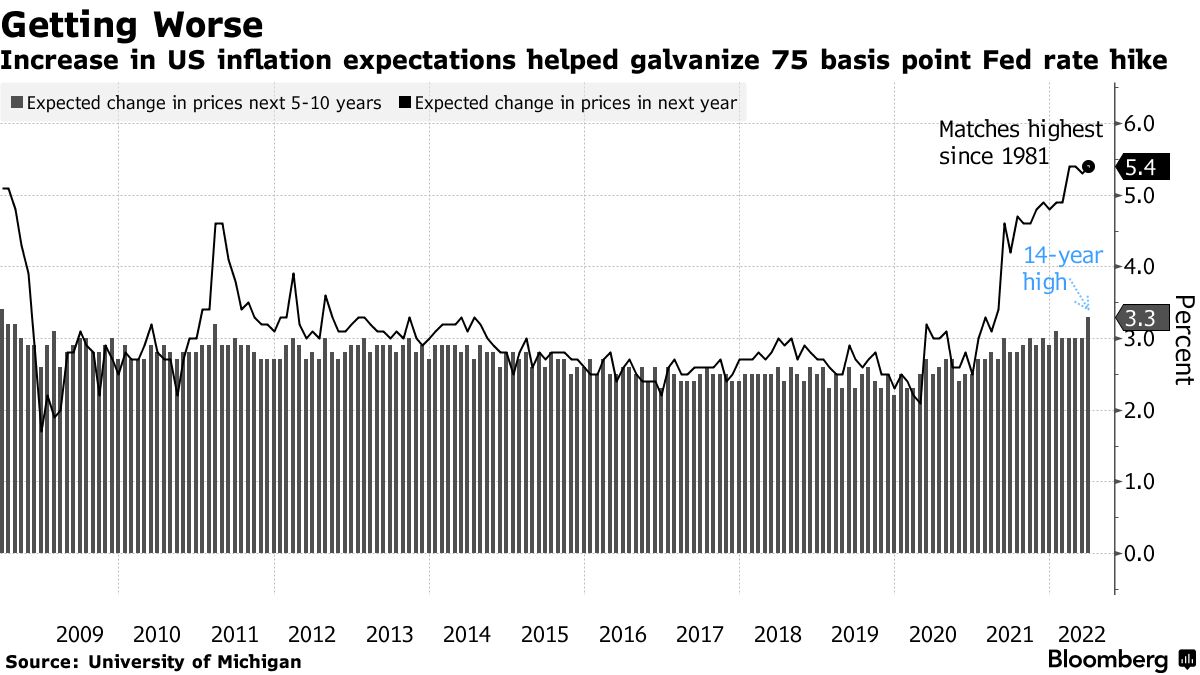
The Labor Department’s consumer price index rose 8.6% last month from a year earlier, a four-decade high. University of Michigan data showed US households expect inflation of 3.3% over the next five to 10 years, the most since 2008 and up from 3% in May.
Fed officials have admitted that they were too slow to tighten and are now trying to front-load rate increases in the most aggressive policy pivot in decades.
While a recession isn’t in the Fed’s forecast, economists are increasingly flagging the likelihood of a downturn sometime in the next two years.
“The American economy is very strong and well positioned to handle tighter monetary policy,” Powell said in his opening remarks.
While he said that he did not see the likelihood of a recession as particularly elevated right now, he said that it was “certainly a possibility. It is not our intended outcome at all,” noting that events in the last few months have made it harder for the Fed to lower inflation while sustaining a strong labor market.A soft landing “is our goal. It is going to be very challenging. It has been made significantly more challenging by the events of the last few months — thinking there of the war and of commodities prices and further problems with supply chains.” Powell called the labor market “extremely tight.” “The tightening in financial conditions that we have seen in recent months should continue to temper growth and help bring demand into better balance with supply,” he said. Policy makers’ latest forecasts, released last week, show the level of rates roughly doubling in the second half of the year to a target range of 3.25% to 3.5%. They saw rates peaking next year at 3.8%. Officials have also begun shrinking their massive balance sheet. The combined impact of higher borrowing costs and so-called quantitative tightening is expected to come at some cost to jobs.