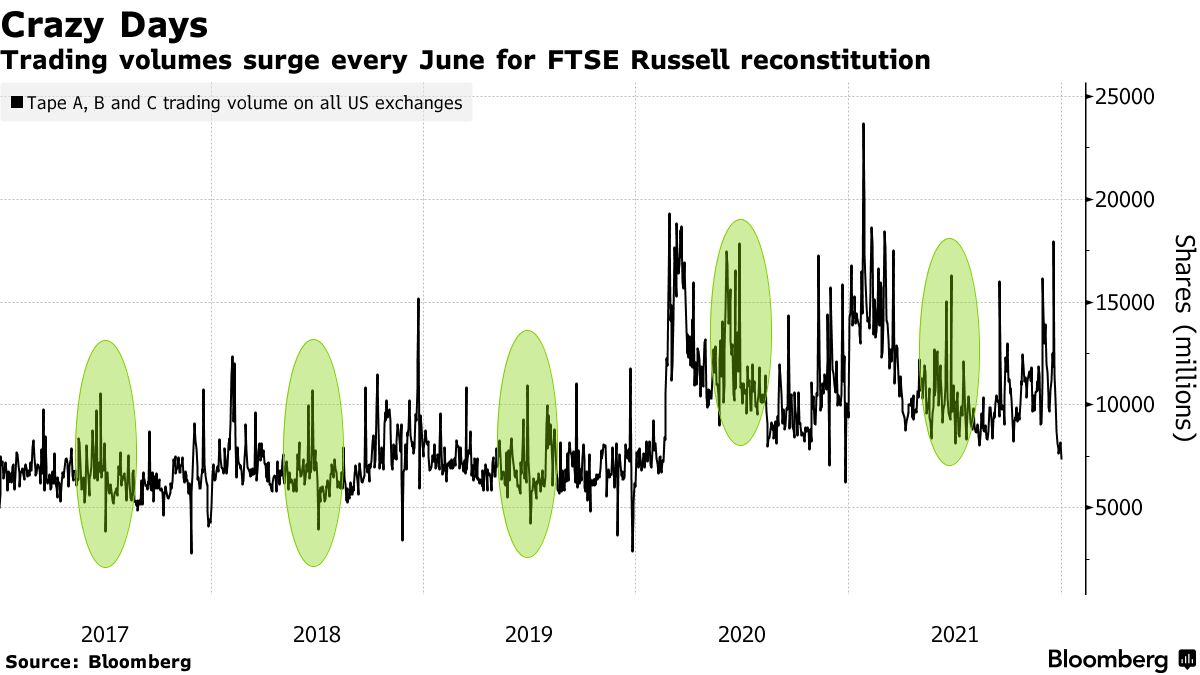
Exactly at the NY open Friday the stock market bases the NASDAQ 100 soared from 11,700 to 12,000 by 10:00 am. To a lot of traders this was a surprise since fund rebalancing usually occurs on the close. In the overnights we got a sniff of movement and spread our positions. When the zoom zoom started we went long and then went flat. In the last few minutes of trading on Friday, equity volumes exploded as funds managing trillions finished up adjusting for the annual reconstitution of the FTSE Russell indexes, instantly making this one of the busiest days of 2022. But on the close (since most of the trades were made on the open) the NASDAQ100 only was up around 200 point.. From 11950 to a high of 12100. We took advantage of the final hurrah to turn our spread bet to a bias to the short side.
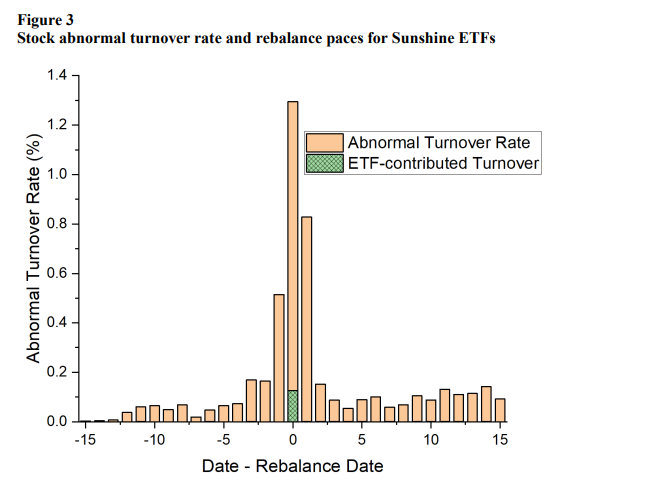
We are fundamentally negative on stocks overall. But our Fridays action was taking advantage of what i call the Li effect. In it, Li — then a PhD student at the University of Illinois Urbana-Champaign — crunched data through 2020 to show that a share rises 67 basis points on average in the five days before it’s bought by a transparent U.S. equity exchange-traded fund and slips 20 basis points in the subsequent 20 days. The 67 basis-point “execution shortfall” he found compares to 24 basis points for other institutions, according to an earlier research paper.
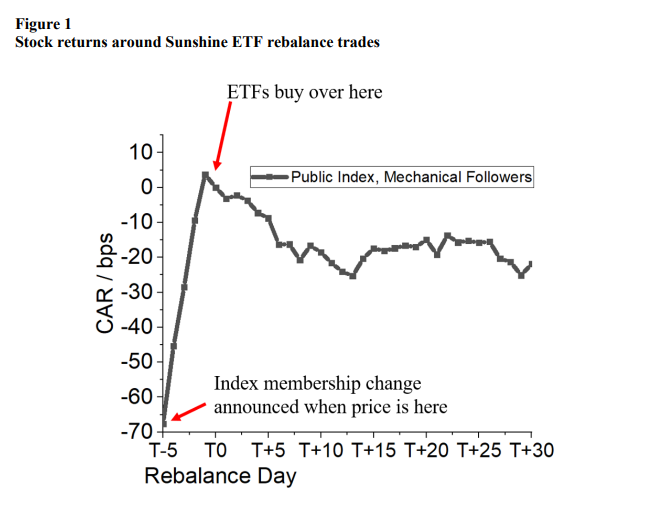
The idea is that passive vehicles are hitched to the public rebalance schedules of indexes like the S&P 500 and Russel 2000, so when stocks are added to the gauge, the trillions tracking it have to snap them up typically on the same day. That bombards the market with such massive and predictable orders that the funds end up paying a premium. Other academics and researchers have fretted over these kinds of distortions for years. In fact, last July FTSE Russell itself announced an internal review of its rebalance frequency. Turnover during the 2021 reconstitution jumped 45% from a year earlier, the firm said after the event. It noted that “a record 2.37 billion shares representing $80.8 billion were executed in the Nasdaq Closing Cross in 1.97 seconds, while 2.1 billion shares were traded on NYSE — their fifth largest NYSE Closing Auction ever, with $105.1 billion in notional value traded.” Li’s claim that arbitrageurs are pushing up trading costs is a contentious one. To Antti Petajisto, who documented the so-called index effect — where stocks enjoy a bump in performance after being added to an index — as a finance professor at New York University in 2010, Li’s results show there’s a case for spreading rebalancing trades across the day or even a few days. But he stresses transparency is actually a win-win for both arbitrageurs and ETF providers.
Fridays trading represented represented the biggest stock market trading gain since May 2020. With the DOW up 0ver 800 points. The S&P500 up 116 points and the NASDAQ100 up over 400 points. Of course the know everything Know nothing Wall Street talking heads called Friday a market reversal since the FEAD will not raise rates as mush as the market previously priced in. Al i can say is BULLSHIT!