OPEC+ Caves to Trump Pressure—But Throws Just a Bone

  • OPEC+ announced a small production increase of only 138,000 bpd for April, citing a “healthier oil market outlook”.
  • The move is more likely aimed at balancing geopolitical risks and appeasing President Trump amid his push for lower oil prices.
  • OPEC+ members may be prioritizing market share over high prices.

OPEC+ cited a “healthier oil market outlook” when it announced this week that it would go ahead with the planned slight increase in production in April. The alliance is indeed the most bullish among forecasters and agencies, expecting global oil demand growth of 1.4 million barrels per day (bpd) for both 2025 and 2026. Yet, a “healthier” oil market outlook is unlikely the primary reason for the group’s decision to finally begin easing the 2.2 million bpd production cuts—easing that has already been delayed several times. With Monday’s decision to add about 138,000 bpd in April, OPEC+ projected its bullish view to the market while seemingly appeasing, for now, U.S. President Donald Trump, who has repeatedly called on OPEC “to reduce the price of oil.” OPEC always publicly claims that it doesn’t mingle politics with market decisions. But in the current geopolitical situation, and an as unpredictable U.S. President as it gets, the

OPEC+ alliance may be looking to anticipate expected declines in oil supply from Venezuela and Iran, which are being hit with more and more sanctions by the Trump Administration.  

The U.S. yanked Chevron’s license to operate in Venezuela on the same day that tariffs on Canadian and Mexican crude took effect. This could leave U.S. refiners that rely on heavy crude from the Americas with options to either accept the tariffs or look for alternatives.

The return of a token 138,000 bpd supply from OPEC+ next month will not make much difference on a fundamentals level, but it sends a message to the market that the group is watching geopolitical developments and is looking not to anger Trump.

Then there is the view from some analysts that after years of restricting production – but failing to boost prices to the high $80s or $90 per barrel needed to balance budgets – many OPEC+ members are itching to capitalize on increased sales volumes instead of higher oil prices. The alliance may have been fed up with losing market share at the expense of non-OPEC+ producers.But OPEC+ may have wanted to anticipate all this by announcing a very small increase that won’t make or break the market, but could potentially take the heat off the group.  OPEC+’s thinking may have been that the market punishes the group with price declines every time it delays the output increase, “because it thinks fundamentals must be so bad,” Croft argues.  The decision to go ahead with the production increase also plays in Russia’s favor, according to the strategist.“Russia would seem to be especially incentivized to appear supportive of an incremental increase, given the looming prospect of US sanctions relief,” Croft wrote in a note carried by Axios.

Of course, OPEC+ left the door open to any changes to its supply in any direction, saying in the press release that it remains “adaptable to evolving conditions,” and “Accordingly, this gradual increase may be paused or reversed subject to market conditions.”The path forward for OPEC+ is to continue monitoring market conditions and President Trump’s actions on sanctions and trade policies, avoiding any clash with the U.S. Administration. The trade wars with America’s biggest trade partners that began in earnest this week could dampen oil demand growth in both the U.S. and China. Moreover, there isn’t any precedence for the economic shock that the U.S.-Canada trade war could cause, Frances Donald and Cynthia Leach of RBC said on Tuesday. That’s the largest trade shock to the U.S. and Canada since the 1930s, and the U.S. is likely to struggle with the inflationary impact of broad-based tariffs, RBC reckons.


EIA Weekly Petroleum Report….. Oil drops further, down 3%

weekly Petroleum Data for the week ending February 28, 2025


U.S. commercial crude oil inventories (excluding those in the Strategic Petroleum Reserve) increased by 3.6 million barrels from the previous week. At 433.8 million barrels, U.S. crude oil inventories are about 4% below the five year average for this time of year. U.S. crude oil refinery inputs averaged 15.4 million barrels per day during the week ending February 28, 2025, which was 346 thousand barrels per day less than the previous week’s average. Refineries operated at 85.9% of their operable capacity last week. Gasoline production increased last week, averaging 9.6 million barrels per day. Distillate fuel production decreased last week, averaging 4.6 million barrels per day. U.S. crude oil imports averaged 5.8 million barrels per day last week, decreased by 106 thousand barrels per day from the previous week. Over the past four weeks, crude oil imports averaged about 6.0 million barrels per day, 10.7% less than the same four-week period last year. Total motor gasoline imports (including both finished gasoline and gasoline blending components) last week averaged 603 thousand barrels per day, and distillate fuel imports averaged 269 thousand barrels per day. Total motor gasoline inventories decreased by 1.4 million barrels from last week and are 1% above the five year average for this time of year. Finished gasoline inventories increased, while blending components inventories decreased last week. Distillate fuel inventories decreased by 1.3 million barrels last week and are about 6% below the five year average for this time of year. Propane/propylene inventories decreased by 2.9 million barrels from last week and are 4% below the five year average for this time of year. Total commercial petroleum inventories decreased by 4.6 million barrels last week.
Total products supplied over the last four-week period averaged 20.2 million barrels a day, up by 3.4% from the same period last year. Over the past four weeks, motor gasoline product supplied averaged 8.5 million barrels a day, up by 0.9% from the same period last year. Distillate fuel product supplied averaged 4.0 million barrels a day over the past four weeks, up by 7.1% fromthe same period last year. Jet fuel product supplied was up 1.3% compared with the same four weeks last year.

Oil drops further, down 3%

The prices of oil futures continued to go down on Wednesday, slumping 3% as the United States Energy Information Administration (EIA) revealed that commercial crude oil inventories in the country rose by 3.6 million barrels. The price was also likely affected by worries over the global economic outlook as tariff wars set off. Furthermore, a Reuters survey showed that the Organization of Petroleum Exporting Countries (OPEC) oil production grew in February and was up 170,000 barrels per day from January, with the cartel showing no signs that it would abandon its plan to boost output starting in April. West Texas Intermediate for April deliveries nosedived 3.05% at 10:42 am ET, going for $65.75 per barrel. Brent for May settlements slid 3.03% a minute later, selling at $68.85 a barrel.

nn: looks like a buy to me

Oil slumps on oversupply concerns…… Trump gives Chevron 30 days to stop pumping oil in Venezuela over Maduro’s stalled reforms, migrant returns

Oil prices declined for a third consecutive session as investors worried about OPEC+’s decision to proceed with a planned increase in oil production, boosting output by 138,000 barrels per day in April, marking the group’s first production rise since 2022 and sparking fears of oversupply. Adding to the downward pressure were fresh US tariffs, including a 25% duty on imports from Canada and Mexico, along with an elevated tariff rate of 20% on certain Chinese products, which triggered  immediate retaliatory measures from these countries. This escalation has heightened worries about potential economic growth slowdowns and their subsequent effects on energy demand. West Texas Intermediate (WTI) for settlements in April tumbled by 1.09% at 5:43 am ET, selling for $67.12 per barrel. Brent for May’s deliveries dropped by 1.24% to sell for $70.14 per barrel a minute later.

Trump gives Chevron 30 days to stop pumping oil in Venezuela 

The Trump administration on Tuesday gave Chevron 30 days to stop oil production in Venezuela after Washington accused President Nicolas Maduro of not making progress on electoral reforms and migrant returns. President Trump reversed a Biden-era license that allowed the oil giant to operate in Venezuela despite US sanctions – a U-turn from January when the White House appeared to be making progress with Maduro.  The Treasury Department gave the US-based oil giant an April 3 deadline to pull up stakes, much quicker than the usual six-month wind-down period. In a statement, Chevron said its business in Venezuela complies with all laws and regulations, including the United States’ sanctions imposed during Trump’s first term. “We are aware of the President’s directive and will abide by any direction given by the US Treasury Department to implement that directive,” a Chevron spokesperson told The Post.

The hard stop to Chevron’s oil production in Venezuela could eventually remove up to 200,000 barrels a day from the global market, according to Bloomberg.

It’s unlikely to have an immediate impact on prices, especially since OPEC decided this week to boost production – planning to increase output by 138,000 barrels per day in April. But Chevron’s exit could shrink Venezuela’s economy by as much as 7.5% this year, according to the Finance Observatory, an opposition-run research group. Republican lawmakers have slammed the Biden administration’s waiver, claiming Chevron has become the backbone of the Maduro-controlled country’s economy.

NN: Chevron =OPEC+
high frequency traders don’t want you to know

Oil prices have bottomed. Trump just sanctioned oil from  Venezuela   and Iran. Americas two biggest trade partners Mexico and Canada threaten to put tariffs on oil imports into he US . Big oil rally coming

Crude Oil Inventories See Larger Than Expected… Oil Drops as Tariffs and OPEC+ Supply Shake Markets Drop…….

The American Petroleum Institute (API) estimated that crude oil inventories in the United States fell by 1.455 million barrels for the week ending February 28. Analysts had expected a smaller 300,000-barrel draw. Earlier this week, the Department of Energy (DoE) reported that crude oil inventories in the Strategic Petroleum Reserve (SPR) stayed at 395.3 million barrels in the week ending February 28. Inventory levels in the SPR are hundreds of millions shy of the levels in inventory prior to the SPR withdrawal that took place under the Biden Administration.   At 11:22 pm ET, Brent crude was trading down $1.48 (-2.07%) on the day at $70.14—a nearly $3 per barrel dip from this time last week and a $6 per barrel drop over the last two weeks. Oil prices began their slide on Monday after OPEC+ said it would begin the process of slowing unwinding its production cuts beginning April 1. The U.S. benchmark WTI was trading down on the day as well, by $1.17 (-1.71%) at $67.20—a nearly $2 per barrel decrease from last week’s level.   Gasoline inventories fell in the week ending February 28, by 1.249 million barrels, adding onto the previous week’s 537,000-barrel increase. As of last week, gasoline inventories are now just slightly below the five-year average for this time of year, according to the latest EIA data. Distillate inventories saw a build this week, adding 1.136 million barrels in the latest week. In the week prior, distillate inventories fell 1.109 million barrels. Distillate inventories were already about 8% below the five-year average as of the week ending February 21, the latest EIA data shows. Cushing inventories—the benchmark crude stored and traded at the key delivery point for U.S. futures contracts in Cushing, Oklahoma, rose 1.630 million barrels for the week, after falling 1.182 million barrels in the week prior.

Oil Drops as Tariffs and OPEC+ Supply Shake Markets

Brent oil extended declines to the lowest closing price since November as US President Donald Trump’s tariffs kick off a series of trade wars and OPEC+ moves to revive production that has been halted for years. Trump delivered on his threat to hit Canada and Mexico with sweeping import levies and doubled an existing charge on China, sparking swift reprisals that threaten to reduce global economic growth and curtail energy demand. The moves come a day after OPEC+ said it would increase output after repeated delays, a decision that surprised a market already weighed down by expectations for a surplus later this year. Global benchmark Brent crude slipped to around $71 a barrel and earlier briefly dipped below $70 for the first time since October. Meanwhile, West Texas Intermediate notched only a marginal decline to around $68 a barrel as the potential loss of Canadian or Mexican supplies tightens the US market.

The turmoil also is accentuating a bearish posture in the market, with oil traders paying the biggest premiums for put options in five months.

“The OPEC+ announcement from yesterday to increase output coupled with the US tariffs on Mexican, Canadian and Chinese imports raise the prospects of an oversupplied market where economic growth and oil demand also suffer,” brokerage PVM wrote in a report. Technicals are also signaling a shift in longstanding market fundamentals, including a tighter market for US crude relative to Brent. WTI’s front-month spread — the difference in futures prices for immediate delivery and the next month — is trading at the biggest premium to the same gauge of Brent since mid-January, when the US ratcheted up sanctions against Russia.

Meanwhile, algorithmic-driven investors known as commodity trading advisers are holding the largest net-short position in WTI since early October, according to Stephen Roseme, managing member of Bridgeton Research Group.

“Unless there’s a contraction of supply outside of OPEC, prices are going to fall even further,” said Gregory Brew, a geopolitical analyst at the Eurasia Group. The firm sees Brent trading in a range with a lower end of $60 for the year, he added. Roughly 38% of more than 100 traders and analysts polled at a Bloomberg event in London on Feb. 26 saw a chance of oil hitting $50 this year.

NN: Market got it wrong…… again


Trump’s tariffs on Mexico, Canada, China take effect…. Soon Oil Will Be Dragged Into The Fray

United States President Donald Trump’s new tariffs on Mexico and Canada, along with a 10% bump to duties on Chinese goods, came into effect as of 12:01 am ET on Tuesday. Imports from Canada and Mexico will now be taxed at 25%, with Canadian energy products hit by a lower 10% rate. The Trump administration also placed an additional 10% tariff on all imports from China, which came on top of the 10% duty imposed by Trump in February. “While President Trump gave both Canada and Mexico ample opportunity to curb the dangerous cartel activity and influx of lethal drugs flowing into our country, they have failed to adequately address the situation,” the White House said in a statement.

NN: Audio file:

Oil prices fall 2% as OPEC+ confirms supply hikes

Crude oil prices fell by more than 2% on Monday after the Organization of Petroleum Exporting Countries (OPEC) and its partners confirmed it will proceed with “a gradual and flexible return of the 2.2 mbd voluntary adjustments” on April 1. Investors were also digesting how the incoming United States tariffs will affect the global economy and the oil demand. The organization argued that this decision was taken due to the healthy market fundamentals and optimistic market outlook. However, the OPEC+ countries noted that this gradual supply increase can be halted or reversed if market conditions change. It also reaffirmed that the compensation period for overproducing countries expires at the end of June 2026.

West Texas Intermediate (WTI) for settlements in April tumbled by 2.30% at 2:28 am ET, selling for $68.44 per barrel. Brent for the same month’s deliveries dropped by 2.04% to sell for $71.57 per barrel at 2:29 am ET.

Trump Crypto Rally Proves Fleeting as Reserves Plan Questioned

  • Coins picked by Trump gave back some initial gains Monday
  • Crypto experts are questioning the benefits of Trump stockpile

Donald Trump’s announcement that the US will include three lesser-known digital tokens in its strategic crypto reserve

was greeted with skepticism in the industry, with investors questioning the project’s merits and the coins he selected giving up some of their initial gains.

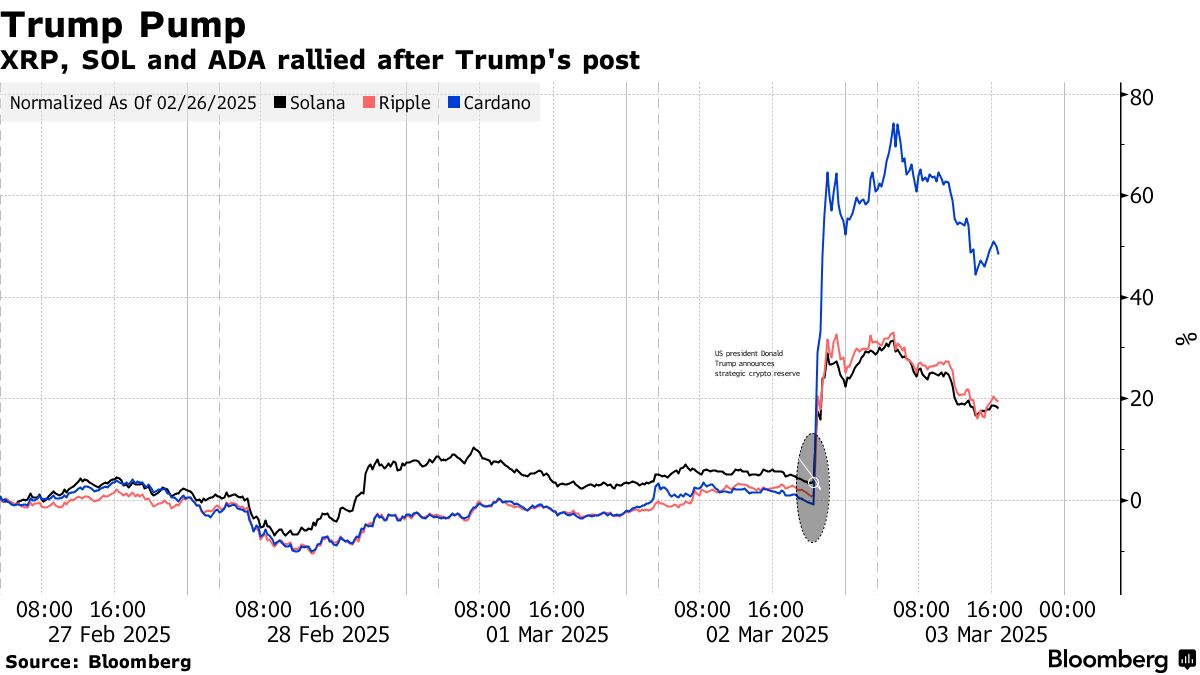
Trump said Sunday on Truth Social that the XRP, SOL and ADA tokens will be included in the reserve, along with Bitcoin and Ether. The news ignited an immediate crypto rally, offering relief to an asset class fresh off its worst month since 2022. Yet the initial euphoria soon gave way to questions about everything from the feasibility of Trump’s plan to the motivations behind it. Crypto markets were back in the red on Monday, with XRP, SOL and ADA each suffering intraday declines of more than 10% after soaring the day before.

The February crypto rout had put pressure on Trump, who returned to the White House after the industry showered him with campaign donations and praise. Even the Securities and Exchange Commission’s reversal of a years-long crackdown had failed to stem the selloff, which many attributed in part to nervousness about Trump’s trade tariffs and dramatic moves to gut government programs. “For a president who thrives on being the market’s hero, last week’s risk asset performance was anything but inspiring,” QCP Capital said in a note on Monday. “The political calculus was clear — Trump needed a win before his approval ratings start slipping, a metric he likely takes very personally.”

In its first statement about creating a crypto reserve in January, the White House said such a stockpile would be “potentially derived from cryptocurrencies lawfully seized by the Federal Government through its law enforcement efforts.” Bitcoin tends to be the main crypto token seized by law enforcement agencies, including in the bust of the notorious Silk Road website. The initial announcement contained little detail on how the reserve would be created, disappointing investors and helping set the stage for February’s selloff. Trump’s Sunday posts came just as his crypto czar David Sacks prepares to host the White House’s first industry summit. On Monday, Sacks took to the X platform to announce that he sold all his cryptocurrency holdings — including Bitcoin, Ether and SOL — before Trump’s administration took over in January. Trump and his wife Melania launched memecoins on Solana in January. The president’s token is down about 80% from its all-time high of about $74, according to CoinGecko data. In February, Argentina’s President Javier Milei became embroiled in a political scandal after directing his followers to a Solana-based memecoin named Libra in a post on X. Launched in 2020, Solana was once closely associated with now-imprisoned entrepreneur Sam Bankman-Fried and his trading firm Alameda Research. The price of SOL, its token, fell sharply after the collapse of Bankman-Fried’s crypto empire in November 2022. It then rebounded in 2024 before hitting an all-time high of $295 on Jan. 19 — the same weekend that Trump debuted his memecoin. The token has since retreated 45% to trade at about $160.

Trump Sparks Crypto Rally by Saying More Coins to Be in Reserve

The cryptocurrency market roared into March with a rally, recouping some of the losses from the asset class’s worst month since 2022, after President Donald Trump once again talked up his plan for a strategic crypto reserve. In a Truth Social post on Sunday, Trump said his January executive order on crypto “directed the Presidential Working Group to move forward on a Crypto Strategic Reserve that includes XRP, SOL, and ADA.” The inclusion of XRP and ADA tokens in Trump’s plan were surprising, according to Andrew Tu, head of sales at crypto market maker Efficient Frontier. Both tokens had huge rallies on Sunday, leading gains across most digital assets. Trump also said Bitcoin and Ether would be included in the reserve, helping those coins recover some of last month’s steep declines. The announcements from Trump reconfirmed his loyalty to an industry that had showered him with donations and praise during his campaign following a crackdown on crypto companies under President Joe Biden’s administration.

Still, many of the details of Trump’s plan are unknown, including how much the government will actually buy and how the purchases would be funded.

“If expectations don’t meet reality, then markets can potentially retreat again,” Tu said.

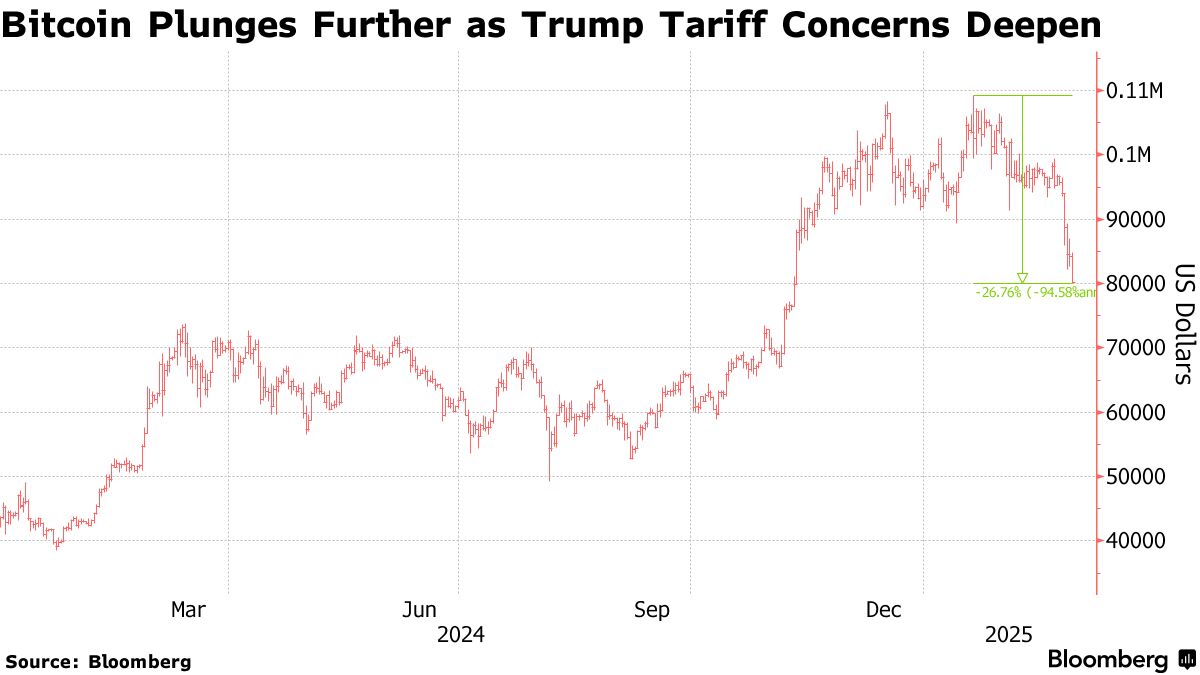
“For now, all the bearishness of the past week has been forgotten by markets,” he said, while adding that macroeconomic concerns are still an overhang that could cause crypto prices to retreat again should equities do the same. The tokens Trump said would be included in the reserve are all among the top eight cryptocurrencies by market value, according to tracker CoinMarketCap.com. The only ones among the top eight that weren’t included were Tether and USDC, stablecoins that track the US dollar, and the Binance exchange’s token Binance Coin, known as BNB. Trump had vowed to create a strategic Bitcoin reserve on the campaign trail, one of many crypto-related promises that helped fuel a surge in prices up until the day of his inauguration. While the Securities and Exchange Commission has dropped several cases and investigations into crypto companies in the early weeks of the Trump administration, little had been said about a strategic reserve since he took office. David Sacks, the president’s artificial intelligence and crypto czar, said on Feb. 4 that administration officials still needed to study the feasibility of the plan. Trump’s crypto-related executive order — issued in January — didn’t mention any specific tokens and referred only to the possibility of a “national digital asset stockpile,” the potential creation and maintenance of which should be evaluated by a White House working group. Bitcoin had fallen as much as 28% from its last record above $109,000 on Jan. 20, the day of Trump’s inauguration, through Friday. It posted an 18% drop in February. 

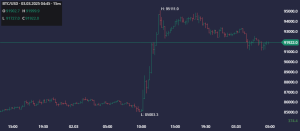
After Trump’s posts on Sunday, Bitcoin jumped 9% to above the $94,000 level. Ether, the second-largest digital token, rallied nearly 13% to above $2,500.

Trump’s comments “have resulted in participants rushing to reestablish long positions and are serving as a spectacular tailwind for prices,” said Spencer Hallarn, global head of OTC trading at crypto investment firm GSR.

 Nick Note:   I’m getting excited now! I’m drooling all over myself,  I’ve been waiting a long long long time to get at this bubble market. With the Trump inauguration Bitcoin put in a record high hitting  Bitcoin  $110,000. These are valuations that are just over the moon. A bubble … a very tricky bubble to trade. But there comes a time when every bubble meets it’s demise. And I believe that time is coming very quickly for Bitcoin to meet its maker. The demise is neigh. We got a  sophisticated cyber attack on bitcoin using a quantum computer for sure.  And this is the first time that’s happened. As a result of the hack Bitcoin  that was trading at 109,000 plunged 30% and put in a low below $78,000. That was the biggest drop in over 2 years causing the Bitcoin boys to panic. Their  savior waved his decree magic wand  and trump declared that they’re going to have a Bitcoin conference on Friday. And that conference is addressing one key issue, establishing a reserve fund. Let me explain this because its the classic situation where you want to buy the rumor and sell the fact.  In order to get a reserve equivalent to what banks or the Treasury  or the Fed Reserve holds its around 7%  Bitcoin in order to have a credible reserve would have to have two trillion dollars in the  fund that guarantee against runs, fraud, Quantum Computer extortion and just plain panic. And  it would have to have a central authority to collect, regulate and administer said fund. The fact is none of this exists and never will. There’s no way anyone is willingly putting up that much money. And without a central regulator with the power to demand a reserve from exchanges and audit them this no more than a pipe dream publicity stunt. Here comes the sell the facts part. They’re talking about a few billion dollars and that will be a big disappointment to market… The devil is in the details. So let me explain, they’re going to take some of the confiscated Bitcoins at the US treasury and government holds and put into said fund. I see that fund at the most getting the 10 billion dollars or less. With no regulated authority to administer the funds… A freeging goat rope.  At best this will create a false sense of security, Bitcoin is on the verge of getting hacked to death with quantum computers as the Lazarus hacking consortium passed its proof of concept hack with flying colors. Now the hacker consortiums needs to scale up the algorithms, the complicated mathematic formulas, the test case proved feasible.  It’s just a question of scaling up and timing.  I never saw a panic from  a hack before like this last  one. That tells me that their are  very week-longs and its a very weak market.  So we want to wait for the Friday bitcoin love convention.  I see us in the aftermath of the bitcoin love fest beginning operations.  I’ll be posting for you a trade reco outlining my strategy for this market. Its the biggest bubble i have ever seen And it will be the biggest bust…. 

Trump to Zelensky: You are gambling with World War III

United States President Donald Trump told his Ukrainian counterpart Volodymyr Zelensky on Friday that he is “gambling with World War III” amid ongoing negotiations over the conflict. Addressing Zelensky in front of reporters in the Oval Office, the American head of state warned him to be thankful for the US support. “You either make the deal or we are out,” Trump stressed, calling the Ukrainian president’s comments disrespectful. The exchange between the two leaders quickly became heated, with Vice President JD Vance stepping in to intervene.

nn: volodymyr really really screwed up. he has yet to grasp the fact  they have lost the war. he thought he was in the white house to get more military aid. wrong wrong wrong he was their to arrange the terms of his surrender

Bitcoin Down 25% From All-Time High as Crypto Rout Worsens

A rout in Bitcoin deepened on Friday as investors rushed to safe assets  marking a dramatic reality check for one of the most popular Trump trades. The cryptocurrency tumbled as much as 7.1% on Friday to the lowest since early November and is down some 27% since it hit an all-time high less than six weeks ago. The selloff came amid a broad plunge in cryptocurrencies, with Ether, Polkadot and XRP all dropping more than 7% on Friday. “The last time we saw sentiment like this was 2022,” said Caroline Bowler, chief executive officer of BTC Markets Pty Ltd, referring to the “crypto winter” when prices plummeted amid rising interest rates and industry woes. “This tanking can be viewed as a response to macro fears on Trump’s tariffs and geopolitical uncertainty.

The focus on trade tensions led to a broad risk-off decline across markets on Friday, pushing down almost all Asian stock markets and fueling declines in European futures. But cryptocurrencies — which are deeply exposed to shifts in risk appetite — were among the worst hit.Bitcoin has now fallen more than 20% in February. If the decline holds through the end of Friday, it would mark the biggest monthly drop since June 2022. The selloff underscores a swift change of fortunes for what was previously one of the most popular Trump trades in global markets: buying Bitcoin on the expectation that the president’s crypto-friendly approach would lead to a broad rally. That worked for a while. Bitcoin hit its all-time high of $109,241 on Jan. 20, the day of Trump’s inauguration. “Given the macro environment, it’s not surprising to see we are where we are,” said Stefan von Haenisch, director of over-the-counter trading in Asia Pacific at crypto custody firm Bitgo Inc. Traders are still waiting for Trump to come up with concrete steps for the sector including a Bitcoin stockpile, he said.

What Bloomberg’s Strategists Say…

“The real panic may be ahead of us still. Bitcoin always has another 70%+ crash in its future, by construction. $72k-$74k would appear to be the technical crunch zone that might trigger the next crypto winter.“

— Mark Cudmore, MLIV Executive Editor

Investors are now being forced to consider quite how far the world’s biggest cryptocurrency can fall. There is support for the coin around $70,000, said Ruslan Lienkha, chief of markets at crypto platform YouHodler, pointing to technical analysis. But he said investors shouldn’t assume the rout in Bitcoin will get that bad. Bitcoin traded around $78,900 at 8:30 a.m. in London. Bearish sentiment this week has also hit spot US Bitcoin exchange-traded funds, with investors pulling out more than $1 billion on Tuesday, the biggest one-day outflow since their debut last year.

 nick note the big story here is that Bitcoin has been hacked

The Lazarus hacker group is a Consortium of Chinese Russian and North Korea hackers. I believe utilizing the first test run of china’s quantum computer (specifically designed to crack high level encryption codes) stole 1,5 billion in bitcoin. The hack was amazingly successful with 44,000 coins stolen for a value of 1.5 billion dollars. They were able to liquidate those coins, turn them into gold and bring the money home. And nobody can do shit about it. The smart money is a bailing. Bitcoin has had as much of a 30% drop off its recent high. A vast majority of new investors are now break even at best with many underwater. And there’s great fear in the market as it should be. I am preparing for you a detailed BlackMask market update that gives you the non-public information of what went on here.  And how to profit from the scary  days coming