The United States 30-year Treasury yield went above the two-year Treasury yield on Monday, with the gap between the two disinvesting for the first time since January. The move comes following the events that took place over the weekend, as investors seemingly tried to assess how the attack on former United States President Donald Trump could affect the country’s political scene and upcoming elections. Meanwhile, it was reported that the US inflation cooled to 3% in June. After topping the two-year Treasury note yield, the return on the 30-year bond increased 3.6 basis points to 4.436% at 4:31 am ET, while the yield on the two-year note fell 1.7 basis points to 4.441% simultaneously. The return on the 10-year Treasury note was up 2.2 basis points to 4.208% at 4:32 am ET. NN: Sometime very soon we will start operations buying into our beloved zeroes principle portion.
Israel strikes UNRWA school, killing 14
Israeli forces bombed a school operated by the United Nations Relief and Works Agency for Palestine Refugees (UNRWA) in the Nuseirat refugee camp in Gaza, killing and injuring several Palestinians, according to health officials. The Gaza media office reported an initial death toll of 14, with the number of casualties expected to grow. Another 70 are also known to be injured in the strike. This incident follows previous Israeli airstrikes on UNRWA-operated facilities amid claims of targeting Hamas, with the latest attack on a school in Gaza killing 20 just this week.
Trump: I was shot, bullet pierced my right ear…….Trump was reportedly denied extra security before rally
Former President Donald Trump confirmed on Saturday that he was “shot with a bullet that pierced the upper part” of his right ear while at a rally in Pennsylvania. “I want to thank the United States Secret Service and all of Law Enforcement for their rapid response to the shooting that just took place in Butler, Pennsylvania,” he said on Truth Social while adding that at this moment, “nothing is known” about the shooter. “I knew immediately that something was wrong in that I heard a whizzing sound and shots and immediately felt the bullet ripping through the skin. Much bleeding took place, so I realized then what was happening,” the former president concluded
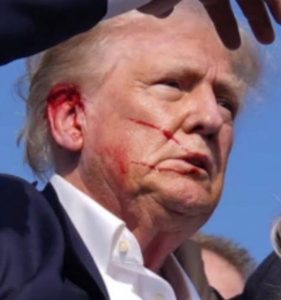
Trump was reportedly denied extra security before rally
The United States authorities reportedly denied former President Donald Trump enhanced security before an assassination attempt at his rally in Pennsylvania, the Federalist reported, citing a source familiar with Trump’s security detail. According to the media outlet, Trump’s security team had requested additional protection for weeks but was repeatedly turned down by the Department of Homeland Security (DHS). USSS denies this report
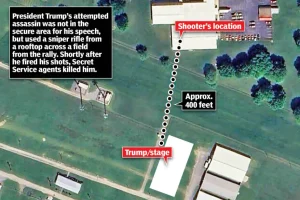
.NN: The assassin was able to set up on a rooftop less than 500 feet away. This is against ALL security protocols. Something is VERT wrong here..
BlackMask Pod Cast: Fight Fight Fight.
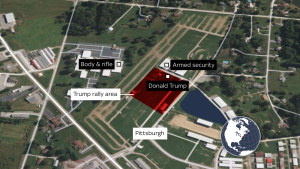
Hamas pulls out of Gaza hostage deal talks……. Israeli defends operation to eliminate Hamas leader
Hamas has temporarily withdrawn from the Gaza ceasefire and hostage talks, citing Israeli “massacres” and a lack of seriousness in negotiations, AFP reported, citing Hamas political leader Ismail Haniyeh. According to the media outlet, the official already informed international mediators about halting the talks, while slamming Israel for its “continued policy of procrastination and obstruction” and attacks on unarmed civilians. The decision follows an Israeli airstrike on the Al-Mawasi area of Gaza, where displaced people were sheltering, which is said to have killed 90 Palestinians.
Israeli defends operation to eliminate Hamas leader
Israeli Foreign Minister Yisrael Katz defended on Saturday the recent operation targeting Muhammad Deif, head of Hamas’s military wing, as “more than justified.” The airstrike in the al-Mawasi area of Khan Younis aimed to eliminate high-ranking Hamas members, including Deif, who is considered a top leader in Gaza’s military-political hierarchy. Prime Minister Benjamin Netanyahu stated that while there is no certainty Deif was killed, the operation was necessary due to his involvement in severe attacks against Israelis, including the October 7 massacre. Katz emphasized Deif’s responsibility for ongoing terrorist activities. NN: Every day more and more Hamass leaders get sliced and diced… As they should Be.
IDF confirms Hamas military chief Deif, Khan Younis brigade commander were targeted in Gaza strike today
Mohammed Deif, the commander of Hamas’s military wing, and Rafa’a Salameh, the commander of Hamas’s Khan Younis Brigade, were the target of the IDF’s airstrike in the southern Gaza Strip this morning, the IDF confirms. The pair were in a low building between the al-Mawasi area and Khan Younis, in a civilian environment, but not in a tent camp for displaced Palestinians. Several dozen more Hamas operatives were also in the area of the site when it was targeted, including guards, military sources say. The al-Mawasi and western Khan Younis areas are part of the Israeli-designated humanitarian zone, but the IDF says the strike was accurate and only targeted the Hamas site.
According to the IDF’s assessments, no Israeli hostages were held at the site when the strike was carried out. The military is still waiting for intelligence to confirm that Deif and Salameh were killed in the strike. The Hamas-run health ministry in Gaza Says at least 71 were killed and 289 were wounded in the strike. It is unclear how many among them are civilians. NN: What is not general knowledge is slowly the IDF is driving the rats out of their tunnel. As the water is shut off, the generators run out of fuel and the stink rises. And as they emerge they are being sent to their waiting virgins. Along with their human sheilds.
OPEC+ Cuts and Demand Woes Keep Oil Prices in Narrow Trading Range
Oil prices have remained in a narrow $75 to $90 a barrel trading range since the end of 2022, as the OPEC+ group continues to keep supply off the market. Still, often-resurfacing concerns about global oil demand have dampened bullish sentiment. After spiking to above $100 a barrel in the wake of the Russian invasion of Ukraine in early 2022, Brent Crude prices have traded between $75 and $90 per barrel since the end of 2022, LSEG data cited by Reuters showed on Friday. While the OPEC+ alliance is keeping a floor under oil prices with its continued policy to withhold some supply from the market, the greater spare capacity of its members has been reassuring traders that the group could handle a sudden outage in production. The larger spare capacity has kept prices in check even after a second war erupted in 2023, in the Middle East, no less. OPEC+ has largely managed to keep oil in a range of around $80 per barrel for the past 20 months. It has moved to act with more cuts when prices dipped in the $70s for longer periods of time. But prices haven’t been close to reaching the triple digits since the end of 2022, largely due to concerns about the global economy, rising interest rates, and anxiety over tepid demand for oil in the world’s top crude importer, China. “Today we see a well-supplied oil market with a rather pronounced stagnation of demand in the Western world and China,” Norbert Ruecker, an analyst at Julius Baer, told Reuters. Earlier this week, ING said that OPEC+ oil production policy is still the critical factor in determining the state of the oil markets. ING expects oil prices will peak in the third quarter before trending lower towards the end of the year and into 2025. Their forecast for Brent crude stands at $88 per barrel for the third quarter of 2024, dropping to $80 per barrel for the full year 2025. The key risk to this outlook is if OPEC+ decides to maintain the full extent of its cuts, which could prolong the market deficit into 2025. NN: OPEC members are demanding to produce more oil.
Oil Prices Up on Crude Draw

Crude oil prices went higher after the U.S. Energy Information Administration reported an inventory draw of 3.4 million barrels for the week to July 5. This compared with a massive draw of 12.2 million barrels for the previous week. The American Petroleum Institute reported on Tuesday an estimated inventory draw of 1.9 million barrels for the week to July 5, strengthening the perception of a strong peak demand season in the world’s largest consumer of the commodity. The EIA, meanwhile, also reported mixed changes in fuel inventories for the week to July 5. In gasoline, the agency estimated an inventory decline of 2 million barrels for the first week of July, with production at 10.3 million barrels daily. This compared with an inventory decline of 2.2 million barrels for the last week of June, when production of gasoline averaged 10.1 million barrels daily. In middle distillates, the authority estimated an inventory build of 4.9 million barrels for the week to July 5, with production averaging 5.1 million barrels daily. This compared with an inventory draw of 1.5 million barrels for the previous week, when production of the fuel averaged 5.1 million barrels daily. Oil prices, meanwhile following the release of weaker than expected economic data from China. The data in question was June inflation, which came in lower than expected, fueling worry about consumer demand in the world’s largest oil importer. Be that as it may, prices increased for the fifth month in a row, at 0.2%, from May’s 0.3%. Benchmarks remained depressed even after OPEC released its latest monthly report, reiterating expectations of robust demand for the commodity, keeping its growth forecast at 2.2 million bpd this year. Oil prices also lost the temporary upward potential offered by Hurricane Beryl after oil companies with Gulf Coast operations signaled they had weathered the storm with little damage. Prices had inched higher following a Fed chairman testimony in Senate, which reinforced expectations of a rate cut later in the year although Jerome Powell signaled the central bank will not rush into cuts until it was confident the economy could handle them.
ADVERTISEMENT
*/ ?>
By Irina Slav for Oilprice.com
More Top Reads From Oilprice.com
Standard Chartered: Oil Demand Growth Will Decelerate in the Coming Months
- Standard Chartered: the recent pullback in oil was caused by short-term profit taking, as well as bearish technicals.
- StanChart thinks global oil demand is already strong and will decelerate to a more sustainable pace over the next couple of months.
- The EIA thinks oil demand growth is curently weak but will strengthen in the coming months
On Wednesday, OPEC released its latest Monthly Oil Market Report (MOMR) wherein it stuck to its forecast for relatively strong growth in global oil demand in 2024 and 2025, citing resilient economic growth and a strong rebound in air travel in the summer months. OPEC sees global oil demand rising by 2.25 million barrels per day (bpd) in 2024 and by 1.85 million bpd in 2025, virtually unchanged from its January forecasts. Unfortunately, other energy agencies have not been quite as consistent, with views on 2024 global oil demand growth moving further apart in recent months. On the same day that OPEC published its report, Standard Chartered released its weekly commodity outlook while the U.S. Energy Information Administration released its Short-Term Energy Outlook (STEO). According to Standard Chartered, May oil demand growth clocked in at a robust 1.787 mb/d Y/Y; in sharp contrast, the EIA has reported May growth came in at just 0.147 mb/d Y/Y. Further, StanChart sees 2024 demand peaking at 104.37 mb/d in August whereas the EIA has predicted that demand will accelerate to 2.083 mb/d in December, reaching an all-time high of 105.03 mb/d in the final month of the year. In other words, StanChart thinks global oil demand is already strong and will decelerate to a more sustainable pace as the months roll on whereas the EIA thinks oil demand growth is weak but will strengthen in coming months. Traders will be waiting for the International Energy Agency (IEA) to release its Oil Market Report (OMR) on July 11 to try and build a clearer picture of the oil demand outlook. Oil prices have pulled back sharply over the past week with front-month Brent futures falling to $85/bbl after toying with $90. However, StanChart says the upwards trend remains unbroken, with the move lower primarily due to short-term profit taking, as well as bearish technicals. A week ago, StanChart projected that global oil markets will record a deficit in Q3 that would spill over into Q4, putting further downward pressure on inventories. StanChart notes that oil market sentiment turned extremely bearish in April with speculative funds moving rapidly to the short side of the market. This negative sentiment shift was largely driven by weak U.S. transport fuel demand as per reports by the Energy Information Administration (EIA) weekly data. Media houses did not help with the narrative, with some talking about multi-decade demand-lows and predicting an imminent collapse of the U.S. economy. To wit, the EIA estimated that U.S. gasoline demand declined 4.4% Y/Y in April, triggering a rapid pivot by speculative funds towards the short side of the market. However, StanChart quickly pointed out that there appears to be a systemic downwards bias in estimates of U.S. fuel demand, with actual gasoline demand exceeding estimates in 22 of the past 24 months, while distillate demand (mainly diesel) has been revised higher in all of the past 24 months. StanChart predicted that EIA estimates for April gasoline demand were too low with actual demand likely to surprise to the upside. StanChart was recently vindicated, with April gasoline demand turning out to be at a two-month low rather than a two-decade low. On 28 June, the EIA published its Petroleum Supply Monthly (PSM) Report that contained large upward revisions for gasoline, distillates (mainly diesel) and jet fuel. The y/y demand changes were revised to -1.5% from -4.1% for gasoline, to -2.0% from -9.2% for distillates and to +5.4% from -1.0% for jet fuel. StanChart notes that the combined upward revision in transport fuel demand clocked in at 602 thousand barrels per day (kb/d), exceeding the upward revisions of 547 kb/d and 487 kb/d made to the initial September and November 2023 data, respectively.
Biden accidentally introduces Zelensky as ‘President Putin’….. Callls Harris VP Trump
On Thursday, United States President Joe Biden accidentally introduced Ukrainian President Volodymyr Zelensky as “President Putin” at a North Atlantic Treaty Organization (NATO) event. “And now I want to hand it over to the President of Ukraine, who has as much courage as he has determination. Ladies and gentlemen, President Putin,” Biden misspoke as he turned to introduce Zelensky. “I’m so focused on beating Putin, we got to worry about it,” he said quickly after making the blunder, in an effort to recover. “I’m better [than Putin]” Zelensky replied jokingly, shrugging off the slip.
Trump: Joe has a case of Trump Derangement Syndrome
Former United States President Donald Trump took to Truth Social after US President Joe Biden mistakenly referred to Vice President Kamala Harris as “Vice President Trump” at a press briefing. It didn’t take Trump long to pounce, taking the opportunity to mock Biden’s blunder by stating that “Crooked Joe has a case of Trump Derangement Syndrome!” He also posted a short video of Biden making the! mistake, with the caption reading “Great job, Joe!”
NN: SAD
Breaking: Biden’s 2024 Bid Faces Moment of Truth at News Conference
President Joe Biden’s news conference at the NATO summit amounts to a make-or-break moment in his quest to quiet a drumbeat of concerns at home and abroad about his 2024 presidential campaign. Biden was dealt fresh blows Thursday, as the New York Times reported that some of the president’s advisers had discussed ways to persuade him to step down as the nominee and that his campaign was polling voters on a hypothetical head-to-head matchup between Donald Trump and Vice President Kamala Harris. Those developments will only intensify persistent doubts from party members about his ability to defeat Trump in November and serve another four years, despite a weeks-long effort to shore up support. Biden’s top political advisers are headed to Capitol Hill Thursday afternoon before the president’s remarks, a bid to calm senators who have spent recent days all but pushing Biden to consider dropping out of the race. The Biden campaign released a cheery memo downplaying polls showing him trailing Trump, calling the contest “a margin-of-error race” in battleground states and saying there is “no indication” another Democrat would run better against the Republican. Ultimately, Biden will need to dramatically turn around perceptions when he steps before the assembled media at the conclusion of the NATO summit.