Donald Trump’s business empire was supposed to be in peril like never before on Monday. Instead, it turned into the single-greatest day on record for the former president’s wealth. Facing a deadline to post a bond of more than $500 million in a New York fraud lawsuit, a state appeals court tossed him a lifeline, slashing the amount he’d have to post to $175 million — an amount he says he’ll cover. Around the same time, his social media company Trump Media & Technology Group wrapped up a 29-month-long merger process, meaning shares worth billions of dollars on paper are now officially Trump’s. All told, his net worth increased by more than $4 billion. That means for the first time ever, Trump joined the ranks of the world’s wealthiest 500 people on the Bloomberg Billionaires Index, with a fortune of $6.5 billion. “We have a great company and are incredibly honored,” Eric Trump, executive vice president of the Trump Organization, said in a statement. Trump, 77, has been rich all his life. But his fortune, which previously peaked at $3.1 billion, has largely consisted of real estate properties, the value of which he and his company were found to have inflated by billions of dollars a year for more than a decade to get better terms on loans. His illiquid wealth created a potential financial crisis ahead of Monday’s deadline to either pay his $454 million verdict or post a bond for 120% of the judgment while he appeals it. New York Attorney General Letitia James signaled she was ready to seize assets if Trump didn’t comply. NN: No more problems paying fines, lawyers, campaign expenses or hookers
Israel reportedly to begin Rafah op in mid-April, early May
Israel is planning to launch a ground military operation in the Gazan city of Rafah by the middle of April or early May at the latest, the Al-Akhbar newspaper reported on Wednesday, citing Egyptian sources familiar with the matter. The sources said Israel made the final decision after its latest round of negotiations with Hamas did not succeed. The ground operation would last four to eight weeks and be preceded by the evacuation of 1.5 million civilians currently displaced in Rafah. According to the sources, Egypt is concerned that a ground operation in Rafah would not mean just an escalation of the conflict in the Gaza Strip but that it would affect the entire region. NN: When this happens the liberal lefties WOK munchkens will scream like a raped ape. Get over it. You start a war shit gets bombed and people get killed
Golden Cross Could Be A Real Blessing $$$$$$$
Their must be a thousand videos on Golden Crosses.. They really suck the traders in. We will cash out of our long positions as they cash in. And roll into a bearish short.
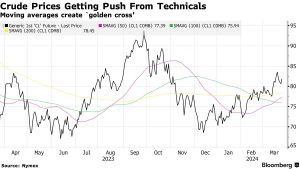
A “golden cross” occurres when the 50 day, 100 day and 200 day moving averages cross. This type of activity indicates that a strong bullish momentum is about to unfold, which could lead to further gains for crude oil.
It doesn’t happen often, but when it does the markets buzz. As long-term indicators carry more weight, a golden cross scenario suggests that a bull market could be on the horizon. This is usually reinforced by high trading volumes which means crude oil could be about to boom.
The fundamentals are being driven by 2 wars and OPEC+ production cuts. THE technical backdrop is extremely bullish with crude’s moving averages forming a golden cross. That’s when an asset’s 50-day moving average exceeds the corresponding 100- day and 200-day figure. Its last formation for the generic oil contract saw WTI surge by more than $25 a barrel. From its June low of $65 to above $90 in September.
This latest Golden Cross happened as U.S. crude futures have risen from around $70 a barrel at the start of the year to above $83. It’s left the 50-day, 100- day and 200-day moving average for WTI oil looking to move above the $90 September high. Projecting oil over $95 bases WTI. That puts BRENT over $98. It’s a classic Golden Cross that often signals a continued bullish trend to new highs. Usually followed by a crash.
blackmask market news and commentary
Casing In On The Golden Cross
Traders Eye OPEC+ Cutbacks and Geopolitics
OPEC+ set to affirm its policy of production cuts amid tensions in the Middle East and Russia. West Texas Intermediate settled above $81, while global benchmark Brent closed above $86 a barrel. OPEC+ delegates aren’t seeing a need to change supply policy at a review meeting next week, according to several national officials, with quotas in place until June proving effective. The Houthis renewed threats against Saudi Arabia if it supported US strikes. Signs of a shift in monetary policy have also aided sentiment. The Federal Reserve has signaled a willingness to cut interest rates later this year, buoying appetite for risk assets, including oil. Crude has risen about 14% this quarter, breaking out of a tight range that held for the first two months of the year. Attacks by Ukraine on Russian refineries have aided gains, together with signs of strength in some product markets including gasoline. The positive overall market outlook has spurred hedge funds to increase their bullish bets on Brent.
Bullish Sentiment Brings $90 Oil Within Reach
In what feels like an increasingly bullish oil market, $90 Brent is now a real possibility. While demand uncertainty persists, geopolitical risk, a weakening U.S. dollar, and OPEC+ supply cuts have moved prices higher. Long positions held by hedge funds and other money managers have seen the strongest influx of bullish interest since September 2023, indicating the market believes geopolitical pressures will keep on pushing oil prices higher.
– Net long positions held in Nymex WTI rose by 50 million barrels in the week ending March 19, whilst ICE Brent net longs increased by almost 55 million barrels, the biggest positioning move of the year so far.
– With physically deliverable Nymex WTI being the riskier financial instrument to bet on, ICE Brent has seen its net length soar to the highest level since March 2023, coming in at 289 million barrels (combined with the period a year ago, short positions have tripled in size to 70 million barrels).
– Proving that oil is becoming fashionable again amidst Middle Eastern conflict and Ukrainian drone strikes on Russian refineries, the combined open interest of WTI and Brent now stands at 518 million barrels equivalent, up 14% since the beginning of this year. ated by Russia doubling down on its OPEC+ production cuts, the US dollar continuing to weaken, and any semblance of an Israel-Palestine truce being off the cards right now. With Brent futures seeing signs of a stellar golden cross pattern developing, it might only take one bullish piece of news for $90 per barrel to happen.
Kurdish Production Sees No Light at the End of Tunnel. One year since the shutdown of Kurdish oil flows through the Kirkuk-Ceyhan pipeline, Iraq is yet to find common ground with oil companies operating in the separatist region, with Baghdad seeking to revise production terms and rights.
OPEC Sees No Need for Policy Change Proposal at Next Week’s Meeting
- OPEC+ group: no need for change in next JMCC meeting.
- OPEC+ members have collectively decided to voluntarily cut 2.2 million barrels per day (bpd) from the group’s production this quarter.
- The production estimates for February have shown that some of OPEC+ members – especially Iraq and Kazakhstan – continued to overproduce above their respective quotas.
OPEC and the broader OPEC+ group do not see any need to propose a change to the current oil production policy when the Joint Ministerial Monitoring Committee (JMMC) meets next week, according to delegates, commodity analyst Giovanni Staunovo reported on Monday.OPEC+ members have collectively decided to voluntarily cut 2.2 million barrels per day (bpd) from the group’s production this quarter, although much of that was production cuts that were already in effect, including Saudi Arabia’s 1 million bpd voluntary cut. In early March, the members of the OPEC+ alliance that had pledged the Q1 cuts announced they would roll over the supply reductions until the end of the second quarter. Saudi Arabia, Iraq, the United Arab Emirates, Kuwait, Kazakhstan, Algeria, Oman, and Russia are now cutting their respective crude oil production and exports in the first half of 2024 with extra voluntary reductions, on top of the voluntary cuts OPEC+ previously announced in April 2023 and later extended until the end of 2024.When the OPEC+ members announced on March 3 their intentions to extend the cuts into the second quarter, Russia changed its production/export cut plan and said that in the second quarter it would reduce supply by 471,000 bpd in the form of cuts to oil production and exports. In April, Russia will reduce production by 350,000 bpd and exports by 121,000 bpd. In May, the 471,000 bpd reduction would be in the form of a 400,000-bpd cut to production and 71,000 bpd cut to exports, and in June the Russian supply cut would be 471,000 bpd entirely from production reductions. The production estimates for February have shown that some of OPEC+ members – especially Iraq and Kazakhstan – continued to overproduce above their respective quotas. In the middle of February, both Iraq and Kazakhstan pledged to comply with the cuts they had announced. OPEC’s second-largest producer, Iraq, is committed to its voluntary cut in the OPEC+ agreement and will produce no more than 4 million bpd of crude oil, Iraq’s Oil Minister Hayan Abdel-Ghani said in February. Non-OPEC oil producer Kazakhstan, for its part, vowed to compensate over the coming months for a lack of compliance with the cuts in January.
Russia Demands Oil Producers Slash Output for OPEC+
Russia’s government has ordered oil companies to lower their output in the second quarter so that the country can meet its OPEC+ production target of 9 million barrels per day (bpd) by the end of June. Previously, Russian Deputy Prime Minister Alexander Novak announced that Russia would cut oil output and exports by an extra 471,000 barrels per day (bpd) in the second quarter, in tandem with production cuts by other OPEC+ members. The country will then gradually ease the export cuts and focus on only reducing output. Although Novak is yet to provide the targeted level for output, Reuters has calculated that production would drop to almost 9 million bpd in June if the country proceeds with the planned production cut.
Private sources not authorized to speak publicly have told Reuters that Moscow has given specific targets to each oil company, an indication of its commitment to keep its OPEC+ pledge in a bid to support international oil prices.
Russian oil and gas condensate production fell from an annual peak of 11.7 million bpd in 2019 to around 10.8 million currently due to production cuts. The country has not disclosed production or export data ever since it started the war in Ukraine. Production has also suffered in the current year due to unplanned outages as well as drone attacks by Ukraine. Novak’s statement did not include a six-month ban on Russian gasoline exports that kicked in from March 1. Russian crude oil and fuel trade has been under Western sanctions ever since Russia launched the Ukraine war two years ago, while the United States has imposed more sanctions on Russia’s leading tanker group Sovcomflot. Bloomberg has, however, reported that Russia is experiencing a drilling boom despite concerted efforts by the U.S. and its allies to limit technology transfer. The withdrawal of major Western oil-service companies from Russia has left their local subsidiaries to fill their void, which they have so far done successfully.
“Only some 15% of the nation’s domestic drilling market depends on technologies from so-called unfriendly nations,” Daria Melnik, vice-president for exploration and production at Rystad Energy, has revealed.
Trump Media to debut on NASDAQ with $3B valuation
Former President Donald Trump’s social media company will begin trading Tuesday under the ticker symbol DJT, the company itself announced in a new regulatory filing on Monday.
The newly merged company will be called Trump Media & Technology Group Corp. (TMTG) and listed on the NASDAQ market. Trump retains a commanding 58% ownership of the merged entity, which, based on current share prices, is worth upwards of $3 billion. Eric Swider, the former CEO of DWAC, will join the board of directors. “As a public company, we will passionately pursue our vision to build a movement to reclaim the Internet from Big Tech censors,” said TMTG CEO Devin Nunes. “We will continue to fulfill our commitment to Americans to serve as a safe harbor for free expression and to stand up to the ever-growing army of speech suppressors. As we mark this milestone, I want to particularly thank Eric Swider for his unflagging dedication to our deal and our cause.” On the financial front, the news has appeared dire for former president Donald Trump this year. Within a span of just a month, two judges in two separate cases ordered him to pay about $540 million in total — a sum so great that pundits have speculated it could erode his campaign finances.
What’s gotten far less attention, though, is this: A frenetic rally in a stock tied to Trump Media & Technology Group — which operates the Truth Social platform he posts on daily — has minted a nearly $4 billion windfall for him.
There are any number of caveats to this figure, including how it’s only a paper profit for now that he’ll have to wait months to monetize, and yet the stock’s surge is a potentially huge financial boost for a billionaire candidate suddenly short on cash. The type of transaction — known as a de-SPAC or blank-check deal — that would hand Trump this new-found wealth is a complex one that briefly became popular on Wall Street during the stock mania unleashed by pandemic-era stimulus. In this particular deal, Truth Social’s owner would enter the stock market by merging with a publicly traded company called Digital World Acquisition Corp.
the come back kid
NN AUDIO
Israel cancels delegation trip as US fails to veto GHamas hails UNSC’s ceasefire vote resultsaza resolution……..
Israeli Prime Minister Benjamin Netanyahu decided to suspend the planned visit of a diplomatic delegation to Washington after the United States did not veto the United Nations Security Council (UNSC) resolution calling for a ceasefire in Gaza without the release of the hostages held by Hamas, the Prime Minister’s Office said in a statement. “This withdrawal hurts both the war effort and the effort to release the hostages because it gives Hamas hope that international pressure will allow them to accept a ceasefire without the release of our abductees,” the statements read. Meanwhile, US National Security Council (NSC) Coordinator for Strategic Communications John Kirby said that he prefers letting “the Israelis speak to whether they’re coming or not.”
Hamas hails UNSC’s ceasefire vote results
Hamas welcomed on Monday the United Nations (UN) Security Council’s adoption of a resolution calling for a ceasefire between the group and Israel in the Gaza Strip.The organization’s statement indicated Hamas’s readiness to “engage in an immediate prisoner exchange process that leads to the release of prisoners on both sides.” “Hamas calls on the Security Council to pressure the occupation to adhere to the ceasefire and stop the war of genocide and ethnic cleansing against our people,” it concluded. Israel objected to the results of the vote and canceled a planned diplomatic visit to the United States after the latter did not veto the resolution.
Brent Crude Tops $87 as Geopolitics Threatens Tight Supply
Brent crude oil surged past $87 on Monday as Russia’s war on Ukraine increasingly focuses on attacks on energy installations, and as mediation in the Israel-Gaza conflict fails. On Monday at 10:14 a.m. ET, Brent crude was trading at $87.16, up 2.03%, for a 1.72-cent gain on the day. The U.S. crude oil benchmark, West Texas Intermediate (WTI), was trading at $82.45, up 2.26%, for a $1.82 gain on the day. The latest rally also comes after OPEC+ said on Monday that it saw no need for any policy changes during next week’s planned Joint Ministerial Monitoring Committee (JMMC) meeting. In combination with geopolitical developments in the Middle East and Russia, including continuing attacks by Iran-backed Houthis in the Red Sea, analysts are eyeing tighter supply as the global economies fight off recession and the Fed sticks to its tentative plans for rate cuts this summer. A Ukrainian drone attack over the weekend has reduced capacity at a Russian oil refinery to around half. Kyiv struck Russia’s Kuibyshev oil refinery in Samara, taking out one refining unit and reducing capacity by half, Reuters reports. According to Reuters calculations, in the first quarter of this year, Ukraine attacked seven Russian refineries, taking nearly 400,000 barrels per day of capacity offline. Russia, in turn, attacked an underground natural gas storage site in Ukraine, though supplies have not been disrupted, according to Kyiv. DTEK, Ukraine’s largest energy producer, is running at 50% capacity, forcing it to suspend electricity exports, according to Ukraine’s energy ministry.
In the Middle East, hopes are now fading, again, for a ceasefire deal as Israel continues with its assault on Gaza.
Also on Monday, Goldman Sachs said commodity demand would increase this year, driven by interest rate cuts by central banks, with potential returns as high as 15%.