Saudi Arabia Likely to Keep Oil Prices to Asia Unchanged

Saudi Arabia is expected to announce in a few days little changes to the price of its crude going to Asia in April, amid a rise in Middle Eastern oil benchmarks, a Reuters survey of refiners showed on Friday. Saudi Aramco, the world’s top crude oil exporter, is set to keep the price of its flagship Arab Light grade for Asia for next month unchanged or raise it slightly by up to $0.20 per barrel over the Oman/Dubai average, the benchmark off which Middle Eastern crude exports to Asia are priced, the survey of six refining sources found. Saudi Arabia typically announces its official selling prices (OSPs) for the following month around the fifth of each month, and does not comment on the pricing.  This month, the Saudis could announce the price of their crude for April after the OPEC+ decision whether to roll over the existing production cuts, a decision expected in early March. The market expects a rollover of the current cuts into the second quarter of 2024. Last month, Saudi Arabia unexpectedly kept the price of Arab Light for March unchanged for Asia from the February price, at $1.50 a barrel over the Oman/Dubai average. The current Arab Light premium over the Middle Eastern benchmark is the lowest in more than two years.

Now Aramco is expected to stick to this policy as the Dubai market structure has strengthened while the Saudis would want to push more barrels into Asia amid the disruption to oil shipping in the Red Sea for barrels going to Europe and the Mediterranean.

“The market structure and product cracks didn’t change too much compared to last month, and I think now with Red Sea shipping still having uncertainty … probably they will want to push the barrels to Asia,” one of the refining sources told Reuters. Saudi Arabia is expected to keep the price of the other crude grades to Asia little changed, too, according to the survey. NN: Which means they are not expecting the recent price rises to stick.
Eurozone manufacturing PMI worsens in February……… UK manufacturing slump persists…. German manufacturing PMI suffers fresh setback in Feb

The Eurozone Manufacturing PMI worsened in February 2024, S&P Global and Hamburg Commercial Bank (HCOB) shared in a report on Friday. The figure stood at 46.5, down from last month’s 46.6, reaching a 2-month low and remaining in contractionary territory. “The attacks by the Houthis on commercial vessels in the Red Sea have had a temporary impact, leading to a brief lengthening of delivery times in January, followed by a subsequent reduction in lead times in February,” HCOB Chief Economist Cyrus de la Rubia commented. The drop in the manufacturing sector was mainly driven by Germany, “which registered its sharpest deterioration in four months,” followed by Austria and France. However, Greece and Ireland witnessed their strongest expansions in 24 and 20 months, respectively. Spain, after almost a year, finally returned to growth.

UK manufacturing slump persists amidst Red Sea crisis

The UK manufacturing sector’s downturn persisted in February, with the S&P Global UK Manufacturing Purchasing Managers’ Index (PMI) at 47.5, slightly up from the previous month’s 47.0. According to the report, the sector issues continued through February 2024, as weak demand and the ongoing crisis in the Red Sea compounded challenges, disrupting production and vendor delivery schedules. Manufacturers reported that these disruptions have increased costs as they seek alternative suppliers from more expensive, closer markets. “UK manufacturers faced challenging circumstances in February, as the ongoing impact of the Red Sea crisis delayed raw material deliveries, inflated purchase prices, and impacted production capabilities. There were also knock-on effects for demand, as new export orders were hit by both supply disruptions and higher shipping costs. Production volumes subsequently contracted for the twelfth successive month while total new orders fell at the sharpest rate since October,” Rob Dobson, Director at S&P Global Market Intelligence, said.

German manufacturing PMI suffers fresh setback in Feb

Germany Manufacturing Purchasing Managers’ Index (PMI) stood at 42.5 in February, down from an 11-month high of 45.5 in January, according to the latest report by S&P Global and Hamburg Commercial Bank published on Friday. The sector saw accelerated declines in both output and new orders, marking a concerning setback as the quarter progressed. The output index similarly fell to 42.3 from 45.7, indicating the fastest rate of contraction since October of the previous year. This downturn was primarily driven by a sharp decrease in demand, affecting both domestic and international sales. February’s data highlighted an increase in factory job losses, the most significant since August 2020, amid falling backlogs of work and dwindling expectations for future activity. “All hope has been dashed – for the moment. After a steady increase of the PMI over the last half a year, the index plunged to its lowest point since last October.  The drop was the result of a broad-based deterioration of indicators like the accelerated fall in new orders, the faster downturn in output, and the more aggressive trimming of jobs.

The widespread nature of the downturn offers little hope for a turnaround in the near future.” Dr. Cyrus de la Rubia, Chief Economist at Hamburg Commercial Bank said. NN:: falling economies means falling demand for oil

Oil prices edge up by 1% on Middle East turmoil

Oil futures prices rose on Friday, as escalating tensions in the Middle East have raised concerns about the potential spillover of the conflict across borders and its wider impact on crude supply.

The uncertainty surrounding ceasefire negotiations between Israel and Hamas, coupled with the recent incident in Gaza where Israeli forces targeted unarmed Palestinians who were collecting aid, resulting in a reported death toll of over 100 according to Hamas, has contributed to the heightened sense of unease.

Additionally, the ongoing Houthi attacks on Red Sea shipping have further added risk to oil prices. West Texas Intermediate (WTI) for April contracts jumped 1.52% to $79.48 per barrel at 06:27 am ET. Brent for May deliveries increased 1.50% to $83.13 per barrel. NN: a worsening crises pushing oil higher and a cease fire and hostage release will take the $12 war premium out of the market… Place your bet.

Israel’s Gallant: Military ready for action in Rafah….. White House: Firing at civilians serious incident

Israel’s Defense Minister Yoav Gallant said on Thursday that the Israeli Defense Forces (IDF) is ready for the ground operation in the city of Rafah, in the southern Gaza Strip.”We are closing in on Hamas. We are preparing to act in Rafah, as well as in the central camps, in order to reach the next stage [which] we will decide according to our priorities,” Gallant stated during his visit to Israeli troops in northern Gaza. Furthermore, the minister claimed that the Israeli military is on its way to destroy Hamas, adding that the militant group is “getting weaker with each passing day.”

White House: Firing at civilians serious incident

The White House described on Thursday the reported firing at Palestinian civilians in Gaza City conducted by the Israel Defense Forces (IDF) as a “serious incident.” “We mourn the loss of innocent life and recognize the dire humanitarian situation in Gaza, where innocent Palestinians are just trying to feed their families,” United States President Joe Biden’s administration remarked in a statement. “This underscores the importance of expanding and sustaining the flow of humanitarian assistance into Gaza, including through a potential temporary ceasefire.” Earlier in the day, the IDF fired at the crowds that gathered around the trucks carrying humanitarian aid but insisted that “dozens of Gazans were killed and injured” due to “the pushing, trampling and being run over by the trucks.” NN: Can you imagine trying to move, house and feed one million of theses people before invading Rafah?  Can you imagine the fun Humas will have arranging another panic driven slaughter?

Analysts Expect Oil Prices to Remain Close to $80 This Year

Sufficient supply and uninterrupted oil trade flows despite the Middle Eastern conflicts are set to keep oil prices close to the $80 per barrel threshold this year, the monthly Reuters poll of analysts showed on Thursday.

For the fourth consecutive month, more than three dozen analysts and economists continued to revise down slightly their forecast for the average price of the two most traded benchmarks, Brent and WTI, the Reuters poll found.

According to the experts, Brent Crude prices will average $81.13 a barrel this year, a slight downgrade from the $81.44 a barrel average consensus in the January poll. For WTI Crude, the surveyed analysts expect an average price of $76.54 per barrel in 2024, down from $77.26 a barrel expected in last month’s poll. Early on Thursday, both benchmarks were set to post their second monthly gain in a row after a period of losses last year, with traders anticipating an extension of the OPEC+ production cuts. An extension would contribute to a perception of a tightening oil market that has served to keep oil prices elevated for most of the past two months. As of 7:45 a.m. EST on Thursday, Brent prices were slightly down by 0.13% at $83.62, while the U.S. benchmark, WTI Crude, traded 0.17% higher at $78.65.

Biden: Gaza ceasefire probably not by Monday

United States President Joe Biden said on Thursday that the potential ceasefire agreement between Israel and Hamas is unlikely to be reached by March 4 as he had initially predicted, Agence France Presse (AFP) reported. In response to the correspondent’s question whether Israel’s attack on the Gaza aid line, which is said to have killed over a hundred Palestinians, would complicate the warring parties’ negotiations on a temporary armistice, Biden said, “I know it will.” “We’re checking that [incident] right now. There are two competing versions of what happened, I don’t have an answer yet,” the US president stressed.

IDF says it fired on Gazans who endangered troops delivering aid in stampede; Hamas claims 70 dead

I  hesitated to run this Al Jazeera fake news video. It blames Israel for the food riot Hamas started as the aid convoys arrived.

This morning, Hamas health officials claimed more than 70 Palestinians waiting for humanitarian aid in Gaza City were killed by Israeli forces. The IDF says that as humanitarian aid was being delivered to the northern Gaza Strip, a “violent gathering” erupted surrounding the trucks, during which Palestinians looted the equipment.

“During the incident, dozens of Gazans were injured as a result of pushing and trampling,” the IDF says, adding that the incident is under review.

A military source says that following the incident, some of the crowd began to move toward Israeli forces in the area — who were tasked with coordinating the entry of the aid trucks to northern Gaza — in a way that “endangered” the troops. The source says troops opened fire at the crowd, and that the second incident is also being investigated. Dozens of Gazans said killed in stampede for aid; IDF opens fire, blamed for deaths

Hamas puts toll at 104, says incident could cause suspension of hostage talks; army says under 10 casualties caused by IDF fire when troops endangered, others trampled amid looting

Dozens of Palestinians were killed Thursday in Gaza City as they swarmed aid trucks that entered the city. Hamas blamed the IDF for the deaths. The military said most of the casualties were caused by a stampede and being run over by the supply vehicles. Gunmen also opened fire in the area as they looted the supplies. However, the army also acknowledged that troops opened fire on several of the Gazans, who they said were endangering soldiers. The Hamas-run Gaza health ministry said the death toll reached 107, with hundreds more injured. The figures could not be independently confirmed. The Israel Defense Forces published drone video showing thousands of people swarming around the aid trucks as they reached the area in northern Gaza. In some cases, the vehicles continued to try and push past the crowds.  According to an initial IDF probe of the crush, the vast majority of the casualties were a result of trampling and being struck by the aid trucks. The incident began at around 4 a.m., when some 30 trucks carrying humanitarian aid arrived at the coast of Gaza City, to deliver food to Palestinians in the Rimal neighborhood. Thousands of Palestinians rushed the trucks after they passed an IDF checkpoint in central Gaza, leading to a stampede in which dozens of Palestinians were killed and hundreds wounded, some after being run over by the trucks, according to the probe. The IDF’s initial investigation found that some of the trucks managed to continue further north, where armed men reportedly opened fire at the convoy near Rimal and looted it. Dozens of Palestinians who rushed the last truck in the convoy began to move toward an IDF tank and troops stationed at the military’s checkpoint, the investigation found. Dozens of Palestinians were killed Thursday in Gaza City as they swarmed aid trucks that entered the city. Hamas blamed the IDF for the deaths. The military said most of the casualties were caused by a stampede and being run over by the supply vehicles. Gunmen also opened fire in the area as they looted the supplies. However, the army also acknowledged that troops opened fire on several of the Gazans, who they said were endangering soldiers. NN: Now imagine Israel trying to provide a humanitarn safety zone for 1.5 million displaced people in Rahala before an ivasion.

Geopolitical Risk Premium in the Oil Price

Oil prices are being driven higher by geopolitical events, James Davis, FGE’s Director of Short-Term Global Oil Service and Head of Upstream Oil, told Rigzone. “You can say there is some ‘risk premium’ as a result, but it would be more accurate to say part of this ‘risk premium’ is due to ‘trade friction’ as shippers avoid the Red Sea,” Davis added. Carole Nakhle, the CEO of consultancy Crystol Energy, if there is a geopolitical risk premium in the oil price right now, Nakhle said, “we all know that geopolitics affect oil markets but no one knows how to quantify the risk premium which depends on one’s own perception of the risk to supply disruptions”. “Today, we haven’t seen supply disruptions. Demand is not booming. Non-OPEC+ supply is healthy, so is the spare capacity largely thanks to OPEC+ cuts,” Nakhle went on to state. Macquarie strategists said, “a combination of factors have driven the recent oil rally”. “The key factors include an increase in Middle East and Russia related risk premiums, and an unusually large number of global production outages,” the strategists added in that report. Macquarie strategists noted that,

“without current geopolitical tensions, we believe crude would sell off meaningfully”.

EIA: US crude inventories up by 4.2 million barrels…. API reports a 8.4 million barrel increaser

Marking the third-straight week of hefty gains,

Commercial crude oil inventories in the United States, not counting those in the Strategic Petroleum Reserve (SPR), saw a weekly rise of 4.2 million barrels to 447.2 million barrels in the seven days ending February 23, the Energy Information Administration (EIA) said in its report published on Wednesday. The country’s inventories thus reached about 1% below the five-year average for this time of year. Refinery inputs averaged 14.7 million barrels per day (bpd), an increase of 100,000 bpd compared to the previous seven days. Meanwhile, refineries operated at 81.5% of their operable capacity. In the meantime, gasoline production grew, averaging 9.4 million bpd. Crude oil imports went down by 269,000 bpd to average 6.4 million bpd. Total commercial petroleum inventories declined by 3.2 million barrels.

Surprise Crude Build Weighs on Oil

Crude oil inventories in the United States rose this week, by 8.428 million barrels for the week ending February 23, according to The American Petroleum Institute (API). The API reported a 7.168-million-barrel rise in crude inventories in the week prior. T he Department of Energy (DoE) reported that crude oil inventories in the Strategic Petroleum Reserve (SPR) rose by 0.8 million barrels as of February 23.

Inventories are now at 360.3 million barrels—the highest level since May 2023.

Gasoline inventories fell this week by 3.272 million barrels, compared to the small 415,000 barrel build in the week prior. As of last week, gasoline inventories were about 2% below the five-year average for this time of year, according to the latest EIA data. Distillate inventories also fell this week, by 523,000 barrels, on top of last week’s 2.908 million barrels drop. Distillates were already 10% below the five-year average for the week ending February 16, the latest EIA data shows. Cushing inventories rose again this week, by 1.825 million barrels after rising by 668,000 barrels in the previous week.NN: oil inventories are soaring. At best you can say their are some supply slow downs by 10 days because of shipping delays. But no supply disruptions. And demand is slowing globally. And inventories are INCREASING!!!

Short Sellers in Trouble As Physical Oil Market Defies Data

  • While official data indicates an oil glut, the physical oil market is experiencing significant tightness, as evidenced by soaring spreads, contrary to market expectations.
  • Factors contributing to the physical market’s tightness include supply issues in various regions, including vessel diversions, freeze-offs in the US, worker protests in Libya, and logistical constraints in the North Sea.
  • Despite the physical market’s tightening, financial players continue to aggressively sell and short the sector, translating into high short interest in energy stocks and challenging the physical oil market’s resilience.

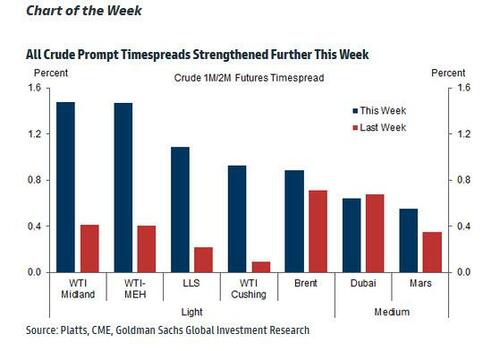
Something odd is taking place in the oil market. While on one hand “data” dissembled by Biden’s Dept of Energy and specifically its statistical arm, the Energy Information Administration, has done everything it could to indicate there is a glut of oil, which is understandable – there is nothing Biden’s handlers fear more than an inflationary surge in oil and gasoline prices ahead of the November elections and will do everything in their power to mandate a dataset that has the most adverse impact on oil prices, the physical market is sending just the opposite signal, with spreads showing screaming physical tightness. Consider the Brent prompt spread which after tumbling to a multi-year low in late December, has exploded higher to a backwardation around 90 cents… … entrenching its strongest position since late October, while several other timespreads also the firmest since last September. The comparable WTI April-May spread was trading around 50 cents after hitting 75 cents last week. Commenting on the surge in time-spreads, Citi strategist Max Leyton – who is far less bearish than oil permabear Ed Morse who recently left the bank – says they strengthened on the “perfect storm” of Atlantic Basin supply issues, and notes that supply issues include “ongoing Red Sea vessel diversions, US freeze-offs hitting oil output, worker protests disrupting Libyan supply, UK oil terminal logistics limiting North Sea Forties supply, and buying up of crude cargoes at the Nigerian Dangote refinery.”

“Most of these issues could ease,” and the second quarter “still looks like a surplus quarter for total oil balances, meaning current strength could pause.” Of course, the current strength could very well accelerate if there is even one small geopolitical hiccup in the middle east where nobody expects any surprises, and where all eyes remain on how much more of its bitch Iran can make Biden, before even the US president is forced to retaliate even if it means 4mm barrels taken off the daily market. The dramatic spikes in prompt timespreads across the crude complex was the Goldman chart of the week just a few days ago, and shows just how dramatically and rapidly the market has tigthened up as a result of sudden scarcity of physical which, however, has barely received any mention in daily discussions about the energy market.

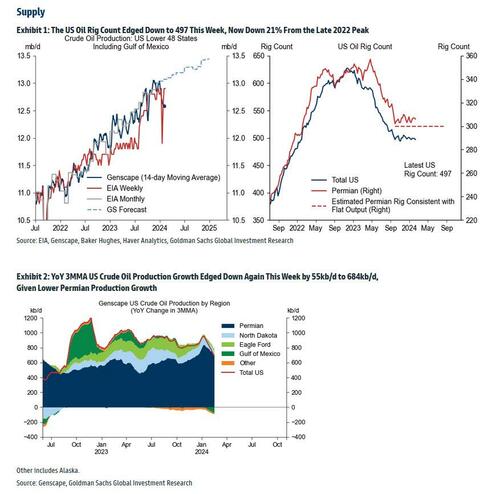
Below we share some more charts from Goldman looking at the most recent indicators in physical markets, starting with supply where Goldman is seeing distinct “firmness”…

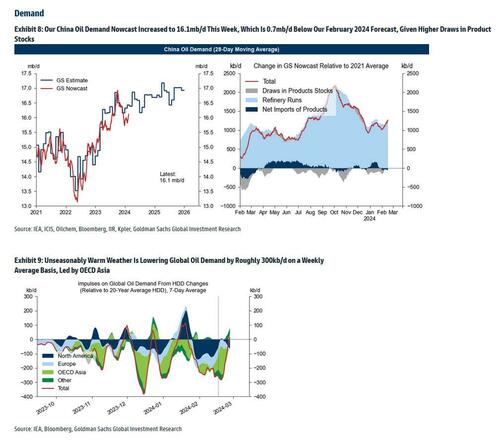
… while on the demand side of the equation, recent unseasonaly warm weather has lowered global oil demand by some 300kb/d.

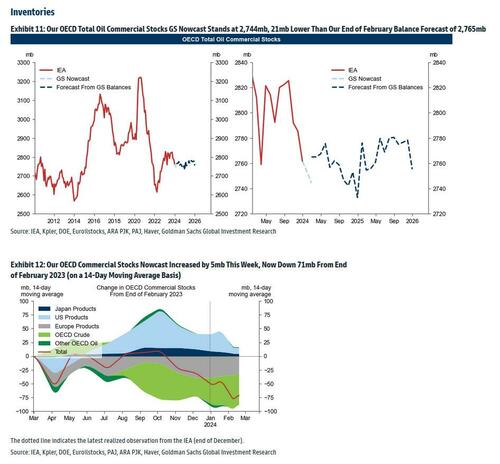
As a result of the tightness in supply, Goldman calculates that total OECD inventories are now about 21mb lower than the company’s end of February balance forecast of 2,765 mb, with estimates pointing to further tightness.

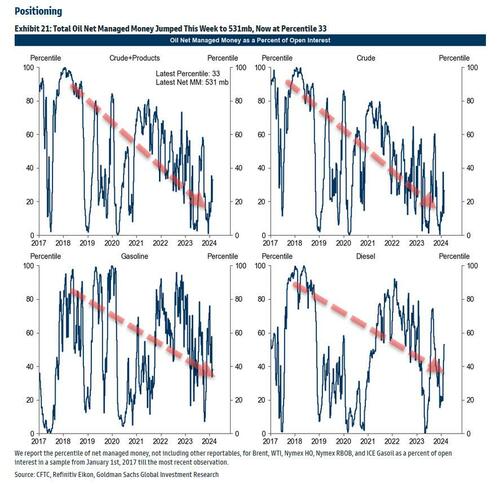
Yet despite this continued decline in supply and inventories, oil prices remain rangebound and seem unable to breakout solidly about the low 80s. Why is that? In a word: financialization, aka “paper oil”, because while the physical oil market is screaming higher, financial players (managed money) continue to aggressively sell and short the sector as shown in the chart below.

This desperate attempt by financial players to keep their underwater positions from getting stopped out and sparking a cascade of margin calls has also translated into a ravenous shorting of energy stocks which as we pointed out a week ago, are the most shorted sector in Goldman’s prime brokerage. This, in turn, has translated into some of the marquee energy names such as Exxon seeing the highest short interest on record… … even though the lifeblood of refiners such as the 3-2-1 Crack Spread is now surging higher. Which begs the question: how much tighter will physical oil have to get before it finally breaks the financial oil shorts?