Crude futures slid more than 2% on Friday after reports emerged that the United Arab Emirates is considering leaving the Organization of the Petroleum Exporting Countries (OPEC). According to a report by the Wall Street Journal, the Middle Eastern country has pushed the cartel to allow it to produce more oil and Emirate officials are now having an internal debate on whether to leave OPEC amid disagreements over output cuts with Saudi Arabia. International benchmark Brent for settlements in May dropped 2.36% to sell for $82.36 per barrel at 9:01 am ET and West Texas Intermediate (WTI) for April delivery slid 2.59% to go for $75.92 per barrel at the same time.NN: nothing to get excited about here…
UAE Officials Say Privately No Plans to Leave OPEC
The United Arab Emirates has no plans to leave the OPEC oil alliance, according to officials speaking on condition of anonymity. The Wall Street Journal reported earlier that a growing rift with Saudi Arabia means the UAE is having internal discussions about quitting the producer group, a move that could potentially leave it free to lift output.
The UAE has said publicly and privately it is sticking to the current OPEC deal for at least this year.
The major producer has for some years been contemplating what alliances best suit its long-term interests, as the country seeks to monetize recent expansion in its production capacity. In a previous OPEC+ dispute with Saudi Arabia, the group’s policy decision was held up for weeks, though in the end a compromise was found. NN:It will be no different this time/
Federal Reserve officials may need to raise interest rates as high as 6.5% to defeat inflation, according to new research that was sharply critical of the central bank’s initially slow response to rising prices. In a paper presented Friday at a conference in New York, a quintet of Wall Street economists and academics argue that policymakers still have an overly-optimistic outlook and they will need to inflict some economic pain to get prices under control. “Our analysis casts doubt on the ability of the Fed to engineer a soft landing in which inflation returns to the 2% target by the end of 2025 without a mild recession,” they wrote. The 55-page academic study included a series of simulations to predict likely paths for the Fed’s benchmark policy rates. The computer models suggested rates would peak at either 5.6%, 6% or 6.5% in the second half of 2023. The Fed has already raised rates from near zero a year ago to a target range of 4.5% to 4.75%, with officials in December projecting it will reach 5.1% this year, according to their median forecast. Data published Friday, after the paper was written, showed the Fed’s preferred inflation measures unexpectedly accelerated in January, prompting investors to increase bets on additional rate hikes. The authors — Brandeis University’s Stephen Cecchetti, JPMorgan Chase & Co.’s Michael Feroli, Deutsche Bank AG’s Peter Hooper, Columbia University’s Frederic Mishkin and New York University professor emeritus Kermit Schoenholtz — presented their paper at an annual policy forum sponsored by the University of Chicago Booth School of Business. They examined 16 different episodes since 1950 in the US and several other large economies when the central bank tightened policy aggressively to cool prices. All of them were associated with a recession. “In the current circumstances that already involve significant policy tightening (and a prospect for further restraint), an ‘immaculate disinflation’ would be unprecedented,” they wrote. They did, however, praise the Fed for abandoning gradualism last year and launching its series of aggressive rate hikes, and were upbeat that this hawkish pivot will get the job done. “Provided policymakers maintain a restrictive stance through 2023 and possibly beyond, the Fed appears on track to approach the 2% inflation target within a reasonable horizon,” they said. NN: I am raising my prediction of the Fed Funds rate to somewhere between 8 to 10%. Holy shit bat man. Yes the wild card is the out of control Federal government spending. The likes of the inflation act and subsidies for alternative energy and the chips act are poring money into the economy at rates never seen before. In essence they have cancelled out Fed Rate hikes so far. That is why jobs and economy are still growing like wild fire. Unfortunately none of the popular data sets are picking up what is in essence the Biden’s administrations massive wasteful stimulus programs,
Federal Reserve Bank of Atlanta President Raphael Bostic said he still prefers to raise rates by another quarter percentage point when officials meet later this month, but is mulling whether central bankers need to lift borrowing costs higher than the range of 5% to 5.25% he’s endorsed to defeat inflation. “I let the data guide me,” Bostic told reporters in a press briefing. “If the data continue to come in suggesting the economy is stronger than I had projected, I’ll adjust my policy trajectory.”
Bostic, who isn’t a voter on monetary policy in 2023, earlier this week reiterated his call for the Fed’s key policy rate to be lifted to around 5.1% this year and then kept there until well into 2024.
The Atlanta Fed chief acknowledged data have come in stronger and said he wasn’t prepared to adjust his formal estimate until going through a comprehensive pre-meeting review with his staff.
‘’I want to be completely clear: There is a case to be made that we need to go higher,” Bostic said. “Jobs have come in stronger than we expected. Inflation is remaining stubborn at elevated levels. Consumer spending is strong. Labor markets remain quite tight.”
US central bankers are waging their most aggressive action against high inflation in a generation. Officials lifted their benchmark lending rate by a quarter of a percentage point at the start of February, bringing the target to a range of 4.5% to 4.75%. That was a step down from the half percentage-point increase at their December meeting, which followed four consecutive jumbo-sized 75 basis-point hikes. Market expectations for the Fed peak rate have climbed to about 5.5% in September following indications of US economic strength, including an acceleration in employment growth in January and improvement in manufacturing, as well as higher inflation. Fed officials led by Chair Jerome Powell have predicted inflation will fall this year, while warning month-to-month changes will be bumpy.Policymakers will meet again on March 21-22 where they are expected to raise rates by a quarter point, though a couple Fed officials have raised the possibility of a half-point move. NN: I like to keep things simple. Inflation is still out of control. Jobs have come in much stronger. Inflation is remaining stubborn at elevated levels. Consumer spending is strong. Labor markets remain quite tight. Which means the FED is losing the battle an they will raise rates a LOT more then the markets are calculating. Its a binary trade the FED is not done raising rates. The economy will be entering into a deep dark depression and the hosing and stock markets will collapse.
China’s seasonally adjusted headline Business Activity Index came in at 55.0 in February, jumping from 52.9 registered in January and marking a further improvement in the country’s service sector, S&P Global said in its report published on Friday. The figure surpassed expectations and experienced the strongest rise since August. Meanwhile, the seasonally adjusted Composite Output Index, which shows the combined results of the manufacturing and services sectors, went up from January’s 51.1 to 54.2. “The economy has entered a post-Covid recovery, with services activity showing signs of a stronger recovery than the manufacturing sector. But the impact of the pandemic remains far-reaching. Currently, the foundation for economic recovery has yet to solidify,” Caixin Insight Group Senior Economist Dr. Wang Zhe commented. NN: China’s big bet paid off. Watch as their economy zooms. And our binary oil bet pays off over the next 12 months.
Asia rises as China’s services sector rebounds
Major stock exchanges in the Asia-Pacific region traded higher in the afternoon session on Friday, with the positive trend seemingly boosted by a sharp recovery in the services sector across China and Japan. Investors also drew optimism from data that registered cooler-than-projected inflation figure in Tokyo. Governor of the People’s Bank of China (PBoC), Yi Gang, previously noted that the bank’s interest rates are at an optimum level, stressing that the central bank will work to maintain currency stability.
JPMorgan believes Russia will be able to maintain its oil production at pre-war levels of 10.8 million barrels per day.
The bank believes Russia’s oil product exports will likely drop by 300,000 bpd due to the EU embargo on imports of Russian fuels.
Growing demand from both India and China will help to maintain Russian oil production, but it is unlikely to return to pre-Covid levels
Russia will likely manage to keep its oil production around the levels from before the Russian invasion of Ukraine, thanks to solid demand for Russia’s crude oil in India and China, JPMorgan said on Thursday. “We believe Russia will be able to maintain its oil production at pre-war levels of 10.8 mbd (million barrels a day) but will have difficulties getting back to peak pre-COVID volumes of 11.3 mbd,” Reuters quoted the Wall Street bank as saying. Still, Russia could struggle to divert part of its oil product exports away from Europe, after the EU embargo on imports of Russian fuels came into effect on February 5, according to JPMorgan.
Seaborne oil product shipments from Russia are set to decline by around 300,000 barrels per day (bpd) to “lows last seen in May 2022,” the bank said.
Before the embargo, Europe was a key destination for Russia’s fuel exports and took in more than 600,000 bpd of Russian oil products. This month, Russia is voluntarily cutting its oil production by 500,000 bpd as a result of the Western sanctions and the price cap on Russian crude oil. The Russian production cut could be “a sign that Moscow may be struggling to place all of its barrels,” or “may be an attempt to shore up oil prices,” the International Energy Agency (IEA) said in its Oil Market Report for February. The attempt at an oil-price boost has failed so far—prices have been pressured in recent weeks by signs that the Fed could raise interest rates to a higher endpoint and hold them there for longer to fight sticky inflation. Russian crude oil and petroleum product exports held strong in February, with oil producers managing to export 7.32 million BPD of crude oil and oil products in February, according to Kpler data. NN: Russia was exporting 11.3 MBPD….. Say they get up to 7.5 MBPD we are still short 4 MBPD in a market where demand has increased by 2 million BPD.
US Treasury yields rose on Thursday, with the yield on the 30-year Treasury bond reaching levels not seen since last November. Market participants have recently been expectant about whether the US Federal Reserve will maintain its pace. Today, markets will receive the jobless claims report, a key piece of data that could provide clues about the direction the bank will take at the next meeting. The return on the 10-year Treasury note rose four basis points to 4.044% at 8:10 am ET. The yield on the two-year note advanced two basis points to 4.918% simultaneously, while the return on the 30-year bond moved up four basis points to 3.999%. BlackMask Blog:
Federal Reserve officials said interest rates will need to increase further and stay elevated into next year to curb US inflation that’s showing few signs of abating despite the central bank’s most aggressive monetary tightening in a generation. Interest rates would need to rise to between 5% and 5.25% and then remain there “until well into 2024,” Atlanta Fed President Raphael Bostic wrote in an essay published Wednesday. “This will allow tighter policy to filter through the economy and ultimately bring aggregate supply and aggregate demand into better balance and thus lower inflation.” Bank of Minneapolis President Neel Kashkari has yet to decide if he will back accelerating the central bank’s interest-rate increases when officials meet later this month, amid signs inflation is not cooling as hoped. “I’m open-minded, at this point, about whether it’s 25 or 50 basis points,” Kashkari said Wednesday in a question-and-answer session in Sioux Falls, South Dakota. “To me, much more important than whether it’s 25 or 50 is what we signal in what’s called the dot plot,” he added, referring to the Fed’s quarterly forecast for the path of its benchmark policy rate. The central bank raised that rate by a quarter percentage point to a range of 4.5% to 4.75% on Feb. 1. The smaller move followed a half-point increase in December and four jumbo-sized 75 basis-point hikes prior to that.
“We’re not yet seeing much of a sign of our interest-rate increases slowing down the services sector of the economy and that is concerning to me,” Kashkari said. “Wage growth is at a level that it actually is too high to be consistent” with the 2% inflation target.
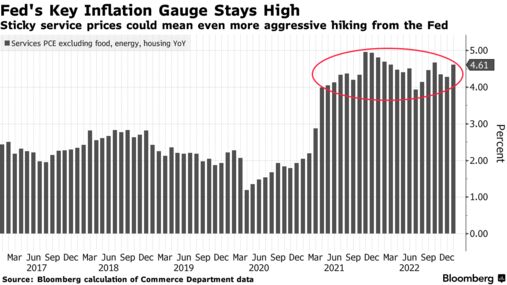
Fed officials are focused on bringing down inflation in core services excluding housing, a part of the economy that has remained strong despite tightening monetary policy — a “concerning” issue, Kashkari said. Prices in that category, where wages account for a large part of costs, rose at a 4.6% annual pace in January, up from 4.3% in December, according to the Fed’s preferred inflation gauge.
Minutes from the January discount-rate meetings showed that directors from the Minneapolis Fed favored a 50 basis-point hike in that rate. Those votes are typically a proxy for how the president would like to vote on the federal funds rate at the upcoming Federal Open Market Committee meeting. Minutes from the Jan. 31-Feb. 1 FOMC meeting showed that “a few” participants favored or could have supported a 50 basis-point increase. But Kashkari, who votes on policy this year, ultimately joined his colleagues in voting for the smaller raise. Kashkari reiterated that in December he saw the fed funds rate rising to as high as 5.4% in this tightening cycle. He said Wednesday he hasn’t yet decided where his new estimate will be at the March meeting, when policymakers provide their quarterly forecast updates, but that he’s leaning toward supporting more rate increases. Financial-market bets for the peak rate reached 5.5% Wednesday. Several recent reports have shown inflation accelerated more than forecast in January, a surprising pivot after prices had cooled in the last three months of 2022. The labor market also remained tight at the beginning of the year, with employers adding a whopping 517,000 jobs in January.
“History teaches that if we ease up on inflation before it is thoroughly subdued, it can flare anew,” Bostic said in an essay on the Atlanta Fed’s website. “That happened with disastrous results in the 1970s.”
Bringing down inflation remains the Fed’s No. 1 job, Kashkari said. While the US economy is not yet in a recession, history shows that tighter monetary policy usually leads to one. “Typically, when the central bank has caused a recession by raising interest rates, the bounce back can be very fast,” he said. NN: Bringing down inflation is Job No 1 at the FED. not saving the bubble stock and real estate markets…
Events in China, not Russia, drove oil prices this past year, and now that Chinese manufacturing activity is on the upswing, the next 12-18 months are likely to see another spike in oil prices, says Goldman Sachs. That could mean crude oil targeting prices above $100 per barrel in the fourth quarter of this year. The situation is “tighter” today, Jeff Currie, global head of commodities research at Goldman Sachs, told Bloomberg Surveillance Early Edition on Wednesday. The big event last year was not Russia. It was China. “Global oil demand contracted 2% in the fourth quarter of last year, and that’s a recession in my book,” Currie said. That contraction, said Currie, created the spare capacity in oil and other commodities, but manufacturing data coming out of China this morning shows that is now reversing. The Chinese manufacturing purchasing managers’ index (PMI) jumped to 52.6 in February from 50.1 in January, data from China’s National Bureau of Statistics showed on Wednesday. The surge in factory activity was the fastest in over a decade. Additionally, the index for non-manufacturing sectors also jumped, signaling an overall expansion of the Chinese economy in February. Altogether, it signals the potential for a faster-than-expected rebound after the reopening from the ‘zero-Covid’ policies abandoned by Beijing just at the end of 2022. “We created new supply, not through investment, but through China contracting, through lockdowns. Now, as China comes back, we’re gonna lose that spare capacity and we’re gonna be back to the same problems we had before,” Currie warns. The real focus, according to Goldman, is supply scarcity. “At this point, the ability to get from one year to the next given how scarce supply is, is really the focus. And the markets have been trading that way,” Currie said, noting that a commodities supercycle is not an “upward trend”; rather, it is a “sequence of spikes”. “We’re coming off the backside of one spike. He’s confident we’ll see another spike in the next 12-18 months,” he said. NN: Do not let the chop shop chop up your trade. Reality is the market has to find 2 million BPD of new oil. Plus Russia oil that comes off the market because of sanctions and well mismanagement. Remember Russia oil companies relied upon Big Oil from the US to provide technical expertise. Sanctions ended that party.
China’s economy appears to be leaving behind the early faltering of the reopening, with manufacturing, construction, and export orders rebounding sharply in February, in a sign that the world’s top crude importer could soon start seeing a jump in oil demand. The Chinese manufacturing purchasing managers’ index (PMI) jumped to 52.6 in February from 50.1 in January, data from China’s National Bureau of Statistics showed on Wednesday. The surge in factory activity was the fastest in over a decade—the highest figure since April 2012. The index for non-manufacturing sectors, including construction and services, also jumped, signaling an overall expansion of the Chinese economy in February and possibly a faster-than-expected rebound after the reopening from the ‘zero-Covid’ policies which the country ditched at the end of last year. The Caixin China General Manufacturing PMI, compiled by S&P Global, also showed a rebound in February and signaled a return to more normal business conditions. This, in turn, raised business confidence of Chinese manufacturing firms to a 23-month high, S&P Global said. Analysts warn that the big monthly jump in the Chinese manufacturing and non-manufacturing indicators could be the result of a low base of comparison in January and pent-up demand following the reopening. Nevertheless, some economists say the return to normal conditions could happen sooner than expected. Last month, the International Energy Agency (IEA) said that global oil demand was set to increase by 2 million barrels per day (bpd) this year, pushed up by growth in Chinese consumption after the reopening. In its closely-watched Oil Market Report, the IEA raised its 2023 global oil demand growth estimate by 100,000 bpd from the previous month’s forecast. China’s resurgent oil demand – with growth seen at 900,000 bpd this year – and the rest of the Asia-Pacific region will dominate global growth, according to the IEA. “China accounts for nearly half the 2 mb/d projected increase this year, with neighboring countries also set to benefit after Beijing ditched its zero-Covid policies,” the IEA said. NN: I do not know where the extra barrels will come from.
Federal Reserve Bank of Atlanta President Raphael Bostic warned on Wednesday that should the central bank dip into the easing of monetary policy too soon, this could lead to inflation flaring up anew. In an article posted on Atlanta Fed’s website, Bostic wrote that “amid some signs that price pressures could be receding, a narrative has gained momentum among some commentators that the Fed should consider reversing its course of raising the federal funds rate lest we go too far and cause undue economic hardship.” Although he understands such concerns, he cautioned that the last time the Fed loosened its monetary policy “prematurely,” back in the 1970s, it took 15 years for it to get inflation back to the target 2%. “We don’t want a repeat, so we must defeat inflation now,” Bostic stressed. He reiterated that the rate should be hiked to between 5% and 5.25% and remain there “until well into 2024.” NN: Wall street are you listening?