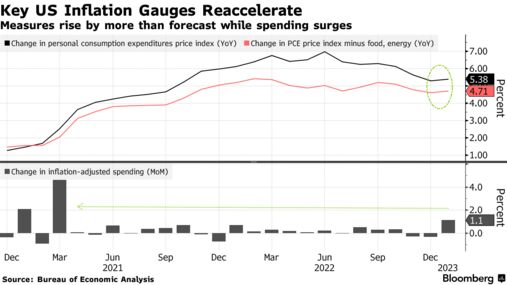
Fed’s preferred price index rose 5.4% in January, core up 4.7%
Inflation-adjusted consumer spending increased most since 2021
The Federal Reserve’s preferred inflation gauges unexpectedly accelerated in January and consumer spending surged after a year-end slump, adding pressure on policymakers to keep ratcheting up interest rates.The personal consumption expenditures price index rose 5.4% from a year earlier and the core metric was up 4.7%, both marking pickups after several months of declines. Consumer spending, adjusted for prices, jumped 1.1% from the prior month, the most in nearly two years, after consecutive declines. US stock futures fell and Treasury yields rose as traders firmed up bets that the Fed will raise interest rates by a quarter-point at each of the next three meetings. Investors also expect a higher terminal fed funds rate.
The resilient spending and stubborn inflation suggest that the Fed’s path to taming prices and demand will be bumpier and longer than data for late 2022 had previously indicated. While that could bolster policymakers’ resolve to raise borrowing costs higher than anticipated and keep them there for longer, it may increase risks of a recession. The PCE price index increased 0.6% from a month earlier, the most since June, Commerce Department data showed Friday. Excluding food and energy, the core PCE price index also climbed 0.6%. Both advances exceeded projections. Fed’s Preferred Inflation Gauge PCE up 5.4% year over year and core up 4%. NN:This was not suppose to happen. According to Wall Street the Fed was done. WRONG WRONG WRONG!! You got another year of FED tightening. And they will have to get FED FUNDS to over 6%.
Fatih Birol of the International Energy Agency issued a warning to the European Union in an interview with the Financial Times, urging Russia to speed up preparations for the upcoming heating season without any energy supplies. Biol claims that the EU has “moved mountains” and avoided a full-blown energy crisis largely as a result of its efforts to secure alternative supplies and mild weather, which has allowed gas storage to be fully stocked. allowed to do. The possibility that the members of the block will not be ready for the coming winter still remains. Russia tried to win with the Energy card, but failed. But to say that Europe has already won the energy war would be an exaggeration. Overconfidence is dangerous for the upcoming winter, and it is time to keep working for 2023.” Birol urged decision-makers to prioritize renewable energy and energy efficiency. Progress in reducing Russia’s revenue and promoting clean energy is commendable, but it is not a long-term fix. The pleasant weather has been helpful. Although we have got some time, which is important, there is still a lot to do. According to the expert, two factors pose significant threats to the energy security of the region. First, Russia could reduce the supply that is still flowing to the EU through a transit pipeline through Ukraine and Turkey, or about 20% of 2021 levels. Second, the reopening of China after COVID-19 could intensify competition for supplies of liquefied natural gas (LNG), on which Europe has become increasingly dependent over the past year. Both scenarios would make it harder to replenish supplies for the upcoming heating season, which could result in shortages, especially if the upcoming winter turns out to be much colder than the current one. Before the conflict that broke out in Ukraine nearly a year ago, the EU depended on Russia for almost half of its energy needs. However, gas flows have been steadily declining over the past year as a result of technical challenges such as Western sanctions against Russia and the sabotage of Russia’s Nord Stream pipelines in September, which rendered them inoperable.
After plunging for six straight sessions on economic growth concerns, oil prices have now gained over 2% on the back of indications that gasoline demand is starting to improve alongside a weekly decline in U.S. gasoline inventories.
On Thursday, the Energy Information Administration (EIA) released its weekly inventory report, showing that while crude oil inventory continued to rise for the ninth week in a row, gasoline inventory fell by 1.9 million barrels. Despite the crude oil inventory build, the gasoline inventory decline is driving oil prices upwards today, with gasoline demand expected to strengthen as we head out of winter and into higher driving seasons. Also driving oil prices higher are impending cuts to Russian oil output in March, along with indications that cuts could be greater than initially expected. Earlier in February, Russia announced it would slash production by 500,000 barrels per day in March, in retaliation for Western sanctions. On Wednesday, Reuters reported, citing unnamed sources, that Russia planned to cut crude exports from Western ports by one-quarter in March and April, which would suggest an apparent extension of the 500,000 bpd output cut. There was no official confirmation of the Reuters report. At the same time, a stronger dollar, along with continual rises in U.S. crude oil inventory, serve as counterbalances to rising prices.
Reuters cites UBS analysts as saying that a reduction in Russian oil output combined with China’s reopening should support higher prices despite a stronger dollar.
Russia will slash crude exports from western ports by one-quarter in March and April, expanding the 500,000 barrel-per-day cuts it announced for next month in apparent retaliation for Western sanctions, Citing three sources in the Russian oil market, Reuters says that the plan to cut exports by up to one-quarter from Western ports goes beyond the 500,000 bpd production cut planned for March. There is no confirmation of the reported 25% cut in exports from Western ports from Russian authorities, nor has Russia’s pipeline giant, Transneft, responded to Reuters’ requests for comment as of the time of writing. When Russia announced the 500,000 bpd production cut for March, markets were largely unshaken, despite the drop in Russian seaborne crude exports already in place at the time. Western sanctions are forcing Moscow to perform various oil market acrobatics, from output cuts and the creation of new pricing mechanisms for its flagship Urals crude to selling its crude to China and India at massive discounts. Russia’s original plans to cut production by 500,000 bpd in March would amount to 5% of Russia’s output or 0.5% of global production, based on Reuters data. Cutting from Western ports reflects the diversion of Russian crude to eastern markets, primarily Indian and China, but also Turkey. The rerouting, however, has hit snags with refined products, which have been under Western sanctions since February 5th. Western sanctions on December 5th and February 5th, along with the G7 price cap, are intended to reduce Putin’s access to oil revenues to finance his war against Ukraine.
OPEC revised up 2023 oil demand to 2.3 million barrels daily….. lEA oil demand a record high of 101.9 million barrels daily
In its latest Monthly Oil Market Report, OPEC revised its 2023 oil demand projections up to 2.3 million barrels daily earlier this week. That represented a 100,000-bpd change from last month’s forecast. Of this, 2 million bpd in demand growth will come from non-OECD countries, the oil group said. A day later, the International Energy Agency forecasted oil demand this year would hit a record high of 101.9 million barrels daily, rising by 2 million bpd from last year. The IEA’s upward revision was also to the tune of 100,000 bpd from last month’s projections. In China, the IEA said, demand for crude oil will rise by some 900,000 barrels daily. NN: do not let them make you an asshole…. $150 oil here we come!!
Chesapeake Energy will be slowing drilling for 2023 amid a sustained plunge in natural gas prices, with other operators following suit in the American shale patch. On Wednesday, Chesapeake said it would be pulling out three rigs this year, including two in the Haynesville shale and one in the Marcellus shale. Reuters cited Chesapeake CEO Nick Dell’Ossa as saying that it is “prudent” at this time to “pull back capital”, and warning that others appear to be of the same mind in Louisiana and east Texas. “We’re making money on the capital that we are investing but the margins are not nearly on a full cycle basis what they were historically,” he added, Reuters reported. For Chesapeake, the announcement that it will cut back on natural gas rigs comes as the company agrees to sell its South Texas oil assets to INEOS for $1.4 billion. On Tuesday, the U.S. benchmark natural gas price plunged by as much as 10% to its lowest level since September 2020 amid lower demand caused by milder winter weather conditions. After Tuesday’s slump, the gas price at the Henry Hub fell to a low of $2.043 per million British thermal units (MMBtu) early on Wednesday, before paring some of those additional losses later in the day. At 10:53 a.m. EST on Wednesday, Henry Hub prices were trading up 5.74% at 2.192; however, this is not enough to make up for a nearly 50% drop in prices since last summer. Oversupply is now driving lower prices and leading operators such as Chesapeake to pull back on rigs. In February, Comstock Resources Inc, an operator in the Haynesville Shale, said it would drop two of its nine natural gas rigs in the region, citing the plunge in natural gas prices. “In 2023, we will continue to derisk and delineate our western Haynesville play with a two-rig program in 2023 and we are managing our drilling activity to levels to prudently respond to the lower gas price environment we’ve had so far this year,” CEO Jay Allison said during a Q4 earnings call. NN: What most people do not understand about energy is the fact the lower the price goes the higher it goes. Allow me to explain. Oil is a very expensive risky business. As prices go lower oil companies stop drilling. And oil wells become quickly depleted so it takes a constant stream of new wells coming into prodction. But the problem is returns. Lower prices means more wells are not economically feasible. So the lower prices goes the less product comes to market. Faster then dropping demand. Demand drops production and therefore supplies drop. And up goes the price again. WHY? As Euro lefties are discovering you cannot survive without oil. Their is no alternative… not wind, not solar not even nukes….
Oil extended its longest run of losses this year ahead of the release of minutes from the Federal Reserve that may provide further clues on the path forward for monetary tightening in the US. West Texas Intermediate dipped near $76 a barrel after declining for a fifth session on Tuesday. The prospect of more aggressive interest-rate hikes from the Fed to quell inflation have kept a lid on prices, despite increasing evidence of a robust recovery in China following the end of Covid Zero The market has endured a bumpy ride this year as traders juggle concerns over a US slowdown and China’s rebound from virus curbs to try and determine the direction for global energy demand. That’s trapped futures within a range of around $10 a barrel as the bullish and bearish narratives clash. The fallout from sanctions on Russian crude and oil products, and the rerouting of global trade flows has added another element of uncertainty to the market. The US is planning more penalties, including on the nation’s energy sector. “Expectations for a more hawkish Fed continue to grow, which is providing strong headwinds to the oil market,” said Warren Patterson, the Singapore-based head of commodities strategy at ING Groep NV. However, the market is likely to tighten significantly over the second half of the year, which should see prices break out of the current range, he added. NN: Fed rate hikes are not a factor for oil demand. This is the latest spin jib. WHEN the US economy goes into a full blow recession 2 years from now MAYBE you will see US oil demenad stop increasing. We are talking about and should be concentrating on Chinese oil demeand. The Fed’s crises right now is the fact the US economy is NOT slowing. And demand for oil is INCREASING,,,,,,
Federal Reserve policymaker Jim Bullard argued on Wednesday that the United States economy turned out to be stronger compared to what the Fed and markets previously thought. Speaking for CNBC, Bullard noted that the Fed will likely have to push rates past 5% in order to tame inflation. The rates should peak at 5.375%, he estimated, insisting that the Fed should slow the pace of rate hikes only once it has hit the terminal rate. Turning to the labor market, Bullard stressed that the latest tech layoffs haven’t impaired the economy. However, the St. Louis Fed president asserted inflation could go down even with the strong employment numbers. The US economy will see a “moderately slow growth” in 2023 with inflation declining, he concluded.
Some Washington D.C. lawmakers want to limit Wall Street’s role in the housing market. In recent years, a small but mighty group of corporations bought hundreds of thousands of homes in sunbelt-region suburbs. These homes are traditionally a crucial investment for American families. But rising home prices are shutting would-be homebuyers out of the market. Meanwhile, financial groups are profiting from rising rents while their subsidiaries build small amounts of new standalone homes in the U.S. Since the early 2010s, Tricon Residential, Progress Residential, American Homes 4 Rent, Invitation Homes have each bought thousands of homes. They’ve also added to the housing supply in some cases with built-for-rent communities.Some of these companies are financed by private equity firms like Blackstone and investment managers like Pretium Partners. “It’s almost a captive market” said Jordan Ash, director of Labor-Jobs and Housing at the Private Equity Stakeholder Project. “They’ve been very explicit about how people are shut out of the homebuying market and are going to be perpetual renters.” These calls come after fierce housing inflation hit many Sun Belt states, including Texas, Florida and Georgia, according to the National Association of Realtors. By 2030, the institutions may hold some 7.6 million homes, or more than 40% of all single-family rentals on the market, according to the 2022 forecast by MetLife Investment Management. NN: Its far uglier then they are telling you. These bastards bought up the homes with damn near free money provided by the FED. But their is a day of reckoning. The 2 .5% mortgage is a thing of the past.. Replaced by the 7% soon to become 10% mortgage. So they bought at the top just in time for the next real estate bust.
Moscow’s invasion of Ukraine highlighted the role of fertilizers — and who controls them — as a strategic lever of global influence
“The role of fertilizer is as important as the role of seed in the country’s food security,” said Udai Shanker Awasthi, managing director and chief executive officer of the Indian Farmers Fertiliser Cooperative, the country’s largest producer. “If your stomach is full then you can defend your house, you can defend your borders, you can defend your economy.” Last year’s jolt to the $250 billion global fertilizer industry highlighted the role of Russia and Belarus as exporters of almost a quarter of all world crop nutrients. While Russia’s agricultural products including the three main types of fertilizer — potash, phosphate and nitrogen — are not targeted by sanctions, exports remain curtailed through a combination of disruptions to ports, shipping, banking and insurance. Russian fertilizer billionaire Andrey Melnichenko, the founder of EuroChem Group AG, argues the European Union’s sanctions regime has clogged up trade to such an extent that it’ll have caused a total curtailment of fertilizer shipments by some 13 million tons by the one-year mark of the war on Feb. 24. Melnichenko is himself subject to sanctions. It was Russian fertilizer caught in limbo in the Netherlands that was freed as part of a wider UN deal to allow grain transports via the Black Sea. The batch that began arriving in Malawi earlier in February was the first of several proposed shipments of fertilizer stranded in ports from the Baltic Sea to Belgium and “donated” by Russia’s Uralchem-Urakali Group. Uralchem is planning a handover ceremony with Malawi’s government to be attended by the Russian ambassador on March 6. The market disruption triggered a spike in prices last summer that led to stockpiling by those able to afford fertilizers, and while costs have since come down significantly, they remain above pre-pandemic levels. Supplies are constrained in poorer areas. The situation is exacerbated by sanctions on potash giant Belarus alongside the decision by China, a major producer of nitrogen and phosphate fertilizers, to impose restrictions on exports to protect domestic supply, curbs that analysts don’t see being lifted until the middle of 2023 at the earliest. The result has been an all-too familiar divide: Bloomberg Intelligence analyst Alexis Maxwell says that even though prices have fallen more than 50% from last year’s peak, farmers in Southeast Asia and Africa remain more exposed than their counterparts in North America, China or India. The African Development Bank has warned that curtailed use is likely to mean a 20% drop in food production, while the WFP sees smallholders in the developing world at risk of “a major food availability crisis as the fertilizer crunch, climate shocks and conflict upend food production.” Indonesian President Joko Widodo warned at the Group of 20 summit he hosted in November of “a more dismal year” ahead without immediate steps to ensure availability of affordable nutrients. Indian Prime Minister Narendra Modi, who now holds the G-20 chair, pledged to focus efforts to “depoliticize” global fertilizer supply, “so that geopolitical tensions do not lead to humanitarian crises,” he wrote in the Times of India in December. The geopolitical fallout is being felt as far away from Ukraine as Canada, the world’s biggest potash producer (Russia and Belarus are No. 2 and No. 3 respectively). Brazil’s agriculture minister traveled there immediately after the war’s outbreak to secure more shipments for the food-exporting superpower, while Prime Minister Justin Trudeau’s government has said it’s looking at increasing exports to Europe of “strategic commodities” including potash. Nutrien Ltd., the world’s largest fertilizer company and the biggest private employer in its home base of Saskatoon in Canada, is expanding production at its potash mines, helping fuel the city’s spread out into the great prairie lands of central Saskatchewan. BHP Group Ltd gave the green light to build its own massive potash mine in Saskatchewan about 18 months ago; it’s already looking at options to accelerate an expansion that would see total output double. Nutrien mines potash from a 400 million-year-old rock known as the Prairie Evaporite Formation at a depth of some 1,000 meters (3,280 feet). This far down, the heat is a stark contrast with the sub-zero temperatures outside in the Saskatchewan winter. The air has an ocean tang that comes from the high concentration of salt in the potash. Huge boring machines cut tunnels to extract the ore, which is moved by conveyors to underground storage areas, then taken to the surface and on-site mills. The US both produces fertilizer and is a major importer, and for now its farmers still have access to plenty of nutrients. That can’t be said of some of its neighbors. Latin America depends on imports for 83% of fertilizers applied, mostly from Russia, China and Belarus, according to the Washington-based International Food Policy Research Institute. President Vladimir Putin blames sanctions for the disruption in fertilizer supply from Russia, saying in late November that more than 400,000 tons were frozen in European ports. A portion of that amount has since been unfrozen and donated. The UN says the core problem lies with shipping insurers unwilling to cover Russian cargoes, and with key agriculture banks being unable to make financial transactions since they are disconnected from SWIFT. The EU and US issued a joint statement in November clarifying that “banks, insurers, shippers, and other actors can continue to bring Russian food and fertilizer to the world.” NN: China and Russia have jointly put a strangle hold on the worlds key commodities. Not just oil, but fertilizer, grains, strategic metals like cobalt and Lithium. That was while your leaders have decided its a matter of human rights that kids are raised gender fluid….. And the crises you face are global warming, or cooling… ozone holes that need to be plugged along with all mines and oil wells… good luck!
Billionaire investor and Berkshire Hathaway Vice Chairman Charlie Munger speaks at the Annual Shareholders Meeting of the Daily Journal Corporation. NN: Definitely someone worth listening to.