President Joe Biden declared the end of the pandemic, after nearly three years since the CDC confirmed the first coronavirus case in the United States. “The pandemic is over,” Biden said in an interview with CBS News’ Scott Pelley that aired on 60 Minutes Sunday. “We still have a problem with COVID,” the president continued. “We’re still doing a lot of work on it. But the pandemic is over.” Biden, 79, was speaking with Pelley following a visit together to the first Detroit Auto Show in three years, which the president attended to celebrate his help towards funding of charging stations for electric vehicles. “If you notice, no one’s wearing masks. Everybody seems to be in pretty good shape. And so I think it’s changing,” said Biden. “And I think this is a perfect example of it.” Coronavirus has lead to the death of more than 1 million people in the U.S., not to mention the social and economic impacts it has had across the population. The global pandemic was declared in March 2020, though the first COVID case in the US was reported in January 2020. Just last week, the World Health Organization reported a historic low in worldwide deaths, NBC News reported. The U.S. averages 478 COVID-related deaths a day — an increase from early July, when COVID deaths were at its lowest rate ever (168 daily deaths the week). “We have never been in a better position to end the pandemic,” WHO Director-General Tedros Adhanom Ghebreyesus said at a briefing Wednesday, NBC News reported. “We are not there yet, but the end is in sight.” Biden’s interview with 60 Minutes was conducted on Sept. 15, days before the president and First Lady Dr. Jill Biden traveled to the U.K. to visit the coffin of Queen Elizabeth II. The interview was Biden’s first on the broadcast as president. It was staged primarily in the Roosevelt Room of the White House (with a quick detour through the Oval Office), and served as a way to get candid responses from Biden about the state of affairs both abroad and at home, especially as he takes heat for rising prices that’ve strapped Americans thin. During a visit to 60 Minutes headquarters, PEOPLE got an exclusive first look at the stories in the works this season as they go into their historic 55th season. While explaining the topics he went in prepared to discuss with Biden, Pelley noted that his children — ages 27 and 30 — had not previously witnessed inflation like this in their lifetime, calling it “gravely disappointing” to see how severe it’s gotten. The two went on to discuss topics including Russia’s war on Ukraine, the midterm election in November, and running for office again. Asked if it’s normal to turn around such a high-profile interview in only three days, Pelley told PEOPLE it’s the standard for a story entwined with current events: “It needs to be right on the news.” NN: I would be not so ready to declare victory just yet. But Biden is on job won. Get his democratic associates elected in the November elections. And he has to score “victories” on inflation, energy prices and the epedimic…. real or imagines
A further 27% drop in the S&P 500 could be coming
The market is coming to terms that it’s not just that the U.S. Fed is going to be aggressive in September after the latest shocking U.S. inflation figure, still running at 40-year highs, but that the central bank will have to hike rates higher, and keep them high for longer, than many seem to have anticipated.
In a new note to clients, Goldman Sachs chief markets economist Dominic Wilson and global markets strategist Vickie Chang crunched the numbers on what it would mean if Fed has to take a more aggressive path than the market is forecasting.
The results are not great. If the Fed has to hit the economy hard enough to get the unemployment rate up to 5%, the S&P 500 would have to fall 14% to below 3,400, the yield on the 5-year note would have to rise 91 basis points, and the trade-weighted dollar would rise 4%.
In the more severe scenario where the jobless rate would have to hit 6%, the S&P 500 would fall 27%, to below 2,900, the yield on the 5-year Treasury would climb 182 basis points, and the dollar would rise 8%.
That severe scenario implies a tightening of financial conditions comparable to the global financial crisis of 2008, and before that the recessions of the early 1980s.
“If only a severe recession—and a sharper Fed response to deliver it—will tame inflation, then it is likely that the downside to both equities and government bonds could still be substantial, even after the damage that we have already seen,” said the strategists.
The latest U.S. inflation data sent the Dow plummeting 1,200 points: After drifting around aimlessly for far too long on the U.S.S. Transitory, the delusional Fed is laughably too little, too late. Catching up will be difficult. But, hey, good luck on that soft landing. In January, Interactive Brokers founder Thomas Peterffy said, “1% or 2% [in interest rate hikes] doesn’t mean anything. If they really wanted to stop inflation, they would have to raise rates to 4%, 5%, 6%.” The Fed’s current target interest rate range is 2.25% to 2.50%. NN: You have not seen shit yet. The biggest drops the stock market has ever seen is on the near horizon…. And IF IF IF IF IF we can time it right and NOT NOT NOT over leverage we could make a buck or two!! HOW COOL IS THAT!
Russia to replace Nord Stream 2 with pipeline to China
Moscow has announced that Nord Stream 2 will be “replaced” by an alternative gas pipeline to China. Power of Siberia 2, something Moscow and Beijing have discussed for several years, will take the place of Nord Stream 2, said Russian Energy Minister Alexander Novak on Thursday. Nordstream 2 is a proposed route for bringing Russian gas to Europe, particularly Germany. Construction of the controversial pipeline was completed in September 2021, though its certification was suspended following Russia’s invasion of Ukraine. Speaking on Russian state television, Novak was asked if the Asian pipeline could replace its European counterpart within Russia’s energy strategy — to which he replied “yes”. Earlier in the day, the minister indicated that Russia and China would soon sign a deal to deliver “50 billion cubic metres of gas” per year via the proposed Power of Siberia 2 pipeline. This volume represents almost the maximum capacity of Nord Stream 1 – 55 billion m³ in total – which has been shut down since September. Nord Stream 1, connecting Russia and Germany, used to carry around one-third of Russian gas deliveries to the European Union. Moscow wants Power of Siberia 2 to replace the shelved Nord Stream 2 pipeline, a project long supported by Germany, but which the United States took a very dim view of, over concerns about European dependence on Russian energy. Exports of gas from Russia will “drop by around 50 billion m³” in 2022, Novak added during Thursday’s interview. Meanwhile, the Russian energy minister said energy giant Gazprom is planning to “increase its deliveries” to China to “20 billion m³ of gas” each year. The connection at the beginning of 2023 of the Kovytka field, near Lake Baikal, to the Power of Siberia will contribute significantly to this increase. In 2025 — the year the pipeline will reach maximum capacity — more than 61 billion m³ of Russian gas will be carried to China. NN: It is really really stupid to assume Russian gas will not make it to market. If not the European market then China or South East Asia.
A Price Cap On Russian Oil Could Cause A Supply Catastrophe
- The G7 appears to be intent on implementing its price cap plan designed to reduce oil prices, reduce Russian revenues, and maintain a steady supply of Russian oil.
- In reality, there is a strong chance that the price cap would send oil prices soaring, with the risk that Russia retaliates by halting energy exports altogether.
- Russian oil will have to sail on non-Western tankers if it is to avoid the price cap, and there simply aren’t enough tankers available.
For weeks now, the G7 has been discussing exempting Russian oil from the maritime insurance and financing ban only if that oil is sold at or below a certain price that the group has yet to agree to. This would require a lot of coordination with EU, UK, and U.S.-based providers of maritime insurance and financing. But it would be the easiest part of implementing the price cap. Russia could intensify its already ongoing efforts to have non-Western tankers and insurers agree to ship Russian oil and products. Or Putin can simply make good on his promise to halt all energy supply – including crude, fuels, natural gas, and coal – to the countries that sign up to cap the price of Russian oil.
In any case, oil prices will likely go much higher as the EU embargo on Russian oil – which excludes oil sold at or below the price cap – enters into force at the end of this year.
Russia will continue selling its oil to Asian buyers such as India and China using non-Western fleets of tankers and maritime services while choking supply to the West. Russia is also expected to increase its covert oil exports, taking a leaf out of Iran’s playbook of below-the-radar exports by switching off transponders and/or hiding the origin of the oil, analysts say. Still, the non-Western fleet of tankers that Russia can rely on is not enough, Energy Intelligence’s John van Schaik and Emily Meredith write. If Russia refuses to use any maritime services associated with G7 countries, “Russian oil will have to sail on non-Western tankers – and there aren’t enough vessels to handle Russia’s millions of barrels,” they argue. “The result: less oil, higher prices, and less pain for Russia.” According to Energy Intelligence, Russian oil going to Asia from Russia’s Far East is already shipped there on Russian or Asian tankers. But Russia is estimated to be exporting 4.45 million barrels per day (bpd) from its ports in the Arctic, the Baltic Sea, and the Black Sea – and this is done mostly on EU-linked vessels. Finding tankers and insurance coverage not linked to the EU, the G7, or other countries that may join the price cap mechanism for that amount of oil could be next to impossible. The G7 reiterated in early September that they would finalize and implement “a comprehensive prohibition of services which enable maritime transportation of Russian-origin crude oil and petroleum products globally – the provision of such services would only be allowed if the oil and petroleum products are purchased at or below a price (‘the price cap’) determined by the broad coalition of countries adhering to and implementing the price cap.” In guidance on the upcoming price cap, the U.S. Department of the Treasury said last week that the price cap policy has three objectives: “maintain a reliable supply of seaborne Russian oil to the global market; reduce upward pressure on energy prices; and reduce the revenues the Russian Federation earns from oil after its own war of choice in Ukraine has inflated global energy prices.” While clever in theory, the price cap plan could actually lead to much higher oil prices because trade flows will be upended again, tankers are in short supply, and Russian oil exports – still remarkably resilient – would plunge, analysts say.
The global oil market will have to prepare itself for a loss of 2.4 million bpd supply when the EU embargo kicks in, the International Energy Agency (IEA) said in its Oil Market Report this week. An additional 1 million bpd of products and 1.4 million bpd of crude will have to find new homes, which could result in deeper declines in Russian oil exports and production. The IEA expects oil production in Russia to fall to 9.5 million bpd by February 2023, which would be a plunge of 1.9 million bpd compared to February 2022.
Then there is the very real threat from Putin to simply stop selling oil – and all other energy products – to countries that join the price cap on Russian oil. “We fully believe that Putin/Russia will follow through on this statement and curb exports rather than to accept any price cap regime. This will leave Russia with a severely reduced set of oil-clients and with a big problem of shipping it out,” Bjarne Schieldrop, chief analyst commodities at bank SEB, said earlier this week. “The price cap-regime which now seems close to a certainty will highly likely end up having a very, very bullish impact on oil prices,” Schieldrop added. Despite concerns on the demand side, due to China’s Covid lockdowns and a global economic slowdown, the price cap mechanism “could turn out to be catastrophic to supply and totally overshadow any demand weaknesses NN:
Year over Year PPI up 8.7% …. CPI up 8.3%
The Consumer Price Index (CPI) on Tuesday showed consumer inflation rose in August, as prices for most goods continued to climb.1 Headline inflation rose 0.1% in August, following an unchanged reading in July as costs for food, shelter, and medical expenses rose, while energy costs declined. Prices were up 8.3% from a year ago, decelerating from an 8.5% rate in July, but still near multi-decade highs and above economists’ expectations of 8.1%.
Core inflation, which excludes more volatile food and energy costs, rose 0.6% in August, up from July’s 0.3% gain. On an annual basis, the rate of core inflation accelerated to 6.3%, up from 5.9%.
- The CPI rose 0.1% in August, after being unchanged in July. Prices were up 8.3% year-over-year, down from 8.5% in July, but above analysts’ expectations of 8.1%.
- Core inflation rose 0.6% in August, and was up 6.3% year-over-year, accelerating from 5.9%.
- Gas prices declined 10.6% in August, while costs for food and other price categories continued to accelerate, with food inflation rising at the fastest annual rate since 1979.
- A hotter-than-expected inflation reading will likely strengthen the Fed’s case for more aggressive interest rate hikes.
Energy prices continued to decline, falling 5% in August. Gasoline prices fell 10.6%, driven lower by falling prices for crude oil and other energy commodities. Gas prices have fallen steeply from their peak levels in mid-June, with the national average price for a gallon of unleaded gasoline declining to $3.70, down from a peak of $5.02 on June 14, as reported by AAA.2 Costs continued to increase for other products, particularly food. Costs for food continued to accelerate, rising at an 11.4% annual rate—up from 10.9% in July and marking the highest rate of food inflation since 1979. Inflation for “food at home,” a category that includes groceries and other consumer staples, rose 13.5% year-over-year. By contrast, food away from home, which tracks prices at restaurants and other dining establishments, rose at an 8% annual rate. The report showing prices continue to rise will likely strengthen the Federal Reserve’s case for continued interest rate hikes. The Federal Open Market Committee (FOMC) will conduct its next monetary policy meeting on September 20-21, with markets increasingly pricing in a rate hike of 75 basis points (bps). NN: the only vote that counts is the FED Reserve. And i can assure you they do not see inflation moderating…… AND they are shitting bricks
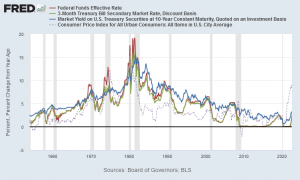
One Chart Worth Trillions of Dollars
Wall St tumbles to biggest loss in two years following CPI data
- U.S. consumer prices rise unexpectedly
- Likelihood grows of a 100 bp Fed rate hike in Sept
- Indexes slide: Dow 3.94%, S&P 4.32%, Nasdaq 5.16%
A broad sell-off sent U.S. stocks reeling on Tuesday after a hotter-than-expected inflation report dashed hopes that the Federal Reserve could relent and scale back its policy tightening in the coming months. All three major U.S. stock indexes veered sharply lower, snapping four-day winning streaks and notching their biggest one-day percentage drops since June 2020 during the throes of the COVID-19 pandemic. Surging risk-off sentiment pulled every major sector deep into negative territory, with interest-rate-sensitive tech and tech-adjacent market leaders, led by Apple Inc (AAPL.O), Microsoft Corp (MSFT.O) and Amazon.com Inc (AMZN.O) weighing heaviest. The Labor Department’s consumer price index (CPI) came in above consensus, interrupting a cooling trend and throwing cold water on hopes that the Federal Reserve could relent after September and ease up on its interest rate hikes. read more
Core CPI, which strips out volatile food and energy prices, increased more than expected, rising to 6.3% from 5.9% in July.
The report points to “very persistent inflation and that means the Fed is going to remain engaged and raise rates,” Nolte added. “And that’s an anathema to equities.” Financial markets have fully priced in an interest rate hike of at least 75 basis points at the conclusion of the FOMC’s policy meeting next week, with a 32% probability of a super-sized, full-percentage-point increase to the Fed funds target rate, according to CME’s FedWatch tool. “The Fed has increased (interest rates) by three full percentage points in the last six months,” Nolte said. “We have not yet felt the full impact of all those increases. But we will feel it.” Worries persist that a prolonged period of policy tightening from the Fed could tip the economy over the brink of recession. The inversion of yields on two- and 10-year Treasury notes, regarded as a red flag of impending recession, widened further. The Dow Jones Industrial Average (.DJI) fell 1,276.37 points, or 3.94%, to 31,104.97, the S&P 500 (.SPX) lost 177.72 points, or 4.32%, to 3,932.69 and the Nasdaq Composite (.IXIC) dropped 632.84 points, or 5.16%, to 11,633.57. All 11 major sectors of the S&P 500 ended the session deep in red territory. Communications services (.SPLRCL), consumer discretionary (.SPLRCD) and tech (.SPLRCT) shares all plummeted more than 5%, while the tech subset semiconductor sector (.SOX) sank 6.2%. Declining issues outnumbered advancing ones on the NYSE by a 7.76-to-1 ratio; on Nasdaq, a 3.64-to-1 ratio favored decliners. The S&P 500 posted 1 new 52-week high and 16 new lows; the Nasdaq Composite recorded 29 new highs and 163 new lows. Volume on U.S. exchanges was 11.58 billion shares, compared with the 10.33 billion average over the last 20 trading days. NN: This was a major sell off. Among the top ten daily drops i have ever seen. As you recall we had you take profits on your shorts and stand aside for the rally back. Once the marker started crashing again we advised to go back in on the sell side. It is our belief the market will put in new lower lows, Of course i could be full of shit and wrong…… So roll the dice and piss away your money…..
Why Europe Won’t Exploit Its Huge Gas Reserves
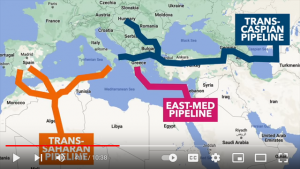
- Estimates show that Europe has more recoverable shale gas than the U.S.
- Despite its huge
- gas reserves, hydraulic fracturing has many opponents in Europe.
- Fracking in Europe has long been a contentious issue because of population density.
As energy prices continue to soar across Europe, with gas prices surging 26% on Monday after Russia stopped pumping via Nord Stream 1, the highly contentious fracking debate is now re-emerging on the continent, led by a new British prime minister with fossil fuels on her mind. The European Union–which no longer includes the UK–plans to replace two-thirds of Russian gas imports by the end of the year, though analysts warn that the bloc’s best shot at replacing Russian gas imports will fall well short of the target. In 2021, the EU imported ~155 billion cubic meters (bcm) of natural gas from Russia. Unfortunately, the bloc’s proposed gas replacements by the end of 2022–which include LNG (liquefied natural gas) diversification, renewables, heating efficiency, pipeline diversification, biomethane, solar rooftops and heat pumps–only amount to around 102 bcm annually, according to data from the EU Commission’s REPowerEU. Proponents of fracking hold that Europe’s shale gas potential is needed now more than ever, though Germany, France, the Netherlands, Scotland and Bulgaria have all previously banned fracking. Now, the debate is being revived by recent moves in the UK. Britain’s new Prime Minister Liz Truss has announced that the UK is lifting a 2019 moratorium on shale gas fracking as the country looks to ramp up domestic energy resources and help households and businesses struggling to pay soaring energy bills. The lifting of the fracking ban comes just three years after the government ended its support for fracking after the authority supervising the oil and gas industry determined that “it is not possible with current technology to accurately predict the probability of tremors associated with fracking.” Britain owns just two shale gas wells in Lancashire operated by Cuadrilla Resources. Cuadrilla CEO Francis Egan has welcomed the lifting of the ban, saying: “This is an entirely sensible decision and recognises that maximizing the UK’s domestic energy supply is vital if we are going to overcome the ongoing energy crisis and reduce the risk of it recurring in the future. Without the strong measures set out today, the UK was set to import over two thirds of its gas by the end of the decade, exposing the British public and businesses to further risk of supply shortage and price hikes down the line.”
Despite its desperation, the rest of Europe is unlikely to follow–even if the revival of the debate has reignited talk of just how much shale potential Europe has, and why it’s not being tapped into.
Shale Gas In Europe
Europe has more recoverable shale gas than the U.S., according to estimates. However, the only major fracking activity is in Ukraine, which managed to wean itself off of Russian gas years ago.

Fracking in Europe has long been a contentious issue because of population density, in large part. This isn’t North America. In 2016, Cuadrilla Resources won permission to frack as many as four wells in the UK, putting an end to years’ long battles with local authorities. Five years prior, the company had been forced to cease drilling after the government placed a one-year moratorium on fracking due to tremors caused by an exploratory Cuadrilla rig in northwestern England. In 2013, the company’s drilling activity was disrupted again after hundreds of protesters camped in a tiny village south of London and forced it to abandon its wells. Meanwhile, in 2012, protesters in Zurawlow, a town in eastern Poland, successfully blockaded a fracking site while Greenpeace activists occupied a shale gas rig in Denmark. Strong public opposition–along with tax concerns, regulatory delays, and poor output from a handful of test wells–drove away investors. Exxon Mobil (NYSE: XOM), Chevron (NYSE: CVX) and TotalEnergies (NYSE: TTE) were forced to abandon projects in Poland after exploration proved disappointing. Poor gas flows also halted progress in Denmark, with Total ditching shale gas drilling there. The big problem with fracking in Europe is that some of the conditions that fueled the U.S. shale boom don’t exist in Europe. In most countries, it’s the state, and not private landowners, that owns the mineral rights to oil and gas in the ground. Contrast that with the U.S. where landowner’s cut can be as much as an eighth of production revenue. This in effect means that fracking does not yield big financial rewards for European landowners. To garner more public support for the technology, the British government and some companies have previously proposed direct payments to people affected by fracking. However, environmental groups have strongly opposed the move, terming such payments as bribes. The situation is not helped by the fact that the population density in Europe is more than 3x that in the United States, fueling not-in-my-backyard protests. For instance, many rural projects have in the past been rejected because they would bring trucks and equipment used for fracking onto picturesque roads dating back to Roman times. Indeed, Gazprom has previously said that the difficulty in finding unpopulated land in Europe and enough water to exploit shale wells will help Russian gas stay competitive. Even better for Russia: it can produce gas for about a sixth of the break-even cost for U.K. shale. Even after decades of fracking in the U.S. many Europeans still view the technique as untested. It’s going to be interesting to see whether record high energy prices will finally convince Europeans to change their minds about shale gas fracking. Several European nations have already backed down and returned to burning coal at record levels to keep their power grids alive thus reneging on their climate goals. NN: Maybe they want a energy crises…. Think about it!
Russia ready to start Nord Stream 2 anytime – envoy
Russian President Vladimir Putin said that Moscow “is ready” to open the Nord Stream 2 gas pipeline after the indefinite closure of Nord Stream 1 due, according to the Russian version, to problems of oil leaks. During his attendance at the Eastern Economic Forum, the Russian president stated that the start-up of Nord Stream 2, one of the ways to increase gas supplies to Europe, depends on “appropriate technologies”, mechanisms that Moscow assures has already developed, according to the TASS news agency. Likewise, he has emphasized that it is only necessary to “press a button” to open this gas pipeline. Putin has also explained that the German firm Siemens “does not respond to Gazprom’s requests” in the framework of the dispute over the damaged turbine in recent months. It must be remembered that the Russian giant announced the indefinite closure of the Nord Stream 1 gas pipeline after an oil leak was detected, according to the Russian version, during maintenance work on the only turbine that was still active. Due to the dispute between the German firm Siemens, manufacturer of the turbine supposedly damaged in the gas pipeline, and the Russian gas company Gazprom, some German politicians, such as the Vice President of Parliament, Wolfgang Kubicki, chose to ask Russia to open the Nord Stream 2 before the cuts of the Nord Stream 1, now closed indefinitely.
However, the German government coalition made up of the Social Democratic Party (SPD), the Free Democratic Party (PDL) and the Greens distanced themselves from these requests. Even Ukrainian Foreign Minister Dimitro Kuleba called on Germany not to become “addicted” to Russian gas. NB: Germany cannot become addicted to Russian gas because it already is hopelessly Putin’s bitch at least for now
On the other hand, Putin has stressed that Russia has no problem “selling its energy resources to the world”, given its “excellent” relationship with China, while, on the other hand, the European market has changed “very quickly” and has stopped be “premium”. “The demand (for energy resources) is so great in world markets that we have no problems with implementation,” the Russian president commented, adding that Russia’s “agreements” with different countries are “stable.” In this regard, he stressed that the Power of Siberia gas pipeline, which works thanks to Moscow’s agreement with the China National Petroleum Corporation (CNPC), “is working at full capacity.” Putin has also advanced that “all the main parameters” have been agreed with Beijing to expand the gas pipeline to countries such as Mongolia. Russia sells to China gas from fields in eastern Siberia, which are not connected to its gas pipelines to the west, although Gazprom is working on the construction of an interconnector that in the future could allow it to redirect gas from its European neighbors to new clients in Asia.
US may sanction non-compliance with oil price cap
The US Treasury issued rough compliance guidelines on Friday for its proposed cap on the price of Russian oil, focusing on the documentation needed by the private sector to comply with the program. The guidance, issued by the Treasury’s Office of Foreign Assets Control, gives private companies the task of enforcing the cap by seeking certification that Russian oil is sold at or below a price set by the US along with other Group of Seven members. The guidance is aimed at the insurance companies and financial firms that facilitate the international oil trade. The cap is meant to be in place by the Dec. 5 for crude oil, and Feb. 5 for petroleum products, in line with the implementation of the European Union’s ban on services associated with seaborne oil and refined products. The program “will rely on a record keeping and attestation process that allows each party in the supply chain of seaborne Russian oil to demonstrate or confirm that oil has been purchased at or below the price cap,” OFAC said in the statement, adding the following details:
- “Actors who regularly have direct access to price information in the ordinary course of business, such as commodities brokers and refiners, should retain and share, as needed, documents that show that seaborne Russian oil was purchased at or below the price cap”
- Firms who don’t have direct access to pricing information should request that, and if they cannot obtain price information “should request customer attestations in which the customer commits to not purchase seaborne Russian oil above the price cap”
“This record keeping and attestation process is designed to create a ‘safe harbor’ for service providers from liability for breach of sanctions,” OFAC said. The statement also warned service providers to watch for certain “red flags” indicating possible violations of the price cap, including the refusal or reluctance to provide price information, unusually favorable payment terms and indications of manipulated shipping documents. The guidance came hours after officials said Russia would have an economic incentive to participate. Treasury Deputy Secretary Wally Adeyemo on Friday highlighted that European Union and G-7 countries account for 90% of global shipping insurance, along with the majority of financing and payments services for the market. He also said the G-7 is working to make it straight-forward for companies to comply with the oil-priced cap, while also impose consequences if they seek to get around it. His Treasury colleague Ben Harris said, “We absolutely need the cooperation of the private sector in order to facilitate this trade.” NN: Wanna know the hell of all this. The US, UK and EU have all the oil, gas and nuclear energy they will ever need. In other words all this suffering is because the powers that be have decided not to exploit existing resources. In the case of natural gas is the lowest polluting of all fossil fuels. And Nuclear reactors are carbon neutral. Instead they are forcing massive inflation on their populations demanding renewable solutions that are proven not to be able to supply the energy the world uses.