United Kingdom Foreign Secretary Yvette Cooper told reporters in France on Friday that the Group of Seven (G7) foreign ministers have gathered to discuss how to resolve the issue of the Strait of Hormuz. “Iran cannot be able to just hold the global economy hostage,” she commented, further adding that the Strait must be reopened and that international shipping must be protected. Cooper went on to say that London is “deeply concerned” about the Russia-Iran ties, especially when it comes to exchanging weapons.
Two More Months of War Could Send Oil to $200
Oil prices could hit a record $200 per barrel if the war in the Middle East drags on through the entire second quarter, analysts at Macquarie Group have warned. The odds of the Iran war dragging on until June were put at 40% by the analysts in a note carried by Bloomberg. But the scenario of the war ending by the end of March currently appears more plausible, with odds at 60%, according to Macquarie.
“If the strait were to stay closed for an extended period, prices would need to move high enough to destroy an historically large amount of global oil demand,” Macquarie’s analysts wrote in the report.
“The timing of the re-opening of the straits, and physical damage to energy infrastructure, is the main determinant of the longer-term impact on commodities,” they added.
Many other analysts warn that if the Strait of Hormuz, which is already closed to most tanker traffic for nearly a month, remains blocked for another month or two, oil prices could jump to as high as $150 and even $200 per barrel, forcing a global economic shock. Analysts started expressing views that $200 oil is not a fantasy anymore—with 20% of global oil supply choked at the Strait of Hormuz buyers are racing to procure physical cargoes, refiners in Asia consider cutting processing rates, and Asian countries restrict fuel exports.
Andrew Harbourne, Wood Mackenzie’s senior analyst for oil markets, notes that the record 400-million-barrel release coordinated by the International Energy Agency (IEA) will cover only about four weeks of disruption in the Gulf.
“Strategic stocks remain an effective emergency buffer, but they are a one-off intervention that must eventually be rebuilt and cannot cover a sustained supply gap,” Harbourne added. Supply shocks in the past suggest that if the war and the disruption in the Strait of Hormuz persist, Brent crude prices could surge to $150 to $200 per barrel. For some petroleum products, such as diesel and jet fuel, the effective prices could be $200 to $250 a barrel or more, according to WoodMac.
NN: Enjoy!
The Iran War Is All About the Future of Hormuz
If Iranian leaders are, as Donald Trump says, “begging” him for terms to end the war, they have a very odd way of showing it. The negotiations he announced to soothe markets at the start of the week amounted to an exchange of demands that neither side could expect the other to accept. Factor in what both are actually doing — the US deploying a small ground force to the Persian Gulf and Iran legislating to turn the Strait of Hormuz into a permanent toll booth — and it seems we are in for a longer conflict. A lot has been said, including by some of America’s most storied generals, about how the US administration went into this fight: over-confident in its conventional military advantage, over-reliant on airpower and fundamentally misunderstanding the nature and asymmetric strengths of its enemy. As a result, it now has few good options. At this juncture, though, it’s probably more important to understand how the Iranians view their situation. And judging by the response Tehran sent to Trump’s 15-point peace offer, Iranian leaders believe they’re in a stronger position to see this out — and they don’t trust Trump enough for a quick settlement to be feasible, anyhow. Both Iranian beliefs are well-founded. From what we know of Trump’s 15-point peace proposal, it offers to end air strikes and lift sanctions in exchange for Tehran returning the Strait of Hormuz to its status as open seas; ending and demolishing its entire uranium enrichment program, civilian or otherwise; opening up to inspections that achieve complete transparency; accepting limits on the numbers and types of ballistic missiles it can have, configured for defense only; and ending all support for proxy militias abroad. In other words, it demands the capitulation the Iranians refused to accept in talks before the US and Israel launched air strikes on Feb. 28, but with the additional requirement that it reopen Hormuz, which became a problem in need of a solution only because of the war. The regime would accept such terms only if it had no hope of survival, which is not the case. The Iranians shot back with five conditions they say the US must meet before it will talk. These consisted of a halt to all US-Israeli hostilities against Iran, including assassinations; a halt to attacks on its regional proxies; concrete guarantees that none of these hostilities are renewed; war reparations; and — the big one — international recognition of Iran’s sovereign control over Hormuz. Yes, these are starting positions. On Thursday, Trump extended his ultimatum threatening to bomb Iran’s energy infrastructure by a further 10 days. He said this was due to an Iranian request, and that talks were going “very well.” That’s all conceivable, but also uncorroborated and unlikely to produce a result so long as both sides believe they have the upper hand, which it seems they do. It’s pretty clear why Trump would think so. He’s apparently getting a two-minute daily video that shows him the things the US blew up in Iran the day before. The combined American-Israeli force has sunk Iran’s conventional navy, destroyed much of its missile launching and manufacturing capacity and decapitated the Islamic Republic’s leadership. At least 7,000 Marines and troops from the 82nd Airborne are on their way to the Gulf to add some of the missing land dimension to US airpower. The Iranian case is more complex and militarily weaker, but it has a clearer path to strategic success. The most commonly cited aspect of this asymmetrical advantage is that all the Islamic Republic needs to do to win this war is to survive it, a low bar against airpower alone. Harder for outsiders to grasp is that the two US attacks on Iran — in June and again now — have also resolved a decades-long debate between regime hardliners and pragmatists as to whether the US was trustworthy enough to make normalization worth pursuing. It has also ended tactical restraint over issues such as closing Hormuz. Trump’s talk of a negotiation and potential deal is nothing more than a “a new deception — larger than the previous two.” That’s a reference to the nuclear negotiations that were underway both times the US struck. Second, that the Iranian leaders believe this US sleight of hand aims to obscure “the execution, within the coming days, of a major and decisive military operation against Iran in the Persian Gulf — an amphibious operation accompanied by heavy strikes on Iran’s infrastructure in the southern regions.” And finally, that the US was pressured into this war by Israel and the Gulf states, which collectively seek the “complete destruction of Iran,” making this an existential fight for Tehran. Once institutionalized, running Hormuz would allow the Iranians to turn it into a cash machine, tolling not just the ships that carry the 25% of the world’s seaborne oil and 20% of its liquid natural gas trade, but also the many other products that the Gulf states export via the strait. Germany’s Kiel Institute recently listed the top 50 products other than crude oil and LNG that passed through Hormuz in 2024, finding that they accounted for a cumulative $773 billion in value and an average 14.9% of total global exports for each product category.
Passing Hormuz
Share of global exports crossing the Strait in 2024
Before the war, the Iranian regime was bankrupt, out of ideas on how to fix the economy and under pressure from a furious population it could control only by jailing or killing them. Hormuz represents a potential route to its longer-term survival. That is not the kind of regime change Trump was hoping for. It’s also a potential precedent for other choke points, including the Red Sea or the Strait of Malacca. Tehran has discovered in Hormuz a geopolitical tool and deterrent far more powerful than its network of proxies, and more exploitable than owning a nuclear arsenal. The ability to choose which ships to let through and which to block, overcharge or detain for alleged safety violations would give Tehran enormous leverage and, in the process, upend a key pillar of the American century: the freedom of navigation that the US Navy guaranteed for its own economic benefit and that of its trading partners. This is why Tehran’s Majlis, or parliament, is rushing through wartime legislation to write a unilaterally claimed sovereignty over the strait into Iranian law. So transformative would this change be that the issue almost guarantees the conflict’s escalation until it gets resolved. That can come through force, as Trump again threatened on Thursday, or through the kinds of negotiated tradeoffs that Trump would be loathe to make, because they’d look so very much like defeat.
UAE demands the use of force to reopen Strait of Hormuz
The United Arab Emirates (UAE) is pushing for a multinational force to secure and reopen the Strait of Hormuz, the Financial Times reported on Friday, citing three people familiar with the matter. Officials said Abu Dhabi is urging allies, including the United States, to form a broad coalition to escort vessels and ensure safe passage, with the UAE ready to contribute its navy. “The focus is on creating as broad an international force as possible,” a source said, adding that the goal is not escalation but restoring global trade flows. The country is also working with Bahrain on a United Nations Security Council resolution to provide the mission with a mandate, though Russia and China could oppose the move, according to one of the sources. Meanwhile, Gulf states and Washington increasingly see naval escorts as necessary, while the White House said there is no timeline for tanker traffic.
NN: The world cannot allow Oran to control the Straights. On the other hand its the last card Iran has to play. This will be a big shit. Watch as oil tanker go up in flames.
Oil jumps over 5% after Trump’s comments on Iran
Crude oil prices continued to grow on Thursday, rising by more than 5% after United States President Donald Trump said that his country may not be “willing” to make a deal with Iran anymore, even though they are “begging” for one. He also noted that Washington has other targets it wants to hit in Iran “before leaving,” and that seizing the Middle Eastern country’s oil is “an option.” The US president’s comments followed reports that Iran sent their official response to the American 15-point peace plan to Washington through intermediaries, and that Tehran views Trump’s five-day deadline for reaching a deal as “a new Trump deception.”
West Texas Intermediate (WTI) for May’s deliveries jumped by 5.4% to go for $95.20 per barrel at 12:33 pm ET. Meanwhile, Brent for the same month’s settlements soared by 6.51% and went for $108.87 per barrel at 12:33 pm ET.
Blackrock Oil may still spike to $150 a barrel
BlackRock Inc. President Rob Kapito said investors may be underestimating the risks stemming from the Iran war, which are likely to weigh on growth and drive inflation higher even if the conflict ends soon. Growth could be hit by as much as two percentage points, while inflation may rise by a similar margin even if the war ends shortly, warned Kapito at the Asia Pacific Financial and Innovation Symposium in Melbourne on Thursday.
Oil may still spike to $150 a barrel even “if we announce tomorrow the war is over,” as it would take time for disrupted supply chains to return to full capacity.
“What if this disruption is a week, six months, a year — what is it going to mean for the companies that I own?” Kapito said. “My biggest concern is that people aren’t looking at this – they’re just making the assumption” for an optimistic outcome. The S&P 500 index of US stocks has fallen less than 5% since the war began almost a month ago, while some defensive trades have misfired. Gold has fallen almost 15%, and Treasuries — which typically offer portfolio ballast — have declined as rising oil prices trigger inflation concerns.
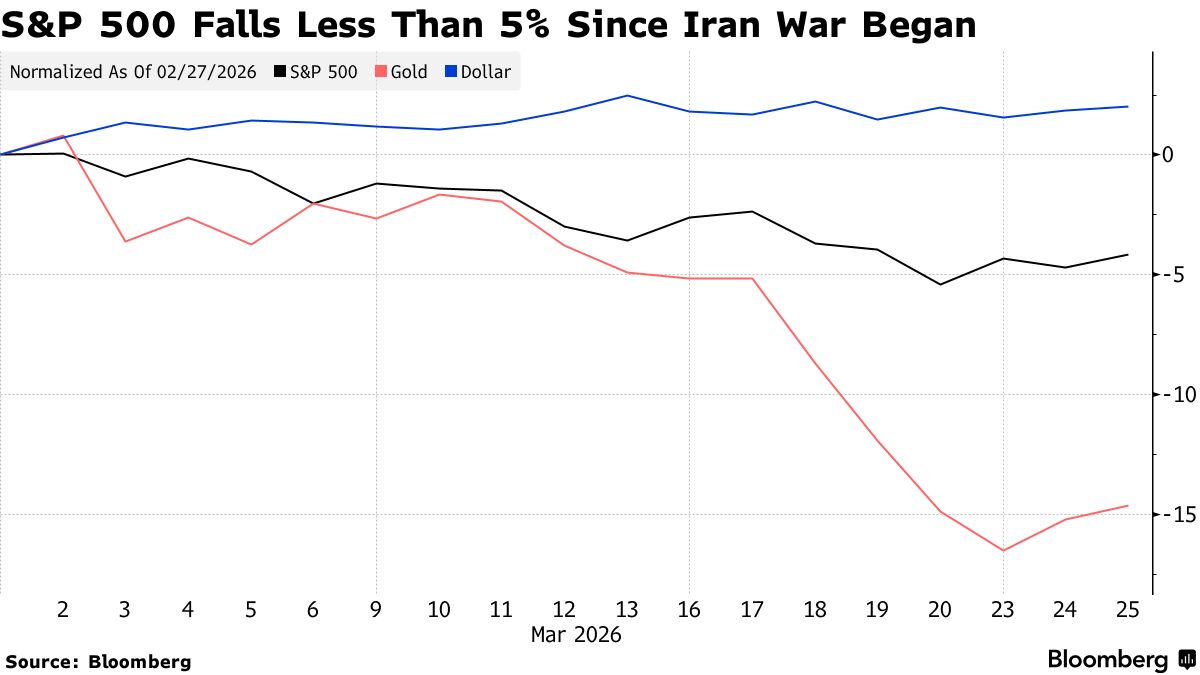
In the past, “when there was a conflict like this, you bought short-term Treasuries, you bought gold and you shorted the equity market,” Kapito said, highlighting the uneven market response to the war. At the same event in Melbourne, Apollo Global Management’s President Jim Zelter also cautioned about a heightened risk of a US recession and to the credit cycle from a prolonged conflict. The warnings highlight growing concern that markets are too complacent about the economic fallout from the conflict, particularly the potential for prolonged disruptions to energy and shipping that may ripple across global supply chains. Zelter said US consumers who have been a bulwark of the economy for the last few years are already showing signs of distress. Consumer confidence in the first two months of the year had been waning, and higher oil prices will cause further pain to their pockets, he added. “It’s not really a rates shock, it’s a confidence shock on spending in the largest economy in the world,” Zelter said. Despite the prospect of slower growth and higher inflation linked to the war, Kapito said he remains upbeat over the long term, citing themes such as AI and the rise of private markets as key tailwinds for investors.
Trump says Iran must get serious on deal
United States President Donald Trump said on Thursday that Iranian negotiators were “begging” for a deal with Washington. In a post on Truth Social, Trump described the Iranian side as “very different” and “strange”.
“They better get serious soon, before it is too late, because once that happens, there is NO TURNING BACK, and it won’t be pretty,” he added.
The remarks came as reports emerged that the United States was considering other military options, further pressuring the talks.
US said to review more Iran war options, including bombing
The United States Department of Defense is discussing new options for dealing the “final blow” to Iran, including deploying ground forces there and launching a high-pressure bombing campaign, Axios reported on Thursday. According to two US officials and two other sources familiar with the matter, such moves will become more likely if the latest effort to have Washington and Tehran negotiate fails. US President Donald Trump insisted that the talks are ongoing on the proposed 15-point plan for Iran’s nuclear status, while the other side dismissed such claims. Trump later said that the Iranian leadership is “afraid to say it because they figure they’ll be killed by their own people.” The outlet’s sources now said that potential options for intensifying pressure on Iran were discussed during a Zoom meeting. However, they pointed out that all the prospects are still “hypothetical” and that Trump has not decided on going for either of them yet.

NN: Shit I can’t decide lets do all 4
Gold down 2%, silver dips 3%

The price of precious metals fell on Thursday as investors awaited clearer evidence of progress in efforts to ease tensions in the Middle East. Financial markets remained uneasy due to conflicting statements from the US and Iran over possible peace negotiations. Washington claimed Iran was desperate to reach an agreement, while ordering the deployment of thousands of troops to the Middle East, contradicting the Iranian foreign minister, who claimed his country had no intention of holding talks to end the conflict and instead set its own conditions, including sovereign control over the Strait of Hormuz.
Gold lost 2% at 7:15 am CET, going for $4,416.14 per ounce, while silver fell by 3.01% and went for $69.13 per ounce a minute later. Platinum dropped by 1.09% at 7:16 am CET to go for $1,918.74 per ounce, while palladium lost 0.76% to sell for $1,398.57 per ounce.
NN: I sure hope you get in on our great precious metals short trade
Oil up 2% as war de-escalation hopes fade
Crude oil prices rose on Thursday amid conflicting signals and fading hopes of de-escalation in the Middle East conflict, following Iran’s dismissal of US President Donald Trump’s claim that the sides were holding talks to end the conflict.
West Texas Intermediate (WTI) for settlements in May climbed by 2.21% to go for $92.27 per barrel at 2:28 am ET. Meanwhile, Brent for the same month’s deliveries advanced by 2.27% and went for $104.39 per barrel at 2:27 am ET.