The annual inflation in the United States decreased to 8.5% in July, the Labor Statistics Bureau revealed in its report on Wednesday. Month on month, the Consumer Price Index (CPI) was unchanged compared to June. The gasoline and energy indexes fell 7.7% and 4.6% in July. Meanwhile, the food index kept rising, gaining 1.1% monthly, while the food at home index increased by 1.3%. The core CPI, which excludes food and energy, was up 5.9% in July on an annual basis. On a monthly basis, the figure grew 0.3% in July. NN: You are now seeing market insanity… They are celebrating inflation at 8.5%. I hasten to remind you the FEDS target is2.5% and if i round up Feds Funds are close to 3%. Which means the FED has got to get their rate to 8.5% at least. A 5% increase… In fact as i looked at the numbers i put the cork back in the bottle and put the Champaign back in the fridge. Core inflation was up a ass kicking 5.9%… certainly no joy here…..
Don’t be fooled by a drop in U.S. headline inflation. Markets will be attuned to another figure on Wednesday.
Traders, investors and economists are all counting on Wednesday’s consumer-price index report to show a decline in the annual headline U.S. inflation rate for July. But there’s another figure buried in the consumer-price index data that has the propensity to jolt markets.
It’s called the core year-over-year CPI reading, a measure which strips out volatile food and energy costs. It came in at 5.9% for the 12 months that ended in June, and the consensus view is that it will inch up to 6.1% on a year-over-year basis for July.
Gargi Chaudhuri of BlackRock Inc., the world’s largest money manager, sees the core reading coming in even a bit higher, at 6.2%, while a pair of Goldman Sachs analysts are warning that the near-term U.S. inflation picture “is likely to remain uncomfortably high.” A move higher in the annual CPI core rate would be significant because it would be seen as reflecting the true underlying trend of inflation — while also dashing widespread hopes in financial markets over the past month that price gains have peaked. Many traders and investors have generally been clinging to the overall annual headline CPI rate for July, which includes food and energy — and the view that it probably fell to 8.7% or 8.8%, from an almost 41-year high of 9.1% in June, after factoring in recent declines in gas and commodity prices. “The outlook for inflation remains the primary concern for investors,” Wilmington Trust Investment Advisors’ Chief Investment Officer Tony Roth and Chief Economist Luke Tilley wrote in an email on Tuesday. “Persistent inflation is weighing on sentiment for consumers and businesses, yet economic data remains quite mixed and concerns are elevated that aggressive Fed policy could push the U.S. into recession.” “While we still expect inflation to decelerate going forward, some components will remain stubbornly high and complicate the outlook,” they said.
Signs of the financial market’s broad-based expectations that inflation is poised to ease are abundant: U.S. stocks have generally rallied from their lows in mid-June, though they finished lower on Tuesday. Meanwhile, medium- and long-term Treasury yields have dropped from their peaks in June — along with break-even rates, according to Tradeweb data. NN: I am placing a big (some would say also stupid) bet that core inflation continues to soar. This TEMPORARY reprieve in energy price will help the head line number in todays CPI report. I would like to think that institutional traders with trillions of dollars of other peoples money will at least read the first page of today’s release… Unfortunately with the people manning the trades desks, that are more interested in weddings, beach parties and where the warehouse is for tonight’s rave party… Like many generations of losers before them that caused depressions they will suffer greatly. The millennials who got everything will soon have nothing…. I can’t wait, to tell the truth i plan to help them wipe out….
FBI searches Trump’s Mar-a-Lago home, apparently part of probe into alleged removal of classified records……. Pence concerned about search of Trump’s home……. Judge who OK’d Mar-a-Lago raid Obama donor once linked to Jeffrey Epstein
NB: This is a long story. I strive to make my news posting brief and concise. In this case their is a lot to report. This GUARANTEES THE REPUBLICAN SWEEP IN THE FALL ELECTIONS. taking both the the house and senate by wide majorities in the house
WASHINGTON — The FBI searched Donald Trump’s Mar-a-Lago estate as part of an investigation into whether he took classified records from the White House to his Florida residence, people familiar with the matter said Monday, a move that represents a dramatic and unprecedented escalation of law enforcement scrutiny of the former president. Trump, disclosing the search in a lengthy statement, asserted that agents had opened up a safe at his home and described their work as an “unannounced raid” that he likened to “prosecutorial misconduct.” The search intensifies the months-long probe into how classified documents ended up in more than a dozen boxes located at Mar-a-Lago earlier this year. It occurs amid a separate grand jury investigation into efforts to overturn the results of the 2020 presidential election and adds to the potential legal peril for Trump as he lays the groundwork for another run. Familiar battle lines, forged during a a four-year presidency shadowed by FBI and congressional investigations, quickly took shape again Monday night. Trump and his allies sought to cast the search as a weaponization of the criminal justice system and a Democratic-driven effort to keep him from winning another term in 2024 — even though the Biden White House said it had no prior knowledge of it, and the current FBI director, Christopher Wray, was appointed by Trump five years ago and served as a high-ranking official in a Republican-led Justice Department. “These are dark times for our Nation, as my beautiful home, Mar-A-Lago in Palm Beach, Florida, is currently under siege, raided, and occupied by a large group of FBI agents,” Trump wrote. “Nothing like this has ever happened to a President of the United States before.” “After working and cooperating with the relevant Government agencies, this unannounced raid on my home was not necessary or appropriate,” Continue reading “FBI searches Trump’s Mar-a-Lago home, apparently part of probe into alleged removal of classified records……. Pence concerned about search of Trump’s home……. Judge who OK’d Mar-a-Lago raid Obama donor once linked to Jeffrey Epstein”
Big Bet….. Stock Market MAY Crash this month……
The pace of the stock market’s rise as it continues a bounce off the June lows is nearing a magnitude that’s preceded “huge” moves in the past. The dilemma for investors is that those moves can be in “either direction,” analysts at Jefferies observed in a weekend note. Through Friday, the S&P 500 SPX, -0.12% had bounced more than 13% off its 2022 closing low of 3,666.77, set on June 16. While the S&P 500 remains in a bear market, having tumbled more than 20% from its Jan. 3 record close, the Dow Jones Industrial Average DJIA, +0.09% traded above the threshold — 32,877.66 — that would mark its exit from a market correction, before trimming early gains on Monday. The Nasdaq Composite COMP, -0.10% temporarily traded above the level — 12,775.32 — that would signal an exit from its brutal bear market. The Dow eked out a small gain Monday, while the S&P 500 and Nasdaq ended 0.1% lower.
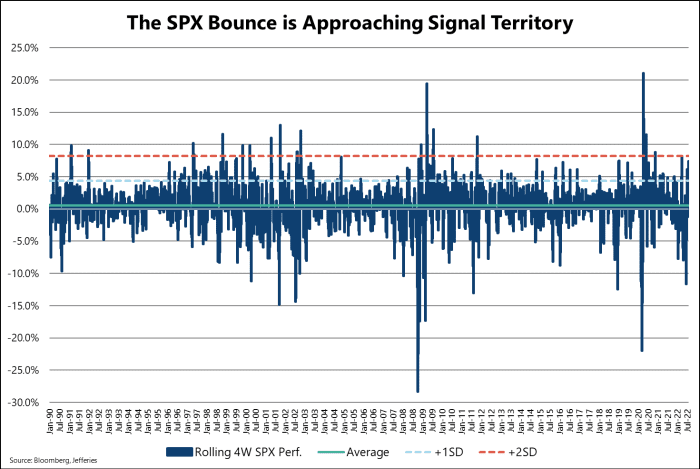
But it’s the large-cap benchmark S&P 500’s more-than-7% rise over the past four weeks that is “dangerously close to extremely interesting from a signal perspective,” wrote Jefferies strategists, including Andrew Greenebaum, in a Sunday note.
A rise of just more than 8% over four weeks would mark a two-standard deviation for S&P 500 rallies, they observed, based on data going back to 1990, which means the market won’t need “much more juice” to hit statistically significant territory. And in the 17 times the S&P 500 has hit that threshold, the subsequent performance “looks massive,” they wrote, averaging 9% over the next six months.
But there’s a notable caveat in that there were also several instances that saw double-digit negative returns. And when the prior six months were negative —
And when the prior six months were negative — as would be the case this time around — “the likelihood of positive returns drops precipitously,” they wrote (see chart and table below).
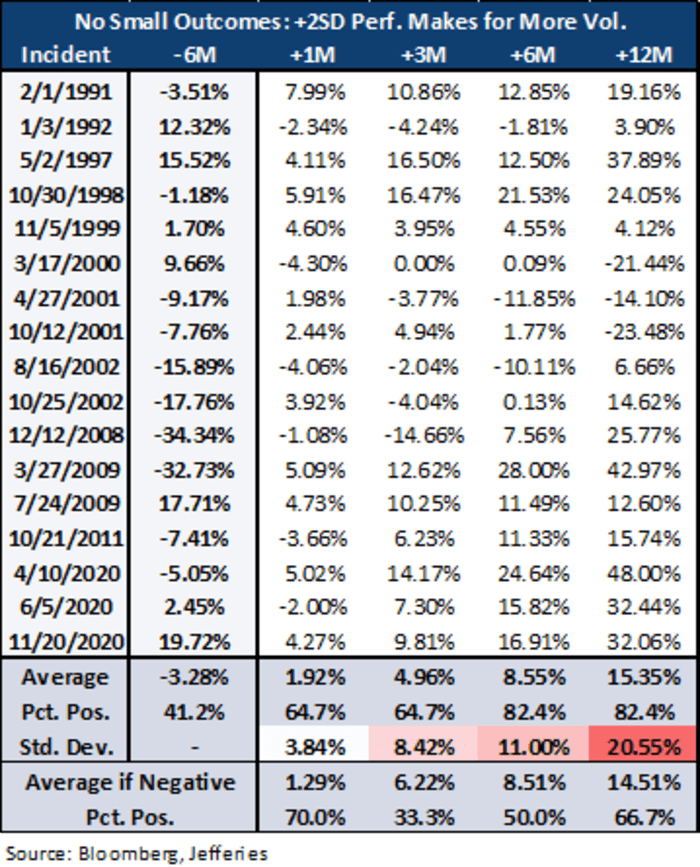
The takeaway, they said, is that “while the seemingly unstoppable bounce may lure folks in, there is still a strong chance it’s just a (quite tradeable) bear market rally.” NN: When i consider the run away inflation even if it moderates somewhat, The inverted yield cure, the 2 quarters of negative GDP growth AND energy prices that are still at record highs…..And i know that in order to stop inflation the central bank has got to get Fed Funds rate above the PCE inflation rate that means the FED still has to raise rates at least 3% MORE TO at least 5%. See Chart below of core market based PCE data that the FED watches like a hawk:
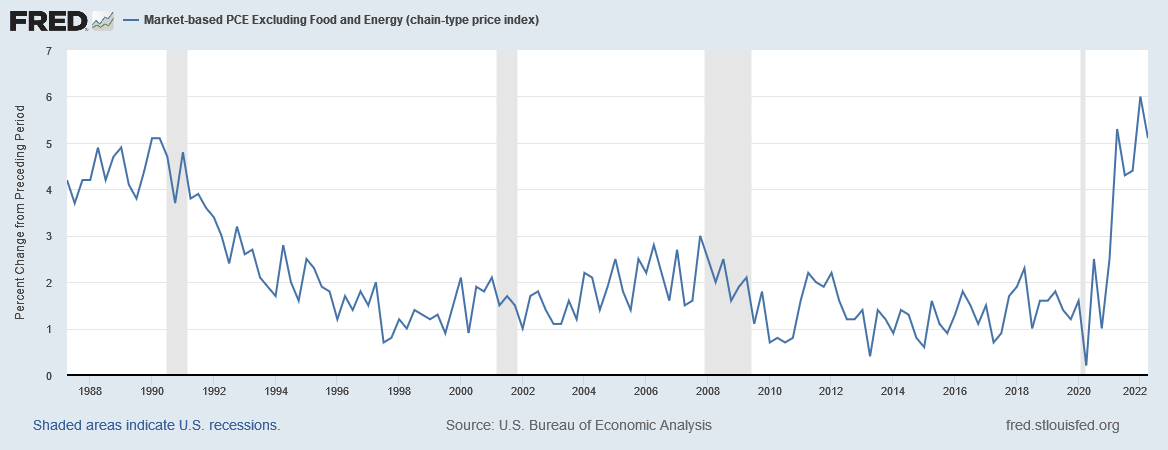
My calculations and proof: ( current FED FUNDS rate 2,32% current PCE is 8.1% excluding food and energy (core) its 5.1%) I use the data i know for a fact the FED watches that is: Gross Domestic Product > Release Tables > SECTION 2 – PERSONAL INCOME AND OUTLAYS > Table 2.3.7. Percent Change from Preceding Period in Prices for Personal Consumption Expenditures by Major Type of Product. I put a active link below to the chart so you can see for yourself
Table 2.3.7. Percent Change from Preceding
My conclusions: The FED has no choice they HAVE to continuing raising rates. Do not fight the FED. reality is they have NO choice. They have to throw the economy into a recession at least. I am of the opinion a 5% FED FUND (a doubling from here) is a must. That will collasp the stock market. This is a inflation crises of epic proportions. Requiring emergency action by the FED. Remember i am using their numbers i know they live and die on. The PCE understates inflation that is why they use it. Inflation at the core assuming the temporary reprieve on energy prices is running over 10%. Past central banks have gotten them into the same data traps. Unfortunately the people crunching the numbers the FED uses for it decisions live in a world of alter reality….. And every time we have been at this point they fuck up. Lest you forgot the transitory trap they fell into last year. This year its wishfull thinking and to little to late
The Oil Price Collapse Conspiracy
- WTI oil prices have given up nearly all their gains since Russia invaded Ukraine, falling roughly 9.5% over the course of the week amid fears oil demand is collapsing.
- Some oil pundits are now claiming that the Biden administration has been fabricating low gasoline demand data in order to drag prices lower.
- While Gasbuddy claims there was a 2% rise in gasoline demand last week, the EIA reported a 7.6% drop in demand.
WTI crude oil prices fell to their lowest point since early February on Thursday, giving up virtually all gains since Russia invaded Ukraine. WTI crude for September delivery tumbled -1.5% to close at $89.26/bbl while Brent crude for October delivery fell -2.1% to $94.71/bbl. WTI crude has lost ~9.5% over the course of the week, marking the largest one-week percentage decline since April amid growing fears that oil demand will collapse when western nations descend into a full-blown recession. While oil producers are certainly beginning to feel the heat, it’s refiners like Valero Energy (NYSE: VLO), Marathon Petroleum Corp.(NYSE: MPC), and Phillips 66 (NYSE: PSX) who have been hardest hit by the pullback thanks to a sharp decline in their refining margins aka crack spreads. For months, refiners have been enjoying historically high refining margins, with the profit from making a barrel of gasoil, the building block of diesel and jet kerosene, hitting a record $68.69 in June at a typical Singapore refinery. The margin later settled in the high 30s a few weeks later, a level still nearly four times higher than the $11.83 at the end of last year, and some 550% above the profit margin at the same time in 2021. But crack spreads have now gone into full reverse: according to Refinitv data, Asian gasoline margins plunged more than 102% in July to a discount of 14 cents a barrel to Brent crude, a far cry from a premium of $38.05 a barrel they reached in June. Asian refining margins have now crashed to just 88 cents a barrel over Dubai crude, from a record $30.49 in June. The effect: a sharp rise in inventories from the United States and Singapore to Amsterdam-Rotterdam-Antwerp. Refiners are being forced to cut gasoline output to minimize losses and switch to producing more profitable fuels. The collapse in oil prices has been so epic and unexpected that some oil pundits are now accusing the Biden administration of fabricating low gas demand data in a bid to hammer oil prices.
To wit, in late June the EIA shut down reporting for several weeks, ostensibly due to a server malfunction. But as ForexLive has pointed out, gasoline demand data has been consistently bad ever since the EIA returned: “Maybe there’s an issue with reporting or maybe it’s a conspiracy“, ForexLive has declared.
Even Wall Street has begun questioning the EIA data. Bank of America energy strategist Doug Legate has published a note titled the “fall of gasoline demand appears grossly exaggerated.’’ “For the week ending July 22nd, implied gasoline demand rebounded to 9.2 million b/d – a 1 million b/d increase vs the last two week average, and the second highest level of 2022,” BofA wrote in the note to clients. Curiously, the EIA reported a steep drop in gasoline demand shortly thereafter, prompting Piper Sandler global energy strategist to label the data “crooked”, saying the methodology left “significant room for error”. “We are supposed to believe that in July, in the middle of driving season we are only using 8.6 million barrels per day. That would be down half a million barrels a day from May of this year; that would be below the Covid low of 2020,” Sandler noted. “So we ask all the refiners, we ask all the retailers, we ask everybody that reported earnings this season. Every single one of them tells you that their sales are not down materially from even pre-covid days. Some report record high sales,” Piper Sandler’s allegations are buttressed by U.S. refining giant Valero. Asked about falling gasoline demand at the company’s earnings call last week, CEO Gary Simmons had this to say: “I can tell you, through our wholesale channel there is really no indication of any demand destruction… In June, we actually set sales records. We read a lot about demand destruction and mobility data showing in that range of 3% to 5% demand destruction. Again, we’re not seeing it in our system.” Further, alternate demand data from GasBuddy deviates considerably from EIA’s. GasBuddy tracks retail gasoline demand at the pumps in the U.S. According to GasBuddy, there was a 2% rise in gasoline demand last week, making it the strongest demand of the year. In sharp contrast, the EIA reported a 7.6% drop in demand for the same time period. The Biden administration certainly is gunning for even lower fuel prices. In an interview with Bloomberg on Tuesday, Amos Hochstein, the White House’s senior adviser for global energy security, said that gas and oil prices need to go even lower while U.S. producers and OPEC+ need to raise output. But as Adam Button, chief currency analyst at Forexlive, notes, it’s the Biden administration calling the shots now, and “at the end of the day, traders have to trade what’s in front of them”.
“Right now it’s a crude chart that’s breaking support after a major period of consolidation — that’s not good. The calls for a recession are growing louder crude demand has a long history of following global growth. There are supply factors that will eventually be bullish — like the SPR releases ending in October — but that’s months away and OPEC is still adding some barrels,” NN:DO not be FOOLED…. Oil and gasoline demand is not dropping. I have been so frustrated with the API ans EIA numbers we stopped publishing them. I have reached my downside number on crude oil at $88 a barrel. we have begun buying operations. Going in with ETF’s first. Soon we will be buying WTI oil….
Inflation data may seal fate of bear market rally
NEW YORK, Aug 5 (Reuters) – A rally in U.S. stocks that has powered on despite skepticism from Wall St faces a reality check in the coming week, as key inflation data threatens to shut the door on expectations of a dovish shift from the Federal Reserve. The S&P 500 (.SPX) has walked a tightrope this summer, rising 13% from its mid-June lows on hopes that the Fed will end its market-bruising rate increases sooner than anticipated. A blowout U.S. jobs number on Friday bolstered the case for more Fed hikes but barely dented stocks – the S&P fell less than 0.2% on the day and eked out its third straight week of gains. More upside could hinge on whether investors believe the Fed is succeeding in its fight against soaring consumer prices. Signs that inflation remains strong despite a recent drop in commodity prices and tighter monetary policy could further weigh on expectations that the central bank will be able to stop hiking rates early next year, drying up risk appetite and sending stocks lower once again. “We’re at the point where consumer price data has reached a Super Bowl level of importance,” said Michael Antonelli, managing director and market strategist at Baird. “It gives us some indication of what we and the Fed are facing.” Rebounds in the midst of 2022’s bear market have been short-lived and three previous bounces in the S&P 500 have reversed course to make fresh lows, fueling doubts that the most recent rally will last. Investors’ dour outlook was highlighted by recent data from BofA Global Research, which showed the average recommended allocation to stocks by sell-side U.S. strategists slipped to its lowest level in over five years in July, even as the S&P 500 rose 9.1% that month for its biggest gain since November 2020. Institutional investors’ exposure to stocks has also remained low. Equity positioning for both discretionary and systematic investors remains in the 12th percentile of its range since January 2010, according to Deutsche Bank published last week.
For their part, Fed officials have over the past week opposed the narrative of a so-called dovish pivot, with one of them – San Francisco Fed President Mary Daly – saying she was “puzzled” by bond market prices that reflected investor expectations for the central bank to start cutting rates in the first half of next year. read more
U.S. rate futures have priced in a 69% chance of a 75 bps hike at its September meeting, up from about 41% before the payrolls data. Futures traders have also factored in a fed funds rate of 3.57% by the end of the year. Positioning in options markets, meanwhile, shows little evidence of investors rushing to chase further stock market gains. One-month average daily trading volume in U.S. listed call options, typically used for placing bullish bets, is down 3% from June 16, Trade Alert data showed. “We are surprised to not see investors start to chase upside calls in fear of underperforming the market,” said Matthew Tym, head of equity derivatives trading at Cantor Fitzgerald. “People are just watching.” Celia Rodgers Hoopes, portfolio manager at Brandywine Global, believes much of the recent rally has been driven by short covering, especially among many of the high-flying tech names that haven’t done well this year. “The market doesn’t want to miss out on the next rally,” she said. “Whether or not it’s sustainable is hard to tell.” Of course, investors aren’t uniformly bearish. Corporate earnings have come out stronger than expected for the second quarter, with some 77.5% of S&P 500 companies beating earning estimates, according to I/B/E/S data from Refinitiv, fueling some of the market’s gains. Antonelli of Baird also said a cooler than expected inflation number next week could push more investors back into stocks. “Is there a scenario right now where inflation comes down and the Fed isn’t going to engineer a hard landing? There could be, and nobody is positioned for that.” Tom Siomades, chief investment officer of AE Wealth Management, believes the market is yet to see a bottom and has urged investors to avoid chasing stocks. “The market seems to be engaging in some wishful thinking,” he said. Investors “are ignoring the age-old adage, ‘don’t fight the Fed.'” NN: If we get a pop up next week on a friendly HEADLINE number on CPI inflation i regard it as a further selling opportunity….
US declares monkeypox a public health emergency
WASHINGTON (AP) — The federal government declared a public health emergency Thursday to bolster the response to the monkeypoxoutbreak that has infected more than 7,100 Americans. The announcement will free up money and other resources to fight the virus, which may cause fever, body aches, chills, fatigue and pimple-like bumps on many parts of the body. “We are prepared to take our response to the next level in addressing this virus, and we urge every American to take monkeypox seriously,” said Xavier Becerra, head of the U.S. Department of Health and Human Services. The declaration by HHS comes as the Biden administration has faced criticism over monkeypox vaccine availability. Clinics in major cities such as New York and San Francisco say they haven’t received enough of the two-shot vaccine to meet demand, and some have had to stop offering the second dose to ensure supply of first doses. The White House said it has made more than 1.1 million doses available and has helped to boost domestic diagnostic capacity to 80,000 tests per week. The monkeypox virus spreads through prolonged skin-to-skin contact, including hugging, cuddling and kissing, as well as sharing bedding, towels and clothing. The people who have gotten sick so far have been primarily men who have sex with men. But health officials emphasize that the virus can infect anyone. NN: Here we go again. Among the gay community (not sure that is PC anymore).. but better then calling them fagots. Get real here i am not a homophobic. i grew up next to Greengage village and my first room mate was gay… Shit i even had a gay girlfriend or two. Anyway this is already having a impact. Places in the US with high infection rates are seeing massive Airbnb cancellations…….
S. Korea’s COVID-19 tally above 100,000 for 5th day in a row……. bark Bark
SEOUL, Aug. 4 (Yonhap) — South Korea’s new COVID-19 cases stayed above 100,000 for the third straight day Thursday amid a fresh wave of infections driven by a highly infectious omicron variant. The country added 107,894 new COVID-19 infections, including 435 from overseas, bringing the total caseload to 20,160,154, the Korea Disease Control and Prevention Agency (KDCA) said. Thursday’s figure fell from the 119,922 the previous day, which was the highest since the 125,822 cases reported April 15. The daily caseload was 1.22-times higher than the 88,374 reported a week ago and 1.52-times more than the 71,142 cases from two weeks ago on the spread of the now-dominant omicron variant BA.5. Health authorities warned people to take precautions as the number of seriously ill patients rose to 310, the highest figure since May 18, when the tally stood at 313. The KDCA reported 34 deaths from COVID-19, raising the death toll to 25,144. The fatality rate was 0.13 percent. Among the 172 deaths reported from July 24-30, 167, or 97.1 percent, are aged over 50. Of the 167 people, 61, or 36.5 percent, were either unvaccinated or had received only one shot, the KDCA said. NN: this does not lok good for the coming US and European Covid season starting this fall…
A red-hot July jobs number has traders penciling in another jumbo Fed rate hike
Goldman, Bernstein strategists say stocks rally can fizzle out
https://www.bnnbloomberg.ca/goldman-bernstein-strategists-say-stocks-rally-can-fizzle-out-1.1801337
https://www.bnnbloomberg.ca/goldman-bernstein-strategists-say-stocks-rally-can-fizzle-out-1.1801337
The recent brisk rebound in equity markets won’t last as the macroeconomic data continue to deteriorate and earnings forecasts are being slashed, strategists at Goldman Sachs Group Inc. and Sanford C. Bernstein warn. “Without clear signs of a positive shift in macro momentum, temporary re-risking could actually increase risks of another leg lower in the market rather than signal the end of the bear market,” Goldman strategists led by Cecilia Mariotti wrote in a note dated Aug. 4. \With investors once again flocking to equities in recent weeks, Goldman strategists said market positioning has improved from a very bearish level seen in June, and the swing in asset allocation could fuel the rally in the short term. But ultimately, strategists said they’re “not convinced that we are past the ‘true’ trough in positioning just yet, and we think the path from here is likely to become more dependent on macroeconomic data.” Bernstein strategists Sarah McCarthy and Mark Diver said in a note on Thursday that the earnings downgrade cycle is just starting along with outflows from stock funds. While investors have stopped buying equities in the second quarter, funds haven’t yet seen a reversal of the “huge” inflows of US$200 billion seen in the first quarter, they said.
“We expect another leg down in the market in the short run,” Bernstein strategists wrote.
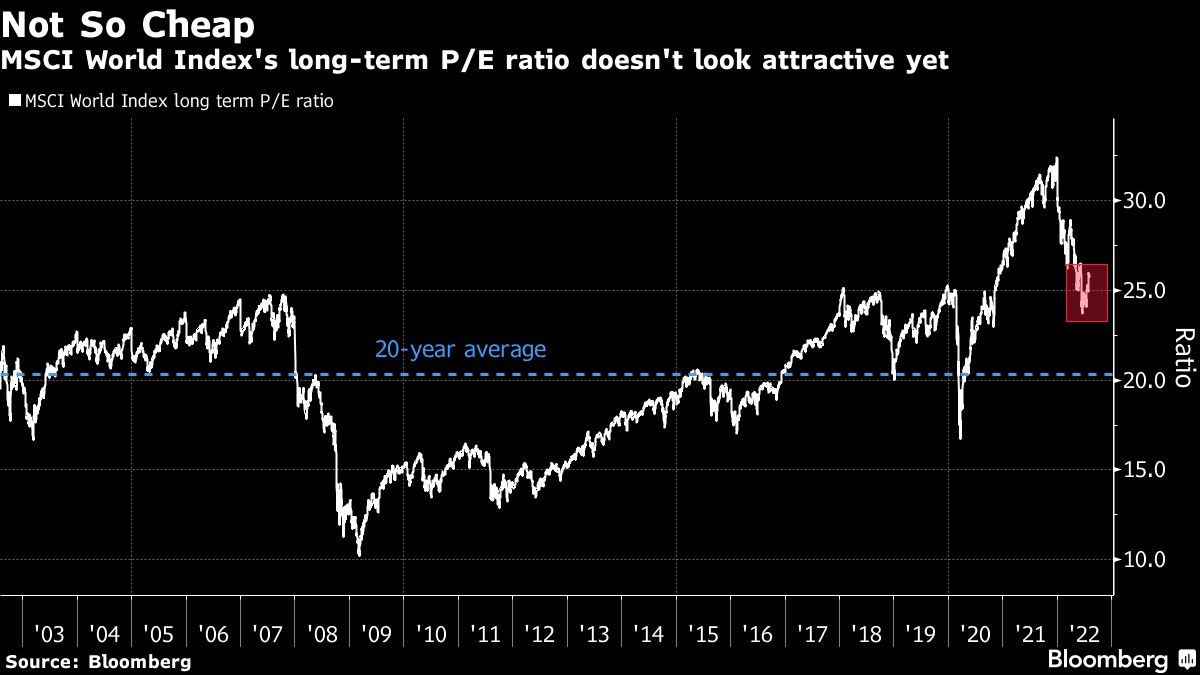
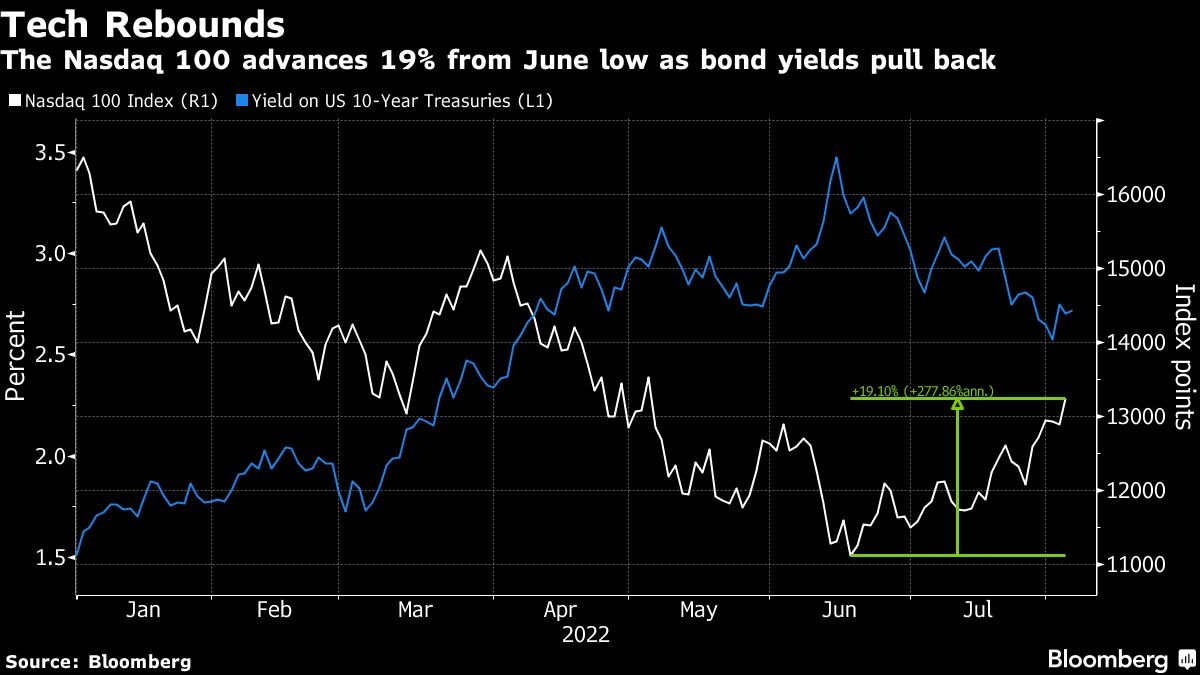
European and US stock markets in July posted their biggest monthly gains since 2020 as investors turned optimistic about corporate earnings proving resilient to surging inflation and a glum consumer outlook, while weaker economic data increased bets on a dovish pivot by the Federal Reserve. The drop in bond yields has fueled a 19 per cent bounce in the Nasdaq 100 from its June lows. But with Federal Reserve leaders pledging to continue an aggressive fight to cool inflation despite recession risks, strategists have cautioned against assuming a sustained recovery in stock markets. And although corporate earnings have been much better than feared this season, the likes of Morgan Stanley and Bank of America Corp. strategists have said that profit estimates will need to see much stronger cuts before stocks can find a true low.
Berenberg strategists Edward Abbott and Jonathan Stubbs also warned of the threat to equities from weaker earnings to come. The strategists’ top-down model showed corporate earnings are likely to fall 15 per cent to 20 per cent year-over-year as margins come under pressure, they wrote in a note dated Aug. 3. NN: Going for broke. I got it all on the line betting that this bear market rally ends in tears as in new stock market lows. Starting next week i will recommend you short this stock market rally using ETF’s, Futures and CFD’s through a English trust…..,,,,, AND I COULD BE WRONG AND WE COULD ALL LOSE A BUNDLE. This is not savings, this is not investing… it even beyond gambling…. This is worse odds then the power ball lottery,
odds are 1 in 88 quadrillion
Now that is my kind of gamble!!!!