United States Treasury Secretary Janet Yellen said on Tuesday that her country is interested in maintaining the flow of Russian oil to world markets while limiting Moscow’s revenues to avoid a worldwide economic crisis.
“What we want is for Russian oil to continue to flow to world markets in order to contain the growth of global oil prices and avoid a jump that could provoke a global recession,” Yellen told the Senate Finance Committee.
She further explained that there are several ways to limit Russia’s oil selling profits, which include a possible move by buyers to band together and cap the oil prices paid to Moscow. Last week, European Union introduced the sixth package of sanctions against Russia, which includes a partial ban on oil imports. NN; this is insanity…. Russia is not embargoing oil. One branch of government is tripping over itself to stop Russian oil and natural gas flows with no replacements in sight. While the other part of government is warning about the dire consequences of said embargoes. This is insanity. Sanctions are killing the greeenwinnnieeee democracies. Talk about giving yourself a lethal injection and calling it medicine
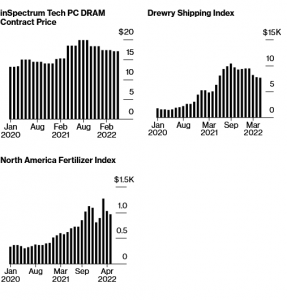
Three of the key supply-side factors driving today’s global inflation levels have already turned around, meaning relief could be on the horizon for shoppers worldwide.
Price Relief
Three big inputs to global inflation are seen easing from recent peaks
Sources: InSpectrum Tech Inc., Drewry Shipping Consultants, Green Markets
Notes: InSpectrum contract prices reported monthly. Drewry (price per 40-foot container) and Green Market (per short ton) indexes are weekly; last figure for month shown here
Bellwether semiconductor price— a barometer of costs of finished electronics products as diverse as laptops, dishwashers, LED bulbs, and medical devices delivered worldwide — is now half its July 2018 peak and down 14% from the middle of last year.
Spot rate for shipping containers— which tells us more about expenses we can expect later in the pipeline for apparel in Chicago, luxury items in Singapore or home furnishings in Europe — has declined 26% since its September 2021 all-time high.
North America’s fertilizer prices— an indicator of where global food inflation is going, including bills for tomatoes in London or onions for sale in a Johannesburg market — is 24% below its record high in March.
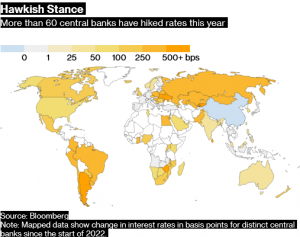
With inflation now exceeding 8% in the euro area, expected to stay above that level in the US when May data comes out on Friday and on the march in Asia too, central bankers around the world are scrambling to contain it.
Hawkish Stance
More than 60 central banks have hiked rates this year
Source: Bloomberg
Note: Mapped data show change in interest rates in basis points for distinct central banks since the start of 2022.
Even as central bankers raise rates, more economists are coalescing around the idea that peak inflation is behind us — though there will be a lag before the lower costs of raw materials filter through to the prices shoppers see. Though few forecasters are predicting a return to pre-pandemic prices in the short run, global retail giants like Walmart Inc. are now struggling to unload bloated inventory to a less enthusiastic shopper. So a moderation in those supply-side pressures could eventually allow central bankers to slow their tightening cycles. “While inflation in some parts of the world are yet to peak, there are at least some signs emerging that we may not be too far off in terms of a turning point at which we start to see the annual inflation rate start to head lower,” said Khoon Goh, Singapore-based head of Asia research at Australia & New Zealand Banking Group. China’s producer prices peaked in late 2021 and are beginning to moderate. Economists are forecasting a 6.5% rise in factory prices in May from a year earlier, down from 8% in April. That’s a promising development for relief in imported-goods inflation worldwide, said Goh. In addition, lower container freight rates and improving supplier delivery times in purchasing managers indexes point to easing bottlenecks that should curb price pressures later this year, he said. NN: We are experiencing 3 types of inflation:
Supply chain
Commodities shortages
Energy supply
The supply chain is now overfilled. China is back. And the smartie pants like Wall Mart hired their own ships and filled up their warehouses. They are sitting on billions in overstock that will be liquidated at steep discounts… Just the opposite of consumer goods Inflation
Commodity shortages in food are 1 season away from being resoled. Sky high price for food goods have seen farmers and producers over plant. Wheat peeked at $13.00 a bushel. Now its at $10.00. Corn touched $10.00 now its now approaching $7.00. Already grain prices are plunging and its not even harvest time which will be a record. As far as minerals and metal shortages alternative suppliers have cranked up operations. Platinum hit $1,200 a ounce now its trading at $1,000. Palladium hit $3000 a ounce now at $2000. You can see this in cooper and steel prices which are plunging. Lumber hit $1,400 now trading at $600.
The last monster on the supply side is energy. Prices are so high that we are starting to see demand destruction and oil looks to me like its topping.
Wage push inflation. With the slaves sitting fat and sassy with happy checks and a 35,000 Dow. It was why worry be happy and thanks to Robin Hood all they had to do was check the follow me off the cliff trade system to se how much they made. Well that fantasy is over as the masses are racking up hugh stock market losses. And the happy check money is running out. The work force is expanding and wage growth has stopped as the masses compete once again with each other for jobs.
The inflation rate still high has peeked. The worst is over. That does not mean the Fed does not have to raise rates. But it does mean that prices will moderate and drop. The perfect ingredients are in place for a BIG bear market rally.
We are now in a bull spread and all i can say is GOD please have mercy on me.
Washington might turn ‘blind eye’ to help lower prices: Vitol
Market opinions on direction of oil have ‘never been wider’
The US may allow more sanctioned Iranian oil onto global markets even without a revival of the 2015 nuclear accord, according to the biggest independent crude trader. While a new agreement would limit Iran’s atomic activities and ease US sanctions on its energy exports, talks between Tehran and world powers have stalled since March. Oil traders are increasingly pessimistic that negotiators will strike a deal. Still, US President Joe Biden could decide that the need to bring down record-high pump prices ahead of November’s midterm elections outweighs the benefit of strictly enforcing sanctions, including by seizing more Iranian oil tankers. “Uncle Sam might just allow a little bit more of that oil to flow,” Mike Muller, head of Asia at Vitol Group, said Sunday on a podcast produced by Dubai-based Gulf Intelligence. “If the midterms are dominated by the need to get gas prices lower in America, turning a somewhat greater blind eye to the sanctioned barrels flowing out is probably something you might expect to see. US intervention in these flows has always been pretty sparse.” The US confiscated oil from an Iranian-flagged vessel off Greece last month, which was followed days later by Tehran detaining two Greek tankers in the Persian Gulf. But Washington’s move is unlikely to signal the start of more tanker seizures by the US, according to Muller. Iran has raised oil exports this year, most of them ending up in China. A new nuclear deal would lead to an additional 500,000 to 1 million barrels per day coming on to international markets, enough to weigh on prices, according to energy analysts. The Islamic Republic also has around 100 million barrels of oil in storage that could be sold down quickly. Crude prices have soared more than 50% this year to almost $120 a barrel, mostly because of the fallout of Russia’s invasion of Ukraine. While many Republicans and some Democrats oppose any lifting of Iranian sanctions, Biden is under plenty of pressure to lower gasoline prices, which have shot up to an average of more than $4.80 per gallon in the US. There’s little consensus about the direction of oil prices, according to Vitol, which traded 7.6 million barrels of crude and refined products a day in 2021. While supplies are tight, Washington’s release of strategic reserves is helping balance the market. Thursday’s decision by OPEC+ — a 23-nation group of producers led by Saudi Arabia and Russia — to accelerate output increases is unlikely to have much impact, Muller said. That’s because many members will struggle to pump more and Moscow’s exports could drop due to sanctions over the war in Ukraine. “The range of expert opinion out there has never been wider,” said Muller, who’s based in Singapore. “There are people who think the market’s going to $135-$140 a barrel. And there are people who think we’re going below $100 again.” There’s also a dichotomy emerging between richer and poorer countries, he said. Some in Asia such as Malaysia and Singapore are experiencing a demand rebound as coronavirus lockdowns ease. Others including Pakistan and Sri Lanka, which has defaulted on international bonds and is struggling to pay for fuel imports, are experiencing demand destruction. “It’s a tale of two worlds,” Muller said. “The affluent world is going to have their holidays and burn jet fuel. But the impact elsewhere is a lot more profound. The divide between the prosperous and the countries that have a lower ability to pay for commodities is becoming extremely stark.” NN: they systematically kill the domestic US oil industry that could be the worlds largest exporter of natural gas. And facilitating buying from literally the enemies of the civilized world . Iran has sworn a oath to destroy America who they call the great Satan. And cruel dictators like Venezuela. How do you think this will end up.
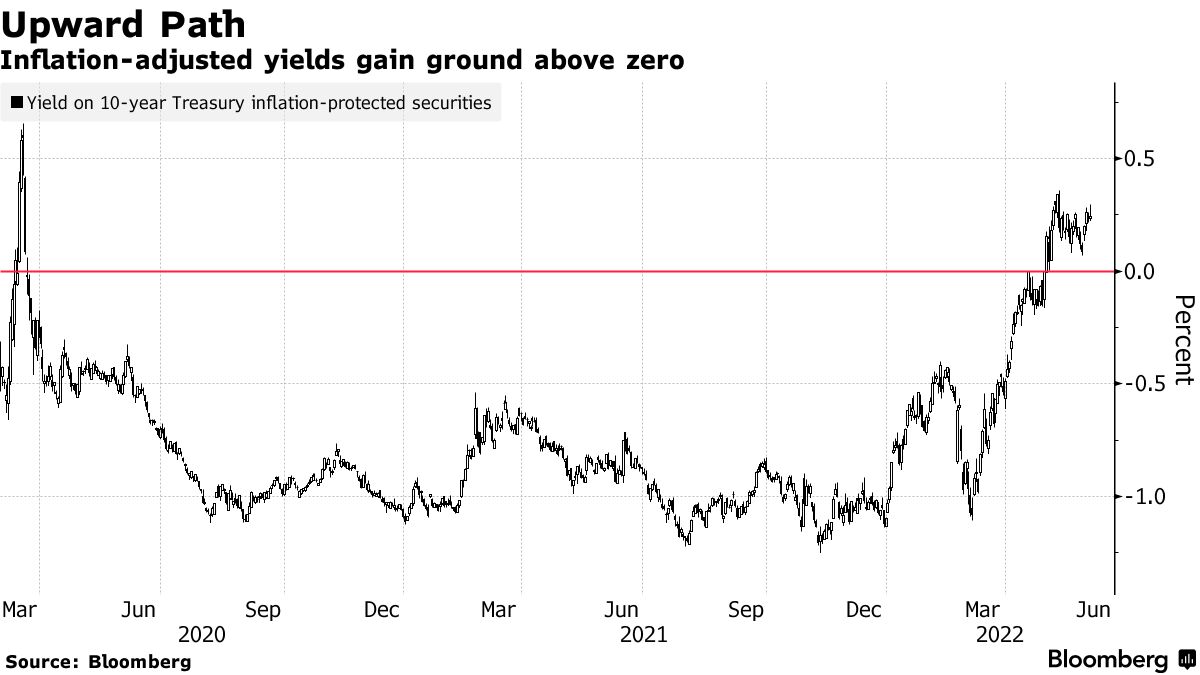
The fate of the world’s biggest bond market is hanging largely on a single question: Has inflation in the US already peaked? Treasury yields have swung back at forth since last month as traders try to game out whether the Federal Reserve will need to stick with an aggressive series of interest-rate hikes or have room to ease up if the economy slows enough to snap the steepest inflation in four decades. The Friday release of the May consumer-price index report may help clarify the outlook, potentially holding the key to whether the benchmark 10-year Treasury yield stages another retreat or retests May’s high by pushing back over the psychologically key 3% level. It flirted with that Friday, when the yield rose as much as 8 basis points to 2.98% after the monthly jobs report underscored the economy’s continued strength. With wages rising steeply amid a tight labor market, swaps contracts are pricing in certainty that the Fed will raise its target rate by a half-percentage point at its June and July meetings. But there’s still no strong consensus on whether policymakers will continue that pace at the September meeting or enact a quarter-point move, a step they may take if they’re worried about driving the economy into a recession or feel confident inflation is coming down. “The jury is still out in terms of the inflationary trajectory,” said Jeffrey Rosenberg, senior portfolio manager for systematic multi-strategy at BlackRock Inc., said on Bloomberg Television. “You can’t really get the Fed out of the business of focusing on the number one priority — of getting inflation down — until you really start to see that definitively show up. Until that happens, it’s going to be a very tough time.” That uncertainty ahead of the end-of-week release is adding to other forces promising to keep Treasuries volatile in the days ahead, including potential liquidity pressure. Also this week, the Treasury will hold its first auctions since the Fed has decided to stop reinvesting the proceeds of some of its maturing debt, another tool it’s using to tightening financial conditions. Treasury yields rose across the board Friday after the Labor Department reported that US firms hired at a faster-than-expected pace in May. It also showed that average hourly earnings were up 5.2% from a year earlier, down slightly from 5.5% in April but still well above pre-pandemic levels. The May CPI figure is forecast to show an annual increase of 8.3%, matching April’s pace and down from as much as 8.5% in March. But there are signs of faith in the Fed’s ability to rein it in. Its monetary policy tightening has started to drive down inflation expectations as higher yields ripple through the financial system. That mix has pushed real rates, or those adjusted for the anticipated rate of inflation, above zero this year from deeply negative territory, signaling less accommodative financial conditions.
“The jobs data was aligned to more of a soft-landing story,” said Alan Ruskin, chief international strategist at Deutsche Bank AG. However the risk is that inflation stays sticky and lags a slowing economy, he said, a “dilemma that policy officials wish to avoid but which appears likely.” The 10-year breakeven rate, which uses the difference between nominal and inflation-protected Treasury yields as a gauge of expected inflation, has fallen to around 2.75% from 3.1% in early April. Fed speakers “are all almost repeating the same script — that bringing inflation down is job one,” Jones said. “As long as they talk the talk and walk the walk, long-term inflation expectations will stay pretty well anchored.” The Fed’s reinvestment purchases are done with so-called auction add-ons, which reduce the amount the Treasury has to borrow from the public. While for now that lost Fed support won’t require the Treasury to sell more debt since out-sized tax revenue has reduced the deficit, strategist anticipat
Economic calendar:
June 7: Trade balance; consumer credit
June 8: MBA mortgage applications; wholesale trade
June 9: Jobless claims; Bloomberg June US Economic Survey; household net worth
June 10: Consumer prices; real average hourly earnings; University of Michigan sentiment/current conditions/expectations; monthly budget statement
Fed calendar is empty due to the standard pre-FOMC meeting quiet period
Auction calendar:
June 6: 13- and 26-week bills
June 7: 3-year notes
June 8: 10-year notes reopening
June 9: 4- and 8-week bills, 30-year bonds reopening
The U.S. stock market’s two-week rally is even stronger than it looks. That’s saying something, since this rally has already tacked on impressive gains. As of the market’s close prior to the Memorial Day exchange holiday, the S&P 500 SPX, -1.63% was 6.6% higher than where it stood at its mid-May low. The Nasdaq Composite COMP, -2.47% was 8% higher, and the Russell 2000 Index RUT, -0.77% was 9.9% above its May low. Yet the stock market’s internals are even stronger than these headline numbers suggest. One illustration of this sub-surface strength: over the three trading sessions prior to Memorial Day, the stocks that fell in price did so on lighter volume than the stocks whose prices rose. Take Wednesday, May 25, for example, when three times as many stocks in the S&P 500 rose as fell. According to Hayes Martin, president of advisory firm Market Extremes, that day’s ratio of upside volume to downside volume for S&P 500 stocks was 7.6 — more than twice as high. Something similar was seen the next day, May 26: the ratio of advances to declines on the S&P 500 was 8.4, while the ratio of upside volume to downside volume was 11.7. May 27’s ratio of upside-volume to downside volume was even higher, at 12.8. These high ratios are one indication of the power behind what market technicians refer to as the market’s “thrust.” Martin told me in an interview that he focuses on more than 20 similar measures of thrust, and he said that the stock-market’s thrust from Wednesday through Friday of last week was stronger than on only a handful of other occasions over the past four decades. It “signifies a level of intense buying pressure that is rarely seen, …comparable to extremes at a number of significant lows.”
The stock market produced handsome average returns in the wake of those prior occasions, as you can see from the chart below. It shows the S&P 500’s average return over the subsequent three-, six- and 12-month periods following the nine other occasions since the early 1980s that, according to Martin’s work, experienced three consecutive days of similarly powerful upward thrust.
JPMorgan Chase CEO Jamie Dimon is telling investors to batten down the hatches, as the Ukraine war and the Federal Reserve’s monetary policy are potentially creating an economic hurricane. Dimon, speaking at a financial conference sponsored by AllianceBernstein, said, “It’s a hurricane. Right now, it’s kind of sunny, things are doing fine, everyone thinks the Fed can handle this,” However, “That hurricane is right out there, down the road, coming our way,” he added. “We just don’t know if it’s a minor one or Superstorm Sandy or Andrew or something like that. You better brace yourself.” Dimon’s warning echoed one made earlier by former Goldman Sachs CEO Lloyd Blankfein, who told CBS talk show Face the Nation last month that there is a “very, very high risk” factor for an economic recession. The Federal Reserve is shedding nearly $9 trillion in bond holdings, and are looking to enact another interest rate raise at their meeting in June. “JPMorgan is bracing ourselves and we’re going to be very conservative with our balance sheet,” Dimon said. NN: Let me tell you what is really happening. The 3 blind mice wall street highly leveraged players are sure as shit having a very bad feeling, see a enormous hurricane and very very high risk… Are really warning about their very very high debt and over leveraged balance sheets. They all thrived on free money. And it reflects the inhere flaw is banking…. Which is borrow short term cheap money and lends it out long and pocket the difference in rates. After years of borrowing money for free and dumping their securities on the FED for endless liquidity that party is ending. And on their balance sheets are enormous debts were they loaned long. The curse of the banking system… Borrow money in the spot market and lend it out for on average for ten years at a fixed rate. The problem is the short term money which was damn near free is getting very costly and soon they will be upside down. Meaning the interest they are collecting long is not enough to cover their ever rising short term borrowing costs…. INCOMING!!!
For me this is way way premature. At the earliest the recession will not hit into late next year. Their is plenty of time to rally in a bear market oingaver and over a
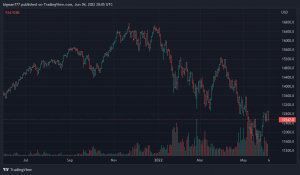
Major US stock markets closed lower on Friday as traders digested a stronger-than-expected employment report and its implications for monetary policy in the future. Tesla Inc. led the day’s declines after it was learned that Elon Musk is considering a hiring freeze and a 10% job cut. Nonfarm employment in the United States increased by 390,000 in May, as reported by the country’s Bureau of Labor Statistics. Traders likely reacted to the rate hike move with fears that the Federal Reserve will tighten monetary policy. The benchmark 10-year Treasury yield rose following the report above 2.97%. The Dow Jones Industrial Average lost 1.05% or 348 points at the close, with Apple sinking 3.86%. The Nasdaq 100 fell 2.67%, losing 344 points, while Tesla closed 9.22% down. The S&P 500 declined 1.65%. The euro fell 0.25% against the dollar at 3:58 pm ET, selling for $1.07202. NN: Wall street is becoming obviously very negative… Musk rat has a bad feeling…. Really this is a man who believes he is a alien and is the man from mars. SO excuse me if i pay no mind to his “super bad feeling” it might be a result of martian death rays. OR to much sushi and Champaign. And if that was enough to not want me to prepare for a rally back…… Jamie Dimon, the Head Of Largest US Bank, (no longer in the world Dubai took care of that burden) Predicts “Economic Hurricane” In Next Few Months. Well hells bells. As you know i am predicting a full blown depression. It will be a nuclear blast compared to Jamie’s hurricane. But before then i expect many bear market rally backs. And when wall street turns negative most often the marker does a zoom zoom albeit temporary in nature. In the mean time i feel like i am being diced and sliced in a food processor.
OPEC+ agreed to open its oil taps faster in the summer months, a gesture of reconciliation to the US that nevertheless keeps Russia at the heart of the cartel. The White House welcomed the deal, which came after months of diplomatic pressure on Saudi Arabia to mitigate the surge in energy prices that’s battered the economy since President Vladimir Putin’s decision to invade Ukraine. The modest supply boost — amounting to just 0.4% of global demand over July and August — may ease tight markets. But it leaves unanswered the question of whether the US can turn Saudi Arabia into an ally in its campaign to economically isolate Russia. “The frost is melting in Saudi-US diplomatic relations, but it will take more progress before full normalization,” said Bill Farren-Price, a director at Enverus Intelligence Research. “Whether the US will be able to drive a wedge between Riyadh and Moscow is a bigger challenge.” Before Thursday’s OPEC+ meeting, oil had fallen on reports that Saudi Arabia and other members were prepared to fill the gap in the market created by Western sanctions on Russian oil, or even remove the country from the OPEC+ quota system altogether. Russia’s output has already fallen by about 1 million barrels a day since the start of the war and may drop further after the European Union agreed further sanctions on its oil. The policy shift eventually agreed upon by the Organization of Petroleum Exporting Countries and its allies was far less dramatic. The group approved oil-production hikes of 648,000 barrels a day for July and August, about 50% larger than the increases seen in recent months. Moscow gave the plan its full backing and talks were concluded in just 11 minutes, delegates said, asking not to be named because the information was private. The deal was “a pretty minor tweak,” said Farren-Price. Given the cartel’s recent struggles to hit its production targets, several analysts predicted that the additional volumes that would actually reach the market would be much smaller than the headline figure. Opening the taps even just a little wider is still a turnaround for Saudi Arabia. The kingdom doggedly stuck to the OPEC+ plan for gradual monthly supply increases even after Russia’s invasion of Ukraine upended global markets and sent energy prices soaring. Last week, the Saudi foreign minister said there was nothing more the country could do to tame oil markets, and even suggested there was no shortfall of crude. NN: as you know we had a good run of oil trade and i have stood aside. Now you can see why. My strategy was/is to stand aside and wait out the political drama and technically i want to see $120 oil breached. Biden has been a asshole to the Saudis. Now he has to suck wind and go hat in hand to the Saudis graveling in the sand begging for more oil. Ironic when the biggest fields in the world inside the US are off limits. I have been on a few graveling in the sand to the gulf nations…… They love that shit. For the record The Omega Trust has established offices and a presence in Dubai. More on that after i come out of my dark period,
WASHINGTON (Reuters) – The U.S. economy may be primed for several years of above-trend growth as families spend perhaps $2 trillion in excess savings banked during the pandemic, Richmond Federal Reserve President Tom Barkin said, and inflation will head higher for a while.
But Barkin in a Reuters interview late Wednesday would not detail how he expects that strong outlook to influence the Fed’s interest rate or bondbuying policies, saying he would only make and discuss those decisions as data show the economy either meeting or falling short of the Fed’s stated goals. Investors and journalists may be interested in where he put his “dot” – or estimated target interest rate – in the set of projections issued by Fed officials last week, but Barkin, a voting member of the Federal Open Market Committee this year, said that distracts from the central bank’s intent to let outcomes, not forecasts, drive monetary policy.
“I don’t think it matters. I think what matters is the outcomes we actually get,” Barkin said.
The Fed’s pledge not to raise rates or curb $120 billion in monthly bond purchases until the economy more clearly recovers “is quite explicit and outcome based,” Barkin said. “When we hit the guidance I want to normalize as much as the next guy. But I want to hit the guidance.”In an economy revved to boom, the Fed’s likely path to “normalization” is a key question for investors analyzing bond and stock prices and households wondering where interest rates are heading as they plan major purchases. Fed officials have shown a disparate willingness to pin down their views, leaving some investors and economists flummoxed at what they do not know about the central bank’s collective “reaction function.” Essentially, what is its tolerance for higher inflation, its working notion of “maximum employment” and its definition of words like “substantial” that are important to understanding what the Fed might do and, importantly, when? Barkin said the demand for details set against the calendar – something bond markets clamor for to price securities influenced by Fed interest rate decisions – amount to a “gotcha game” at a time when the central bank wants to be more deliberate about reaching its goals, particularly a healed job market, before changing policy. For example the Fed has said it would not consider reducing its crisis-era $120 billion in bond purchases until there was “substantial further progress” in restoring the labor market and ensuring inflation hits its 2% target. That is just one of the phrases Fed officials contend are easy to understand but market participants see as imprecise. Barkin said it was possible that sort of progress could be achieved this year, at least opening the door for the start of a policy discussion. “I hope so,” he said. With pandemic supply bottlenecks feeding price hikes and post-pandemic demand expected to surge in the service sector, “it is pretty straightforward for me to imagine we are going to make substantial further progress on the pricing front.” It should not change the “paradigm” of pricing and inflation, he said, but could help coax inflation expectations to the Fed’s 2% target. On employment, “I would like to hope we have a pretty strong spring and summer.” But even that is just the start of a conversation. Top Fed officials have emphasized they are in no rush to curb help for the economy until it is clear damage from the pandemic recession is substantially repaired. As to rate hikes, in the most recent projections 11 officials said they did not think a rate increases would be appropriate until at least 2024; four said it might need to happen next year, and three others joined them to see likely increases in 2023.Barkin would not claim his group, saying events could push him in any number of directions. “There are various outcomes that I would eagerly embrace as opportunities to begin the process of normalization. There are outcomes I would eagerly embrace the need to wait,” Barkin said. “I don’t have a religious principle” regarding when rates need to increase. NN: The FED is scared to death to remove stimulus. And rate hikes alone will not put out the fire. In other words they are royally screwed. Their is no good outcomes here
(Reuters) – Saudi Arabia is prepared to raise its oil production if Russia’s output falls substantially because of the western sanctions imposed on it, the Financial Times reported on Wednesday, citing sources.
Discussions had been held about an immediate increase in production from Saudi Arabia and the United Arab Emirates, which could be announced at Thursday’s OPEC+ meeting, according to the report
OPEC+ comprises of members of the Organization of the Petroleum Exporting Countries and their allies led by Russia. Production increases that are scheduled for September would be brought forward to July and August, the source said. Saudi Arabia, the top producer in OPEC, has previously rebuffed calls by Washington to boost oil output by more than the gradual increases it has agreed to as a member of the OPEC+ group which includes Russia. Saudi agreed to shift its stance and raise output to calm oil prices as part of a rapprochement with Biden administration, the report said, citing people familiar with the talks. The country has also assured to eventually respond by raising production should a supply crunch hit the oil market, the report added. NN: Now you can see why we took profits and stood aside in the oil trade. Oil hit $120 this week and dropped $8 bucks… I am out of the oil business for now. I believe the Saudi’s will increase production to give Biden a bone.