Italy set another record in daily COVID-19 cases, as the number of people who tested positive jumped by 78,313 during the last 24 hours, the Health Ministry’s data showed on Tuesday. Within the same timeframe, the country’s health authorities have detected 202 fatalities attributed to the virus, the data revealed. Italy’s COVID death toll, which is the second-highest in Europe, climbed to 136,955 after the latest updates.
UK: COVID-19 infections at daily high of 129,471
Health authorities of England and Wales reported 129,471 additional coronavirus infections on Tuesday, the largest single-day increase in cases in the entire United Kingdom since the pandemic began, even though figures from Scotland and Northern Ireland were not included in the final tally. Over 12.33 million cases were registered so far in the UK. On the other hand, the total number of deaths within 28 days of a positive test hit 148,021, after rising by 18. More than 51.67 million people in the country received at least one dose of a coronavirus vaccine, representing an 89.9% share of the population aged 12 and older, while 56.9% received either a booster or three doses.
US adds 512,553 COVID cases amid backlog
The COVID-19 case total in the United States grew on Tuesday by 512,553 as some states were late in reporting their daily figures over the holiday weekend. The US has seen 52,280,854 infections since the start of the pandemic, according to data from Johns Hopkins University. The death toll increased by 1,762 on Tuesday. There have been 816,436 fatalities attributed to COVID-19 so far.
Finland bans unvaccinated travelers
Finland announced on Tuesday an entry ban for people who are not fully vaccinated against COVID-19 or can present proof of recovery within the past six months. Travelers will also have to submit a certificate of a negative COVID-19 test taken less than 48 hours prior to arrival. The measure comes into force immediately and will remain in place until January 16. Finnish citizens, foreigners residing permanently in Finland, or persons who have an essential reason for entry will be exempt from the ban .NN: it will take a couple more weeks to know how serious this 4th wave is. I urge you to hunker down till we know more.
(Reuters) – The S&P 500 hovered around record highs on Tuesday as conviction in the U.S. economy helped investors shrug off concerns over Omicron-driven travel disruptions and store closures, and extended Wall Street’s four-day rally amid thin trading volumes. The Centers for Disease Control and Prevention (CDC) on Monday shortened the recommended isolation time for Americans with asymptomatic cases of COVID-19 to five days from the previous guidance of 10 days. The CDC’s update, along with approvals to new pills and more vaccines to fight COVID-19, have all helped investors look past thousands of flight cancellations and Apple Inc shutting its New York stores due to surging cases, and put the three main indexes on pace for monthly gains. “This policy change is sending the message that it is becoming more like the flu and less like the variants we saw early on when we had no treatments, no vaccines and it was much more deadly,” said Thomas Hayes, managing member at Great Hill Capital in New York. The S&P 500 and Nasdaq on Monday posted their best four-day rally since November 2020, with the S&P 500 closing at a peak. Among the 11 major S&P 500 sector indexes, eight traded higher on Tuesday and financials led the charge. At 9:44 a.m. ET, the Dow Jones Industrial Average was up 114.24 points, or 0.31%, at 36,416.62, the S&P 500 was up 7.62 points, or 0.16%, at 4,798.81, and the Nasdaq Composite was up 3.97 points, or 0.03%, at 15,875.23. Some megacap companies have roared in the recent rally, with Tesla Inc jumping 0.8% after surging nearly 22% in value over the past four sessions. Apple dipped 0.4% after coming within spitting distance of becoming the first U.S. company to hit $3 trillion in market capitalization in premarket trading. Boeing added 1.9% as Indonesia lifted a ban on the company’s 737 MAX, three years after the crash of one of its aircraft that led to the loss of all 189 people on board. Markets are in one of the seasonally strong periods, also called the Santa Claus Rally, with CFRA Research data showing the S&P 500 has on average risen 1.3% in the last 5 trading days of the year, and first two days of the new year since 1969. Advancing issues outnumbered decliners by a 1.93-to-1 ratio on the NYSE and by a 1.20-to-1 ratio on the Nasdaq. The S&P index recorded 60 new 52-week highs and no new low, while the Nasdaq recorded 68 new highs and 69 new lows. NN: Its one hell of a party they are throwing… Be ready for the hang over….. As you are seeing we are standing aside waiting for our turn……..
The S&P 500 is trading at $4,725.79 to close 2021 – up 28% YTD.
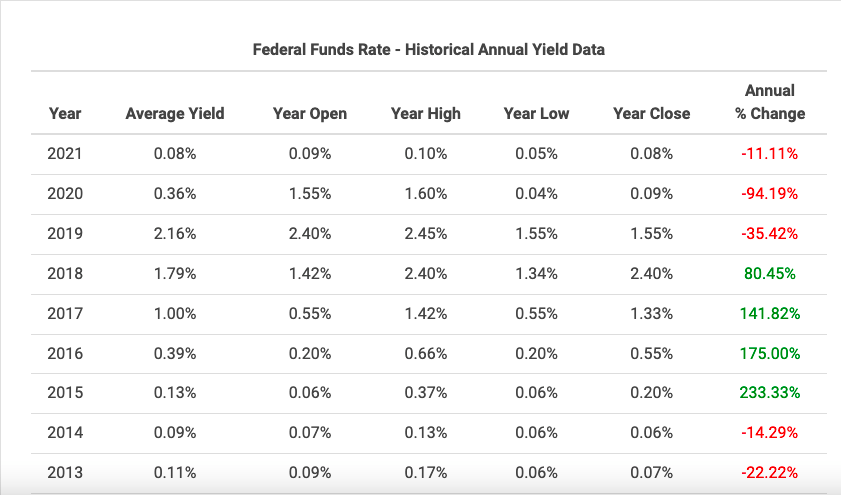
With the Federal Reserve planning to raise interest rates in 2022, investors are expecting more moderate gains than the rise seen in 2021.
There are two major policy decisions to follow in the first quarter of 2022. 1.) The outcome of the Biden spending package 2.) The Federal Reserve raising interest rates
With only a few more days of trading left in 2021, the S&P 500 will likely finish at ~ 29% YTD. Compared to the 2020 gains of 16%, the index and any funds that track the index had quite a remarkable year.
Typically, the common barometer of if a stock performed well in a given year is how it’s done relative to its peers. The S&P 500 is a popular index to use in these situations. This past year, beating the S&P was harder than it’s ever been. Comparing the performance of the index to years past, it may be time to adopt a more conservative perspective on the 2022 outlook of the 500 companies included within Standard & Poor’s stock market index. To put it plainly, interest rates were low in 2021. More specifically, the federal funds rate was low. This is the interest rate that banks use to lend money to each other overnight. A look behind the curtain would show you that banks are constantly lending money back and forth to each other in order to keep the required percentage of their customer’s money on reserve.The federal funds rate is used to control the supply of money as a way to manage inflation. When the Federal Reserve raises the fund’s rate, like they’re expected to do shortly, it becomes more expensive to borrow. When rates are low, as they have been through all of 2021, investors are more likely to acquire risk assets such as stocks to take advantage of the cost of borrowing. With economic stimulus and low rates, Americans were throwing money into a variety of risk assets such as stocks, cryptocurrency, and NFT’s.
Source: Macro Trend
Looking ahead, the Federal Reserve has already announced that it will begin tapering interest rates to address inflation acceleration. Higher interest rates devalue the future projected earnings of companies and, in turn, negatively impact their share prices. Interest rates were at a bottom in early 2020, largely due to the pandemic and economic stimulus efforts in both fiscal and monetary policy. With Wall Street expecting interest rates to increase in the near term, the question becomes, how soon do portfolio managers and investors as a whole begin selling off their risk? Once these initial sell-offs happen and the idea of interest rate hikes becomes more of a reality, the S&P will suffer a blow.
As excerpted by Karen Langley of the Wall Street Journal,
“We know there’s going to be a rate hike,” said Tiffany Wade, senior portfolio manager at Columbia Threadneedle Investments. “How soon before that do you start to position around valuations maybe coming off?”
Karen continues in her article,
“The S&P 500 has averaged an annual gain of 8.4% from 1957, the year it was introduced, through last year. But it is coming off three much stronger years. The index jumped 29% in 2019, even more than its advances in 2020 and so far in 2021.
While it’s not going to be the popular opinion, being realistic about the market outlook in 2022 is going to pay investors’ dividends. The gains recognized by the market in the years following the introduction of COVID-19 to the global economy were being propped up by stimulus packages and government spending, loan forbearance, and near-zero interest rates across the board. To adopt a term currently being used by the National Basketball Association to describe cases in which unforeseen events occur, we can refer to these policies as “hardship policies”. These hardship policies are not sustainable policies for a country of any size – let alone the United States. If not at its boiling point already, inflation will become a major priority to address and interest rates will have to be raised as a means to curb spending and the output of money.
Per Nick Timaraos of the Wall Street Journal,
Fed officials are facing two opposite risks. One is that they tighten monetary policy that causes the economy to slow on top of a sharp drop in the rate of inflation next year. The other is that inflation stays higher and households and businesses come to expect prices to keep rising, leading to a wage-price spiral.
The economy is in a period of really high growth, strong demand, and high incomes. The issue is, these have all been manufactured. Normally, after a downturn akin to the one we faced at the start of the pandemic, the economy takes longer to return to normalcy. The aggressive monetary and fiscal policies initiated in 2019 have caused the Federal Reserve to become stuck between a rock and a hard place. Their alternatives are to tighten up monetary policy to address inflation or allow prices to keep rising and handle the future ramifications as they present themselves. At the end of the day, investors in ETFs that track the performance of the S&P 500 (SPY) can rest easy at night with ~28% YTD returns on their investments. With so much uncertainty at both the fiscal and monetary levels, there is a legitimate concern for the valuation of the index’s companies moving forward. Some of these companies are trading at abnormal P/E ratios. The stocks that comprise the S&P 500 trade at high multiples. Microsoft (NASDAQ:MSFT), Apple (NASDAQ:AAPL), and Tesla (NASDAQ:TSLA) are all trading above 30 Trail PE. This is a valuation multiple that is based on the last 12 months of actual earnings. By taking the current stock price and dividing it by the trailing EPS for the past 12-months. Tesla, in fact, is trading at 289.59 Trailing Price-to-Earnings. It seems inevitable that a correction is coming, regardless of whether or not the Fed raises rates tomorrow or in six months. That reality, coupled with the sky-high valuations of the major players in the S&P 500, should be reason enough to adopt a conservative outlook on 2022 performance. Something just has to give…and soon.
As omicron continues to spread across the country, COVID-19 cases are continuing to emerge on cruise ships. Carnival Cruise Line, Royal Caribbean International and MSC Cruises are among the cruise lines currently dealing with clusters of cases on board resulting in a myriad of scenarios including protocols kicking in to mitigate spread, itinerary changes and the Centers for Disease Control and Prevention investigations. The CDC has been working with global public health experts and industry partners to learn about omicron, spokesperson Dave Daigle told USA TODAY Thursday. “We are still learning how easily it spreads, the severity of illness it causes, and how well available vaccines and medications work against it.”
He continued that “cruise travel is not a zero-risk activity.”
The likelihood of contracting coronavirus on cruise ships is “high because the virus spreads easily between people in close quarters aboard ships,” Daigle saidThe CDC advises people who are not fully vaccinated against COVID-19 to avoid cruise travel and advises travelers get a booster shot if eligible. MSC Seashore, which was scheduled to disembark passengers Thursday, sailed with 28 passengers who tested positive for COVID-19.”During a routine monitoring aboard MSC Seashore, a limited number of guests and crew tested positive for COVID-19. Twenty-eight (all fully vaccinated) of the 4,714 guests and crew members – 0.59% of the onboard population – were discovered to be positive,” MSC said in a statement provided by spokesperson Stephen Schuler. MSC health protocols were implemented “immediately” and all who tested positive and their close contacts were isolated in balcony cabins in a separate area on the ship. The majority of those who tested positive are asymptomatic, some have mild symptoms. The cruise line said Wednesday it would continue to monitor the health of those passengers and crew members and would offer complimentary testing for passengers who wished to have it “to feel reassured and for peace of mind.” Carnival Freedom, which is sailing in the Caribbean according to Cruise Mapper, has a “small number” of coronavirus cases on board and is following protocols, spokesperson AnneMarie Mathews told USA TODAY Thursday. Mathews did not immediately specify the number of cases on board when asked. “Our protocols anticipate this possibility and we implement them as necessary to protect the health and safety of our guests and crew,” she said. “This is a vaccinated cruise and all guests were also tested before embarkation.” Aruba and Bonaire did not permit Carnival Freedom to call at their ports. “We are working closely with the CDC and local health authorities in all ports and destinations that we visit,” Mathews said. “Unfortunately, the rapid spread of the omicron Variant may shape how some destination authorities view even a small number of cases, even when they are being managed with our vigorous protocols. Some destinations have limited medical resources and are focused on managing their own local response to the variant.” When port visits are canceled, she said, the cruise line will try to find an alternative destination. “CDC is investigating the recent increase in COVID-19 cases identified on Royal Caribbean International’s Odyssey of the Seas,” CDC spokesperson David Daigle told USA TODAY Thursday. “All cases appear to be mild or asymptomatic. Additionally, there have been no COVID-19 related hospitalizations, medical evacuations, ventilator use, or deaths from this ship.” Fifty-five passengers and crew members have tested positive for COVID-19 on Royal Caribbean’s Odyssey of the Seas cruise ship, which departed Fort Lauderdale, Florida, on Saturday for an eight-night Caribbean trip, Royal Caribbean said in a statement shared by spokesperson Lyan Sierra-Caro. The ship, which returned briefly to port on Sunday to disembark a passenger with COVID-19, is carrying 3,587 passengers and 1,599 crew. With vaccinations required among all crew members and guests 12 and older, 95% of those on board were fully vaccinated, according to Royal Caribbean. The health agency is working closely with Royal Caribbean and will “consider multiple factors” before marking the ship as “Red” status at which point it would be required to return to port. As of Thursday afternoon, Odyssey of the Seas was classified as “Yellow” status meaning the “CDC has investigated and ship remains under observation.” Royal Caribbean announced Wednesday that the cruise will not stop in Curacao or Aruba as planned.”The decision was made together with the islands and out of an abundance of caution due to the current trend of cases in the destination communities and having COVID-19 positive cases on board … representing 1.1% of the onboard community,” according to a statement shared by Sierra-Caro. NN: I am sorry to report people can not bunch up. No on planes, trains, cruise ships, sporting event, movie theater and even restaurants.
Dec 27 (Reuters) – Venezuela this year almost doubled its oil production from last year’s decades-low as its state-owned company struck deals that let it pump and process more extra heavy crude into exportable grades. The surprising reversal began as state-run Petroleos de Venezuela, known as PDVSA, won help from small drilling firms by rolling over old debts and later obtained steady supplies of a key diluent from Iran. The two lifted output to 824,000 barrels per day (bpd) in November, well above the first three-quarters of the year and 90% more than the monthly average a year earlier.Whether it can continue to ramp up production is unclear. Years of unpaid bills, mismanagement and, more recently, U.S. sanctions here have cut its access to specialized drilling equipment and foreign investment. The sanctions have also limited its customers to firms with no track record of trading.PDVSA’s latest gains – including reaching 1 million barrels of daily output for the first time in nearly three years, which Oil Minister Tareck El Aissami described in a Christmas day message as a “great victory” – still fall short of current management’s 2021 goal of producing 1.28 million bpd. Workers in producing regions say the reopening of oilfields continues and more flow stations are expected to restart. However, oil experts said PDVSA has done all it can and further gains might be capped by a lack of additional rigs and functioning upgraders for its tar-like crude.“Base production in 2021 was way below PDVSA’s production capacity,” said Francisco Monaldi, director of the Latin American Energy Program at Rice University’s Baker Institute in Houston. “We are reaching that capacity now. To see an output increase during 2022, investment in new wells and upgrading infrastructure is needed,” he added. The main turning point came from a swap deal between state-run firms PDVSA and National Iranian Oil Company (NIOC) that began in September. It proved crucial for generating exportable grades from the extra-heavy crude produced at Venezuela’s top region, the Orinoco Belt. Hard-currency proceeds from domestic fuel sales and higher oil exports to Asia have also allowed PDVSA to amortize some debts with service companies and settle overdue debts with a promise of future work and permits that allowed some domestic firms to operate workover rigs. A few service companies also accepted payments in kind, mainly oil byproducts and residual fuel later sold domestically and overseas, according to people familiar with the matter. By mid-December, there were a total of 47 workover and maintenance rigs active in the Orinoco Belt and 29 more in other regions, according to a PDVSA internal document seen by Reuters. That same report showed 19 others that were inactive. No active drilling rigs, which are needed for building output capacity, were reported.PDVSA did not reply to a request for comment. The U.S. Department of Treasury, which enforces sanctions on PDVSA, did not immediately reply to a request for comment.
* Travel stocks drop on Omicron-related flight groundings
* Indexes up: Dow 0.33%, S&P 0.52%, Nasdaq 0.54%
Dec 27 (Reuters) – The S&P 500 hit a record high on Monday, as a strong retail sales report underscored the strength of the economy and overshadowed worries from Omicron-driven flight cancellations at the start of this year’s final trading week. Retail sales in the country rose 8.5% during this year’s holiday shopping season from Nov. 1 to Dec. 24, powered by an ecommerce boom, a report by Mastercard Inc showed. “Despite the variant and travel interruptions, retail sales were up strongly, which bodes well for the economy going into the new year,” said Peter Cardillo, chief market economist at Spartan Capital Securities in New York. Travel-related stocks, typically sensitive to news around the coronavirus, slid after U.S. airlines canceled about 800 more flights on Monday after nixing thousands of flights during the Christmas weekend, as Omicron cases soared. The S&P 1500 airlines index shed 1.6%. Cruise operators Norwegian Cruise Line Holdings, Royal Caribbean and Carnival Corp fell 2.2%-3%, leading declines on the benchmark S&P 500. “The market will continue to rally even though the virus fear factor remains prevalent in the market,” Cardillo said. Monday’s climb marks a fourth straight session of gain for Wall Street’s main stock indexes after encouraging news last week related to the Omicron variant calmed investor worried about the strain’s economic impact. Nine of 11 main S&P 500 sector indexes advanced, with tech leading percentage gains. At 9:48 a.m. ET, the Dow Jones Industrial Average was up 119.06 points, or 0.33%, at 36,069.62 and the S&P 500 was up 24.64 points, or 0.52%, at 4,750.43. The Nasdaq Composite was up 84.21 points, or 0.54%, at 15,737.59 on a boost from megacap companies, including Tesla Inc, Microsoft Corp, Apple Inc, and Meta Platform, rising between 0.9% and 2.3%. Main stock indexes in the United States are eyeing a third straight yearly gain, with the benchmark S&P 500 on track to close out the year 26.4% higher. The Dow is set to rise 17.8%, while the Nasdaq is looking at a 22.1% climb. Looking ahead, thinner-than-usual trading volumes ahead of New Year could make markets susceptible to volatile moves, although the last five trading days of December and the first two days of January have boded well for U.S. stocks 75% of the time since 1945, according to CFRA Research data. GoDaddy Inc rose 6.5% after a report activist investor Starboard Value LP had purchased a 6.5% stake in web services company worth about $800 million.Advancing issues outnumbered decliners by 1.5-to-1 ratio on the NYSE, while declining issues outnumbered advancers on the Nasdaq by 1.2-to-1 ratio. The S&P 500 posted 27 new 52-week highs and no new low, while the Nasdaq recorded 60 new highs and 52 new lows.NN:I LOVE this. Rally on the 4thwave of the plague. And a fed that has run away inflation it will have to deal with……. I can not wait for our turn!
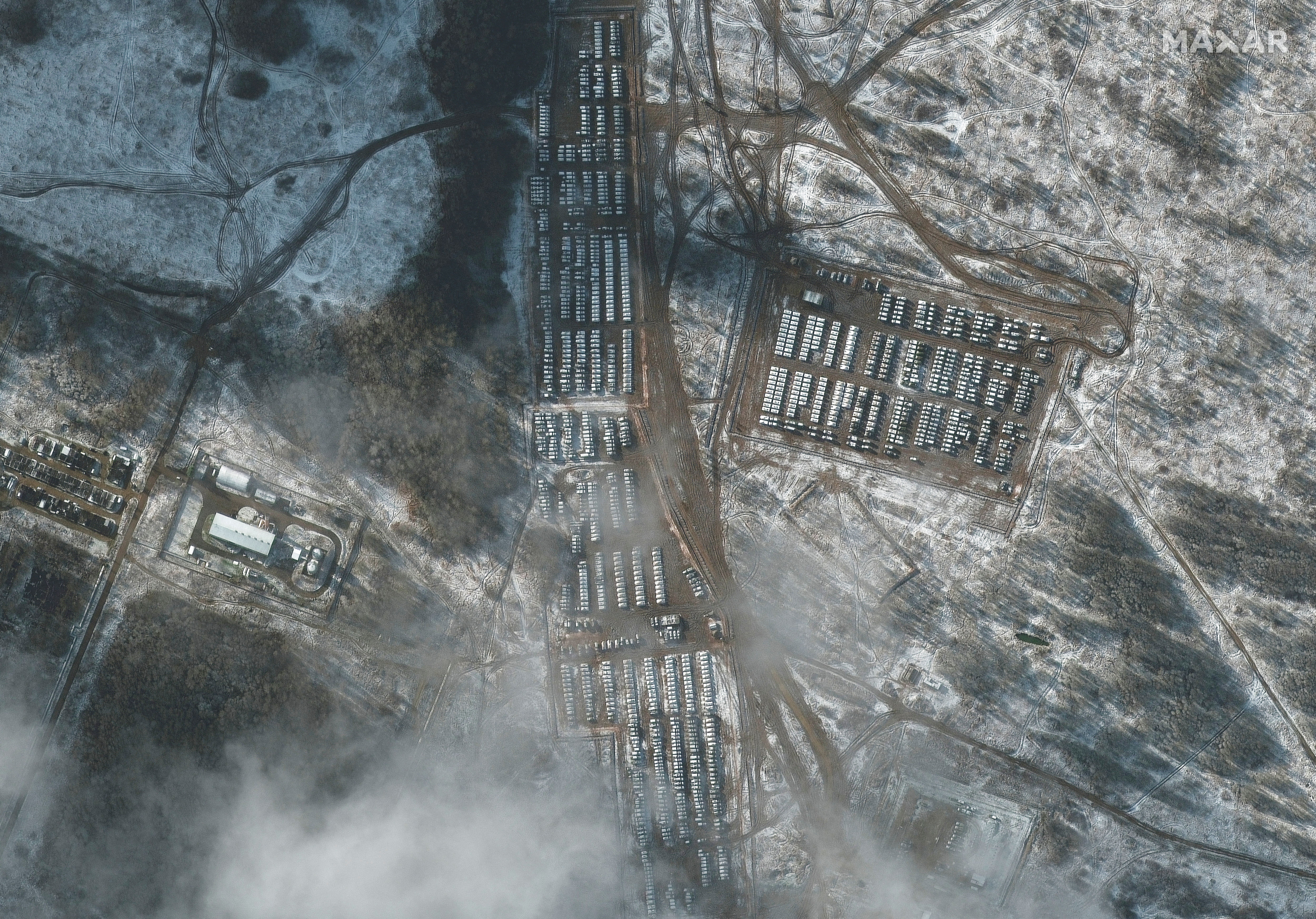
A satellite image shows Russian armored units training in Pogonovo Training Area near Voronezh, Russia, November 26, 2021.
Picture taken November 26, 2021. Satellite Image ?2021 Maxar Technologies/Handout via REUTERS
Dec 24 (Reuters) – New satellite images captured by a private U.S. company show that Russia has continued to build up its forces in annexed Crimea and near Ukraine in recent weeks while pressing the United States for talks over security guarantees it is seeking. Reuters could not independently verify the latest images from U.S.-based Maxar Technologies. The Kremlin reiterated on Friday that it reserves the right to move its own forces on Russian territory as it sees fit and that Western countries were carrying out provocative military manoeuvres near its borders. U.S., European and Ukrainian leaders have accused Russia of building up troops again near Ukraine’s border since October after an earlier brief buildup in April, when Maxar also released images. U.S. President Joe Biden and other leaders say Moscow appears to be weighing an attack on Ukraine as soon as next month, something Moscow has repeatedly denied. The images released late on Thursday showed a base in Crimea, which Russia annexed from Ukraine in 2014, packed with hundreds of armoured vehicles and tanks as of Dec. 13. A Maxar satellite image of the same base in October showed the base was half empty.Maxar said a new brigade-level unit, comprised of several hundred armoured vehicles that include BMP-series infantry fighting vehicles, tanks, self-propelled artillery and air defence equipment, had arrived at the Russian garrison.”Over the past month, our high-resolution satellite imagery has observed a number of new Russian deployments in Crimea as well as in several training areas in western Russia along the periphery of the Ukraine border,” Maxar said in a statement.It cited increased activity at three sites in Crimea and at five sites in western Russia. President Vladimir Putin said on Thursday that Russia wanted to avoid conflict, but needed an “immediate” response from the United States and its allies to its demands for security guarantees. read more Moscow has said it expects talks with U.S. officials on the subject to start in January in Geneva. On Friday, Putin said Russia had conducted a test launch of a hypersonic missile. The test follows earlier ones this month, in October, and in July as part of what he said was a new generation of unrivalled arms systems. When asked on Friday about the build-up of Russian troops near Ukraine, Kremlin spokesperson Dmitry Peskov said Moscow was acting to defend its own security.”Russia is moving its own troops around on its own territory against the backdrop of highly unfriendly actions by our opponents in NATO, the United States and various European countries who are carrying out highly unambiguous manoeuvres near our borders,” said Peskov. “This forces us to take certain measures to guarantee our own security.”Russia also accused the United States and the European Union of using the planned Nord Stream 2 pipeline to take Russian gas to Europe as a bargaining chip. The West has threatened to block the pipeline, which is awaiting regulatory approval in Germany, if Russia invades Ukraine. Biden has threatened strong economic and other measures in retaliation for any invasion, building on sanctions imposed over Moscow’s 2014 annexation of Crimea and backing for an ongoing separatist rebellion by pro-Russian forces in eastern Ukraine. read more A U.S. official has said new retaliatory measures could include tough export controls. Russia says its wants NATO to halt its eastwards expansion and is seeking guarantees that the Western military alliance will not deploy certain offensive weapons to Ukraine and other neighbouring countries. Other Maxar images showed a build-up at the Soloti staging ground in Russia close to the Ukrainian border, with photos shot at the start of December showing a larger concentration of military hardware than in September. Pictures also showed continuing build-ups at Yelnya, a Russian town around 160 miles (260 km) north of the Ukrainian border, and at the Pogonovo training ground near the southern Russian city of Voronezh. NN: Its simple. Germany opens up Nord Stream II pipeline and all this goes away.
WASHINGTON/NEW YORK, Dec 26 (Reuters) – U.S. airlines canceled more than 1,300 flights on Sunday as COVID-19 thinned out the number of available crews, while several cruise ships had to cancel stops after outbreaks on board, upending the plans of thousands of Christmas travelers. Commercial airlines had canceled 1,318 flights within, into or out of the United States by mid-afternoon, according to a tally on flight-tracking website FlightAware.com. At least three cruise ships were also forced to return to port without making scheduled port calls after COVID-19 cases were detected on board, according to multiple media reports. It was the third straight day of pain for some Americans traveling over the weekend as the Christmas holidays, typically a peak time for travel, coincided with a rapid spread of the Omicron variant nationwide. Dr. Anthony Fauci, the nation’s top infectious disease official, warned of rising U.S. cases in coming days and potentially “overrun…hospitals, particularly in those regions in which you have a larger proportion of unvaccinated individuals.” “It likely will go much higher,” he said of the Omicron-driven surge even as President Joe Biden last week unveiled new actions aimed at containing the latest wave and continued urging vaccinations and other prevention strategies.With rising infections, airlines have been forced to cancel flights with pilots and cabin crew needing to quarantine while poor weather in some areas added to travelers woes. A total of 997 flights were scrapped on Christmas Day and nearly 700 on Christmas Eve. Thousands more were delayed on all three days. A Delta Airlines spokesperson said “winter weather in portions of the U.S. and the Omicron variant continued to impact” its holiday weekend flight schedule but that it was working to “reroute and substitute aircraft and crews.” United Airlines also said it was working to rebook impacted passengers, while a Southwest Airlines spokesperson said its cancellations were all weather related. Overall, U.S. airports most heavily impacted were in Seattle, Atlanta, Los Angeles, Dallas-Fort Worth and JFK International in New York. A White House official, who asked not to be named, said the administration was monitoring the delays closely but noted that while they can disrupt plans “only a small percentage of flights are affected.” Delta on Sunday canceled 167 flights or 6%; United canceled 115 flights or 5% and American canceled 83 flights or 2%, according to FlightAware. Globally, 3,023 flights were called off and more than 13,742 were delayed, as of 8:15 p.m. EST on Sunday (0015 GMT Monday), FlightAware data showed. Meanwhile, a Royal Caribbean Cruises Ltd (RCL.N) cruise ship turned back to Ft. Lauderdale, CNN reported, and on Sunday a Carnival Corp (CCL.N) ship returned to Miami after COVID was detected onboard, although it was unclear if the cases were Omicron. Carnival said “a small number on board were isolated due to a positive COVID test” on board its Carnival Freedom ship, which again left Miami later on Sunday for its next trip with another round of passengers. “The rapid spread of the Omicron variant may shape how some destination authorities with limited medical resources may view even a small number of cases, even when they are being managed with our vigorous protocols. Should it be necessary to cancel a port, we will do our best to find an alternative destination,” it said in a statement. A Holland America ship also returned to San Diego on Sunday after Mexican authorities banned it from docking in Puerto Vallarta citing onboard cases, NBC News and Fox News reported. Carnival, which owns Holland America, did not address that reported incident in its statement.Representatives for Royal Caribbean did not respond to a request for comment. Overall, COVID-19 outbreaks altered at least six sailings in the past week, the Washington Post reported, echoing the turmoil facing the industry after COVID erupted in early 2020. Testing woes have compounded the travel angst, as many Americans scrambled for their status amid long lines and lack of at-home test kits amid the holiday travels. “We’ve obviously got to do better. I mean, I think things will improve greatly as we get into January, but that doesn’t help us today and tomorrow,” Fauci told ABC’s “This Week.” Meanwhile, some states are already bracing for the upcoming New Year’s holiday weekend, warning residents to reduce potential exposure to the virus.
“Omicron is surging statewide,” Louisiana’s health department tweeted on Sunday, noting Omicron-related hospitalizations had doubled in the past week. “We are urging everyone to take safety precautions ahead of New Year’s Eve.”
NN: The horror show I warned you about (bark Bark BARK) starts all over again. And as in the past the lack of leadership is painfully apparent. No test kits, people totally confused about vaccines and masks. AND no vaccine requirements.I am told on the airplanes and cruise ships it been a free for all. The travel and leisure industry does not give a shit about their clients. Its a mad scramble to fill seats, book cabins and occupy room. Instead of lock downs we will get shut downs. To my horror the next super spreader even New Years is soon upon us. Their will be hell to pay.
The New York State Department of Health warned of an increase in children hospitalized with COVID-19, in a notice sent to doctors on Christmas Eve. “NYSDOH is closely monitoring an upward trend in pediatric hospitalizations associated with COVID-19,” the notice read. The jump in hospitalizations of children — who usually face very mild COVID-19 cases — is “concentrated in New York City and the surrounding greater metropolitan area,” according to the health advisory.
Pediatric admissions in the city have risen four-fold from the week starting December 5, 2021, to the week starting December 19, according to the bulletin, which did not quantify the actual number of children hospitalized.
The DOH did not immediately return a message seeking the number of hospitalizations. About half of the children hospitalized were under five, and therefore ineligible for the vaccine, according to the notice, which encouraged physicians to continue to promote social distancing and wearing “a well-fitting mask” among their younger patients. In addition, the notice advises doctors to remind parents “not to assume a mild respiratory illness is a routine ‘cold’; test for COVID-19.” NN: as you know i am adamantly opposed to sending vaccinate kids to school. If you must i urge you to give them our N95 fun masks or the kiddie sized N95 masks we offer.Fun masks with filters here
Europe’s energy crisis worsened this week when Kosovo introduced rolling blackouts to most of its two million citizens, according to Bloomberg. On Thursday, the Kosovo Energy Distribution Services (KEDS) announced rolling two-hour power blackouts for 2 million people due to an “overload” of its electrical grid. KEDS asked customers to reduce power given “insufficient internal generation to cover consumption and the global energy crisis.” The Balkan country, Europe’s poorest nation, experienced a technical issue at its largest coal-fired power plant that had to shut down last month, which forced the government to import electricity at high prices. Simultaneously, Serbia was forced to cut electricity to customers, Britain’s network operator issued a power supply warning, and France’s nuclear plant outage, all culminated into a perfect storm of straining the continent’s grid, resulting in reduced power supplies and exorbitantly high prices. Last week, Kosovo’s economy minister, Artane Rizvanolli, said the shuttering of the nation’s main coal-fired power plant had worsened the energy crisis. He said power imports were “extremely costly.”
Jeremy Weir, CEO of commodities trader Trafigura Group, warned that more European countries could face rolling blackouts in the event of a severe winter.
Eleven European associations (from steel to fertilizers to cement to paper mills) published a memo Thursday indicating energy-intensive companies are paying “unbearably high energy prices” that may force them to shutter operations. However, there is good news for the continent as benchmark Dutch front-month gas plunged as much as 43% from a peak of 180 euros per megawatt-hour to around 102 euros in the last several days as a flotilla of US liquefied natural gas (LNG) tankers is headed to the fuel-starved continent. More good news is that weather forecasts for Germany will turn milder. This will help keep a lid on gas prices. Europe remains caught in its worst energy crisis ever as some relief is on the way, but the worst may not be over as the Northern Hemisphere winter has just begun. NN: Talk about a self inflected wound. Is it not ironic their solution to climate change the wind mill is not supplying the anticipated power. WHY because climate change has reduced the wind in northern Europe and the wind mill are not providing their designed power. Is it not the height of stupidity to rely upon a unproven power source and simultaneous shit can proven power sources like nuclear and natural gas. I hope the greeneewennies freeze their asses off.