Natural gas prices in Europe soar on pipeline setback

UK and EU wholesale gas prices have risen by 17% after Germany’s energy regulator suspended approval of the controversial Nord Stream 2 natural gas pipeline from Russia to Germany.

It said the pipeline’s operating company needed to be compliant with German law before it would certify the €10bn (£8.4bn) project. Critics fear the pipeline will increase Europe’s energy dependence on Russia. The pipeline was finished in September, but it had been beset by delays. Running under the Baltic Sea, Nord Stream 2 will double Moscow’s gas exports to Germany, but it will also circumvent Ukraine, which relies on existing pipelines for income and would be hard-hit by the loss of transit fees. German businesses have invested heavily in the 1,225km (760-mile) pipeline and former Chancellor Gerhard Schröder has played a big role in its development. Gas prices were already high before this latest setback for the project. A cold winter in Europe last year put further pressure on supplies and, as a result, stored gas levels are much lower than normal.The German regulator said “it would only be possible to certify an operator of the Nord Stream 2 pipeline if that operator was organised in a legal form under German law”.  The decision is likely to set the project back several months and even when it receives German approval it will require a green light from the European Commission. The regulator said its approval procedure would remain suspended until “the main assets and human resources” had been transferred from the Swiss-based Nord Stream 2 parent company to its German subsidiary, which owns and operates the German part of the pipeline. Ukraine has opposed Nord Stream 2, described by President Volodymyr Zelensky as a “dangerous geopolitical weapon”. This week, UK Prime Minister Boris Johnson said a choice was coming shortly “between mainlining ever more Russian hydrocarbons in giant new pipelines and sticking up for Ukraine and championing the cause of peace and stability”. German Chancellor Angela Merkel said recently that further sanctions might be imposed on Russia if it used the pipeline against Ukraine. The German regulator’s decision to suspend certification has been welcomed by Ukrainian energy firm Naftogaz. And Polish gas company PGNiG responded with a call for energy solidarity in the EU to ensure security of supplies. The Nord Stream 2 consortium declined to comment on possible delays to gas exports. Under the EU’s gas directive, gas producers have to be separate from the company that owns the pipeline As well as Germany’s Uniper and BASF’s Wintershall unit, other European companies have stakes too, including Anglo-Dutch Shell, OMV of Austria and Engie of France. Germany’s government estimates that “natural gas will continue to make a significant contribution to energy supply in Germany over the coming decades”, saying it is “more climate-friendly compared to other fossil fuels as it produces less CO2”. But environmentalist groups in the country such as Deutsche Umwelthilfe oppose Nord Stream 2, arguing that it is incompatible with Germany’s emissions goals in the battle against man-made climate change. NN: This is some crazy shit: The grenniesswenniees do not want the dutch to open up Europe’s huge gas field in the Netherlands because of the “danger” to the environment… But the powers that be are duplicating the gas buying it from from Russia. What is the difference. At the end of the day they still burn domestically the same amount of gas. Its amazing to me how stupid people are
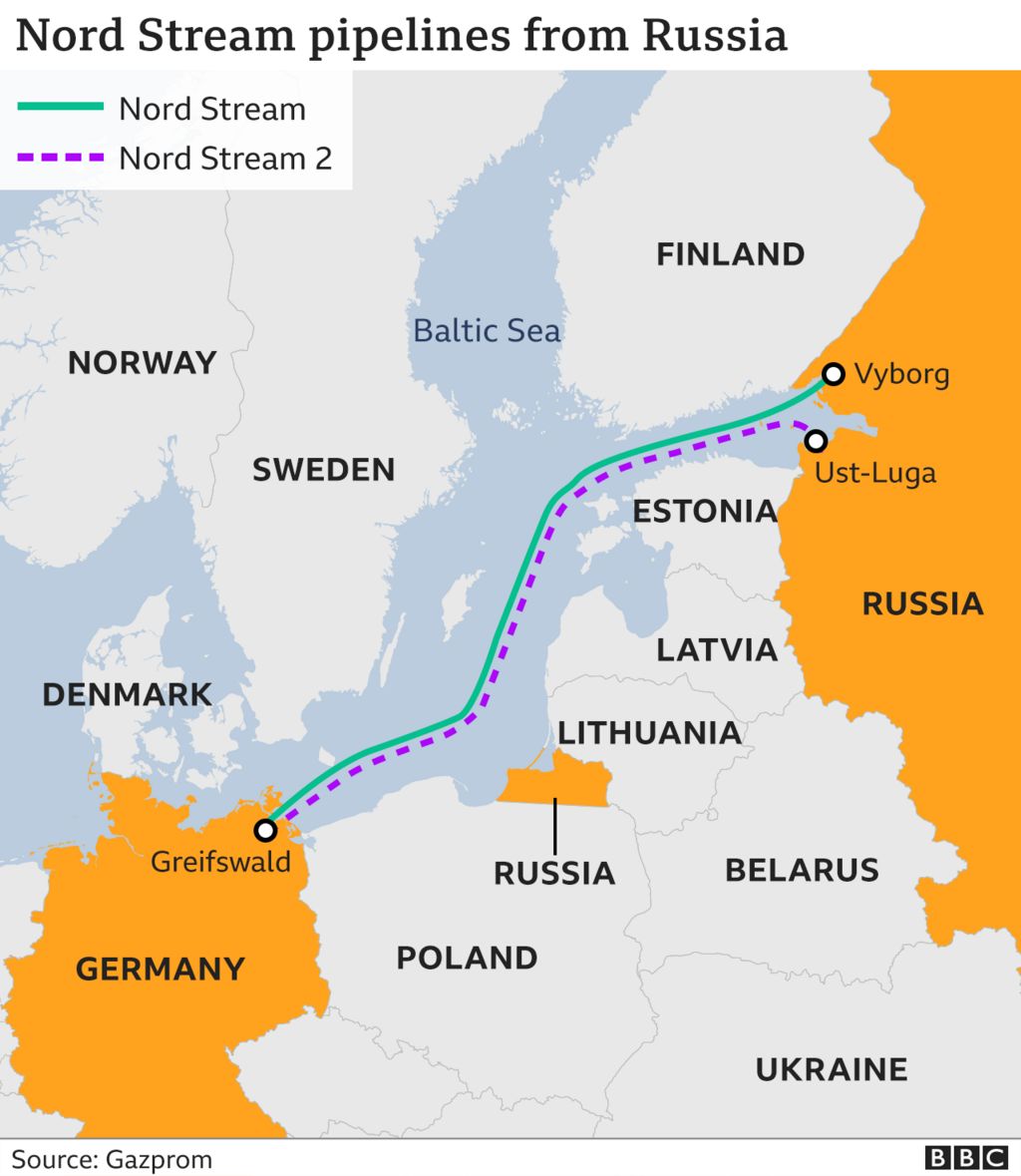
BBC graphic

Germany’s coronavirus situation is dramatic, Merkel says

BERLIN (Reuters) -Germany’s coronavirus situation is dramatic, Chancellor Angela Merkel said on Wednesday, calling for a push to distribute booster shots faster and appealing to those sceptical of vaccination to change their minds. Germany reported 52,826 new infections on Wednesday – a jump of a third compared with a week ago and another daily record, while 294 people died, bringing the total to 98,274, as the pandemic’s fourth wave tightened its grip on Europe. “It is not too late to opt for a first vaccine shot,” Merkel told a congress of German city mayors. “Everyone who gets vaccinated protects himself and others. And if enough people get vaccinated that is the way out of the pandemic.” Only 68% of people in Europe’s most populous country are fully vaccinated – lower than the average in western Europe due to a tradition of vaccine hesitancy, while 5% of the population has had a booster shot. Merkel, governing in a caretaker capacity during negotiations to form a coalition government after an election in September, said there needs to be a national effort to get mass distribution of vaccine booster shots underway. She also appealed to federal and regional leaders meeting on Thursday to introduce a measure that would trigger tighter restrictions based on the number of infected people who have to go to hospital in a week.

Germany has enough doses for a booster campaign, in part because it has delayed plans to donate vaccines to the COVAX facility that distributes them to poorer countries, Health Minister Jens Spahn said.

The Social Democrats, Greens and Free Democrats, who are negotiating to form the next government, are set to propose a range of measures to fight the pandemic in a draft law set to be voted on in parliament on Thursday. They want to force people using public transport or attending workplaces to provide a negative COVID-19 test, or proof of recovery or vaccination. NN: its not the first jab that is the issue here. Its the fact that immunity wears off after 6 months. The message should be get your booster shot…… Unfortunately this is political and the message is not based on science….. What part of you have lost your immunity after 6 months is so hard to understand. What is it about telling people to get their third vaccines is so difficult to understand….. The world has gone stark raving mad.

Washington asks Beijing to release oil reserves – report

The United States has asked China to release oil reserves to help stabilise soaring international crude oil prices as part of ongoing discussions on economic cooperation between the two countries.

The US wants China to join it in releasing crude oil reserves and the issue was raised during the virtual meeting between Chinese President Xi Jinping and US President Joe Biden on Tuesday, according to a person familiar with the matter.

The issue was also broached during a phone conversation between Chinese foreign minister Wang Yi and US Secretary of State Antony Blinken two days earlier. “One of the pressing issues for both sides is energy supply,” the person said, who requested anonymity as the information is not public.

“Currently, the energy departments from both sides are negotiating the details,” the person said, adding that China is open to the US request but has not committed to specific measures yet, citing the need to consider its domestic consumption needs.

Source familiar with the matter The US has the world’s largest reported strategic petroleum reserve at 727 million barrels whereas China has about 200 million barrels and is by far the world’s largest importer of crude oil. If the two countries jointly take action, it will have a deep impact on global oil prices. Regardless of China’s decision, Washington is likely to announce – as early as next week – that it will start to gradually release strategic petroleum reserves into the market early next year. Speaking in a teleconference later on Tuesday, Vice Premier Han Zheng said authorities would be closely monitoring international energy market changes. “(We must) strengthen management of energy trade and reserves management to better guide and stabilise market expectations,” he said, according to a report by state news agency Xinhua. The Biden administration is under growing pressure to consider releasing strategic reserves, after US inflation jumped above 5 per cent for six straight months, due to pandemic-related supply disruption and monetary stimulus by the Federal Reserve. The US inflation rate hit 6.2 per cent in October. Earlier this month, the Organization of Petroleum Exporting Countries (OPEC) and its allies refused a US request to produce more crude. US West Texas Intermediate, a crude benchmark, is up 67.5 per cent year to date. “We need immediate relief at the gas pumps and the place to look is the Strategic Petroleum Reserve,” Senate Majority Leader Chuck Schumer was quoted by Reuters as saying on Sunday. In Tuesday’s Xinhua report, Xi said the world’s two-largest economies should advocate for the international community to jointly safeguard global energy security and strengthen natural gas and new energy cooperation. NN: All China and the US has to do is make up no more then 2 million barrels a day  of what OPEC is holding off the market. Between the US and China they have a billion barrels in  storage. Releaseing 2 million barrels a day form their strategic stock pile is nothing.  It would easily bring oil to $40 to $50 a barrel in two months

ear off…. No matter your age vaccines wear off

People’s ages had no effect on the vaccine’s waning, meaning that the vaccine waned for everyone and not just older people
People vaccinated with two shots of the Pfizer coronavirus vaccine in January and February had a 51% increased chance of contracting the virus in July compared to those who were vaccinated in March or April, a new Israeli study published in Nature Communications has shown.
 The team of researchers from KI Institute worked with doctors from KSM Research and Innovation and used data provided by Maccabi Health Services to conduct a retrospective cohort study comparing the incidence rates of breakthrough infections and COVID-19-related hospitalizations between people vaccinated toward the beginning of the country’s campaign (January and February) and those vaccinated toward the later stages (March and April). The study included more than 1.3 million records.
As noted, the risk of infection was significantly higher for people the earlier they were vaccinated, with an additional trend for high risk of hospitalization. The results, the researchers said, are consistent with other
studies on the subject that show a decline in antibody levels and immune system compounds after four to six months.
Moreover, people’s ages had no effect on the vaccine’s waning, meaning that the vaccine waned for everyone and not just older people. NB: obviously only giving the the third shot to the eldery puts the younger people at extreme risk. As i have been screaming for the past 6 months. Everyone 6 months out needs a booster shoy

The Health & Wellness portal is presented in collaboration withSamson Assuta Ashdod University Hospital  “The vaccine’s effectiveness wanes equally for everybody, according to the study,”  Dr. Barak Mizrahi, a researcher in computational health for KI Institute who led the study, said. Israel set a policy to administer a third shot to all individuals over the age of 12, in contrast to many other countries and the recommendation of the World Health Organization only to give the third jab to people at the highest risk of contracting the virus or developing serious disease.

 More than four million Israelis have taken a booster shot. The results were that the infection rate dropped significantly. Mizrahi explained that the vaccine waned more the further one got away from the original second dose, meaning that people vaccinated in January were more at risk of contracting corona than people vaccinated in February and so forth.

Will the third dose last longer?

Mizrahi said that it is difficult to tell at this stage. Very preliminary data has started to be collected in various studies that shows antibodies are waning after the third shot, too. However, he said that the level of antibodies is not the only factor when it comes to immunity. Officials will need to watch and see if infections start going up and then set vaccination policy accordingly, Mizrahi said. “I don’t think it will take us that long to know,” he concluded. The study was done as the Delta variant was burning across the country and many believed that the variant may be the cause of increased infection in Israel. Mizrahi said the study shows that the variant was likely less of a factor than assumed – though this is still not confirmed.

U.S. offshore oil auction begins under court order, shadow of climate deal

(Reuters) – The Biden administration on Wednesday will auction oil drilling rights to 80 million acres in the U.S. Gulf of Mexico days after joining a global agreement that for the first time targeted fossil fuels as the main driver of global warming. The sale by the Department of Interior will be the first under President Joe Biden, whose administration paused drilling sales under a promise to end development on federal properties. But Biden lost a court fight to oil-producing states that sued to reinstate the sales. The administration has appealed and a suit by environmental groups seeking to halt the sale is pending. The U.S. is moving ahead to hold onshore lease auctions in several states early next year. Interior’s Bureau of Ocean Energy Management will auction almost all available unleased Gulf of Mexico blocks, 80 million acres, at a live-streamed event on Wednesday morning. It will be the first opportunity to test the oil and gas industry’s demand for Gulf acreage with energy prices at multi-year highs. U.S. crude futures on Tuesday settled at $80.76 a barrel, up 95% in the last 12 months. The Trump administration’s final Gulf sale, held last November, generated a modest $121 million in high bids. But oil companies Royal Dutch Shell, BP and Chevron are seizing on the higher prices to advance offshore projects. Despite the court-ordered resumption of auctions, Interior spokesperson Melissa Schwartz said the agency was “conducting a more comprehensive analysis of greenhouse gas impacts from potential oil and gas lease sales than ever before.” Environmentalists called for Biden to halt the sale via executive order. “Biden has the authority to stop this, but instead he’s casting his lot in with the fossil fuel industry,” said Kristen Monsell, senior attorney for the Center for Biological Diversity. Ocean conservation group Oceana said the administration should “explore every opportunity to uphold the president’s commitment to protecting our communities, our climate, and our economy from the threat of drilling.” NN: Reality is the “energy crises” is a direct result of the lefty liberals that marched into town with the Biden presidency and their anti oil policies. The good news  is it will get the democrat driven out of town on a rail….

Oil drops as U.S. gasoline stock draw boosts prospects of SPR release

SINGAPORE (Reuters) – Oil fell on Wednesday after an industry report showed U.S. gasoline stocks dropped more than expected last week, potentially heightening pressure on the Biden administration to release oil from emergency reserves to cap soaring fuel prices. U.S. West Texas Intermediate (WTI) crude futures fell 69 cents, or 0.9%, to $80.07 a barrel at 0635 GMT, extending a 12 cent loss from Tuesday. Brent crude futures dropped 66 cents, or 0.8%, to $81.77, erasing Tuesday’s 38 cent gain. U.S. President Joe Biden has been considering releasing oil from the Strategic Petroleum Reserve (SPR) to cool gasoline prices, which hit a record high at California pumps this week. Lawmakers, however, have mixed views on whether it is needed. The United States is the world’s biggest oil user. U.S. House Majority Leader Steny Hoyer said late on Tuesday he did not agree with Senate Majority Leader Chuck Schumer’s call on Sunday for tapping the SPR to lower gas prices, saying the reserve was there to fill a crude oil supply gap in times of emergency. “With holiday season around the corner, increase in travelling demand may be the reason behind the decline in U.S. gasoline stocks. (Now) that may bring President Biden more pressure to release the U.S. Strategic Petroleum Reserve, which may put oil prices at risk,” said Leona Liu, analyst at Singapore-based DailyFX. “In the short-term, the upcoming EIA inventory report may act as a catalyst for the next move,” she said, referring to the Energy Information Administration, which will release its weekly report later on Wednesday. Analysts say SPR oil would only offer temporary relief and what is needed is increased supply from U.S. shale producers or the Organization of the Petroleum Exporting Countries (OPEC). “It seems the energy market is convinced that even if the U.S. resorts to tapping the Strategic Petroleum Reserve, the benefits would be minimal … to the U.S. consumer,” OANDA analyst Edward Moya said in a note.

WTI Crude up On Cushing Inventory Draw, Gasoline Draw

API

Crude +5.213mm (+900k exp)

Cushing -2.275mm

Gasoline -4.575mm (+600k exp)

Distillates -2.707mm (-1.1mm exp)

A big build in crude stocks was offset from a market perspective by the big gasoline draw in the prior week…

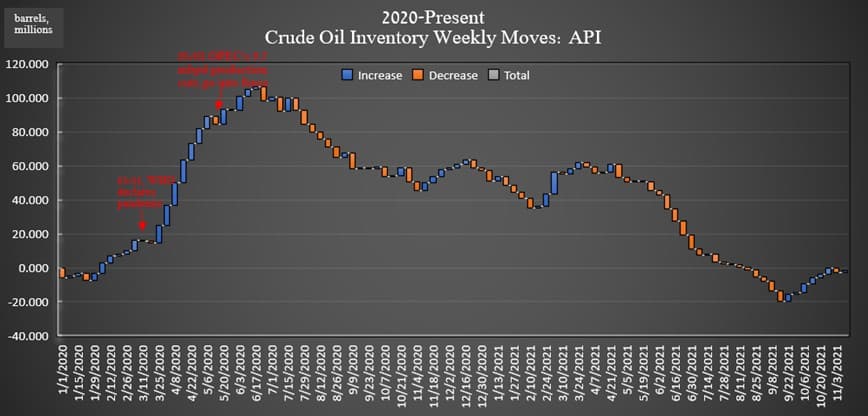
Crude oil inventories in the United States increased by 655,000 barrels in the week ending November 12, private data from the American Petroleum Institute (API) reportedly showed on Tuesday. Reserves in Cushing, Oklahoma, allegedly decreased by 491,000 barrels. Gasoline stockpiles declined by 2.8 million barrels, while distillate inventories grew by 107,000 barrels, according to the reported data. Brent for January 2022 deliveries rose by 0.38% to go for $82.48 per barrel at 4:29 pm ET, while West Texas Intermediate (WTI) for settlements in December was 0.26% lower, selling for $80.71 per barrel a minute later. U.S. crude inventories are now 60 million barrels below where they were at the beginning of the year.

U.S. oil production for the week ending November 5—the last week for which the Energy Information Administration has provided data—stayed the same at 11.5 million bpd, a figure that is only1.6 million bpd below the all-time pre-pandemic high of 13.1 million bpd. The API reported a draw in gasoline inventories of 2.792 million barrels for the week ending November 12—on top of the previous week’s 552,000-barrel draw, as high gasoline prices in the United States continues to draw attention. Distillate stocks saw an increase in inventories of 107,000 barrels for the week, on top of last week’s 573,000-barrel increase. Inventories at the largest U.S. oil hub, Cushing, continued to draw this week. The API estimated the draw at cushing to be 0.491 million barrels.

Fed officials say high inflation weighing on consumers and needs to be controlled

(Reuters) – Federal Reserve officials said on Tuesday they are vigilant of the ways that higher inflation can affect U.S. households and dampen consumer sentiment and want to get it under control. While wages are rising for some workers, consumer sentiment is down to a “level that you might associate with a recession,” said Richmond Fed President Thomas Barkin, citing the consumer sentiment survey from the University of Michigan. “I think that’s very much because of the impact that prices have on people,” including those who spend a significant part of their pay on food and gas, Barkin said during a virtual panel organized by the Fed. Atlanta Fed President Raphael Bostic said the central bank aims for low inflation because it doesn’t want households to stress about rising prices. “That’s one of the reasons why, you know, I think you’ve heard from all of us concerns about the higher levels of inflation that we’ve seen recently and the need to get that back under control,” Bostic said. The Fed this month began to reduce the pace of its monthly asset purchases, the first step in scaling back the support offered to the U.S. economy during the pandemic. Fed officials would like to wind down the bond purchases before they raise interest rates. Some policymakers say the Fed should be prepared to act in case inflation lasts longer than expected. St. Louis Fed President James Bullard, speaking earlier in the day, said the Fed should “tack in a more hawkish direction” over its next couple of meetings to be prepared in case inflation does not ease. “If inflation happens to go away we are in great shape for that. If inflation doesn’t go away as quickly as many are currently anticipating it is going to be up to the (Federal Open Market Committee) to keep inflation under control,” Bullard said on Bloomberg Television. NN: The last thing in the world. The Fed is as far away as you can get about being “diligent” on Inflation. The greatest FUCK up of any fed on any monitory policy  issue ever. It is their mandate to control;; inflation. Now clocking over 7% bases the CPI. Their mandate was 2.5% inflation MAX>>>. Let me be clear here. The Fed is down to praying for a miracle. Fed Funds with inflation out of control should be 5% not ZERO!  And their may be big changes at the Fed if Biden’s lefty liberals have their way… Time for a scapegoat… Unfortunately its to late for the US economy..

99% of COVID infections Delta variant – WHO


  1. Almost all of the up to 900,000 Covid cases sequenced worldwide over the last 60 days originated from the delta strain, Maria Van Kerkhove, the WHO’s technical lead on Covid, said.
  2. Europe accounted for roughly 60% of the more than 3.3 million new cases in the world last week, Van Kerkhove said.
  3. Covid cases worldwide have been increasing over the last four consecutive weeks, she added

The delta variant, first detected in India a little less than a year ago, now represents 99% of sequenced Covid-19 cases globally, making it more prevalent than any other strain, officials from the World Health Organization said Tuesday. Almost all of the up to 900,000 Covid cases sequenced worldwide over the last 60 days originated from the delta strain, Maria Van Kerkhove, the WHO’s technical lead on Covid, said during a Q&A streamed on the organization’s social media channels. Van Kerkhove’s comments come amid an international increase in Covid infections driven by surging cases in Europe. The Continent accounted for roughly 60% of the more than 3.3 million new cases in the world last week, Van Kerkhove said. “Delta is really the dominant one,” Van Kerkhove said. “And there are two variants of interest – mu and lambda – that we’ve been tracking as well, but again, where delta is present, delta takes over.”    Van Kerkhove said Europe represented more than half of the just under 50,000 global Covid deaths in the last week, a 5% increase in fatalities across the Continent. Covid cases worldwide have been increasing over the last four consecutive weeks, she added.

“The pandemic is heading in the wrong direction at the moment,” Van Kerkhove said.

The decreased use of masks and social distancing are to blame for Europe’s surge, Van Kerkhove said at a briefing last week. She cautioned Tuesday that societies reopening across the Northern Hemisphere this winter could lead to a rise in respiratory illnesses over the months ahead, including influenza and other pathogens. Select European countries are bearing the brunt of the surge. Germany set a record seven-day average of nearly 39,300 new cases on Monday, up almost 40% from the week before, according to a CNBC analysis of data from Johns Hopkins University. The U.K. tallied a weekly average of more than 38,500 new cases Monday, an increase of 13% from the previous week. Seven-day averages in France and Italy were both up by nearly 40% as well. Russia also saw a pandemic high of roughly 1,199 deaths on Monday, Johns Hopkins reported. But its seven-day average case count, over 38,000 infections, decreased by more than 2%. NN: Let me tell you the secret. You can find what you are NOT looking for. The common denominator is the Delta mutation is penetrating the low level anti body shield of people whose vaccine is more then 6 months old…… But that is not PC…. Reality is They should have rolled out the booster shot 6 months ago. And they should have never allowed crowd fests, flying in those disease incubators and Requiring the green pass for people to circulate… Its ok what is coming will be far far worse. their is a price to pay for stupid!


U.S. retail sales surge as Americans kick off holiday shopping,

WASHINGTON (Reuters) – U.S. retail sales surged in October as Americans eagerly started their holiday shopping early to avoid empty shelves amid shortages of some goods because of the ongoing pandemic, giving the economy a lift at the start of the fourth quarter. The solid report from the Commerce Department on Tuesday suggested high inflation was not yet dampening spending, even as worries about the rising cost of living sent consumer sentiment tumbling to a 10-year low in early November. Rising household wealth, thanks to a strong stock market and house prices, as well as massive savings and wage gains appear to be cushioning consumers against the highest annual inflation in three decades. “It’s more important to look at what consumers do than what they say,” said Gus Faucher, chief economist at PNC Financial in Pittsburgh, Pennsylvania. “They are concerned about higher inflation, but they are still in good shape and are continuing to spend.” Retail sales jumped 1.7% last month, the largest gain since March, after rising 0.8% in September. It was the third straight monthly advance and topped economists’ expectations for a 1.4% increase. Sales soared 16.3% year-on-year in October and are 21.4% above their pre-pandemic level. Several of the top U.S. retailers this week have noted an earlier start to holiday shopping. While this could lead to declines in November and December, economists and retailers expect holiday sales this year will be the best in a while. “Today’s numbers show that consumers are getting a jump on their holiday shopping,” said Matthew Shay, president of the National Retail Federation in Washington. “We continue to urge consumers to shop early and shop safely, and we fully expect this holiday season to be one for the record books.”Retail sales are mostly made up of goods, with services, including healthcare, education and hotel accommodation, making up the remaining portion of consumer spending. The nearly two-year long COVID-19 pandemic has caused an acute shortage of labor, delaying deliveries of raw materials to factories as well as shipments of finished goods to markets. October’s broad increase in sales partly reflected higher prices as monthly consumer inflation surged 0.9% in October, which boosted the annual rate to 6.2%. Stocks on Wall Street were trading higher on the data and also as Walmart forecast a strong holiday quarter. The dollar rose against a basket of currencies. U.S. Treasury prices fell. Sales were led by motor vehicles, with receipts at auto dealerships advancing 1.8% after gaining 1.2% in September. The rise reflected the first increase in unit sales in six months, as well as higher prices. The tight supply of automobiles because of a global semiconductor shortage is driving up prices. Sales at service stations increased 3.9%, boosted by more expensive gasoline. Online retail sales rebounded 4.0%. Receipts at building material stores advanced 2.8%. There were also increases in receipts at furniture outlets as well as sporting goods, hobby, musical instrument and book stores. Sales at electronics and appliance stores rebounded 3.8%. But sales at clothing stores fell 0.7%. Sales at restaurants and bars were unchanged despite an ebb in COVID-19 infections, driven by the Delta variant. Restaurants and bars are the only services category in the retail sales report. These sales were up 29.3% from last October. Economists speculated that either high inflation was forcing consumers to cut back on eating out or that spending had permanently shifted in favor of goods. “If services spending has largely recovered, strong goods demand increasingly looks to be a structural shift in consumer preferences, rather than a temporary COVID-related outcome,” said Andrew Hollenhorst, chief U.S. economist at Citigroup in New York. Excluding automobiles, gasoline, building materials and food services, retail sales shot up 1.6% last month after rising 0.5% in September. These so-called core retail sales correspond most closely with the consumer spending component of gross domestic product. Adjusting for inflation, retail sales are up at a roughly 5% annualized rate from the third-quarter average. Consumer spending, which accounts for more than two-thirds of U.S. economic activity rose at a tepid 1.7% rate last quarter. Economists at JPMorgan boosted their fourth-quarter GDP growth estimate to a 5% rate from a 4% pace. Goldman Sachs raised its estimate by 0.5 percentage point to a 5.0% rate. The economy grew at a 2% rate in the third quarter. The economic picture was further brightened by a separate report from the Federal Reserve on Tuesday showing manufacturing output surged 1.2% last month to its highest level since March 2019, after falling 0.7% in September. “The economy has thrown off whatever lethargy it might have had in the summer, and it is growing quite strongly,” said Joel Naroff, chief economist at Naroff Economics in Holland, Pennsylvania. Businesses are also making steady progress replenishing depleted inventories, which should help to keep factories humming and support the economy. Business inventories increased 0.7% in September, a third report from the Commerce Department showed. NN: I call this the last hurrah. They will have a great big drunken orgy and blow their wad. And their new found stock market wealth will go up in smoke. And the next wave of the plague will end their d back to denial and its back to zoom birthday parties…..