LONDON (Reuters) – Oil prices fell on Wednesday after industry data showed crude oil stockpiles rose more than expected and fuel inventories unexpectedly increased last week in the United States, the world’s largest oil consumer. Crude oil inventories rose 2.3 million barrels in the week ending Oct. 22, American Petroleum Institute figures said late on Tuesday. That was the 5th straight weekly increase. Gasoline inventories rose by 500,000 barrels and distillate stocks increased by 1 million barrels, With Brent rising the past eight weeks and WTI climbing for the past 10 weeks supplies are roaring back. “Barring more bullish headlines, which is possible considering what we saw yesterday, we could see some profit-taking in Brent and WTI which would be healthy for the market,” said Craig Erlam, senior market analyst at OANDA. Storage tanks at the Cushing, Oklahoma, delivery hub for WTI oil are more depleted than they have been in the last three years, while prices for longer-dated futures contracts point to supplies staying at those levels for months. But a patchy recovery around the world from the worst health crisis in 100 years, after the COVID-19 pandemic dented demand for months on end, has often led to doubts over the sustainability of prices. “The global oil market is still at risk due to not fully containing the coronavirus and its variants,” said Stephen Brennock of oil broker PVM. “A flare-up in cases over the summer weighed heavily on prices and this could feasibly happen again if the situation worsens.” NN: My position is clear. If they want to pay me $80 a barrel for oil i will sell them some. And if they are fool enough to pay me $90 a barrel i will sell them a whole lot more
Grid Operator: France Needs Nuclear Power For Net-Zero
France could reach net-zero emissions by 2050 if it continues to keep a large nuclear generation fleet in the long term and develop significantly renewable energy sources, the operator of the French grid, RTE, said in a report on Monday on the pathways to reaching carbon neutrality.Nuclear power generates most of France’s electricity. France curre ntly gets more than 70 percent of its total electricity from nuclear power generation and is a major exporter of electricity, including to the UK. France cannot meet its goals by nuclear energy alone, or by renewables only, the grid operator said. The country will need 14 new nuclear reactors and a lot more renewable energy developments if it is to reach net-zero by 2050 at the cheapest cost, it added. Building more nuclear reactors would be feasible if access to financing for nuclear power doesn’t differ from the ease of funding for other low-carbon technologies, the French grid operator said. Earlier this month, French President Emmanuel Macron said that France aimed to become a leader in green hydrogen production and reinvent nuclear power by building a small modular reactor by 2030 as part of a wider $34.6 billion (30 billion euro) plan to decarbonize industry and slash emissions. France’s bet on nuclear power—unlike Germany’s decision to phase out all nuclear plants after the Fukushima disaster—has been vindicated in recent weeks as Europe’s natural gas and power prices hit record highs. The gas and electricity crisis clashed with the net-zero pledges of the European Union and the United Kingdom as some utilities were forced to fire up mothballed coal plants as natural gas prices surged. France also led a group of EU member states, including Finland and several central and eastern European countries, who pushed earlier this week for including nuclear energy in the upcoming green investment rules of the European Union. “To win the climate battle, we need nuclear power,” say the EU member states led by France. This push has divided Europe, and the EU is reportedly delaying a decision on how to deal with nuclear energy, as well as natural gas, in upcoming legislation about which types of energy would classify as eligible for “green financing.”
Factbox-Countries vaccinating children against COVID-19
Number of COVID-19 infections in Spain hits 5 million, Russia, Portugal, England all report a surge in infections
More For You
WTI Crude Hits Highest Level In 7 Years
The culprit behind the latest jump in oil prices isn’t soaring natural gas prices or even OPEC+’s limits on output but rather what is happening at America’s largest oil storage hub in Oklahoma. Traders are fretting that stockpiles in Cushing will fall as low as they physically can. It has sent gauges of market health known as timespreads soaring to their most bullish levels in years, a move that is now spilling over to the global Brent benchmark. Cushing is the delivery point for U.S. crude futures and one of the largest storage hubs in the world. Supply and demand balances there drive daily oil trading worth hundreds of millions of dollars. The higher the cost of oil for prompt delivery relative to later-dated contracts reflects just how short supply is relative to demand. The numbers are eyewatering. For U.S. crude, nearby contracts are at their biggest premium to those for five months later since 2018 — when Cushing stockpiles were near operational lows. The December-December spread, a favored trade of the world’s oil hedge funds, is at its strongest since 2013 a year when prices averaged almost $100 a barrel.
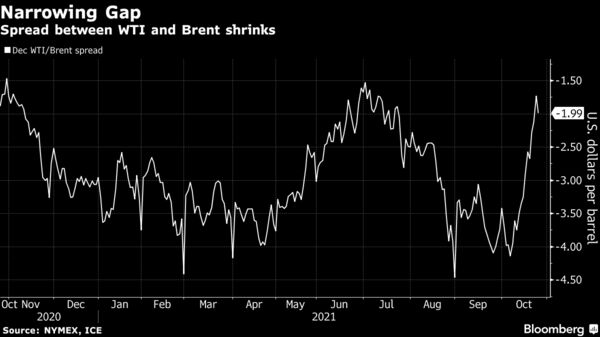
As a result, the oil market is doing whatever it can to keep U.S. crude at home. West Texas Intermediate crude was its smallest discount to international benchmark Brent since April 2020, a move that’s set to curb flows abroad. That means similar quality North Sea barrels are expected to rally, and that is spurring buying of the global Brent benchmark’s structure. Its closely-watched Dec.-Red-Dec. spread is just 60 cents away from a record. “This is really a Cushing story with market fears around tank bottoms,” said Kit Haines, a global crude analyst at consultant Energy Aspects. “WTI is pricing to stay domestic. Brent will have to chase to get the sweet barrels, and already has to a certain extent” he said, referring to those with a low sulfur content. The relative value of lower-sulfur crudes has climbed in recent weeks as natural gas prices boost the cost of hydrogen — a key ingredient in sulfur removal. As a result, Brent’s premium to heavier sour crudes has grown to its widest since 2018 in recent days. Canada is a microcosm of the dynamic with traders across the U.S. shunning its heavy oil production in favor of lighter grades.
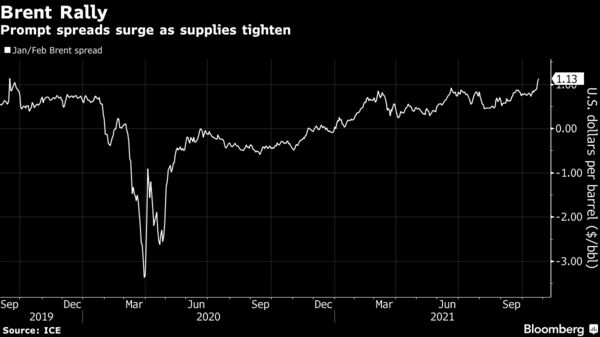
Despite the surge, there are reasons to be cautious. Demand from Asia has helped support physical crude markets in recent weeks but there are some signs of a slowdown. Two supertankers laden with Forties have also been floating off Southwold, England, for more than one month after failing to secure buyers in Asia, according to ship tracking data compiled by Bloomberg. Higher premiums for light-sweet crudes make them less attractive to buyers in Asia and physical differentials are yet to show the same roaring strength as timespreads. The rampant bullishness also shows up in speculative flows. Oil options flows indicate investors strongly favor bullish wagers- known as calls – over bearish bets. Trading of Brent $100 calls has jumped in weeks, and open interest over the next year has almost doubled to more than 80,000 contracts so far this month. There’s also been buying as high as $150 and $200. For now though, the Brent market is following WTI higher as traders wager that light sweet supply will remain tight. The difference between January and February contracts is above a dollar for the first time since 2019, while the February-March spread also topped a dollar. The only other time that spreads further down the futures curve have settled at such strong levels, headline prices were trading closer to $100. “Brent spreads are rallying as the idea of diminished exports from the U.S. with good margins and stronger global runs means that Brent related barrels may have to replace U.S. crudes,” said Scott Shelton energy specialist at ICAP. NN: They have another couple of months until supplies arrive in mass. If they want pay us $100 a barrel for crude we should sell them some
Repsol brings Norway’s Yme oil field back on stream after 20 years
OSLO, Oct 25 (Reuters) – Spanish energy firm Repsol (REP.MC) started oil production at Norway’s Yme field on Monday, the company said in a statement, applying new technology to bring the North Sea petroleum reservoir back on stream 20 years after it was first abandoned. Norway’s Equinor (EQNR.OL) closed Yme in 2001 after only six years of production amid a plunge in crude oil prices, while Canada’s Talisman Energy later gave up an attempt to revive the field. “Achievement of first oil is a true testament to the lean operations of the Yme New Development project,” Repsol said, adding that it was made possible “through the use of new technology and innovation”. The Spanish firm and its partners aim to produce about 63 million barrels in extra recoverable oil reserves, with plateau output seen at 56,000 barrels of oil equivalent per day (boepd), the company said. “COVID-19 has unfortunately caused the project to be delayed and more costly than expected, but we have still managed to deliver the project in a safe and reliable way,” said Vidar Nedreboe, head of Repsol’s Norwegian operations. Repsol has 55% stake and operates the field, while Polish Lotos (LTSP.WA) has 20%, Norway’s OKEA 15% and Kuwaiti KUFPEC the remaining 10%. “With production start in highly favourable market conditions, Yme will add significant positive cash flows going forward and further strengthen OKEA’s positioning for the next growth phase,” OKEA Chief Executive Svein Liknes said. The Norwegian independent said it expected its share of net production from Yme to average about 5,600 boepd for the next 12 months, compared to its total production in the third quarter of 2021 of 16,315 boepd. Norwegian authorities approved the redevelopment plan for the Yme field in 2018 after an earlier project launched by Canada’s Talisman Energy was abandoned over technical problems. Talisman was acquired by Repsol in 2015. Repsol will produce oil using a mobile drilling rig, Maersk Inspirer, modified to serve as a production facility, a more economic solution compared to the previous plan to have a fixed platform. In addition, price of North Sea oil surged to a multi-year highs in October as economies recover from pandemic-induced slumps. Since the plan’s approval in 2018, Yme’s startup has been delayed several times however and its costs rose by a third to 11.9 billion Norwegian crowns ($1.42 billion), Norway’s fiscal budget for 2022 showed earlier this month. NN: Do not let them shit you. All the oil the market could ever want or need is on the way…….
S&P 500 Rebounds To New Record High As Heightened Volatility Confirmed
- SPX reached a new record high on
- Thursday, October 21, closing at 4,549.78, which puts the trajectory of the index into the upper half of the latest redzone forecast range.
- The market is experiencing greater-than-typical levels of volatility.
- The market-moving headlines of the week point to several contributing factors for what new information has contributed to improving the outlook for investors.
Given all the issues that are dominating the news, would you have guessed the S&P 500 (Index: SPX) would reach a new record high? The index closed at a record high of 4,549.78 on Thursday, October 21, 2021, which puts the trajectory of the index into the upper half of the latest redzone forecast range:
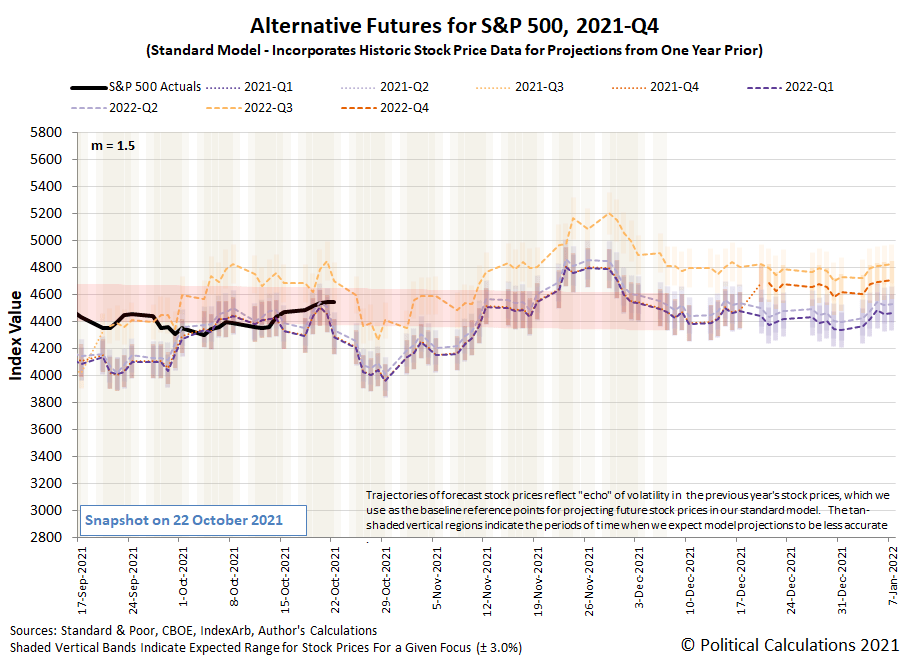
Sharp-eyed readers will catch that the trajectory of the range has itself shifted upward, which is a result of the “dynamic” method we use to set it. When we bridge across periods where the echoes of past volatility in stock prices affect the dividend futures-based model’s projections, the past end of the range is fixed, while the future end “floats” with changes in expectations. For the chart, the rising expectations for the future now means parts of the S&P 500’s actual trajectory that were once within the redzone forecast range now fall outside of it. That’s visible by design in this period, because we set the total width of this forecast range to be plus or minus three percent of the historic typical level of volatility for stock prices. Under typical volatility levels, the trajectory of the index should generally fall well within that statistically determined range. But as the chart visually confirms, the market is experiencing greater-than-typical levels of volatility. For us, what that means is that when we get around to projecting the S&P 500’s future trajectory for 2021-Q4, we’ll need to generate a new redzone forecast, since today’s stock prices will become the base reference points from which we project the future for the index in that period. The echoes of today’s volatility will affect the accuracy of the dividend futures-based model’s projections a year from now. The market-moving headlines of the week point to several contributing factors for what new information has contributed to improving the outlook for investors. was: NN: their is a lot of hyper-blow out their. Their is so much money in the markets because of stimulus insanity everyone is a market Grue. Reality is a precious few really understand what is going on. To be more precise A epic stock market crash is coming. Driven by embedded inflation… And a soon to be desperate FED that has gotten it so wrong…. again. You got to love these pompous pricks they have allowed us to take million out of the market over and over again. So we wait for the stock market rally to continue. We are shorting oil, soon we will short bitcoin and gold. and the big Kahuna,….. A stock market wipe out that will make 1929, 1987, 1990, 1997, 2000-2001, 2007-2008, 2020 look like a cake walk……. I predict our greatest trades ever is this coming stock market crash which will be the 2022-2023 biggest market disaster yet. We need to get our ducks lined up in a row.
Polish Gas Firm To Wean Itself Off Russian Gas After 2022…. Urges the EU not become more dependent on Russia
Polish Oil and Gas Company (PGNiG) doesn’t expect it would be “forced” to buy gas from Russia after its supply deal with Gazprom expires at the end of next year, PGNiG’s chief executive officer Pawel Majewski told Reuters in an interview published on Friday. Poland has been trying for years to shake off its dependence on Russian gas as it considers Russia’s energy policy a threat to energy security. “We assume that after 2022 we will not be forced to buy gas from Gazprom. This is our strategy. That is why we are diversifying gas supplies to Poland – to ensure energy security,” PGNiG’s Majewski told Reuters. The top executive didn’t rule out spot purchases from the Russian gas giant in the future. Aiming to cut its dependence on Russia, PGNiG has signed in recent years several long-term contracts for the delivery of liquefied natural gas with major LNG exporters such as Qatar and the United States. PGNiG has a 24-year contract with U.S. Cheniere for LNG deliveries which began in 2019, and a strategic agreement with Qatar for LNG supply until 2034. Poland, as well as PGNiG, have been vehemently opposing the controversial Gazprom-led natural gas pipeline project Nord Stream 2, which awaits an operational license from German authorities to begin shipping gas to Europe, bypassing Ukraine.PGNiG and PGNiG Supply & Trading (PST) have presented their position to the German energy ministry regarding the certification procedure of Nord Stream 2, the Polish company said on Thursday. “Both companies underlined the risks for security of gas supplies to the European Union resulting from launching of this pipeline,” PGNiG said. “Current situation on the European Union gas market proves the scale of the risks for security of supplies created by Nord Stream 2 project,” Majewski said in a statement. “Suggestions that additional gas supplies are possible only through Nord Stream 2 are the manifestation of pressure on the certification procedure and prove that the project is aimed at bypassing the traditional transit routes. Since there are spare capacities of the existing pipelines, there is no need for Nord Stream 2 to increase gas supplies to the EU Member States,” he added. NN: The Poles of all people know and fear Russia. It would be wise for the EU to listen to polish concerns about starting the Nord Steam 2 gas pipeline from Russia. When they abandoned European sources of energy and rely upon Russia they are literally buy the rope, putting it around their necks and inviting Russia to hang them…
Powell: No time to raise rates…. in the same breath Powell says inflation is ‘well above’ target
There should be no interest rate hikes at this time, United States Federal Reserve Chair Jerome Powell noted on Friday. At the moment, most economic risks are related to “longer” and “more persistent” supply bottlenecks, that result in high inflation, he said during the BIS-SARB Centenary Conference Panel discussion. He specified that the interest rates should not be changed as supply constraints are directly related to the coronavirus pandemic and “we don’t know how long” these and other issues will last.
Powell says inflation is ‘well above’ target
The inflation rate in the United States is now “well above” the 2% target, US Federal Reserve Chair Jerome Powell (pictured) noted on Friday. Answering questions at the Virtual Bank for International Settlements-South African Reserve Bank Centenary Conference, Powell pointed out that the central bank’s approach wasn’t “designed” for the current scenario, and added that the Fed’s two mandates of ensuring stable prices and full employment are “somewhat in tension.” Powell’s remarks were mostly in line with the central bank’s previously expressed stance that the tapering of asset purchases might come in the near future. NN talk about Taking out of both sides of your mouth. Powell admits inflation is running wild and at the same times he says he will not raise interest rates. Hear my words after talking the same shit in 1993 the fed funds rate was 3% and inflation was 2.60%. In 1995 the Fed Raised rates 300 bases point eventually bringing the Fed Funds rate to 6%. this was to lower inflation from 5,4% to 1.6%. One time in a single move they increased the FED Funds rate 75 bases points and kept raising them…. And as inflation was rising like now they claimed it was temporary. Look at the great danger now as inflation is running 5.7% and the Fed funds rate is 0%.. Now you can understand why i am adamant the Fed must and will raise rates 300 to 400 bases points. That will result in a Fed Funds rate of at least 3%. Taking our beloved ZEROES up to 5% and to maybe 6% depending how steep they decide to take the yield curve. These comming rate increases makes gold, silver the Crypto currencies a overwhelming short, when the time is right. And this will wipe out the stock market.
UK’s Newest Gas Projects May Ease Crisis
The U.K’s natural gas production is soon expected to increase, as two new projects come online. Two new projects in the North Sea have recently started to flow gas, according to Bloomberg, and the extra capacity couldn’t come at a better time. The first of the two, Shell’s Arran gas and condensate field in the UK’s North Sea, started to flow gas on September 22, and is expected to produce 21,1000 boepd, with 100 MMcf/d of gas. The second field is NEO Energy’s Finlaggan field, which has also recently started flowing after a delays to the Forties Pipeline that spanned almost a year due to Covid. Another field, Serica Energy’s Columbus development, is expected to come online shortly. Initial production is expected to be 7,000 boepd, about three-quarters of which will be gas. There are other natural gas projects that are expected to come online also, including Harbour Energy’s Tolmount field, and IOG’s—both of which should come online near the end of the year. That’s all well and good for some partial respite from the gas crisis that the UK now finds itself in. But at least one other gas project in the UK that has been recently canceled before it even bega continues to threaten their long-term energy supply. Shell had its Jackdaw gas development there turned down by environmental regulator OPRED earlier this month—even in the throes of a gas crisis—although Shell has proposed some changes to the project in hopes of gaining reconsideration. The project was expected to come online sometime in Q4 2024, and was expected to peak at 4.85 million cubic meters per day. NN: Their are 2 take aways from this story. The first is the fact that solar panels and wind mills will not meet the earths energy needs anytime soon…. if ever. The second take away is natural gas and nuclear will be the bridge power source until the world (if ever) goes to 100% no nuclearrenewables