SEOUL (Reuters) -North Korea carried out successful tests of a new long-range cruise missile over the weekend, state media said on Monday, seen by analysts as possibly the country’s first such weapon with a nuclear capability. The missiles are “a strategic weapon of great significance” and flew 1,500 km (930 miles) before hitting their targets and falling into the country’s territorial waters during the tests on Saturday and Sunday, KCNA said. The latest test highlighted steady progress in Pyongyang’s weapons program amid a gridlock over talks aimed at dismantling the North’s nuclear and ballistic missile programs in return for U.S. sanctions relief. The talks have stalled since 2019. North Korea’s cruise missiles usually generate less interest than ballistic missiles because they are not explicitly banned under U.N. Nations Security Council Resolutions. “This would be the first cruise missile in North Korea to be explicitly designated a ‘strategic’ role,” said Ankit Panda, a senior fellow at the U.S.-based Carnegie Endowment for International Peace. “This is a common euphemism for nuclear-capable system.” It is unclear whether North Korea has mastered the technology needed to build warheads small enough to be carried on a cruise missile, but leader Kim Jong Un said earlier this year that developing smaller bombs is a top goal. The two Koreas have been locked in an accelerating arms race that analysts fear will leave the region littered with powerful new missiles. South Korea’s military did not disclose whether it had detected the North’s latest tests, but said on Monday it was conducting a detailed analysis in cooperation with the United States. The U.S. military’s Indo-Pacific Command (INDOPACOM) said it was aware of the reports and was coordinating with its allies and partners. “This activity highlights (North Korea’s) continuing focus on developing its military program and the threats that poses to its neighbours and the international community,” INDOPACOM said in a statement Rodong Sinmun, the ruling Workers’ Party’s official newspaper, ran photos of the new cruise missile flying and being fired from a transporter-erector-launcher. The test provides “strategic significance of possessing another effective deterrence means for more reliably guaranteeing the security of our state and strongly containing the military manoeuvres of the hostile forces,” KCNA said. It was seen as the North’s first missile launch after it tested a new tactical short-range ballistic missile in March. North Korea also conducted a cruise missile test just hours after U.S. President Joe Biden took office in late January. Jeffrey Lewis, a missile researcher at the James Martin Center for Nonproliferation Studies, said intermediate-range land-attack cruise missiles were no less a threat than ballistic missiles and were a pretty serious capability for North Korea. “This is another system that is designed to fly under missile defence radars or around them,” Lewis said on Twitter.
Markets Sniffing Out The End Of The Delta-Driven Economic Slowdown
While Covid infections continue to rise and weigh on economic data, the markets seem to be seeing a receding in the impact on the horizon. Some might point to the weakness in U.S. stocks last week to refute the point, but that selling was likely exacerbated by investors realizing capital gains in advance of the likely increase in the capital gains tax rate. Since late July, the U.S. economic surprise index has been below zero, with readings below zero indicating that economic releases have been weaker than expected. In contrast, positive readings indicate better than expected economic releases. Despite the continued weakness in the U.S. economic surprise readings, the 10-year Treasury yield has begun to move higher. This weakness in the economic surprise data combined with rising yields is not just a domestic phenomenon. While the Citi global economic surprise readings have been trending lower since mid-June and are currently negative, the percentage of debt currently with a negative yield has also been trending lower since late August. A rise in the amount of negatively yielding debt has typically been associated with weaker expected economic growth. The move higher in global bond yields corresponds with the U.S. 10-year Treasury yields rising While Covid infections are continuing to rise in the U.S. and many other countries, perhaps the decline in the rate of change is some indication that things are already beginning to improve. The momentum of U.K. infections seems to have peaked for now, and the U.S. appears to be following suit. The speed of increase in U.S. Covid cases finally declined after 11 straight increases in week-over-week cases. Interestingly, Japan adds another data point to this narrative since Japan has had significant Covid issues, and the Japanese economy is very dependent on the global economy. The economic surprise data in Japan has been weakening since late May, while the pace of infections began to rise sharply in July. While the weekly growth of infections remains high, the peak momentum was in late August. Japanese stocks hit their recent bottom at roughly the same time as the pace of infections peaked and have outperformed the S&P 500 by almost eleven percentage points since that time. The TOPIX just made a 30-year high by exceeding the level set back in March 1991 The Senate returns from recess on September 13, so the whirlwind of legislative activity from Congress is beginning. While much of the tax and spending bills will likely take until the fourth quarter to be completed, the contemplated actions are likely to add noise and volatility to markets. In addition, the effective date of any proposed increase in the capital gains tax might be on September 15, when the Senate has set the deadline for committees to submit their reconciliation bills. Tuesday’s August consumer inflation readings should still reflect pricing pressures, with the year-over-year rate expected to be at 5.3%. Supply chain issues remain to haunt the data along with demand, but the year-over-year rate should have peaked in July. The August retail sales report should continue the streak of weaker U.S. economic readings. Spending on services had been keeping the retail sales levels near peak levels with goods spending softening. The increase in Delta variant infections likely negatively impacted services spending on the margin. In addition, supply chain issues will put a lid on auto-related sales. Keep an eye on the continued reaction to the weaker economic activity to see if markets look past the current challenges and continue to think the global economy will “break on through to the other side.” Nick Note: I see this market as topping with a few fake outs along the way. I DO NOT WANT TO CHASE THE TOP!
No vaccine passports: UK PM to set out winter COVID-19 plan
LONDON, Sept 12 (Reuters) – British Prime Minister Boris Johnson will this week set out his plans to manage the COVID-19 pandemic in the winter months, announcing a decision to scrap the introduction of vaccine passports and steps to end some emergency powers.
Johnson, under fire from some in his governing Conservative Party for raising taxes to fix a health and social care crisis, looks set to try to soothe those critics by ditching plans to introduce passports despite an increasing number of coronavirus cases.
Speaking to broadcasters, Health Minister Sajid Javid said he did not anticipate more lockdowns and that the vaccine passports would not be introduced in England, as the government depends instead on vaccines and testing to defend the public. “Now that we’re entering autumn and winter … the prime minister this week will be setting out our plans to manage COVID over the coming few months and in that we will be making it clear that our vaccine program is working,” Sajid Javid told Sky News.
He told the BBC he was not “anticipating any more lockdowns” but would not take the measure off the table, that the government would not go ahead with vaccine passports to allow people to attend mass events and he wanted to “get rid of” PCR tests for travelers as soon as possible.
Javid added the government would remain “cautious,” but “the vaccine program, our testing program, our surveillance program, the new treatments … this is all our wall of defense and whilst there’s a lot of virus around, it is working.”
The government was handed sweeping emergency powers in March 2020 with the introduction of the Coronavirus Act, which included measures to allow the authorities to bar protests, shut down businesses and restrict travel. The main opposition Labour Party said it agreed it was a “reasonable” approach to take some measures off the statute book but that lawmakers would study the detail of the proposals. “Obviously we will want to study the detail when it comes to parliament, because there have been huge concerns about the way in which the Coronavirus Act has been misused by the authorities,” Labour’s health policy chief Jonathan Ashworth said. Nick Note: Its gotten political….. Politicians know how to steal money, fuck whores and fuck things up. We are seeing them try to convince us they are scientists. All they are doing is avoiding the hard decisions and making things worse. A great example is the FACT England now has its highest record breaking Covid19 death rate. And the politicians are opening things up even further… Same in the US with opening up the schools . Every school hose in America is a super spreader event in the making. The SCIENTIFIC evidence proves mask or no masks the kiddies and their teachers are getting infected and sickkkkkkkk… What the fuck are we doing?
NICK NOTE…. I hate being misunderstood (YOU WOULD THINK I WOULD BE USE TO IT BY NOW)….. So I have put my thoughts about Fridays close in Writing
- With sell signals in place, volume rising, and breadth weak, a retest of the 50-dma early next week will not be a surprise.
- Deutsche Bank’s strategists ‘expect an imminent correction’ even though they see the S&P 500 rising back around current levels by year-end.
- With supply chain disruptions looking to last longer than expected, the Fed is trapped between supporting a slowing economy and fighting inflation.
The downturn started on Monday with the week ending in 5 straight down days which is the worse slide since February. The total decline for the week was just -1.69%. Yes, that’s it, less than 2%. Robin Hood traders who have never seen such a things were sacrificing rabbits and drinking chicken blood begging the FED to interveneNI.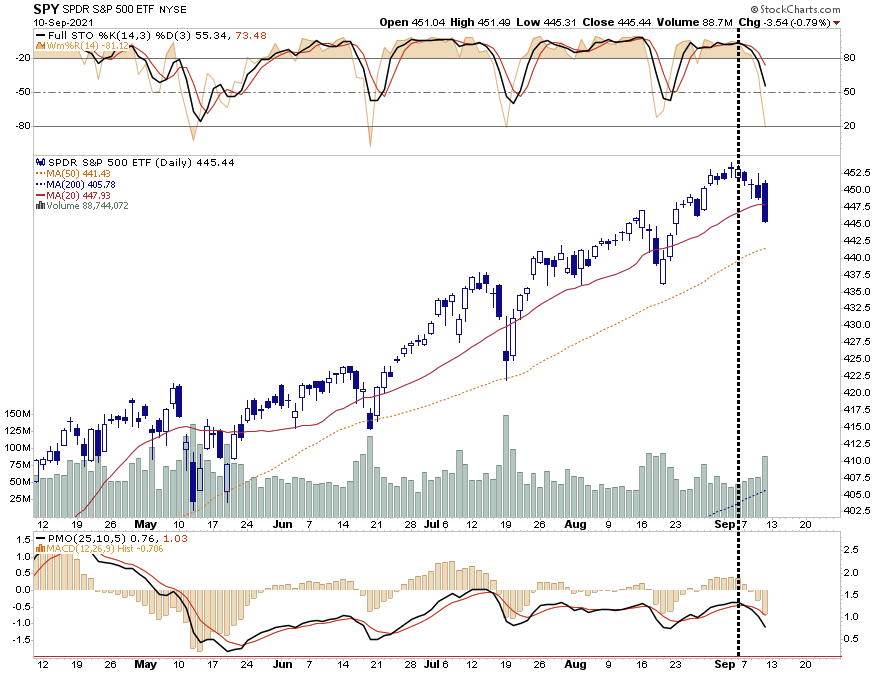
With sell signals in place, volume rising, and breadth weak, a retest of the 50-dma early next week will not be a surprise. Before I jump I want to see if the buy on the dip traders show up again, as they have done every other time over the last 6 months. As shown, the market remains well confined to its rising trend with support sitting at the 50-dma. Volatility did pick up late last week as volume spiked suggesting more selling pressure on Monday. As you can see by the chart below the Bull channel remains in tact. As long as this downward move stay in this channel we will continue to wait…..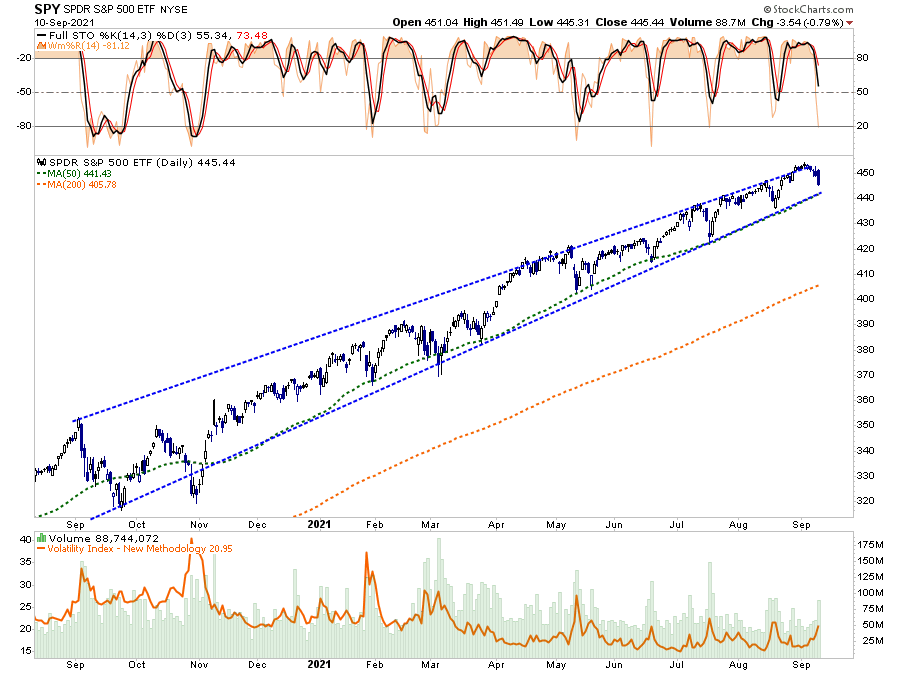
The question is will the market hold the 50-dma again, or has the risk of a more substantial correction finally caught up with investors. Although 5-10% corrections are absolutely normal in any given market year. I would like to catch this move if i can.
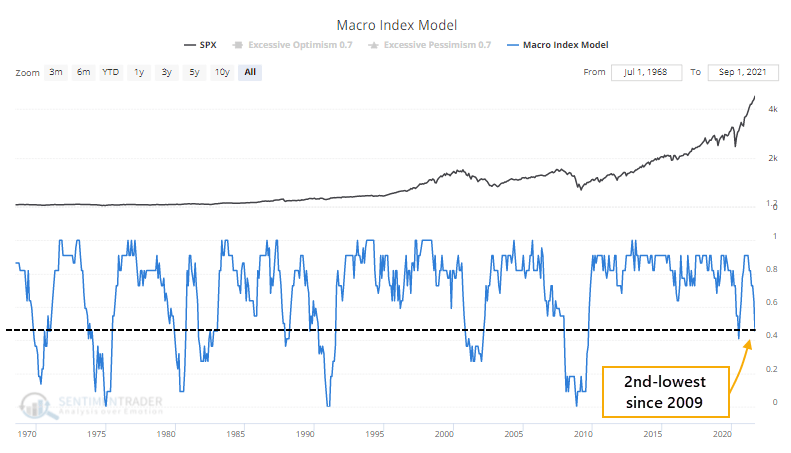
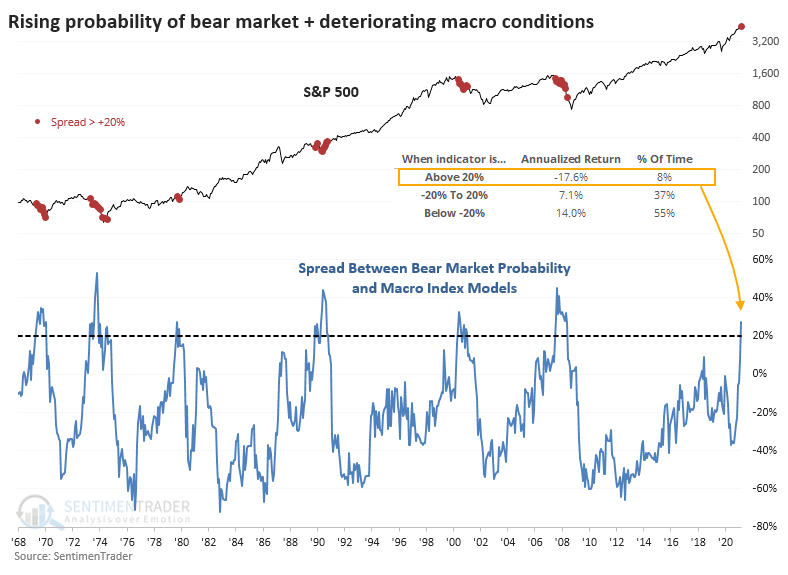
Over the last couple of weeks, I have seen weakening breadth, lower participation, and negative divergences. But we have also seen lower volume and considering its the end of vacation season some market softness is to be expected. The Macro Index Model combines 11-diverse indicators to determine the state of the U.S. economy. Once the final reports were in for August, the model plunged below 46%, the 2nd-lowest reading of the past decade.“
At the same time, Sentiment Trader noted their Bear Market Probability Indicator also jumped. This model has 5 inputs, namely the unemployment rate, ISM Manufacturing index, yield curve, inflation, and valuations.
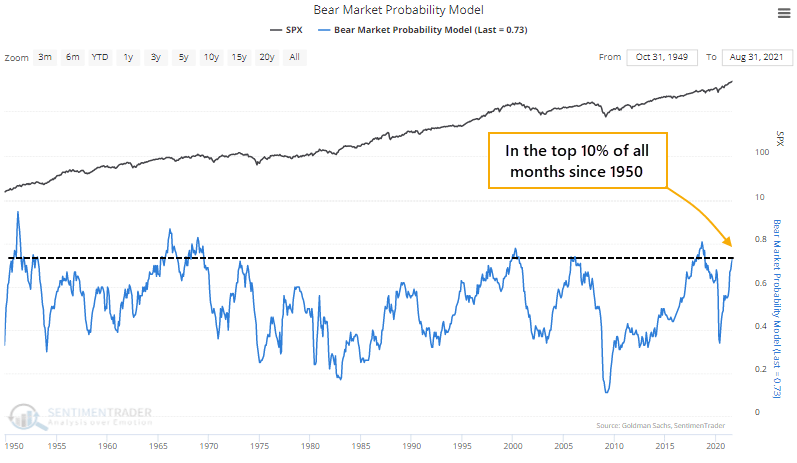
“The chart below shows the spread between the Bear Market Probability and Macro Index models. The higher the spread, the higher the probability of a bear market. The chart shows that the S&P 500’s annualized return is a horrid -17.6% when the spread is above 20% like it is now.”
The point here is that while the market remains exceedingly bullish, there are signs of trouble brewing beneath the surface. Such is why we suggested raising cash levels, adding non-correlated assets, and reducing overall risk. Without any concern for corrections, individuals have increased equity risk levels relative to their overall net worth. BUT remember they have the highest saving rate ever and the millennial traders have no fear because they have not been fucked by Wall Street just yet…… 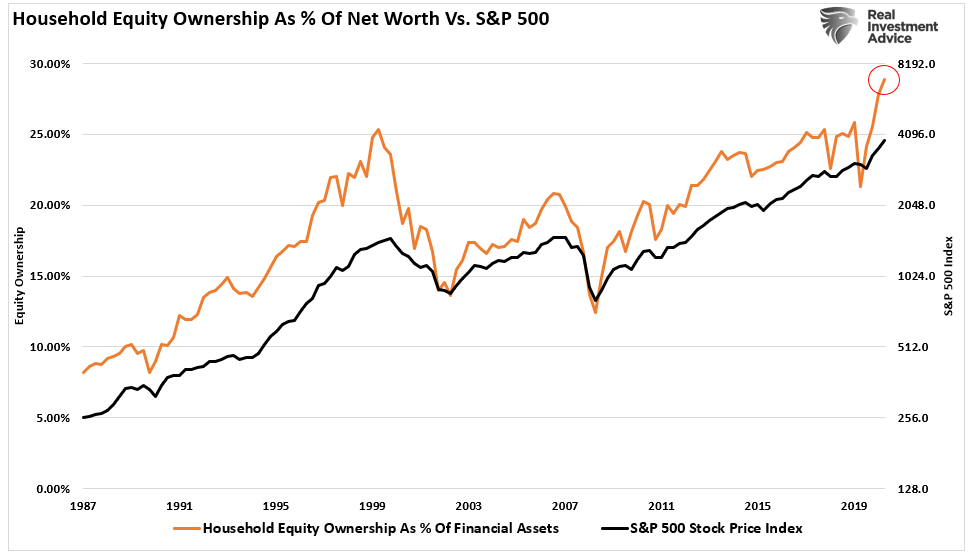
We see the same overvaluations when we analyze their equity allocations as a percentage of their overall financial assets. They are all in… But not necessary One and done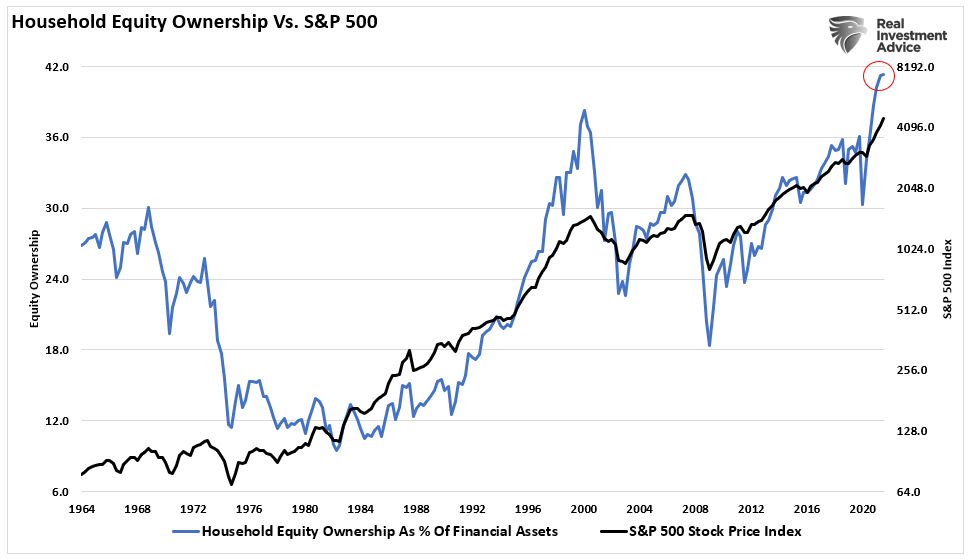
The two charts above clearly show the market is a bubble. without a doubt. BUT with unprecedented FED stimulus and realizing we came out of a shutdown induced by the pandemic you can see why newbee investors are throwing caution to the wind.. Old rules really do not necessarily apply. At the moment investors are incredibly confident that markets can only go higher as long as the “Fed” remains accommodative. While there is undoubtedly a substantial argument as to the ability of the Fed to keep markets inflated, there are other “risks” present that could lead to a short-term correction.
Record leverage in the market, economic growth slowing, and rising inflationary pressures, numerous issues could disrupt the high levels of market complacency
The bullish argument is that such a correction will force the Fed’s hand. As Morgan Stanley aptly concluded: “Even the smallest market hiccup will prompt a furious response at the Marriner Eccles (FED RESERVE) building, because we are now well beyond the point of no return and Jerome Powell and company simply can not afford even the smallest drop in stocks without risking a full-blown market meltdown, much to the chagrin of the banks above who are predicting just that.”
The most significant risk for the market is a change in investor psychology. As long as nothing disrupts that bullish bias, investors will continue to aggressively “buy dips.” However, that psychology is directly linked to the Fed’s ongoing balance sheet expansion. Thus, the potential problem for investors is inflation.
The Fed’s Beige Book is a summary of economic conditions in the 12 Federal Reserve Districts.
- Boston: “Inability to get supplies and to hire workers.”
- New York: “Businesses reporting widespread labor shortages.”
- Philadelphia: “Labor shortages and supply chain disruptions continued apace.”
- Cleveland: “Staff levels increased modestly amid intense labor shortages.”
- Richmond: “Many firms faced shortages and higher costs for labor and non-labor inputs.”
- Atlanta: “Wage pressures more widespread.”
- Chicago: “Wages and prices increased strongly”
- St. Louis: “Contacts continued to report labor and material shortages.”
- Minneapolis: “Hiring demand outstripped labor response by a wide margin.”
- Kansas City: “Wages grew at a robust pace.”
- Dallas: “Wage and price growth remained elevated amid widespread labor and supply chain shortages.”
- San Francisco: “Hiring activity intensified further, as did upward pressures on wages and inflation.”
Inflation is becoming a BIG problematic for the Fed.
Rising producer prices were initially good for profit margins. But we will soon be at the point where these inflation driven price increases cannot get passed along to consumers. we are at a historical spread between PPI and CPI.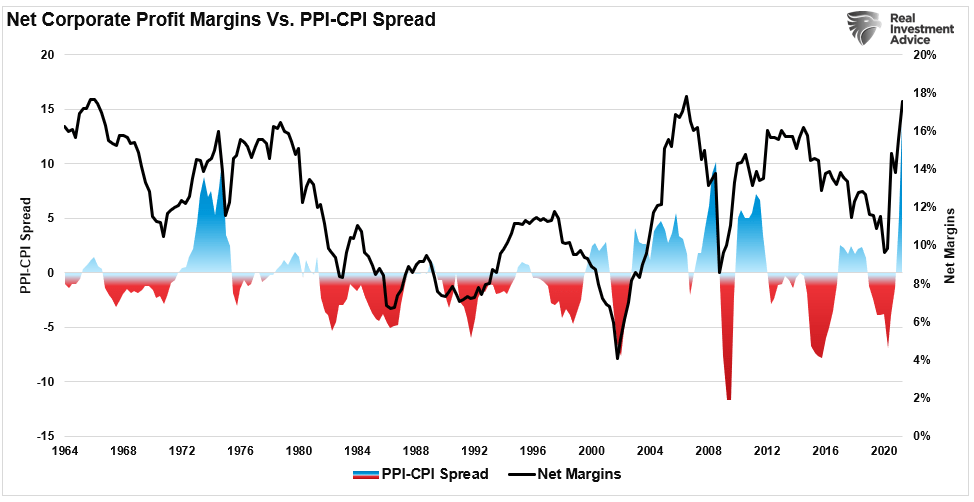
With supply chain disruptions looking to last longer than expected, the Fed is trapped between supporting a slowing economy and fighting inflation. It’s a battle they will eventually lose, no matter what they choose. So yes a epic crash is coming. No doubt about it. And its could be up to a 50% correction. BUT BUT their is still enough gas left in the tank for this market to still rally. Nick
Producer Price inflation record 8.3% in August
A Storm is blowing in the stock market.. Epic crashes only happen every ten years.. DO NOT MISS THIS ONE!
(Bloomberg) — Strategists from almost all the top Wall Street banks have come out this week with a nervous message about the U.S. stock market. The latest views hail from Deutsche Bank AG and Goldman Sachs Group Inc., and echo earlier pronouncements from Morgan Stanley, Citigroup Inc. and Bank of America Corp.While investment banks tend to be measured in their outlooks, there are common threads that underpin their predictions that the market is vulnerable. Valuations are at historical extremes, stocks have rallied non-stop for seven months, the economy looks soft and the Federal Reserve is preparing to taper stimulus. “The risk that the correction is hard is growing,” wrote Deutsche Bank equity strategists including Binky Chadha. “Valuation corrections don’t always require market pullbacks, but they do constrain returns.” Some of the market strain is already showing up. The S&P 500 has fallen about 1% in the past three sessions, though U.S. futures were indicated higher on Friday morning. The index has soared 100% since the March 2020 lows.
Here’s a rundown of commentary this week:
Binky Chadha, equity strategist at Deutsche Bank
“Equity valuations at the market level are historically extreme on almost any metric.” Trailing and forward price-earnings ratios, as well as valuation metrics based on enterprise value and cash flow, are all in the 90th percentiles, he said.
James Congdon, co-head of Canaccord Genuity’s research division Quest
“Global stock markets may be entering a period of turmoil.” He added that investors should favor stronger businesses with robust cash flows over weaker and more speculative companies.
Dominic Wilson, strategist in economics research at Goldman Sachs
“While the broad U.S. market outlook is solid in our central case, we think peak cyclical optimism in the U.S. may be behind us.” The strategists said hedges look attractive, especially on a shorter time horizon.
Andrew Sheets, cross-asset strategist at Morgan Stanley
“We are going to have a period where data is going to be weak in September at the time when you have a heightened risk of delta variant and school reopening.” The bank cut U.S. equities to underweight and global stocks to equal-weight on Tuesday.
Savita Subramanian, head of U.S. equity and quantitative strategy at Bank of America
“The S&P 500 has essentially turned into a 36-year, zero-coupon bond,” she said. “If you look at the duration of the market today, it’s basically longer duration than it’s ever been. This is what scares me.”
The threat is that “any move higher in the cost of capital via interest rates, credit spreads, equity risk premia, that’s basically going to be a huge knock on the market relative to the sensitivity we’ve seen in the past,” she said. Nick Note: I could not be clearer here. This is the greatest bubble market ever. In stocks, real estate and Bonds. A disaster is on the near horizon…. I have well documented what is see about to happen. GET YOUR DUCKS IN A ROW! DO not miss this opportunity bubble markets only come along every 5 to 10 years. And Epic wipeouts are a hundred year in the making….
Exclusive-U.S. could authorize Pfizer COVID-19 shot for kids age 5-11 in October – sources
A nurse fills a syringe with Pfizer vaccine as mobile vaccination teams begin visiting every Los Angeles Unified middle and high school campus to deliver first and second doses of the coronavirus disease (COVID-19) vaccines in Los Angeles, California, U.S., August 30, 2021. REUTERS/Mike Blake Top U.S. health officials believe that Pfizer Inc’s (PFE.N) COVID-19 vaccine could be authorized for children aged 5-11 years old by the end of October, two sources familiar with the situation said on Friday.The timeline is based on the expectation that Pfizer, which developed the shot with Germany’s BioNTech (22UAy.DE), will have enough data from clinical trials to seek emergency use authorization (EUA) for that age group from the U.S. Food and Drug Administration (FDA) towards the end of this month, the sources said. They anticipate the FDA could make a decision on whether the shot is safe and effective in younger children within three weeks of the EUA submission. Nick Note: Lets say by October 30th the Pfizer application is submitted. EUA vaccines approved for the kiddies under 12.will be issued with a little luck by the end of November. It will take at lest a month to roll it out that takes you to Decemember 30th. Now allow 30days for the vaccine to become effective. And that takes you to the end of the y. That means you have gone through the flu season. And you have the super spreader event like Halloween, Thanksgiving and Christmas with the kiddies unprotected. It does not end their… FDA still has not given full approval to the 4th booster shot. Which means by the time that get around to authorization and roll out for adults the masses will be unprotected through the holiday season. We are on the verge of another AWH SHIT!
Vaccine mandate comes due to high opposition – Psaki
A number of conservative governors across the U.S. are vowing to fight President Joe Biden’s newly announced vaccine mandate plan, which will require businesses with more than 100 employees to require inoculation or weekly COVID-19 testing. The move, predictably, was both applauded and condemned by Americans, political leaders and union heads. It will be enacted through a forthcoming rule from the Occupational Safety and Health Administration that carries penalties up to $14,000 per violation, an administration official said.
Republican governors criticized the mandate and many – including the governors of Arizona, Indiana, Georgia, Montana, South Carolina, Tennessee and Texas – vowed to fight it. The Republican National Committee said it would file a lawsuit against the Biden administration when the requirement goes into effect. Biden said Friday he was “disappointed” in the governors who said they plan to challenge his new requirements, adding that they have been “so cavalier” about the health of children and their communities. During a visit with first lady Jill Biden to Brookland Middle School in Washington, the president was asked what his message was to Republicans who decry the vaccine mandates as federal overreach and plan to challenge them in court. “Have at it,” Biden said following remarks in the school’s courtyard. “We’re playing for real here. This isn’t a game.” The plan, which Biden announced Thursday as part of a new six-part strategy, is expected to affect about 100 million workers in the country. “Many of us are frustrated with the nearly 80 million Americans who are still not vaccinated,” Biden said Thursday when announcing the new strategy. “This is not about freedom from personal choice, it’s about protecting yourself and those around you.”
?Today’s numbers: The U.S. has recorded more than 40.6 million confirmed COVID-19 cases and more than 655,800 deaths, according to Johns Hopkins University data. Global totals: More than 223 million cases and 4.6 million deaths. More than 177.8 million Americans — 53.6% of the population — have been fully vaccinated, according to the CDC. Nick Note: Bottom line in a health emergency the authority to coerce vaccinations and quarantine exists. I believe you have a right to decide to vaccinate or not. I believe vaccines are working and the way to go. Of course their are risks… SO! People do not have the right to infect people. I believe that unaccounted people have to suck it up. If you are not vaccinated it will be a lonely life and rightly so. I deal with reality and reality is that not enough people have been vaccinated, The mutations over a short period of time will defeat the vaccines and what everyone always new and forgot to tell the public the vaccines wear off after 5 to 6 months. Oh yes unless you are using a officiated ULPA filter in a proper sealing mask you are very vulnerable. It called the N95 mask because its 95% effective AT BEST! See to me Job! in a pandemic is to survive… not make a political statement!
Dow sinks 270 pts at close as US mandates vaccines
Wall Street closed on Friday with major losses as investors digested the government’s decision to impose the COVID-19 vaccination mandate for all federal workers and employees working in large private companies. Commenting on the move, coronavirus response coordinator Jeff Zients said at today’s press briefing the White House hasn’t excluded the possibility of also requiring vaccinations for all international travelers. In business news, a California court ruled that Apple’s enforcement of anti-steering provisions on its App Store is anticompetitive, with the ruling coming as part of the Apple-Epic Games case.
The Dow Jones plunged 0.78% or 271 points at the closing bell, with Apple tumbling as much as 3.31%. The Nasdaq 100 lost 0.77% or 120 points, as the Kroger Co. sank 7.50%. The S&P 500 fell by 0.77%. Okta was the worst performer by declining 4.68%. The euro traded 0.10% lower against the dollar to sell for 1.18138 at 3:53 pm ET. Nick Note: Lets see if after a few days they get another buy on the dip rally. This market is definitely in trouble and shortly we will make them pay us a great big exit fee…… Get you ducks in a row
Fed to scale down bond buying in November
Members of the United States Federal Reserve are planning to reduce the institution’s bond-buying in order to start cutting back on its easy-money policies, heavily used amid the crisis caused by the COVID-19 pandemic, in November, the Wall Street Journal (WSJ) reported on Friday. According to sources familiar with the matter, the Fed is planning to scale down those policies by the middle of the next year and thus facilitate an increase in interest rates. The report comes after Fed Bank of Atlanta President Raphael Bostic told the same magazine he believes the country’s economy will be able to function without the institution’s bond-buying aid.