U.S. surgeon general defends CDC mask change, blames tech companies for COVID deaths

https://youtu.be/hV37a62gX5k

WASHINGTON (Reuters) – U.S. Surgeon General Vivek Murthy stood by federal guidance that those fully vaccinated against COVID-19 no longer needed to wear masks, while blaming social media companies for fueling vaccine misinformation. Murthy told CNN’s “State of the Union” that allowing vaccinated individuals to forgo masks also gives communities the flexibility to revert to mask mandates based on new infections and vaccination rates, as Los Angeles https://www.reuters.com/world/us/mask-mandate-returns-los-angeles-coronavirus-cases-rise-2021-07-15 has done.

Nationwide, new U.S. COVID-19 cases surged 70% this week compared with the prior seven days to an average of 30,000 new infections a day, fueled by the Delta variant. Deaths rose 26% week-over-week to an average of 250 lives lost a day, mostly in unvaccinated patients.

Murthy said that social media companies have fueled false narratives about the safety and effectiveness of COVID-19 vaccines, echoing President Joe Biden’s comments that social media companies were “killing people.” https://www.reuters.com/business/healthcare-pharmaceuticals/white-house-says-facebooks-steps-stop-vaccine-misinformation-are-inadequate-2021-07-16 “There have been positive steps taken by these technology companies,” Murthy said. “But what I’ve also said to them publicly and privately is that it’s not enough.” Facebook defended itself against Biden’s assertion in a post https://bit.ly/3xSyRDV on Saturday, saying that it promoted authoritative information about vaccines and acted aggressively against health misinformation on its platforms. Democratic Minnesota Senator Amy Klobuchar told CNN’s “State of the Union” that she was looking into ways to hold social companies legally responsible for vaccine misinformation and suggested some might even need to be broken up. “I am a fan of using anti-trust so we can get true competition against the dominant platforms,” Klobuchar said. Ken McClure, the mayor of Springfield, Missouri, blamed misinformation as part of the driving force behind poor vaccination rates in his community which has experienced a huge spike in COVID-19 cases. “I think we’re seeing a lot spread through social media,” McClure told CBS’s “Face the Nation.” “I think we as a society and certainly in our community are being hurt by it.” Nick Note: some crazy shit. With covid cases soaring even amoung the vaccinated does it make any sence to lift face mask usage. The poblic at large are very confused.  We are destined to do the whole kabuki dance all over again.           

OPEC+ extends deal on oil output

(Bloomberg) — OPEC and its allies agreed to gradually add more oil supplies to the market, ending a two-week spat between Saudi Arabia and the United Arab Emirates. The unusually public dispute that tested the unity of the cartel was resolved in a classic compromise — with Riyadh meeting Abu Dhabi halfway in its demand for a more generous output limit. “Consensus building is an art,” Saudi Energy Minister Prince Abdulaziz bin Salman told reporters after the meeting. The deal is evidence of the strong bonds between members and shows “OPEC+ is here to stay.” The agreement means the cartel will boost output by 400,000 barrels a day each month from August, continuing until all of its halted output has been revived. The deal will also give the UAE and several other countries higher baselines against which their production cuts are measured, starting in May 2022, according to a statement from the group. The UAE’s level was increased to 3.5 million barrels day, below the 3.8 million it initially demanded but above the previous baseline of 3.17 million. The truce between the two long-time allies will ease a looming supply squeeze and reduce the risk of an inflationary oil price spike. It also puts an end to a diplomatic spat that unnerved traders, as the fight between the two long-time allies risked unraveling the broader accord between the Organization of Petroleum Exporting Countries and its allies that has underpinned the recovery in crude prices. The multifaceted agreement means several things for the oil market. It gives consumers a clearer view of how quickly OPEC+ will restore the 5.8 million barrels a day of production it’s still withholding, since making deep cuts last year in the initial stages of the pandemic. The baseline adjustments won’t alter the pace of the 400,000 barrel-a-day monthly output increases when they take effect next year, Prince Abdulaziz said. The group will continue to meet every month, including a review of the market in December, and could adjust the schedule if required, he said. “The monthly meetings and the December review tell you that that is all amendable,” said Bill Farren-Price, a director at research firm Enverus. “So oil bulls should read this as positive — OPEC+ supply management continues.” The accord also resolves longstanding grievances that caused tensions within OPEC+ since late 2020. The UAE blocked an agreement earlier this month, arguing that the way its quota was calculated was unfair because it didn’t reflect a costly expansion in the country’s industry. The spat was particularly bitter, and the tensions go beyond oil diplomacy amid growing economic rivalry between Abu Dhabi and Riyadh. Ministers of each country used media interviews to make their case, stirring memories of the 2020 Saudi-Russia price war, and also past threats from the UAE to leave the cartel. With a successful deal in the bag, both countries emphasized the strength and friendliness of their relationship. “The UAE is committed to this group and will always work with it,” Energy Minister Suhail Al-Mazrouei told reporters after the meeting. He thanked Saudi Arabia and Russia for keeping OPEC+ together and fostering a constructive dialog that enabled a deal. Nick Note: Oil approaching $80 a barrel is a inflation nightmare scenario. Biden and the tree huggers are devastating the US oil industry. So Americans have to suffer. The Grennie winnie wet dream is not reality. Their is no viable alternative to fossil fuels. Maybe it will take a $100 oil for them to figure it out.

I have bad news and bad news: Israeli government says Pfizer’s COVID-19 vaccine provides ‘significantly less’ protection against the Indian ‘Delta’ variant than health officials had hoped

The Pfizer-BioNTech COVID-19 vaccine is ‘weaker’ against the Indian ‘Delta’ variant than health officials had hoped, a new report from Israel claims On Friday, Prime Minister Naftali Bennett held a discussion about the coronavirus with his Cabinet at the Kirya in Tel Aviv. Israel once led the entire world in the vaccine race, vaccinating 61 percent of its population with the Pfizer-BioNTech vaccine – but is now dealing with a surge in cases. On Thursday, the test positivity rate was 1.52 percent, which is the highest number since March. As of June 6, the vaccine provides only  64 percent protection against infection from the variant, according to the Israeli government. ‘At the moment, there is an idea that is spreading to the effect that the protective ability of the existing vaccines against the Delta mutation is weaker than what we had hoped,’ Bennett said. ‘We do not know exactly to what degree the vaccine helps, but it is significantly less. We are all hoping to see a slowdown but the facts at the moment are that there is no slowdown, not here and not in the world.’ The Delta variant has been labeled as a ‘double mutant’ by India’s Health Ministry because it carries two mutations: L452R and E484Q. L452R is the same mutation seen with the California homegrown variant and E484Q is similar to the mutation seen in the Brazilian and South African variants. Both of the mutations occur on key parts of the virus that allows it to enter and infect human cells. Bennett also addressed the crises in the UK and the US, both of which are using the Pfizer vaccine and are overrun with the Delta variant. On Thursday, the U.S. recorded 28,412 new cases with a seven-day rolling average of 26,079, a 135 percent increase from the 11,067 average recorded two weeks ago. Nearly every state and the District of Columbia have seen infections rise in the last week, according to a DailyMail.com analysis of Johns Hopkins data. What’s more, about 40 states have seen their infection rates increase by at least 50 percent with some of the biggest rises seen in hotspots such as Arkansas, Louisiana and Missouri. With cases doubling every two weeks, this means the U.S. could see 50,000 cases per day by the end of July and 100,000 per day at the end of the month. Meanwhile, Britain’s daily coronavirus cases hit 50,000 on Friday for the first time since the depths of the second wave in January.  Figures from the Department of Health show that the number of positive tests, which sits at 51,870, has risen by 45 percent in a week. Hospitalizations and deaths are now both rising steadily following the ferocious surge in cases, which top experts blamed on the relaxation of restrictions and Euro 2020. ‘At the moment, the Delta mutation is leaping forward around the world, including in vaccinated countries such as Britain, Israel and the US,’ Bennett said. ‘In Britain, in recent days, we have seen a jump in the number of children who are being hospitalized on a daily basis. This is a development that we are aware of; we are dealing with it rationally and responsibly.’ ‘On the one hand, the vaccines are effective against the virus; therefore, we are seeing to the necessary continuity of vaccinations and inventories. ‘Whoever hoped that the vaccines alone would solve the problem, they are not. What is necessary is a strategy that brings as many vaccines as possible on the one hand and, on the other, also understands the limits of the vaccine.’ Nick Note: Hear me well. ITS BACK… bigger and batter then ever. Its politics driving the narrative… enough to get you killed. They just had to have their 4th of July fuck fest. They had to fly around in those virus incubation tubes.. And now the price will be paid. Once again they opened up things to soon. It time to mask up, isolate  and take your ivermectin if your at extreme risk and your CoronaVit. See Link for the video: https://www.wsifn.com/corona.asp


‘Bond King’ Gundlach: Inflation today reminds him of the 1970s

The current inflation scenario is reminiscent of the 1970s and the Federal Reserve needs to take action to temper the rising prices, according to the “Bond King” Jeffrey Gundlach. DoubleLine Capital CEO said on Thursday that with inflation rising and Treasury yields remaining so low, U.S. bonds are essentially negative yielding assets. “When you look at real interest rates on long-date Treasurys, it looks like Jimmy Carter area,” said Gundlach. “We’re talking about the CPI at 5.4%, and if we want to use the 10-year Treasury it’s not even at 1.4%, that’s a negative 4% interest rate. That’s Jimmy Carteresque.” Inflation readings have continued to roll in higher in recent months, as warned by the Federal Reserve, though the numbers lately have been higher than even the central bank may have anticipated. June’s consumer price index came in at 5.4% — its largest year-over-year increase since 2008 — and the producer price index for last month jumped 7.3% on a year-over-year basis.

Gundlach compared the current period of rising prices to the 1970s, when inflation ballooned from 1% under President Lyndon Johnson in 1965 to a breakneck of near 15% in March 1980.

“A lot of things remind me of the 1970s. We’re just pulling out of a failed war in Afghanistan where we basically fought to stalemate. It kind of reminds me of the ’70s in Vietnam and we had guns and butter that lead to inflation in the late ’60s and the ’70s and even the early ’80s and we certainly have guns, butter, student loan cancellation, free unemployment benefits and everything else,” Gundlach said. To combat the price rises in the Jimmy Carter era, then-Fed Chairman Paul Volcker hiked the federal funds rate and tightened the money supply. The rate, used by banks and credit unions for overnight loans to other depository institutions, reached a record 22.36% in July 1981. Meanwhile, the central bank is sticking with its unprecedented stimulus programs and interest rates near-zero, which Gundlach said is keeping the stock market elevated near record highs.

Fed Chairman Jerome Powell has repeatedly signaled that the central bank believes rising inflation will be transitory, but Gundlach said a few more months of hot inflation readings are going to necessitate action from the Fed. Nick Note: Rates real rate are negative. And the fed has pure and simple over stimulated. In the next matter of months they will have no choice but to pull back on the rains and get control of this running wild stage coach. We will get higher rates. Not near as high in the Volcker era. But I could see a 4% handle on the thirty year….. And we want to buy the surge in rates in our beloved ZEROS. Point in fact rates will not d o a moon shot into Volcker ozone land. But they will plunge to double digit (same thing) negative.. Its not the numbers but the range……

United States Philadelphia Fed Manufacturing Survey below forecasts (28) in July: Actual (21.9)

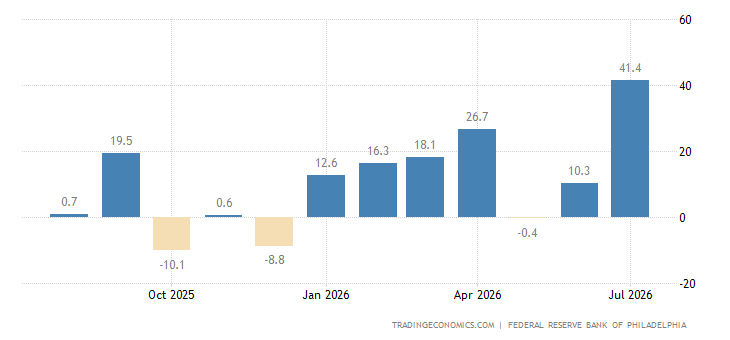
The Philadelphia Fed Manufacturing Index in the US fell for the third month to 21.9 in July of 2021 from 30.7 in June, the lowest since December and below market forecasts of 28. The firms’ responses continued to suggest ongoing growth in the region’s manufacturing sector this month. The survey’s indicators for general activity, new orders, and shipments remain elevated but declined. The firms also continued to report increases in prices. Most of the survey’s future indexes tempered but continue to indicate overall optimism about growth over the next six months. source: Federal Reserve Bank of Philadelphia

United States Philadelphia Fed Manufacturing Index
Philadelphia Factory Growth at 7-Month Low
The Philadelphia Fed Manufacturing Index in the US fell for the third month to 21.9 in July of 2021 from 30.7 in June, the lowest since December and below market forecasts of 28. The firms’ responses continued to suggest ongoing growth in the region’s manufacturing sector this month.  United States Philadelphia Fed Manufacturing Index Philadelphia Fed Manufacturing Index is based on The Business Outlook Survey of manufacturers in the Third Federal Reserve District. Participants report the direction of change in overall business activity and in the various measures of activity at their plants: employment, working hours, new and unfilled orders, shipments, inventories, delivery times, prices paid, and prices received. The index above 0 indicates factory-sector growth, below 0 contraction. Nick Note: Greatest stimulus ever…. AND all they are stimulating is a bubble stock market and bubble housing market. All that stimulus ans still in REAL America where jobs are created no cookie….. And to make matters worse  ITS BACK! Talk about a fly in the ointment…….

U.S. COVID-19 cases more than double in two weeks as delta variant spreads fast, and WHO warns ‘pandemic nowhere near finished’

U.S. COVID-19 cases more than double in two weeks as delta variant spreads fast, and WHO warns ‘pandemic nowhere near finished’

WHO sees ‘strong likelihood’ of new and possibly more dangerous variants of concern ‘that may be even more challenging to control’ The number of new cases of COVID-19 in the U.S. has more than doubled in the last two weeks, as the delta variant continues to race across the nation, infecting both vaccinated and unvaccinated people, who account for more than 99% of recent fatalities. The average case tally on Wednesday was 26,513, according to a New York Times tracker, (link)up 111% from two weeks ago. Hospitalizations have climbed 22% and deaths are up 5% in the same time frame, albeit they remain at far lower levels than at the peak of the crisis in the spring of 2020. Overall, 47 states are showing new cases up 10% from a week ago, according to Johns Hopkins University data (link). Experts are increasingly describing two Americas, divided between the vaccinated and unvaccinated, with the latter group putting themselves and others at risk of infection as the vaccine program grinds to a halt. Delta variant drove COVID-19 casesare  higher across the globe last week — including in the U.S (link). The Centers for Disease Control and Prevention and Infection’s vaccine tracker (link) is showing that 160 million Americans are fully inoculated, equal to 48.2% of the overall population. That means they have had two shots of the vaccines developed by Pfizer (PFE) and German partner BioNTech (BNTX) and Moderna (MRNA), or one shot of Johnson & Johnson’s (JNJ) one-dose regimen. The AstraZeneca (AZN.LN) vaccine has not been granted emergency use authorization in the U.S. Among adults 18-years-and-older, 59.1% are fully vaccinated, while 67.8% have received at least one dose, still short of President Joe Biden’s goal of having 70% of the adult population receive at least one shot by the July 4 holiday. The numbers are barely budging day-to-day now, despite concerns expressed by healthcare experts. “We’re losing time here. The delta variant is spreading, people are dying, we can’t actually just wait for things to get more rational,” Dr. Francis Collins, director of the National Institutes of Health  told CNN Wednesday. The World Health Organization’s emergency committee warned that with delta and three other variants of concern still circulating, the “pandemic is nowhere near finished.” Instead, there is a “strong likelihood for the emergence and global spread of new and possibly more dangerous variants of concern that may be even more challenging to control,” the committee said in a statement emergency-committee-regarding-the-coronavirus-disease-(covid-19)-pandemic). Elsewhere, Indonesia set another daily case record of 54,517 and has overtaken India as the Asian epicenter of the pandemic, CNN reported. At least 991 fatalities were recorded in the nation of about 170 million people on Wednesday to push the total to 69,210. Russia had 25,293 new cases and a record death toll of 791 on Thursday, according to The Moscow Times, raising the overall death toll to 146,069, the highest official number in Europe. In China, local governments are moving aggressively to push residents to get vaccinated and some are planning to bar them from accessing public venues if they refuse, The Wall Street Journal reported. Roughly a dozen counties and cities in the eastern provinces of Zhejiang, Fujian and Jiangxi have set late-August deadlines for people 18 years or older to complete a two-shot vaccine regimen, according to similarly worded online statements. Many of them also set dates in late July by when unvaccinated people would be barred from entering schools, libraries, prisons, nursing homes and inpatient facilities at hospitals without a valid medical exemption, the paper reported. China has fully vaccinated more than 40% of its population of 1.4 billion so far. A cluster of COVID cases at a hotel hosting Olympic athletes is raising concerns coming just over a week before the opening ceremony, Reuters reported. Adding to the gloom, Tokyo has just recorded its highest number of new COVID cases in six months. Singapore reported its highest case number in 10 months, after uncovering a cluster among hostesses and customers at Karaoke bars, Reuters reported. Singapore has yet to reopen KTV lounges and clubs and authorities said the places where the virus spread were operating as food and beverage outlets. Meanwhile, the United Nations’ Unicef agency and the World Health Organization said about 23 million children missed out on other basic vaccinations during the pandemic and warned of the potential for outbreaks of diseases including polio, measles and meningitis. “Multiple disease outbreaks would be catastrophic for communities and health systems already battling COVID-19, making it more urgent than ever to invest in childhood vaccination and ensure every child is reached,” WHO Director-General Tedros Adhanom Ghebreyesus said in a statement. “This is a wake-up call — we cannot allow a legacy of COVID-19 to be the resurgence of measles, polio and other killers,” said Dr. Seth Berkley, CEO of Gavi, the Vaccine Alliance. “We all need to work together to help countries both defeat COVID-19, by ensuring global, equitable access to vaccines, and get routine immunization programs back on track.” Pfizer is making the case for COVID-19 boosters. Health officials say we don’t need a third dose yet. The global tally for the coronavirus-borne illness climbed above 188.5 million on Thursday, while the death toll climbed further above 4.06 million, according to data aggregated by Johns Hopkins University. The U.S. leads the world with a total of 33.9 million cases and in deaths with 608,135. India is closing in on the U.S. in cases at 30.9 million but is third in deaths at 411,989, while Brazil is second in deaths at 537,394 but is third in cases at 19.2 million. Mexico has the fourth-highest death toll at 235,507 but has recorded just 2.6 million cases, according to its official numbers. In Europe, the U.K. has 128,797 deaths the second highest in Europe after Russia. China, where the virus was first discovered late in 2019, has had 104,157 confirmed cases and 4,848 deaths, according to its official numbers, which are widely held to be massively underreported. Nick Note: I want to be clear here THEY ARE BACK.  Their is now getting away from it. And listen to Pfizer you will need a booster shot. We have put together the CoronaVit see this link. https://www.wsifn.com/corona.asp
Fed ‘not comfortable’ with current inflation levels – Powell

Jerome Powell, chairman of the U.S. Federal Reserve, said Thursday that the central bank is “not comfortable” with recent inflation figures, but he believes the aggressive rate of price increases have come because of a “shock going through the system” rather than factors in the underlying economy. Speaking before a congressional committee, Powell suggested that the Fed’s main focus is on inflation expectations as it decides when to tighten its highly accommodative monetary policy. The Fed chair acknowledged that recent inflation figures, including a consumer price report earlier this week that showed a 5.4% annual inflation rate, were “well above” the 2% mark policymakers target. He added that these inflation indicators were also higher than the central bank had expected prior to the start of the economic recovery. However, Powell argued that the increased prices were not tied to the “usual things” that drive inflation, like a tight labor market. Rather, he blamed the “shock” of the economy coming back to life after the COVID pandemic. Powell said it would be “inappropriate” to react aggressively to the high inflation if it proves to be temporary. However, he said the Fed would monitor statistics and rethink its course if the high rates of price increases last longer than expected. Powell supported his view that high inflation rates will be temporary by pointing to the list of items that have seen the most significant price increases. The Fed chair said that a “handful of things, all of which are tied to the reopening” have accounted for “essentially all of the overshoot” in recent inflation numbers compared to the target level. Specifically, Powell cited airplane tickets and hotel rooms, as well as new, used and rented cars. “What we don’t see now is broad inflation pressure showing up in a lot of categories,” he said. “The concern would be if we did start to see that.” Powell added: “We won’t have to wait a tremendously long time to know whether our basic understanding of this is right.” Longer-term, Powell focused on inflation expectations as an important measure the central bank will be “closely watching” as it determines future policy. He said the Fed wants inflation expectations anchored at 2%. Powell’s comments came as part of his regular semiannual appearance before the Senate. In his prepared testimony, the Fed chair repeated his remarks from the previous day, when he told a House of Representatives committee that a decision to begin tightening monetary policy was still “a ways off.” Nick Note: I am afraid they are behind the power curve and have let the inflation gennie out of the bottle. And their will be hell to pay by the masses. For us it could well be our greatest pay day ever…..

Oil drops for now U.S. fuel stocks grow and OPEC+ nears deal

Oil’s rally fizzled as a build in U.S. fuel inventories and a potential OPEC+ agreement to increase supply cooled a buying spree that had pushed the market above US$75. Futures in New York fell 2.8 per cent, the most since May. Both gasoline and distillate inventories rose last week, according to a U.S. government report. Meanwhile, Saudi Arabia and the United Arab Emirates were said to resolve the standoff that has prevented OPEC+ from satisfying growing demand for extra barrels. Technical indicators also showed crude close to overbought territory earlier Wednesday, which signals oil may be due for a pullback. With the prospect of more supply from OPEC+ and crude nearing overbought levels, “it’s not surprising to see it down,” said Tariq Zahir, managing member of the global macro program at Tyche Capital Advisors LLC. Economic recovery in countries like the U.S. and China has increased fuel consumption over the course of this year, propelling oil prices forward by more than 50 per cent. Rising demand, especially during the peak summer travel season in the U.S., drew warnings about a deepening supply deficit after OPEC+ talks on a production hike broke down earlier this month. The latest breakthrough proposal involves a higher output quota for the UAE, which said OPEC+ talks are ongoing. It would need to be approved by all OPEC+ members before it can take effect. If the compromise is ratified at a new meeting, it could open the way to higher output, although some members have already locked in most of their supply volumes for August. The 23-nation coalition is aiming to restore supplies in installments of 400,000 barrels a day through to late 2022. “So far it’s been proven that the OPEC+ agreement has been effective at stabilizing oil prices,” said Rob Thummel, a portfolio manager at Tortoise, a firm that manages roughly US$8 billion in energy-related assets. The impasse introduced volatility in the market over the last week while near-term supply remained in question. In addition to gasoline, a boom in durable goods is driving demand for naphtha to make plastics as well as diesel to power deliveries. Domestic crude supplies tumbled for the eighth straight week, according to the weekly report. Inventories at the nation’s largest storage hub in Cushing, Oklahoma, fell by 1.6 million barrels. Nick Note: Oil prices are way way to high. Biden has put the kabob on US fracking and pipelines. The US is no longer energy self sufficient. Reality is wind and solar are not their yet. Declaring your using renewals does not mean you have waved a grennie winnie magic wand. EV electric cars moves energy consumption back to coal at the generation plant, the dirtiest fuel know to man kind. Guess what Biden shooting US oil production has driven $40 oil to damn near $80. Meaning then natural gas is to expensive and Electric companis are turning on their coal fired steam plants. Renewables talk is nice but the American public will not tolerate a doubling of their electric bills. And the pressure on embedded inflation will be significant.

Fed’s Powell keeps to script on jobs recovery, feels heat on inflation front

(Reuters) – The U.S. job market “is still a ways off” from the progress the Federal Reserve wants to see before reducing its support for the economy, while current high inflation will ease “in coming months,” Fed Chair Jerome Powell said in remarks prepared for delivery at a congressional hearing on Wednesday.   “Powell’s testimony was on the dovish side and the Treasury curve has steepened slightly in response, although we will look for clarity at this Q+A on Capitol Hill this afternoon.”    “The testimony conveys a stay-the-course attitude. This is not very surprising because testimonies are rarely the preferred venues to convey policy shifts and because the FOMC hasn’t had a chance to discuss recent events, including yesterday’s CPI print. The press conference following the July meeting should be much more informative about the future course of Fed policy. “ Nick Note: What shocking testimony. Its like we are looking at completely different set of number. He is talking about a return to 2% inflation… And we are at 7%…… this is not going to happen without a complete reversal of Fed stimulation and massive increases in interest rates…..

U.S. producer prices surge more than expected in June

WASHINGTON (Reuters) -U.S. producer prices surged in June, leading to the largest annual gain in more than 10-1/2 years, suggesting inflation could remain high as robust demand fueled by the economy’s recovery from the COVID-19 pandemic strains the supply chain. The report from the Labor Department on Wednesday followed on the heels of news on Tuesday that consumer prices increased by the most in 13 years in June. There are, however, signs that inflation is close to peaking. Underlying producer prices rose at a moderate pace on a monthly basis in June. Federal Reserve Chair Jerome Powell in remarks prepared for delivery at a congressional hearing on Wednesday said “inflation has increased notably and will likely remain elevated in coming months before moderating.” Powell has long maintained that high inflation is transitory, a view shared my most economists and the White House. The producer price index for final demand increased 1.0% last month after rising 0.8% in May. A 0.8% increase in the cost of services accounted for nearly 60% of the increase in the PPI in June. Services rose 0.6% in the prior month. Goods prices climbed 1.2% after accelerating 1.5% in May. In the 12 months through June, the PPI surged 7.3%. That was the biggest year-on-year rise since November 2010 and followed a 6.6% advance in May. Higher commodity prices and increased labor costs due to a shortage of willing workers are driving inflation at the factory gate. Very low inventory levels because of supply chain issues are making it easy for producers to pass on the higher costs to consumers. Sectors at the center of the economy’s reopening have seen large price increases, though there were signs in June that inflation was broadening to other segments. Economists polled by Reuters had forecast the PPI increasing 0.6% in June and rising 6.8% year-on-year. U.S. stocks opened higher as Powell’s comments fueled hopes that the Fed would stick to its accommodative monetary policy. The dollar fell against a basket of currencies. U.S. Treasury prices rose. The U.S. central bank slashed its benchmark overnight interest rate to near zero last year and is pumping money into the economy through monthly bond purchases. That ultra-easy monetary policy stance, COVID-19 vaccinations and nearly $6 trillion in government relief since the pandemic started in the United States in March 2020 are whipping up demand. But inflation is likely nearing its peak. Excluding the volatile food, energy and trade services components, producer prices rose 0.5%. The so-called core PPI gained 0.7% in May. In the 12 months through June, the core PPI accelerated 5.5%. That was the largest rise since the government introduced the series in August 2014 and followed a 5.3% increase in May. “We believe this will be the peak in the pace of wholesale inflation as base effects ease, but ongoing friction between supply and demand will continue to keep prices sticky through 2021 and into 2022,” said Mahir Rasheed, a U.S. economist at Oxford Economics in New York. The Fed has signaled it could tolerate higher inflation for some time to offset years in which inflation was lodged below its 2% target, a flexible average. The Fed’s preferred inflation measure, the core personal consumption expenditures price index, jumped 3.4% in May, the largest gain since April 1992. Last month’s surge in the costs of services was led by a 2.1% jump in trade services, which measure changes in margins received by wholesalers and retailers. Twenty percent of the increase services was due to margins for automobiles and parts retailing, which rose 10.5%. There were also gains in the prices of machinery, hardware, building materials and supplies, guestroom rental, professional and commercial equipment and passenger transportation. Wholesale energy prices increased 2.1%. Food prices climbed 0.8%. Wholesale core goods prices rose 1.0% after gaining 1.1% in May. Some of the PPI components, which feed into the core PCE price index, were weak last month. Healthcare costs dipped 0.1% after gaining 0.2% in the prior month. Portfolio management fees fell 0.3% after rising 2.0% in May. Airline tickets rebounded 2.5% after dropping 1.3% in May. Nick Note. Its going to take a lot water to put out this inflation  fire……. The Fed is really fucking up big time….