Broadcom Q2 revenue soars 15% to $6.61 billion

Broadcom Inc. posted on Thursday its earnings results for the second fiscal quarter of 2021, reporting annual revenue growth of 15% to $6.61 billion. The company’s net income surged to $1.49 billion, with diluted earnings per share of $3.30.

“Due to the strength in demand for semiconductors across our multiple end markets, we delivered 20% year-over-year increase in semiconductor revenue. Our third quarter outlook projects this year-over-year growth to sustain, as we continue to see strong demand from service providers and hypercloud,” CEO Hock Tan said in the report.

Commenting on the outlook, Broadcom noted it expects third-quarter revenue of $6.75 billion.

NY Fed’s Williams says now not the time to take action on tapering

https://youtu.be/7SAWHUc9k3s

June 3 (Reuters) – While it makes sense for Federal Reserve officials to begin discussing their options for adjusting monetary policy, the U.S. economy is still far from the point at which the central bank might begin to withdraw its support, New York Fed Bank President John Williams said on Thursday.

“We’re still quite a ways off from reaching the substantial progress that we’re really looking for in terms of adjustments to our purchases,”

Williams said during an interview with Yahoo Finance, referring to the Fed’s monthly purchase of $120 billion in bonds. “I just don’t think the time is now to take any action.”

Russia to exit from all dollar assets in NWF

  • Russia will completely remove U.S. dollar assets from its National Wealth Fund.
  • Timothy Ash, senior emerging markets sovereign strategist at BlueBay Asset Manager, described the decision to ditch U.S. dollar assets as “very political.”
  • The Biden administration imposed a raft of new sanctions against Moscow in April.

Russia is cutting the U.S. dollar from its $186 billion National Wealth Fund as Washington continues to impose sanctions on Moscow. The move was announced at the St. Petersburg International Economic Forum on Thursday by Finance Minister Anton Siluanov. “Like the central bank, we have decided to reduce investments of the NWF in dollar assets,” he told reporters, according to a Reuters translation, adding that the NWF will instead invest in euro, Chinese yuan and gold assets. The changes to the NWF are expected to happen within the next month. Once complete, the share of euro assets in the fund is expected to stand at 40%, the yuan at 30% and gold at 20%. Meanwhile, the Japanese yen and British pound will likely make up 5% each. Timothy Ash, senior emerging markets sovereign strategist at BlueBay Asset Manager, described the decision to ditch U.S. dollar assets as “very political” and one that’s meant to “send a signal” to President Joe Biden’s administration ahead of the upcoming summit with President Vladimir Putin. “The messaging is ’we don’t need the U.S., we don’t need to transact in dollars, and we are invulnerable to more U.S. sanctions,” he said in a research note after the announcement, adding that it could be interpreted as a sign that Moscow is expecting more sanctions from the U.S. The Biden administration imposed a raft of new sanctions against Moscow in April over alleged interference in the 2020 election, a colossal cyberattack against U.S. government and corporate networks, illegal annexation and occupation of Crimea, and human rights abuses. The Russian government denies all of the allegations. Underpinned by money that Russia makes from oil, the NWF was initially designed to support the nation’s pension system. It forms part of Russia’s gold and currency reserves that totaled $600.9 billion on May 27, according to Reuters. Elsewhere, Russia’s central bank governor, Elvira Nabiullina, told CNBC’s Hadley Gamble in an exclusive interview earlier this week that digital currencies will be the future of financial systems. “I think it’s the future for our financial system because it correlates with this development of digital economy,” she said. Moscow published a consultation paper on a digital ruble in October, and aims to have a prototype ready by the end of 2021. Pilots and trials could start next year, Nabiullina said. Nick Note: talk about a nothing burger. You think this is a trillion dollars or a hundreds of billion…. Try 40 billion dollars…… Its a joke. Most money center banks hold a hundreds billion or more in dollars. China has close to 2 trillion treasuries alone.   Japan 1.5 trillion in treasuries….  Central banks hold over 12 trillion in US government securities plus ten trillion in cash US dollars  This is a joke. Russia is pissed off over coming US sanctions……. This is a PR moment nothing more. I am laughing… Shocking how STUPID this new crop of money fund mangers are.

Benefits’ expiry to get people back to labor force – Fed’s Kaplan

More Americans should be expected to return to the labor market as unemployment benefits gradually decline, Federal Reserve Bank of Dallas President Robert Kaplan said on Thursday. Speaking at a virtual event organized by the Rice University, he noted that conflicting data on unemployment create “a puzzle” that does not require additional measures of monetary policy easing. Moving on to economic supply problems, he stated that they should be viewed as structural and that they may not be as affected by monetary policy steps as some demand issues were during previous economic recoveries. Nick Note: DAH… as the bennies run out and the kiddies go back to school this will be over. And the idiots will find something else to fret about….. Climbing a wall of worry comes to mind..

Biden offers to drop corporate tax hike proposal – source

WASHINGTON (Reuters) – U.S. President Joe Biden offered to scrap his proposed corporate tax hike during negotiations with Republicans on an infrastructure package, a source familiar with the matter said on Thursday, in what would be a major concession by the Democratic president as he works to hammer out a deal this week. Nick Note: I have told you from the start Biden will never get his wet dream tax increases passed. AND AND AND Its a little over a year until the midterm elections where they will throw the liberal lefties attaching normal people with white privilege myth out on their ass.

US services PMI reaches all time high of 64.0 in May – ISM


The services sector in the United States improved in May compared to the previous month, the Institute for Supply Management (ISM) reported on Thursday. The Purchasing Managers’ Index rose 1.3 percentage points to another all-time high of 64.0%. The Business Activity Index registered at 66.2%, up 3.5 pps from April, while New Orders increased 0.7 pps to 63.9%. Supplier Deliveries Index climbed 4.3 pps month-on-month to 70.4%, indicating slower deliveries, with the Backlog of Orders jumping 5.4 pps to 61.1%. The Employment Idex fell 3.5 pps to 55.3%. The Prices Index advanced 3.8 pps during the same period to 80.6%, marking the fastest rise since July 2008. “According to the Services PMI, all 18 services industries reported growth. There was continued growth in the services sector in May. The rate of expansion is very strong, as businesses have reopened and production capacity has increased. However, some capacity constraints, material shortages, weather-related delays, and challenges in logistics and employment resources continue,” ISM Chair Anthony Nieves said in the press release.

Initial jobless claims in US down 20,000 to 385,000

WASHINGTON (AP) — The number of Americans seeking unemployment benefits fell last week for a fifth straight week to a new pandemic low, the latest evidence that the U.S. job market is regaining its health as the economy further reopens. The Labor Department reported Thursday that jobless claims dropped to 385,000, down 20,000 from the week before. The number of weekly applications for unemployment aid, which generally reflects the pace of layoffs, has fallen steadily all year, though it remains high by historical standards. The decline in applications reflects a swift rebound in economic growth and the job market’s steady recovery from the coronavirus recession. More Americans are venturing out to shop, travel, dine out and congregate at entertainment venues. All that renewed spending has led companies to seek new workers. Employers have added 1.8 million jobs this year — an average of more than 450,000 a month — and the government’s May jobs report on Friday is expected to show that they added an additional 656,000 last month, according to a survey of economists by the data firm FactSet. The economy remains down 8.2 million jobs from its level in February 2020, just before the virus tore through the economy. AnnElizabeth Konkel, economist at the Indeed Hiring Lab, noted that the number of people who are collecting traditional state unemployment benefits rose by 169,000 in the week of May 22 to nearly 3.8 million. “Reviving a labor market after a deadly pandemic is complicated,” she said. “Not all indicators move at the same speed or take the same recovery path. Hopefully, the COVID-19 cases continue to decline as the number of fully vaccinated individuals rises. Fully returning to pre-COVID normal is essential to a full labor market recovery.” In the meantime, U.S. employers are posting a record number of available jobs. And many of them have complained that they can’t find enough workers to meet rising customer demand. Job growth slowed sharply in April compared compared with March, a pullback that was widely attributed to a labor shortage in some industries, especially at restaurants and other employers in the hospitality sector. At least 25 states have responded by announcing plans to cut off some emergency federal aid to the unemployed — including a $300-a-week federal benefit — as early as next week. Critics argue that the extra federal unemployment aid, on top of regular state jobless benefits, discourages some of the jobless from seeking work. Weekly applications for unemployment aid, which topped 900,000 in early January, have fallen steadily all year, though they remain high by historical standards: Before COVID-19 all but paralyzed the economy in March 2020, claims were regularly coming in below 230,000 a week. In the week that ended May 15, a total of 15.4 million people were receiving some form of jobless aid, including special federal programs to aid the unemployed during the pandemic. That was down from 15.8 million the previous week. That figure has steadily declined from about 20 million in December. Nick Note: Great news for us. The consensuses is building. Soon everyone will realize what we know. Its the greatest fastest growing boom time economy ever. And their is only one place to be….. the stock market!

A ‘tsunami’ of cash is driving rates ever lower. What will the Fed do?

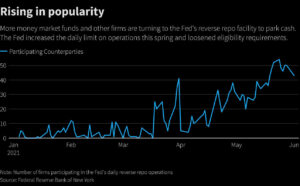
Nowhere is this more evident than in the rising popularity of a Federal Reserve program that lets firms stash their cash overnight with the U.S. central bank in exchange for at best a small return. The payout these days: Zero percent. But usage is soaring to record highs as money market funds and other eligible firms cope with what some analysts are calling a “tsunami” of cash. The banking system is swimming in nearly $4 trillion of reserves, thanks in part to the Fed’s asset purchases, a fall off in Treasury bill issuance and a rapid drawdown in the government’s store of funds at the Fed. The Treasury General Account, or TGA, has dropped by nearly $1 trillion since last fall, mirrored by the surge in bank reserves. All that cash is pushing down short-term rates and increasing expectations the Fed will need to respond with a technical adjustment at its June 15-16 meeting, if not earlier, in order to keep its key policy rate from sliding further. The situation is also a headache for money market funds, which are absorbing much of the money and finding fewer options for investing it, a dynamic the Fed is watching closely. “They’re getting cash in the door and aren’t able to find good places to invest it,” said Gennadiy Goldberg, a senior U.S. rates strategist for TD Securities. Fed policymakers were briefed by staff on money market issues at their last meeting in April. A senior official from the New York Fed advised them they may want to consider making a minor technical adjustment to rates “in the coming months” if the downward pressure on overnight rates continued. The effective federal funds rate – the central bank’s critical policy rate – slipped as low as 0.05% at the end of May before rising back to 0.06%. It is hovering near the bottom of the Fed’s target range of zero to 0.25%. The lowest it has ever settled on a daily basis is 0.04%. The central bank’s options for responding include lifting the interest it pays on excess reserves, or IOER, which is currently at 0.10% and is available only to banks. It could also lift the rate on the facility soaking up much of the extra cash: reverse repurchase agreements, or reverse repos, which are open to non-banks such as money-market funds. Together, the two are designed to form the “corridor” for the fed funds rate. The reverse repo rate – currently at zero – sets the floor by giving firms a risk-free place to park some of their cash overnight. Usage soared to a record $485.3 billion last week, up from nearly nothing in March. The increased popularity of reverse repo may be a sign that the Fed has “injected too much cash into the market,” said Scott Skyrm, executive vice president in fixed income and repo at Curvature Securities. “It’s going straight back to the Fed.” Policymakers expanded access to the facility this year by loosening the eligibility rules and raising the daily limit on operations to $80 billion per user from $30 billion. But some analysts say the Fed may need to do more by boosting the rate from zero, perhaps by 2-3 basis points or its more typical move of 5 basis points. Any adjustments to reverse repo or IOER could happen at the June meeting or before, analysts say. Many banks, unwilling to accumulate any more deposits, are funneling some of the excess reserves into money market funds. But with interest rates expected to stay low for the foreseeable future, money funds could struggle to find safe ways to invest that growing pile of cash to avoid losses for investors. While they can waive fees, fund providers still have overhead costs to cover. “At some point these funds are going to be pressed for profitability too,” said Steven Kelly, a research associate with the Program on Financial Stability at the Yale School of Management. Firms that “take money and invest it at zero percent return” may struggle to cover their expenses. Some money funds might eventually have to close to new investors or lower payouts, he said. The Fed could offer money funds some relief if it raises the rate it pays on reverse repo operations, Kelly said. But that wouldn’t address the longer-term financial stability concerns surrounding the funds, which sometimes have to sell holdings during times of stress in order to meet redemption requests, he said. The central bank and other regulators have singled out money market funds, which the Fed supported at the height of the pandemic and more than a decade earlier during the global financial crisis, as an area that is ripe for more reform. “There’s a structural issue and we know this,” Fed Chair Jerome Powell said during an interview with CBS in April. “It really is time to address it decisively.” Nick Note: The financial system has a crises. TO MUCH CASH. And nothing to do with it. Money Markets investments pay ZERO. Which means when you calculate administration costs they are losing money. Right now the Einsteins on Wall Street are muddled and confused. Their is nothing in their play book of economies going from a depression to massive growth in a year. Once they figure out their is no inflation. And what they are seeing is the greatest economic boom EVER. they will rush in mass into the stock market. Their is nowhere else to go. So they lose money until they figure it out. They will soon get  tired of this insanity.

Fed: Recovery picked up pace in past 2 months

(Bloomberg) — Sign up for the New Economy Daily newsletter, follow us @economics and subscribe to our podcast. The pace of the U.S. recovery picked up somewhat in the past two months, sparking price pressures as businesses contended with worker scarcity and rising costs, the Federal Reserve said. “The national economy expanded at a moderate pace from early April to late May, a somewhat faster rate than the prior reporting period,” the U.S. central bank said in its Beige Book survey released on Wednesday. “Overall price pressures increased further since the last report. Selling prices increased moderately, while input costs rose more briskly.” The report was based on information collected by the Fed’s 12 regional banks on or before May 25 and compiled by the Cleveland branch. Diane Swonk, chief economist at Grant Thornton LLP, wrote in a tweet that the survey shows demand continues to improve faster than supply across the board, which is showing up in prices. “It’s gong to be a hot summer for prices and wages — real test is whether we see shortages persist only 4Q,” she said. Fed officials are considering how quickly to trim monetary policy support with an increased pace of vaccinations brightening the U.S. outlook. The Federal Open Market Committee will update its quarterly forecasts for interest rates, growth, unemployment and inflation at its June 15-16 gathering. The Beige Book reported that some businesses were able to take advantage of stronger demand to pass along higher input costs to customers. “Looking forward, contacts anticipate facing cost increases and charging higher prices in coming months,” the survey said. Several policy makers including Vice Chair Richard Clarida have said central bankers may be able to begin discussing the appropriate timing of scaling back their bond-buying program at upcoming policy meetings. Patrick Harker, president of the Philadelphia Fed, said earlier on Wednesday that officials should get that debate underway. The report cited multiple anecdotes of companies struggling with higher input prices, supply chain disruptions and a shortage of workers. In St. Louis, for example, a group of restaurants held a job fair to fill more than 100 positions — but only a dozen applicants showed up. Leisure and hospitality firms saw increased business as vaccinated Americans sought to travel more frequently. In New York, hotel occupancy topped 50% for the first time since Covid-19 began and nightly room rates rose, while museums and restaurants saw a rebound. The FOMC has committed to only begin scaling back the $120 billion monthly pace of its asset purchases after there’s “substantial further progress” on inflation and employment.     U.S. central bankers will get a fresh update on the status of the labor market on Friday. The May employment report is expected to show the addition of 653,000 new jobs, with the unemployment rate dropping to 5.9%, according to a Bloomberg survey of economists. U.S. consumer prices showed hotter-than-expected inflationary pressures in April. Fed officials have largely written them off as owing to transitory factors associated with supply-chain bottlenecks and the reopening of service industries as the pandemic recedes. The Fed’s forecasts released in March showed officials don’t expect to raise interest rates from near zero before the end of 2023, even as they sharply upgraded projections for growth and employment this year. Nick Note: We are coming out  of a great plague and global shut down. They can not get it through their brain its over. We have a vaccine a cure and the global economy is restarting. Now for the poor and ignorant and stupid  it will take a little longer for them. Some people you cannot help like the loonie tunes that believe their is a chip in the vaccine….. HOW FUCKING STUPID! Not my problem nor yours…..  for you and I we will just gear up for the greatest recovery ever…….. And it will happen in fits and starts…… What part of a recovery from a global plague is so hard to understand,,,,,,

Stocks could hit new highs in early June, but then face challenges from inflation data and the Fed

  • Stocks could hit record highs in June, but there could also be choppy trading as investors keep an eye on inflation.
  • June is often a weak time for stocks, but the economic reopening could keep the market rallying as long as the Fed does not begin to sound too hawkish when it meets mid-month.
  • Inflation and jobs data will also be important to the market this month.

Stocks are likely to reach new highs in June, but the extent of the market’s gains depend on how much a threat inflation becomes and whether it will prompt the Federal Reserve to discuss tightening policy. June is historically a weak month for stocks, when looking back over the last 20 years. But Instinet points out that the S&P 500 has had a better track record recently, gaining every June since 2016. Over 20 years, it averaged a monthly decline of 0.6%, and was negative 11 times.Instinet also notes that over the course of the 20 years, the S&P 500 tended to be higher in the first half of the month before dipping to a multi-month low in the second half. The S&P 500 started off the first trading day of June with a bounce, shooting to within 4 points of its all-time high of 4,238. But by afternoon, it was negative, closing down 2 points to 4,202. The benchmark sits less than 1% from its intraday all-time high. The biggest worry for stocks has been inflation, and the recent readings for inflation have all come in higher than expected. “I really think it’s all about inflation, inflation, inflation and rates, rates, rates,” said Peter Boockvar, chief investment officer at Bleakley Advisory Group. Market focus is already on the June 15 and 16 Fed meeting, viewed as the most important market event this month. The May employment report Friday and inflation measures, like the consumer price index, will also be important. Strategists say the market could hit new highs but it could be choppy if inflation runs hotter than expected or the Fed begins to sound more hawkish. Inflation is a double-edged sword for stocks. On one hand, companies that can pass along higher costs in the form of higher prices have pricing power and that can help earnings grow. But if inflation gets too hot, it can eat away at profit margins. If it keeps rising, it can prompt the Fed to raise interest rates, which increase borrowing costs for companies and threaten returns for growth stocks in particular. Morgan Stanley chief U.S. equity strategist Mike Wilson notes that the June 10 release of the consumer price index could be a key date for the market this month. “Inflation expectations have also increased beyond what may be achievable in the near term. Inflation is on the upswing in our view and will eventually surpass the Fed’s targets on a sustainable basis,” noted Wilson. “However, expectations have increased too and now price this rise in many asset markets.” Wilson said the CPI release may be a “sell the news event that could negatively affect many crowded trades.” So far, the Fed has said inflation is transitory, and price data looks hotter because it is being compared to a weak period last year. But the concern is if it is not, the Fed will have to act to stop rising prices. That means it could start to pare back its bond buying sooner than expected, and ultimately raise interest rates sooner as well. “I don’t think you’re going to prove until the fall, where inflation is,” said James Paulsen, chief investment strategist at Leuthold Group. “If it’s still hot into the fall, we have a problem. I think odds are low on that. Everybody knows we’re going to get hot inflation numbers. We know why at least in part.” Paulsen also does not expect the stock market to pull back until the fall, at the earliest. He said valuations should be helped by much stronger earnings growth, and he expects economic data to start coming in better-than-expected. Scott Redler, partner with T3Live.com, expects the S&P 500 to trade to new highs in June, but he said the market is tentative ahead of jobs data. “The market is waiting to see what is going to happen with the jobs report Friday,” he said. The Fed has emphasized it will be patient, keeping its policy easy as the labor market and economy heals. Treasury yields have been trapped in a range, below early April highs, in part due to the April jobs report and other data that missed expectations. The benchmark 10-year was at 1.60% Tuesday. Yields move opposite price. A comment on labor, however, from St. Louis Fed President James Bullard, however, surprised some market pros. Bullard told the Financial Times that even with the economy down 8 million jobs, the labor market could be tighter than it looks. If so, that would suggest the Fed could be on a faster track to raise interest rates than expected. Economists expect 674,000 jobs were added in May, up sharply from the 266,000 gained in April, according to Dow Jones. Quincy Krosby, chief market strategist at Prudential Financial, said a weaker jobs number may ironically be more favorable for the market. “If we have a weaker number, not as strong as the market expects, we could have new [stock market] highs,” she said. “That suggests the Fed remains steadfast.” But she said the market could be spooked if inflation is higher than expected, and it raises speculation the Fed may begin to slow its asset purchases. The Fed last year changed its policy on inflation so that it now tolerates a range for inflation, where it can run above its former 2% target for a while. Winding down the bond program is seen as a first step toward the Fed raising interest rates, which most strategists don’t expect until 2023 at the earliest. Lately, Fed officials have said they expect to begin discussing the tapering bond purchases at upcoming meetings. “They’ve already offered language about the potential to discuss the pace of monthly purchases. Any language that intensifies that is going to be picked up by the market,” said Prudential Financial’s Krosby. “The market is vulnerable to understanding the timetable of how the Fed is thinking and how the Fed interprets the data.” Marc Chandler, chief market strategist at Bannockburn Global Forex, said the tone of the market heading into June remains “risk on.” “I think that’s what the currency markets are saying. Sterling made a new 3-year high. The Canadian dollar made a new 4-year high. Gold has rallied,” he said. “The underlying tone of the dollar is weak. That tells you it’s risk on.” He said risk assets, like stocks, should continue to do well unless yields start to rise too much. Nick Note: its game on risk on until the Fed stops buying all securities in sight AND raises interest rates…. so in the mean time its party time……