The automotive industry was ravaged early on in the pandemic thanks to lockdown measures and a dramatic decrease in travel, it more recently has begun facing a new problem: a shortage of microchips. Microchips are vital to much of a vehicle’s key functions, such as engine control, transmission, infotainment systems, and more. In the last half of 2020 and now in 2021, vehicle sales recovered fairly quickly, faster than automakers anticipated. Suddenly, they were struggling to meet demand. At the same time, chipmakers were experiencing supply shortages and increased demand from other sectors, such as personal electronics. With the resulting lack of microchip supply, automakers have been forced to slow production, even on their most popular models. For several automakers, the shortage is expected to cost them $1 billion or more — and even still, the alternatives are worryingly few. Nick Note: Demand increased catching car companies sleeping. They did not anticipate the fast recovery or increased demand. That created supply shortages which increases prices. The transportation part of the recent CPI report soared….. Increased inflation OR a reflation. The difference inflation is lasting. But a deflation is temporary in nature and usually followed by a deflation when supply catch up with demand and exceedes it
Underperforming roosters that aren’t producing as many chicks as expected are partly to blame for the US poultry shortage, according to executives at Tyson Foods. The Springdale, Arkansas-based company, one of the world’s largest producers of poultry and other meats, said earlier this week that it’s struggling to ramp up chicken supply because the new roosters it’s been using for fertilizing eggs and breeding new chicks simply aren’t hitting expectations. “We’re changing out one [type of] male that, quite frankly, we made a bad decision on,” Donnie King, president of Tyson’s poultry business, said Monday on a conference call with analysts. Breeding companies provide hens and roosters to chicken producers like Tyson, which then breed the birds and hatch their eggs to produce poultry. Tyson owns one of the major breeding companies in the US, Cobb-Vantress. King explained that the company discovered that eggs fertilized by this specific type of rooster hatch less often, limiting the company’s supply just as nationwide demand for chicken is sky high. He added that the company is working to replace the rooster by the fall, but there could be a lingering supply hit that carries over into next year. The hatching crisis hit Tyson in January, after it introduced the type of rooster that’s now getting the boot, King said. The breeding problem could be responsible for as much as half of Tyson’s problems meeting demand for its chicken, King said. “It’s about a 50/50 split between the hatch issue for us and the strong demand,” King told reporters after the earnings call, according to Reuters. “We’ll get our supply sorted out.”
There are a variety of other factors also holding back chicken supply, according to Gary Mickelson, a spokesperson for Tyson. He said the winter storm that slammed Texas earlier this year as well as “worker absenteeism” and a surge in demand are also hurting supply.
He added that the company switched to the new kind of rooster because it improved the quality of meat. But since Tyson experienced the unexpected drop in chicks, it has moved back to the roosters it previously used, he said. As previously reported, there’s simply not enough chicken to go around as US demand for the meat surges. A meat-processing slowdown caused by pandemic safety measures along with a surge in demand for recently rolled out fried chicken sandwiches are largely behind the shortage, fast-food executives said last month. “Demand for the new sandwich has been so strong that, coupled with general tightening in domestic chicken supply, our main challenge has been keeping up with that demand,” David Gibbs, CEO of Yum Brands, told investors last month. KFC, which is owned by Yum Brands, recently rolled out a new fried chicken sandwich. Other companies, including Dallas, Texas-based Wingstop, Charlotte, North Carolina-based Bojangles and Buffalo Wild Wings have all reported that they’ve also struggled to meet demand in recent weeks. Nick Note: Food prices soared in the dodgeie CPI report. But they were all a result of temporary conditions. Caused by a massive shut down in the economy. Obviously as people go back to work and people go back to spending…… their will be spot shortages called a reflation. Not to be confused with massive inflation.
Dow tumbles 680 points in worst decline since January as hot inflation reading spooks investors
U.S. stocks declined sharply on Wednesday as hotter-than-expected inflation data triggered massive selling, especially in technology shares. The Dow Jones Industrial Average fell 681.50 points, or 2%, to 33,587.66, posting its worst day since January. The blue-chip benchmark tumbled as much as 713 points at its session low. The S&P 500 lost 2.1% to 4,063.04 for its biggest drop since February, while the tech-heavy Nasdaq Composite slid 2.7% to 13,031.68, bringing its weekly decline to more than 5%. Ivestors have been fearful of a pick-up in inflation as it could squeeze margins and erode corporate profits. NB: factis inflation is great for corporate profits sice big corporations raise prices on the inflation excuse and then add some If price pressures run too hot for a sustained period of time, the Federal Reserve would be forced to tighten monetary policy. “There are people who think the Fed is not just behind the curve, they’re maybe missing the point and by the time they start to play catch up, it’s too late,” Wall Street veteran Art Cashin said Wednesday on CNBC’s “Squawk on the Street.” Tech shares, which have been under pressure this week and this month, led the decline again Wednesday as bond yields jumped. Shares of Microsoft, Netflix, Amazon and Apple all fell more than 2%, while Tesla slid over 4%. Alphabet dropped more than 3%. Strength in energy shares, which could do well in an inflationary environment, provided the broader market with some cushion. Occidental Petroleum climbed 2.4%. Chevron and Marathon Oil gained slightly. The Technology Select Sector SPDR is off by 5.6% this week and 6%, as investors reassess the group’s high valuations in the face of rising inflation. The Cboe Volatility Index, also known as Wall Street’s fear gauge, popped above 28 at its session high during Wednesday’s stock rout. The VIX is a measure of fear or expected volatility in the markets computed from option prices on the S&P 500. Nick Note: we saw out and out panic selling yesterday. A velocity break out to the downside. I believe with the SLIGHT possibility of skid marks a significant bottom has been put in. We need to get the PPI report behind us to get the markets to settle down. To be clear here supply shortages caused by shutdowns have created the TEMPORARY price spikes. Car prices increases an important of the CPI were driven by supply disruptions since the suits fucked up and did not keep their parts pipelines full. They have rum out of $5.00 chips that stops them for producing a $50,000 VEHICLE customers are screaming for. Remember pickup trucks and the like are worker bee tools. Blue collar types need their tool wagon… pickemuptrucks, And worker bee mamies need the soccer SUV to get the kiddies off to day care and school. When you weren’t working no need for the car. Many people sold them off for cash. Now its back to work they go and they need transportation…… ITS A TEMPORARY REFLATION NOT INFLATION………..
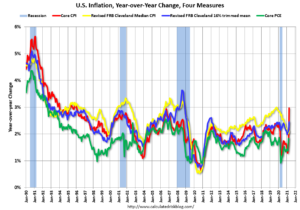
The Cleveland Fed released the median CPI and the trimmed-mean CPI this morning: According to the Federal Reserve Bank of Cleveland, the median Consumer Price Index rose 0.2% April. The 16% trimmed-mean Consumer Price Index rose 0.4% in April. “The median CPI and 16% trimmed-mean CPI are measures of core inflation calculated by the Federal Reserve Bank of Cleveland based on data released in the Bureau of Labor Statistics’ (BLS) monthly CPI report”. Note: The Cleveland Fed released the median CPI details for April here. Car and truck rental was up 505% annualized! Used cars and trucks were up 215% annualized. This graph shows the year-over-year change for these four key measures of inflation. On a year-over-year basis, the median CPI rose 2.1%, the trimmed-mean CPI rose 2.4%, and the CPI less food and energy rose 3.0%. Core PCE is for March and increased 1.8% year-over-year.
Note: We saw negative Month-to-month (MoM) core CPI and CPI readings in March, April and May 2020. We also saw negative MoM PCE and core PCE reading in March and April 2020. Although inflation picked up in April, the year-over-year change was impacted the base effect (decline last year). Nick Note: What made the CPI number fly was the fact last years numbers they are compared against were deflationary as the US economy was in lock down. The widely published report was bogus. I have always used the Median Consumer Price index which is far more accurate. A lot of this was driven my temporary events like the chip shortage…….. Watch ae prices come right back down a the markets get flodded with goods
Watch the hype….. this is a reflation shut down business opening up, inventorying up and gearing up manufacturing. Amazing same numbers we had in 2008 when the stimulus hit during the financial crises
Inflation in the US, as measured by the Consumer Price Index (CPI), jumped to 4.2% on a yearly basis in April from 2.6% in March, the data published by the US Bureau of Labor Statistics revealed on Wednesday. This reading came in higher than the market expectation of 3.6%. On a monthly basis, the CPI edged higher to 0.8% from 0.6%. Further details of the publication revealed that the annual Core CPI, which strips the volatile food and energy prices, increased to 3% from 1.6% The Consumer Price Index (CPI) for all items in the United States jumped 4.2% on an annual basis in April, the US Bureau of Labor Statistics said on Wednesday. The figure marks an increase from the annual inflation rate of 2.6% recorded in March and is the highest since September 2008. The index for all items except food and energy was up 3% year on year, while food prices rose 2.4% on an annual basis and energy prices increased 3%. On a monthly basis, the CPI for All Urban Consumers added 0.8% compared to March, while the index less food and energy gained 0.9%, Nick Note: the last time we had a reflation was 2009 when the economy reopened after the financial panic. I am surprised… at how low the numbers are. Soon the supply chains will fill up and become oversupplied and inflation rates will plunge….. Enjoy the stupideness…
A senior Federal Reserve official has called on the US central bank to be “patient” in pursuing its ultra-loose monetary policy, dismissing inflation worries while highlighting “uneven” improvements in the labour market. The comments by Lael Brainard, a Fed governor, on Tuesday suggest the US central bank is still not ready to begin discussing its first steps to remove its support for the pandemic-hit US economy, even as growth picks up and consumer prices begin to rise. They also indicate that senior Fed officials viewed last week’s weak jobs report for the month of April as reinforcing their concerns that the acceleration in the US recovery so far this year remains uneven and fraught with uncertainty. “The outlook is bright, but risks remain, and we are far from our goals. The latest employment report reminds us that realised outcomes can diverge from forward projections and underscores the value of patience,” Brainard said.
“Remaining patient through the transitory surge [in inflation] associated with reopening will help ensure that the underlying economic momentum that will be needed to reach our goals . . . is not curtailed by a premature tightening of financial conditions.”
The monetary policymaker’s comments come against the backdrop of higher energy prices and mounting evidence of supply chain bottlenecks as economies globally begin to emerge from coronavirus-related lockdowns. Investors have grown increasingly worried that the rise in consumer prices this year may be more pronounced than is currently expected, leading to more sustained inflation that may prompt the Fed to tighten monetary policy sooner than indicated by officials in their projections. Brainard sought to quell those fears on Tuesday, highlighting that production-related issues would smooth out over time and that “supply-demand imbalances” in the in-person services sector would also be resolved within “a few quarters” as the vaccination campaign progresses and the economic reopening continues apace. “To the extent that supply chain congestion and other reopening frictions are transitory, they are unlikely to generate persistently higher inflation on their own,” she said. “A persistent material increase in inflation would require not just that wages or prices increase for a period after reopening, but also a broad expectation that they will continue to increase at a persistently higher pace.” The April jobs report, which showed the US economy adding 266,000 positions last month, sharply lower than its pace of 770,000 jobs in March, was far weaker than projected by most economists. “[The data] reminds us that while there are good reasons to expect the number of jobs and the number of people wanting to work will make a full recovery, it is unlikely they will recover at the same pace,” she said. While some economists, business groups and Republican lawmakers pointed to enduring federal unemployment benefits as a key reason why the demand for labour appeared to be outpacing the supply of labour from workers, Brainard pointed to “virus-related impediments” as the main reason why businesses were facing challenges hiring people. Among them, she noted health and safety concerns, gaps in childcare, and public transport weaknesses. “There is good reason to expect a strong rebound in employment over coming quarters, although the different forces affecting demand and supply may lead to uneven rates of progress,” said Brainard, a former Obama administration official and a Democrat. “But today, by any measure, employment remains far from our goals.” Nick Note: all this inflation spin is the boys trying to start stock market hysteria. Their is no correlation between stock market valuations and inflation rates….. And the idea that high tech stocks are vulnerable to higher rates is beyond stupid. these guys are not bowwerers and in fact have hughe pots of cash…… Do not let them make a idiot out of you.
jUST BECAUSE you can do something does not mean you should do it
Crude prices gained on Monday after the largest fuel pipeline in the United States was shut down over a ransomware cyberattack. The Colonial Pipeline, which transports 2.5 million barrels of fuel a day, halted all operations following Friday’s attack and was being assisted by the White House to tackle supply issues. Nick Note: Do not mistaken the sleeping dragon for a sparrow. The US would not have gone into World War II except for the colossal mistake when the Japaneses attacked Pearl harbor. As Japanese Admiral Isoroku Yamamoto said regarding the 1941 attack on Pearl Harbor by forces of Imperial Japan.
I fear all we have done is to awaken a sleeping giant and fill him with a terrible resolve.
I run in essence a private spy service. I collect information and i share information, i exchange information and we trade information in the market.
An recent example of the first fruits was the pandemic/ We all know who got their first and i kept you alive. I shared information with the wolverines who were still sleeping in January.
Well a similar event has been happening with the hacking community. You have all heard about ransomware. But it is far more dangerous since more complicated functions have gone on line. From the launching of a rocket, routing jetliners, electrical distribution systems, banking even processing your turds are all run, managed and controlled over the internet. And US companies have not taken the threat seriously. Our hacker buddies… sorry software engineers have pushed things to far. Many of them will end up dead…
Shares on Wall Street traded with losses during the premarket session on Tuesday following a major tech selloff in the previous session. Traders were awaiting US consumer price data scheduled for a release later this week amid growing concerns that the Federal Reserve could tighten its monetary policy due to rising inflation. On the earnings calendar, Palantir Technologies was set to report its first-quarter results before the opening bell. The Dow Jones fell 0.50% at 4:25 am ET, while the S&P 500 lost 0.80%. Meanwhile, the tech-heavy Nasdaq 100 dropped 1.36% as investors continued to dump growth stocks on inflation worries. The euro was up 0.12% against the dollar at 4:30 am ET, buying 1.21431. Nick Note: I cannot tell you what the market will do all the time (guess lucky) but i am pretty good at telling you what to do. Their is NO INFLATION. Of course we are about to get bombed with a blizzard of bullshit. Business were closed in mass. And now they are reopening. Spot shortages will be filled as bUssiness gear up across the board and over produce. Then prices will come right back down again. A classic reflation. And the stock market MINOR correction is a hold and a buy when you are able…… THEIR IS NO INFLATION ITS A DEFLATION AND A DEFLATION IS TRANSITORY IN NATURE
New drug helps COVID-19 patients breathe on their own.
(Reuters) – The following is a roundup of some of the latest scientific studies on the novel coronavirus and efforts to find treatments and vaccines for COVID-19, the illness caused by the virus. New drug helps COVID-19 patients breathe on their own. When a new monoclonal antibody drug was added to treatments being given to hospitalized COVID-19 patients who were still breathing on their own, the drug – lenzilumab from Humanigen Inc – significantly improved their odds of not needing invasive mechanical ventilation, researchers found. The 540 patients in the randomized trial were already receiving a variety of standard treatments. Half of them also received lenzilumab via three intravenous infusions. In a paper posted on Wednesday on medRxiv ahead of peer review, the research team reported that patients in the lenzilumab group had a 54% better chance of surviving without needing mechanical ventilation. In patients receiving steroids and Gilead Sciences antiviral drug remdesivir, the addition of lenzilumab improved survival without the need for mechanical ventilation by 92%. In patients under age 85 whose immune system was in the early stages of triggering a life-threatening inflammatory response, lenzilumab improved the odds of ventilator-free survival by nearly three-fold. Humanigen Chief Executive and study coauthor Dr. Cameron Durrant said his team believes the results “indicate a substantial improvement in COVID-19 treatment.” (https://bit.ly/3tzY2YU) Virus might insert genetic fragments into patients’ genetic code A controversial new paper based on laboratory experiments suggests a possible explanation for why some COVID-19 survivors still test positive on viral RNA tests months later. Small fragments of genetic instructions from the coronavirus might get integrated into infected cells’ genome. In the experiments, the fragments that got inserted into the cell’s genetic code came mainly from the tail-end of the viral genome and cannot induce the cell to create infectious virus. However, they might be enough to trigger a positive result on COVID-19 PCR tests. “There is no evidence that the process of these integrations into the genome causes harm,” said study leader Rudolf Jaenisch of the Whitehead Institute for Biomedical Research at MIT, adding that the researchers believe that is very unlikely. Other experts have said the findings, reported on Thursday in the journal PNAS, likely reflect unintended effects of experimental methods. The researchers have so far seen the phenomenon only in test tubes. They are trying to find direct evidence for SARS-CoV-2 sequences integrated into the genome in patients, “but these experiments are technically very challenging,” Jaenisch said. The vaccines from Pfizer/BioNTech BNTX.O> and Moderna use messenger RNA to teach cells to make a protein that resembles a site on the virus. But the cell quickly breaks down the RNA and gets rid of it. “There is no evidence that vaccine RNA could integrate and we believe that this is highly unlikely,” Jaenisch said. The high risks of complications from COVID-19 “would be a very strong incentive to get the vaccine,” he said, citing negligible risk from the shots. (https://bit.ly/3tDs9P8) Home monitoring may keep COVID-19 patients out of hospital A home monitoring program for patients with COVID-19 may be associated with lower odds of hospitalization, according to a new study. At the Cleveland Clinic, doctors remotely monitored 3,975 COVID-19 patients for up to 14 days after a positive test. In a study published on Thursday in JAMA Health Forum, they compared patterns of healthcare use by these patients and by 3,221 similar patients who did not participate in the program. A month after diagnosis, participants in the home monitoring program were 27% less likely than nonparticipants to have been hospitalized, although they had about a two-fold higher likelihood of outpatient visits with the home monitoring program. “As the pandemic continued and we learned more and more about the outcomes of the program, and the natural course of COVID infections in groups of patients, we were able to fine tune the program to those with highest risk,” said Dr. Anita Misra-Hebert, director of the Clinic’s Healthcare Delivery & Implementation Science Center. The trial was not randomized and does not provide conclusive evidence of the program’s value. Instead, the researchers write, the results “support the need for randomized trials to evaluate home monitoring programs … after COVID-19 diagnosis.” (https://bit.ly/3uvHpyW; https://bit.ly/3bdJg3L) Nick Note: Remember its not over before its over! And you can never be sure its over. So assume its not over.
The Nasdaq 100 sank deeper into the red on Monday, losing more than 2% or 300 points dragged seemingly by the shares of tech giants Apple and Facebook, as well as the carmaker Tesla. The disproportion between the Dow Jones Industrial Average, which reached another record in today’s session, and the tech-heavy index was attributed by some outlets to the benefits that Dow’s constituents stand to gain from the economic recovery. The Nasdaq 100 tumbled 2.35% or 324 points at 2:29 pm ET, with Tesla and Facebook losing more than 5% and 4%, respectively. Tech shares reversed Friday’s gains, pulling the S&P 500 and the Nasdaq into negative territory, while industrial and healthcare shares set the blue-chip Dow on course for its fourth consecutive all-time closing high. “You continue to see this rotation between tech-plus and cyclicals, and certainly the spike in inflation of input costs benefits cyclicals in terms of pricing,” said Tim Ghriskey, chief investment strategist at Inverness Counsel in New York. Booming demand is colliding with tight supply in basic materials, helping stoke fears of inflation. The break-even rate on five-year and 10-year U.S. Treasury Inflation-Protected Securities (TIPS) touched their highest levels since 2011 and 2013, respectively. “The Fed has talked a lot about a temporary spike in inflation, that it will be temporary,” Ghriskey added. “But the financial markets are clearly concerned about it.”Those concerns will be in the minds of investors when the Labor Department releases its latest CPI report on Wednesday. A shutdown to halt a ransomware attack on the Colonial Pipeline entered its fourth day, hobbling a network which transports nearly half of the East Coast’s fuel supplies. First-quarter reporting season has entered the home stretch, with 439 of the companies in the S&P 500 having reported as of Friday. Of those, 87% have beaten consensus expectations, according to Refinitiv IBES. Analysts now see year-on-year S&P earnings growth of 50.4% on aggregate, more than double the rate forecast at the beginning of April and significantly better than the 16% first-quarter growth expected on January 1, per Refinitiv
Electric vehicle stocks put on the brakes, with Tesla (NASDAQ:TSLA) Inc down 5.6% and Fisker off 9.0% after Workhorse Group missed quarterly revenue expectations. FireEye (NASDAQ:FEYE) rose 1.9% after industry sources identified the cybersecurity firm as among those helping Colonial Pipeline recover from the recent cyberattack. Advancing issues outnumbered declining ones on the NYSE by a 1.08-to-1 ratio; on Nasdaq, a 1.82-to-1 ratio favored decliners. The S&P 500 posted 221 new 52-week highs and no new lows; the Nasdaq Composite recorded 203 new highs and 122 new lows. Dow reaches all-time high on commodity surge; S&P, the Nasdaq Composite recorded 203 new highs and 122 new lows.