Silver continued gaining ground on Monday, hitting a fresh record high of $110 per ounce. The recent surge in safe investments was partly motivated by geopolitical turmoil and worries about the state of the United States economy, as well as uncertainty surrounding the course of the Federal Reserve’s monetary policy and the central bank’s independence. Silver soared 7.39% at 4:36 am ET, going for $109.88 per ounce. The precious metal is up 53.7% since the start of the year. Gold gained 2.27% at 4:39 am ET and went for $5,094.20 per ounce. Platinum jumped 4.28% to go for $2,889.67 per ounce, while palladium added 2.61% and went for $2,067.78 per ounce.
Gold hits new all-time high of $5,000
Gold climbed above $5,000 per ounce for the first time, underscoring investors’ flight to safety amid diminishing confidence in other assets due to geopolitical tensions and persistent trade uncertainties. The rally towards the stunning milestone was driven in no small part by United States President Donald Trump’s often seismic policy shifts, which have, at their most recent, put a strain on relations between Washington and other NATO members over Greenland. Gold went up by 0.64% to go for $5,015.65 per ounce at 6:07 pm ET. Silver surged 2.51% to $104.68 per ounce at 6:11 pm ET. Platinum dropped by 0.66% a minute later to $2,753.51 per ounce, while palladium went down by 0.44% to go for $2,008 per ounce.
The UK Ministry of Defence confirmed on 22 January that 12 Squadron, the joint RAF–Qatar Typhoon unit, had deployed to the Gulf in a defensive capacity under the UK–Qatar Defence Assurance Agreement. According to the MoD, the deployment reflects “regional tensions” and builds on longstanding cooperation between the two countries, including shared flying training on Hawk and Typhoon aircraft in the UK. The squadron has previously deployed to Qatar for joint training and exercises such as EPIC SKIES and SOARING FALCON, aimed at strengthening interoperability and regional security. “Qatar and the UK are close partners with historic defence ties going back decades. This partnership bolsters the national security of both our nations and supports stability in the Gulf region,” says Defence Secretary John Healey MP. “Today’s deployment builds on those shared aims as Typhoon jets from our joint squadron deploy to support its defence.” The deployment also comes alongside the UK government’s recently announced £500m investment to upgrade the RAF’s Typhoon fleet, reinforcing the aircraft’s role as a core element of the UK’s combat air capability.
In parallel, a dozen US Air Force F-15E Strike Eagles, backed by spare aircraft and tanker support, departed RAF Lakenheath in mid-January, with their arrival in the Middle East confirmed by US Central Command imagery. Open-source analysis and supporting airlift activity strongly indicate that the aircraft were deployed to Muwaffaq Salti Air Base, a long-standing hub for US combat operations. The base is known to host a mix of US tactical aircraft and ISR assets and is currently assessed to include a detachment of A-10C Thunderbolt II aircraft. While F-15Es have maintained a steady presence in Jordan for years, the scale and timing of the latest movements, alongside increased tanker and C-17 strategic airlift activity, point to a broader reinforcement rather than a routine rotation.
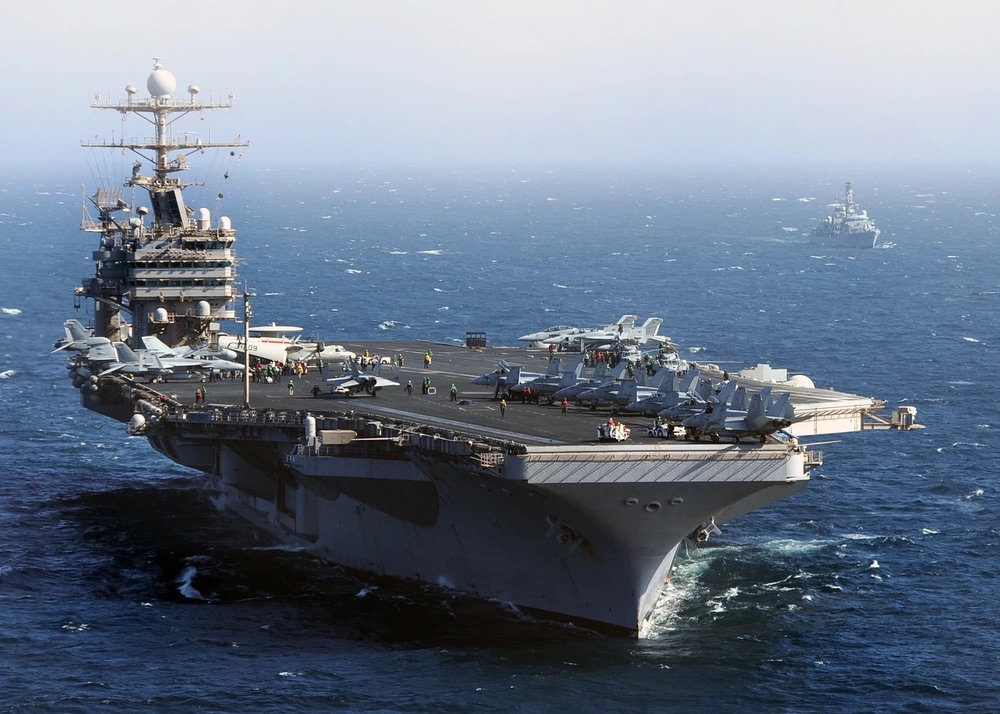
US carrier strike group moves toward the Middle East
Adding weight to the air deployments, the USS Abraham Lincoln Carrier Strike Group has been ordered to redeploy west from the South China Sea and is now moving towards the Indian Ocean and Arabian Sea.
Photo: DVIDS
The carrier brings with it a full embarked air wing, including F-35C Lightning II, F/A-18E/F Super Hornets, EA-18G Growlers and E-2D Hawkeyes, significantly expanding US strike, electronic warfare and air defence options in the region. Its escorting cruisers and destroyers add substantial missile defence and strike capacity.
So far, there has been no clear evidence of a major US bomber deployment to Diego Garcia, suggesting the current posture is focused on flexibility and deterrence rather than signalling imminent offensive action.
What Trump has said about Iran and the risk of escalation
Speaking aboard Air Force One this week, President Donald Trump said the United States was “watching Iran very closely” as a “big force” moved into the region, describing a “massive fleet” heading towards the Gulf.
While Trump said he would “rather not see anything happen”, his comments explicitly linked the redeployment of US naval and air assets to Iran, underlining Washington’s intent to maintain military pressure while keeping its options open.
For now, the movements appear designed to create options, bolster regional defences and deter escalation. Whether the buildup stabilises or expands further is likely to depend on developments inside Iran and the calculations made in Washington and allied capitals in the days ahead.
The Kremlin said the “territorial issue” remains unresolved after President Vladimir Putin held talks with US envoys Steve Witkoff and Jared Kushner on the latest peace plan for ending Russia’s war on Ukraine.
Putin’s foreign policy aide, Yuri Ushakov, said there’s “no hope of achieving a long-term settlement” to the war until Russia’s demands for territory in Ukraine are accepted.
Talks between US, Russian and Ukrainian representatives started in the United Arab Emirates and were expected to continue into Saturday, with discussions to include the question of Donbas and the modalities of a potential peace deal. The Kremlin said the “territorial issue” remains unresolved after President Vladimir Putin held late-night talks with US envoys Steve Witkoff and Jared Kushner on the latest peace plan for ending Russia’s war on Ukraine. There’s “no hope of achieving a long-term settlement” to the war until Russia’s demands for territory in Ukraine are accepted, Putin’s foreign policy aide, Yuri Ushakov, said in an audio recording on Telegram early Friday. That’s even as he characterized the almost four hours of negotiations in the Kremlin as “exceptionally substantive, constructive.” Talks between US, Russian and Ukrainian representatives got started in the United Arab Emirates on Friday and were expected to continue into Saturday, Tass reported, citing the UAE’s Foreign Ministry. Separately, Witkoff and Putin’s envoy, Kirill Dmitriev, will discuss bilateral Russia-US economic matters in Abu Dhabi. This was Witkoff’s seventh visit to Putin in the past year as US President Donald Trump has pushed for a peace deal, so far without success. US and Ukrainian officials have said they’ve made significant progress on a 20-point plan to end the Russian full-scale invasion that’s lasted almost four years and spiraled into Europe’s biggest conflict since World War II.
Still, Kyiv and Moscow remain at an impasse on key points including Putin’s demands for parts of Ukraine that remain under Kyiv’s control in its eastern Donbas territory of Donetsk and Luhansk regions.
Russia is insisting on securing what it calls the “Anchorage understandings” reached at Putin’s August summit with Trump in Alaska. That would require Ukraine to turn over the whole of eastern Donetsk, while fighting would be frozen along the current lines of contact in the southern regions of Kherson and Zaporizhzhia.
Ukraine rejects demands to withdraw its forces from heavily fortified areas of Donetsk that Putin’s military has failed to occupy in fighting that stretches back to 2014. US proposals have suggested turning the unoccupied area into a de-militarized or free economic zone under special administration. An agreement on postwar security guarantees for Ukraine “is ready for signing,” Zelenskiy said Friday. “This document will be the basis for more documents. But we have got the core, highway agreement on the security guarantees.”
Even as peace negotiations go on, Putin has stepped up strikes on Ukraine’s power sector in freezing winter temperatures, leaving millions of people without heating and water. Ukraine has also struck Russian energy infrastructure causing disruptions. Kyiv Mayor Vitali Klitschko warned residents Friday that “the situation is extremely difficult” and urged them to store water, food and any needed medications at home because of the likelihood of further Russian attacks. More than 1,900 apartment buildings are still without heating following Tuesday’s strikes, he said. A visibly angry Zelenskiy tore into Europe for its apparent lack of willingness to stop Putin during a speech in Davos on Thursday.
“Europe loves to discuss the future but avoids taking action today,” he told the audience. “Where is the line of leaders who are ready to act?”
Major European airlines have temporarily halted services to some countries in the Middle East on Friday amid growing security concerns linked to potential United States military action against Iran. Air France and KLM cancelled flights to Tel Aviv, Dubai, and Saudi destinations over the weekend, following Lufthansa Group’s recent decision to suspend night‑time flights to Israel through the end of January, according to the Times of Israel. Meanwhile, Dutch public broadcaster NOS quoted KLM saying it will not fly to Israel, Dubai, Dammam, or Riyadh “due to the geopolitical situation,” and will avoid Iraqi, Iranian, Israeli, and Gulf airspace for now.
NN: A classified briefing was given to the airline. And within minuets they cancelled flights to the war zone
The United States Treasury Department Office of Foreign Assets Control (OFAC) issued fresh sanctions against Iran’s so-called “shadow fleet,” targeting nine vessels and eight related firms, amid the ongoing protests in Iran. According to the Treasury, the sanctioned vessels and entities, some of which are based in India, Oman and the United Arab Emirates, collectively facilitated the transport of hundreds of millions of dollars’ worth of Iranian oil and petroleum products to foreign markets and used that revenue to fund “regional terrorist proxies, weapons programs, and security services.” US Secretary of the Treasury Scott Bessent stated that these measures target a “critical component of how Iran generates the funds used to repress its own people,” adding that the Treasury will continue to “track the tens of millions of dollars that the regime has stolen and is desperately attempting to wire to banks outside of Iran.”
The price of silver continued its historic rally on Friday, rising to a fresh all-time high of $100,17 amid heightened geopolitical risks and increased industrial demand for the metal. Although tensions over Greenland have apparently subsided following the World Economic Forum in Davos and United States President Donald Trump’s pledge not to use force to annex the Arctic territory, investors seemingly still sought safe-haven assets to offset potential global risks. At 10:51 am ET, Silver rose 3.77% to sell for $99.78 per ounce, and gold increased 0.79% to exchange for $4,955.98 per ounce. Platinum surged 4.16% a minute later, changing hands at $2,739.69 per ounce, while palladium jumped 6.06% to go for $2,001.77 per ounce.
NN: Feeding frenzy… Sell the shit out of this insanity
United States President Donald Trump said the US is closely monitoring Iran and has moved significant naval forces toward the region. Speaking to reporters aboard Air Force One, Trump said the US has a “big flotilla going in that direction.” Trump described the scale of the deployment in blunt terms, saying, “We have an armada.” “We have a big force going toward Iran. I’d rather not see anything happen, but we’re watching them very closely,” he concluded.
Must Watch Tesla CEO, SpaceX chief engineer and xAI CTO Elon Musk participates in a discussion at the 2026 World Economic Forum in Davos.
Elon Musk, the richest man in the world, predicted on Thursday that there will be more robots than people in the world in the future. Speaking at the World Economic Forum in Davos, Musk said that there will be billions of humanoid robots and “everyone on Earth is going to have one.” He emphasized that robots will be able to watch over children and care for people’s pets or elderly parents, ensuring that such actions will be performed safely. “I think we will have those things,” the billionaire noted. He also underlined that the world is heading to “a future of amazing abundance, which is very cool.”
The French Navy intercepted a sanctioned Russian oil tanker, part of the so-called shadow fleet, in the Mediterranean, French President Emmanuel Macron revealed in a social media post on Thursday. “The operation was conducted on the high seas in the Mediterranean, with the support of several of our allies. It was carried out in strict compliance with the United Nations Convention on the Law of the Sea,” Macron said, adding that the activities of the shadow fleet contribute to financing Russia’s war against Ukraine. The French president’s announcement follows Ukrainian President Volodymyr Zelensky’s speech at the World Economic Forum in Davos, in which he criticized European allies for not taking action against Russian tankers operating in waters around Europe.
NN: Its about time. Its not just seizing tankers. It is to stop Russian oil sales to cut off funding for their war machine. Which means less oil in the market
ISLAMABAD: President Donald Trump is once again evaluating “decisive” military options against Iran, days after deciding against immediate strikes last week, according to senior US officials. This reconsideration comes amid reports of a brutal crackdown on protesters in Iran that has resulted in thousands of deaths, prompting renewed pressure on Washington to respond forcefully. The shift highlights the volatile dynamics in US-Iran relations, where military planning intersects with domestic unrest in Tehran and broader regional stability concerns. Officials indicate that Trump has emphasized the need for actions capable of delivering a significant impact on the Iranian regime. The Wall Street Journal reported that Trump has repeatedly used the term “decisive” in discussions with aides, pushing the White House and Pentagon to prepare a range of scenarios. These include limited strikes targeting Islamic Revolutionary Guard Corps facilities as well as more ambitious plans potentially aimed at regime change. Although no final order has been issued, the president’s insistence on robust alternatives suggests a willingness to escalate if provocations continue. This development follows an earlier pullback from strikes, influenced by assessments that current US forces in the region might not suffice for a large-scale operation without risking significant retaliation. In parallel with these deliberations, the United States is accelerating a substantial military buildup in the Middle East to enhance its operational capabilities and deterrence posture. Recent deployments include the USS Abraham Lincoln aircraft carrier strike group, which is en route from the South China Sea toward the Persian Gulf, accompanied by destroyers and F-35 fighter aircraft. This carrier’s arrival will significantly boost US airpower projection, enabling sustained operations if required. The movement reflects a strategic effort to position assets closer to potential conflict zones amid heightened tensions. Adding to the naval surge, US F-15E fighter jets have landed in Jordan, providing additional strike and support capabilities for operations across the region. These advanced aircraft, equipped for precision strikes and air superiority missions, strengthen Washington’s ability to respond rapidly to threats. The deployments are part of a broader effort to ensure that any decision on military action is backed by sufficient firepower, addressing earlier concerns that limited regional presence constrained options for a major offensive against Iranian targets. Crucially, the Pentagon is reinforcing defensive systems to protect US forces, bases, and allies from potential Iranian counterstrikes involving ballistic missiles or drones. Additional Patriot missile batteries and Terminal High Altitude Area Defense (THAAD) systems are being deployed to key locations in the Middle East. These advanced antimissile platforms are designed to intercept incoming threats at various altitudes, thereby mitigating risks to American personnel and regional partners. Officials have emphasized that such enhancements are essential for safeguarding assets during any offensive operations. The buildup comes against the backdrop of Iran’s internal challenges, where authorities have intensified crackdowns on widespread protests, leading to significant casualties and international condemnation. Trump had previously threatened intervention in response to violence against demonstrators but paused military action after indications that executions might be halted and killings reduced. Despite this temporary de-escalation, the persistence of regime repression has revived discussions in Washington about the need for a stronger posture to deter further aggression or nuclear advancements. Analysts note that while military options are under active review, the administration is also weighing diplomatic and economic pressures as alternatives. New sanctions have been imposed on Iranian leaders involved in the crackdown, aiming to isolate the regime financially without immediate resort to force. However, the rapid deployment of offensive and defensive assets signals preparedness for escalation, potentially influencing Tehran’s calculations on its regional behavior and proxy activities. The strategic calculus involves balancing the risks of a broader conflict with the imperative to project strength. US officials have been advised that strikes alone may not guarantee regime collapse, necessitating careful calibration of objectives. The presence of an aircraft carrier, advanced fighters, and layered missile defenses collectively enhances Washington’s ability to conduct operations while protecting against reprisals, underscoring a deliberate effort to restore deterrence in a tense environment.
This evolving situation carries implications for global energy markets, given the Middle East’s critical role in oil supply routes through the Strait of Hormuz. Any military engagement could disrupt shipping and spike prices, affecting economies worldwide.
Moreover, allies such as Gulf states have expressed caution about strikes on Iran, fearing retaliatory actions that could destabilize the region further. The US buildup thus serves both offensive and defensive purposes in a complex geopolitical landscape.
NN: I think Trump is going to pull off a shock and ASH!