(Reuters) – The S&P 500 receded from a record high on Thursday while the Nasdaq shed more than 1% as a spike in U.S. bond yields accelerated a move out of growth stocks and into companies viewed as likely to outperform as the economy recovers. The Russell 1000 value index, which is heavily comprised of cyclical stocks such as financials and energy, added about 0.2% while the Russell 1000 growth index, which includes technology stocks, dropped about 1.4%. That rotation helped lift the Dow Jones Industrial Average to an intraday record high, led by UnitedHealth Group and Goldman Sachs Group, both up more than 2%. The yield on the benchmark 10-year Treasuries crossed 1.75% to hit a 14-month high a day after the Fed projected the strongest growth in nearly 40 years as the COVID-19 crisis winds down, and also repeated its pledge to keep its target interest rate near zero for years to come.. “The Fed just saying they are not going to raise rates until 2023 really means nothing,” said Tim Ghriskey, chief investment strategist at Inverness Counsel in New York. “The Fed is on the sidelines, but if bond yields keep going up, that is what really hurts the economy.” Apple Inc and Amazon.com Inc dropped more than 2%. Tech and other growth stocks are particularly sensitive to rising yields because their value rests heavily on earnings far into the future, which are discounted more deeply when bond yields rise. A recent $1.9 trillion spending stimulus sparked fears of rising inflation and contributed to the jump in longer-end Treasury yields. Underscoring the staggered recovery in the labor market, data showed the number of Americans filing for jobless benefits unexpectedly rose last week. A separate report indicated the Philly Fed business index jumped more than expected, to its highest level since 1973. In midafternoon trading on Thursday, the Dow Jones Industrial Average was up 0.49% at 33,176.67 points, while the S&P 500 lost 0.37% to 3,959.43. The Nasdaq Composite dropped 1.46% to 13,328.11. The S&P 500 financial sector index, sensitive to the economic outlook, rose almost 2%, while the industrial index climbed almost 1%. The technology index fell 2.3%. Accenture jumped about 1.9% after the IT consulting firm raised its full-year revenue forecast and reported second-quarter revenue above analysts’ estimates, as more businesses used its digital services to shift operations to the cloud. Dollar General Corp dropped more than 5% after the retailer forecast annual same-store sales and profit below estimates, indicating that a pandemic-fueled rush for lower-priced goods may be waning faster than expected. AMC Entertainment jumped almost 5% after the movie theater operator said it would have 98% of its U.S. locations open from Friday. Declining issues outnumbered advancing ones on the NYSE by a 1.69-to-1 ratio; on Nasdaq, a 1.51-to-1 ratio favored decliners. The S&P 500 posted 84 new 52-week highs and no new lows; the Nasdaq Composite recorded 208 new highs and 20 new lows.Nick Note: Let them try to tickle the dragons tail. This will end badly…… the FED is in firm control. Their is no inflation… Its a reflation and everyone of them end up in a stock market boom. We shall see what we shall see
Europe rises, auto rally lifts German DAX to record high
https://youtu.be/5CRohs_SItY
Powell Holds Dovish Line ZERO rates through 2023
(Bloomberg) — Federal Reserve Chair Jerome Powell and his colleagues continued to project near-zero interest rates at least through 2023 despite upgrading their U.S. economic outlook and the mounting inflation worries in financial markets.
The decision, which came on a volatile day for investors with Treasury yields surging ahead of the announcement, masked a growing number of officials who saw liftoff before then — though Powell stressed this remains a minority view.
“The strong bulk of the committee is not showing a rate increase during this forecast period,” Powell told a virtual press conference Wednesday following a meeting of the Federal Open Market Committee, adding that the time to talk about reducing the central bank’s asset purchases was “not yet.” Seven of 18 officials predicted higher rates by the end of 2023 compared with five of 17 at the December gathering, showing a slightly larger group who see an earlier start than peers to the withdrawal of ultra-easy monetary policy, according to fresh quarterly Fed projections. “Indicators of economic activity and employment have turned up recently, although the sectors most adversely affected by the pandemic remain weak,” the FOMC said in its policy statement. “Inflation continues to run below 2%.”
The Fed expects that a bump in inflation this year will be short-lived. Officials saw their preferred measure of price pressures slowing to 2% next year following a spike to 2.4% in 2021, according to the projections. Excluding food and energy, inflation is forecast to hit 2.2% this year and fall to 2% in 2022.
Ten-year Treasury yields reversed their earlier rise as Powell spoke and U.S. stocks closed higher. Asked about the recent move up in yields, Powell pushed back against the idea the Fed should lean against the market, noting that the current stance of Fed policy, including its asset purchase program, was appropriate.Massive fiscal support and widening vaccinations that will help reopen the economy have buoyed investor expectations for rate increases and inflation, propelling Treasury yields higher as the central bank and federal government keep adding stimulus. The target range of the benchmark federal funds rate was kept at zero to 0.25%, where it’s been since last March. Wednesday’s FOMC decision was unanimous. “The Federal Reserve continues to hold the course, maintaining the glide path for both rates and asset purchases which it established last year, and does not appear to be close to altering its trajectory anytime soon.” U.S. central bankers left asset purchases unchanged at $120 billion a month and repeated that this pace would be maintained until “substantial further progress” is made on their employment and inflation goals. Powell told reporters that the Fed would signal well in advance when that threshold was on track to being achieved. Powell and his colleagues met as the economy continues to improve. Job gains picked up last month and President Joe Biden signed an additional $1.9 trillion of pandemic aid into law on March 11. Vaccinations continue apace, allowing states to start easing lockdown restrictions that could release a torrent of consumer spending. The economy remains far from the Fed’s goals, though. Even with 379,000 jobs added to payrolls in February, 9.5 million fewer Americans have jobs compared with a year ago and inflation remains well below the Fed’s 2% target. “This particular downturn was a direct hit on the part of the economy that employs many minorities,” Powell said. Still, prospects for stronger growth have ignited some concern about higher inflation, contributing to a rise in 10-year Treasury yields in recent weeks. Powell told lawmakers in testimony last month that the economy is still has a long way to go before there’s any risk of overheating. They also upgraded forecasts for economic growth and the labor market, with the median estimate for unemployment falling to 4.5% at the end of 2021 and 3.5% in 2023, while gross domestic product was seen expanding 6.5% this year, up from a prior projection of 4.2%. Christopher Waller, who joined the Board of Governors in late December, contributed projections for the first time this month. Nick Note: Did you think that pig we are fucking in the BlackJack trade is going to make it easy for us. Bottom line the markets will zoom with the raped pig squealing all the way!!

Dow jumps over 200 pts, Treasury yields rise after Fed update
U.S. stocks erased earlier losses and jumped higher Wednesday after the Federal Reserve said it sees no interest rate hikes through 2023 and that it will let inflation run hotter than usual to ensure a full economic recover U.S. stocks erased earlier losses and jumped higher Wednesday after the Federal Reserve said it sees no interest rate hikes through 2023 and that it will let inflation run hotter than usual to ensure a full economic recovery. The Dow Jones Industrial Average gained 210 points. The S&P 500 rose 0.5%. The Nasdaq Composite wiped out losses to traded 0.8% higher. The tech-heavy benchmark fell 1.5% earlier in the session as growth stocks got hit by surging bond yields again. While the Fed expects benchmark interest rates to remain near zero for the next two years, the central bank upgraded their economic outlook to reflect expectations for a stronger recovery from the pandemic-triggered recession. Gross domestic product is expected to grow 6.5% in 2021 before cooling off in later years. Expectations for core inflation also moved higher, with the committee now looking for a 2.2% gain this year as measured by personal consumption expenditures. The central bank’s stated goal is to keep inflation at 2% over the long run. “It sounds like the perfect scenario for investors and the outlook and you’re seeing market response to this very optimistic view,” said Michael Arone, chief investment strategist at State Street Global Advisors. “Monetary policy is going to remain largely accommodative almost regardless of what happens with interest rates, inflation and asset prices.” Fed Chair Jerome Powell said in a press conference that the Fed would need to see a material and sustained move in inflation above 2% before considering changes to its current easy policy stance. “We do expect that we’ll begin to make faster progress on both labor markets and inflation as the year goes on because of the progress with the vaccines, because of the fiscal support that we’re getting,” Powell said. “We expect that to happen, but we’ll have to see it first.” The 10-year Treasury yield came off its high of the day following the central bank’s update, rising 2 basis points to 1.64%. Earlier in the session, the benchmark rate jumped to 1.689%, hitting a level unseen since late January 2020. Higher rates have been hurting growth-oriented companies particularly hard as they erode the value of future cash flows.
“With the 2023 median plot still hugging the floor, stocks and bonds are rising again,” said Anu Gaggar, senior global investment analyst at Commonwealth Financial Network. “This is like a Goldilocks market – strong economic growth, moderately higher inflation, rebounding earnings, and very easy monetary conditions.”
Rising interest rates have been an overhang for stocks in recent weeks, specifically the tech sector. The jump in yields has forced a shift into value stocks from growth, pushing the Dow Jones Industrial Average and S&P 500 to hover near record highs. Shares of Disney erased earlier losses and gained 0.8% after CEO Bob Chapek told CNBC that California’s two Disneyland theme parks will reopen on April 30. McDonald’s climbed 2% after Deutsche Bank upgraded the stock to buy from hold. Nick Note: The fed is running party central….. The only way they are raising rates if wrong again hedge funds capture their families and hold them hostage
Americans Have $1.7 Trillion to Burn in Revenge-Spending Binge
(Bloomberg) — Shoppers are out for vengeance. A year into a pandemic that’s devastated lives, jobs and the economy, those who are lucky enough to have disposable income are ready to go out and splurge — even if they still have nowhere to go in that stunning dress or those brand new sneakers. Some are calling this “revenge spending.” U.S. retail sales are near record highs and employment and employment and vaccinations are on the rise. Americans have amassed a massive stockpile of excess savings — Bloomberg Economics estimates it to be about $1.7 trillion since the beginning of the pandemic through January. And that’s about to be bolstered by a new round of stimulus payments. As the economy reopens, consumer spending over the next two quarters is likely to be the strongest such period in at least 70 years with a rebound in services leading the way, according to economists at Wells Fargo & Co. “A lot of the snapback in spending will come from those more leisure expenditures — your discretionary expenditures,” said Shannon Seery, an economist at Wells Fargo. Revenge spending was seen as early as last April in China after the government began easing back to normalcy after the nation was the epicenter of the coronavirus pandemic in its early days. The impact on companies was clear: U.S. jeweler Tiffany & Co.’s China sales surged 90% in May from the year prior, while Hermes, the French luxury label known for its $10,000 handbags, raked in $2.7 million in one day from a store reopening in Guangzhou. China has been recovering ever since, even as the virus continues to rage across Europe and North America. The reopening of the nation’s domestic travel corridors sparked a tourism revival, with locals visiting destinations like Macau and Hainan. They’ve been spending so much there that brands like Ralph Lauren Corp., Estee Lauder Cos. and Coach are all scrambling to open more stores. There’s universal hope that there’ll be a similar fervor in the U.S. too.
While the U.S. economy will likely reopen gradually over the course of 2021, the federal government is already starting to distribute stimulus checks. Research suggests one-time payments boost spending more than steady payments that lead to a higher income. “This round of stimulus is coming at the same time that the economy is properly reopening,” said Michelle Meyer, head of U.S. economics at Bank of America Corp. “If you have a lot in your bank account already, you don’t have very much debt to pay off, you probably do feel more comfortable spending the stimulus check.” E ven the previous round of $600 stimulus checks, which were less than half the size of the incoming $1,400 payments, helped drive a January spike in discretionary purchases. U.S. retail sales jumped by the most in seven months amid increased spending on clothes, electronics, home furnishings and more. Department stores saw a nearly 21% increase in sales from the prior month. And there’s room to grow, since sales at many types of stores and restaurants remain below their pre-pandemic levels. While spending has eased from January’s breakneck pace — in large part due to severe winter weather — the new round of direct checks will give fresh support to consumers. The $1,400 payments could give restaurant sales a lift for up to seven weeks, according to an analysis by Bloomberg. It may take slightly longer for the wealthiest to shell out cash like they once did. The top 10% of earners account for nearly half of personal outlays in the U.S., according to calculations by Wells Fargo. These consumers, who have been forced into saving because of social distancing, are likely to come out in full force as the health crisis subsides and herd immunity is reached, Meyer said. Almost half of U.S. consumers, meanwhile, said they’d buy little luxuries in the next six months. Over a third said they’d go in on even bigger, more expensive products, according to a survey from Accenture. U.S. retailers from discount clothing stores to luxury jewelry boutiques have been waiting for this for months. Signet Jewelers Ltd., owner of Jared and Kay Jewelers, had hoped it’d come in time to bolster Valentine’s Day sales in February. That didn’t work out, but it’s better late than never. The CEOs of Abercrombie & Fitch Co., Coty Inc. and TJX Cos., which operates TJ Maxx, have each mentioned the prospect of revenge shopping boosting business in the coming months. Poshmark Inc., an online resale marketplace, said sales of summer dresses doubled in February from a year earlier. CEO Manish Chandra said it’s an early sign that the population is ready to get out and spend. “That to me tells us that we are getting ready for something,” said Chandra. “I think we’re all ready for that. America’s definitely ready and the world seems to be ready as well.” Nick Note: their are only so many chocolatties and Cheesecake Factory meals people can buy. MOST of this money is headed into the stock market.. Wait ans see.
US opens mostly lower ahead of Fed interest rate decision
US stocks were set for a mostly lower open Wednesday as traders looked ahead to the release of the Federal Reserve’s policy statement. Dow Jones Industrial Average futures gained 41 points or 0.1%, S&P futures slipped 15 points or 0.4%, and Nasdaq futures declined 138.50 points or 1.1%. Following a two-day meeting, the Federal Open Market Committee is scheduled to release its policy statement at 2 pm. While the central bank is not expected to take action on interest rates, traders will keep an eye on changes to the Fed’s economic projections as well as some color around the selloff in US treasury markets. Across the Atlantic, a string of European countries announced a temporary pause in inoculations due to safety concerns over Oxford-AstraZeneca’s COVID-19 vaccine. Oil prices fell, with global benchmark Brent Crude down 1.1% and US West Texas Intermediate down 1%, as the impending halt in vaccinations in Europe dented demand outlook for crude. At 8:30 am, data showed US housing starts fell 10.3% to 1.421 million annual rate in February compared with estimates for a 1.562 million rate, while permits fell 10.8% to 1.682 million versus estimates for 1.75 million, according to Bloomberg data. In other world markets, Japan’s Nikkei closed 0.02% lower, Hong Kong’s Hang Seng closed 0.02% higher, and Shanghai Composite closed 0.03% lower. Meanwhile, UK’s FTSE 100 fell 0.6% and Germany’s DAX index was 0.1% down in Europe’s early afternoon session. On the winning side, shares of Land’s End (LE) were 5.1% higher pre-bell after the company reported fiscal Q4 results that topped Street expectations. Timber Pharmaceuticals (TMBR) shares surged 5% after the company said its development partner has signed an exclusive license and supply deal with Desitin Arzneimittel GmbH in Europe for Pascomer for the treatment of facial angiofibromas associated with tuberous sclerosis complex. On the losing side, Sunlink Health Systems (SSY) slumped 22% as the company unveiled a $2 million expansion plan for Trace Regional Hospital. Oil States (OIS) shares fell 10% after the company said it will raise $135 million in an offering of convertible senior notes. Nick Note: The Fed is NOT going to takes its foot of the accelerator. The economy HAS NOT RECOVERED. It will and a economic recovery means two things. Plenty of corporate profits. And plenty of flush with cash millennial desperadoes with a pocket full of mumbo dumbo buying shares of anything and everything.
Fauci warns of a third-wave of coronavirus cases
Chief White House Medical Advisor Anthony Fauci warned state leaders on Sunday (March 14) against easing their COVID-19 restrictions, as reported by CNBC. Appearing on two morning news programs, Fauci pointed to a spike in coronavirus cases in Europe as evidence that ending public health precautions too soon could extend the pandemic. “Don’t spike the ball on the five-yard line. Wait until you get into the end zone. We are not in the end zone yet,” Fauci said on “Meet the Press.” Easing restrictions too quickly led some European countries seeing a third wave of COVID-19 cases, Fauci said on FOX News Sunday. “They thought they were home free and they weren’t and now they are seeing an increase,” he added. “If you wait just a bit longer to give the vaccine program a chance to increase the protection in the community, then it makes pulling back much less risky.” According to CNBC, several countries in Europe, including Germany, Italy and Poland, have seen significant spikes in COVID cases, while Slovakia and the Czech Republic are reporting some of the world’s greatest number of fatalities from the virus. Last week, German public health officials reported a 20 percent increase in new COVID cases over the space of seven days. The wave in new cases comes at a time when Germany is also facing high unemployment and flagging retail sales. Germany, like some U.S. states, recently began lifting quarantine restrictions. “We have very clear indications for the fact that the third wave has already begun in Germany,” RKI head Lothar Wieler told reporters in Geneva. “I am very worried.” Wieler stressed that people need to continue to wear masks and practice social distancing. Last week, the Organization for Economic Cooperation and Development called for governments to increase the pace of their inoculation efforts to ensure economic recovery. “Speed is of the essence,” OECD Secretary-General Angel Gurría said in a news release. “There is no room for complacency. Vaccines must be deployed faster and globally. This will require better international cooperation and coordination than we have seen up to now.” Nick Note: Do not let your guard down.
Iran enriching uranium with new advanced machine type at underground plant: IAEA
Iran has started enriching uranium at its underground Natanz plant with a second type of advanced centrifuge, the IR-4, the UN nuclear watchdog said in a report obtained by Reuters on Tuesday, in a further breach of Tehran’s deal with major powers.
Last year Iran started moving three cascades, or clusters, of different advanced models from an above-ground plant at Natanz to the below-ground Fuel Enrichment Plant (FEP). It is already enriching underground with IR-2m centrifuges. The deal only lets it enrich there with first-generation IR-1 machines.
“On 15 March 2021, the Agency verified that Iran began feeding the cascade of 174 IR-4 centrifuges already installed at FEP with natural UF6,” the International Atomic Energy Agency said in a report to member states dated Monday, referring to uranium hexafluoride, the form in which uranium is fed into centrifuges for enrichment. Nick Note: The world sat back and watched Hitler amass mighty weapons and did not stop him when it was easy. History is repeating itself while N.Korea, China and Iran are arming themselves to the teeth. a MIGHTY WAR IS COMMING.
Fed officials may talk technical rate move but delay acting for now
(Reuters) – A spate of volatility in money markets has stoked speculation the Federal Reserve may be forced into a technical adjustment to the levers controlling its benchmark interest rate to ensure that it does not fall too low, but few expect the central bank to act on the matter at this week’s meeting.
Interest rates in some short-term funding markets have dropped into negative territory on a handful of occasions recently, driven down by factors such as the Fed’s $120 billion a month of bond purchases, a surge in bank reserves and a big drop in the federal government’s cash stockpile as it doles out pandemic relief payments and tax refunds.
Fed officials are likely to discuss these sinking borrowing costs when they meet on Tuesday and Wednesday. Most economists and strategists, however, expect them to hold off for now in taking corrective action that would mean lifting the rate the Fed pays on bank reserves – known broadly by the acronym IOER. Currently set at 0.1%, IOER helps the Fed keep its key policy rate, the federal funds rate, within the central bank’s target range, which was slashed to between zero and 0.25% a year ago when the coronavirus pandemic forced a broad economic shutdown. The fed funds rate has held steady at 0.07% since mid-February, although it has drifted lower since the start of the year along with other short-term rates. Fed officials historically have taken corrective action when the fed funds rate is within 0.05 percentage point of the top or the bottom of the target range, said Mark Cabana, head of U.S. rates strategy at Bank of America. So while officials are keeping an eye out, Cabana and most other Fed watchers see them waiting until the funds rate hits that trigger point.
That may happen in the weeks ahead, however, as last week’s enactment of the Biden administration’s $1.9 trillion COVID-19 relief package will send more cash into bank accounts and likely push short-term rates down further, Cabana said. It’s not entirely out of the question that the Fed could move on the matter this week.
Given the Fed also faces a looming deadline on whether to extend an exemption granted a year ago on how bank capital requirements are calculated, which can have a big influence on the level of bank reserves held at the Fed, TS Lombard’s Chief U.S. Economist Steven Blitz sees a need to deal with it now. “What the Fed is likely to do is tweak management of the balance sheet by raising IOER around 5 basis points, and adjust the SLR (supplementary leverage ratio) exemption that is ending,” Blitz wrote in a note. Should it need to take action on IOER, the Fed would likely also raise the rate paid on overnight reverse repurchase operations, which acts as a floor on short-term interest rates. That rate is currently set at zero. The Fed last made such an adjustment – which is seen as technical and not a change in its easy-money policy – in January 2020, when it nudged up IOER and the reverse repo rate but left its policy rate unchanged. The move worked: the funds rate had been trading at 1.55% – just 0.05 percentage point from the bottom of what was then the Fed’s target range of 1.50% to 1.75% – and it promptly rose closer to the middle of that range. Nick Note: The Fed is at the point of no return. They will put up their hands and surrender to double digit negative interest rates. The Fed is absorbing 1 trillion a year in treasury debt. This has a end point. In their death throws they are stepping on the yield curve as i have predicted and documented. Reality is the short end will go lower and the back end will climb by at least 100 bases points…. Buy the back end and sell the front end!
BULLSHIT: Days with large Nasdaq alphas a sign of imminent market weakness.
video to be posted later
On March 9, the Nasdaq Composite index did something it hadn’t done in nearly 20 years: It outperformed the Dow Jones Industrial Average by more than 3.5 percentage points—3.59, to be exact. Some believe it to be bullish for the market as a whole for the tech-heavy Nasdaq to outperform the blue chips by this much. But a careful reading of history suggests otherwise: Large divergences in the two indexes aren’t healthy. If you were to focus on just one trading session to make this point, consider the day when the Nasdaq outperformed the Dow by the greatest amount: Jan. 3, 2001. On that day the Nasdaq’s outperformance (or alpha) over the Dow was an incredible 11.4 percentage points. No other day since the Nasdaq was created in February 1971 has come close to that large an alpha. Yet it was hardly a bullish omen. In fact, it came in the middle of the bear market that was caused by the bursting of the dot-com bubble. That’s just one data point, of course, but it’s consistent with the historical record. More often than not, an increased frequency of days with large Nasdaq alphas has been a sign of imminent market weakness. Newsletter Sign-up We certainly saw that at the top of the dot-com bubble. Over the three months prior to that top, there were no fewer than 14 trading sessions in which the Nasdaq’s alpha over the Dow was at least two percentage points. No other three-month period over the past 50 years has seen as many large positive alphas between the two indexes. In fact, during the nearly 11-year secular bull market between the March 2009 low and the February 2020 high, there was just one trading session with that big of a Nasdaq alpha. Ominously, there have been two such days over the past month alone. It’s not just positive Nasdaq alphas that are concerning. Large negative alphas are too. That’s noteworthy, since there has been a pickup recently in the number of such days as well. Over the past three months, for example, there have been four trading sessions with a Nasdaq alpha of greater than minus two percentage points. That brings the total number of large negative or positive alphas to six over the trailing six months. That’s the most since 2002. This is illustrated by the accompanying chart, which shows the number of large positive or negative alphas by year since the early 1970s. Aside from the months immediately before the top of the dot-com bubble, and then the ensuing bear market, this year is shaping up to be a record.
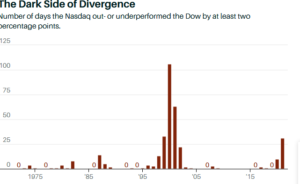
How worried should you be by all this? At least somewhat, according to an analysis conducted for Barron’s by performance-tracking firm Hulbert Ratings. That analysis examined all trading sessions since the Nasdaq Composite was created in 1971, focusing on those days in which there were large alphas (more than two percentage points, positive or negative). A higher frequency of such days was associated with below-average market performance over the subsequent three months. Though the correlation was modest, it nevertheless reached the 95% confidence level that statisticians typically use when determining that a pattern is significant. You shouldn’t be surprised by this result, since a healthy market is one that is firing on all cylinders. While tiny divergences probably don’t mean anything, and a big divergence unaccompanied by any others is probably not a big deal, it becomes a source of concern when large divergences become more frequent—as they have been recently. Even if you aren’t persuaded by this statistical significance, these results show that the market is risky right now. At a minimum, you should not be celebrating days like March 9 in which there was a large positive Nasdaq alpha over the Dow. Nick Note: Hubert is widely followed by Hedge Funds and usually wrnog. That is why Hedge funds are on average break even. In a good year they might make 7%. After this analysis was givn to hege funds the Nasdaq was down by 11%. on March 5th. and a low of around 1200. That is when the bottom was put in. I called the bottom realizing that the hedge funds went all in short beliving it was the START of a great bear market in stocks with many asshole advisers predicting a 30% FURTHER sell off. I correctly saw it as a usual 10% correction and NOT the start just yet of a great bear market. Being a simple man and a lucky guesser i achieved a Nick indicator. Their was blood in the streets and everyone was a seller. Its like a disease with me I had no choice but to declare a bottom and have everyone buy the shit out of the market. When everyone else is selling i am a buyer… pretty simple don’t you think. I declared a bottom and issued a urgent buy ON THE BOTTOM on March 5th.