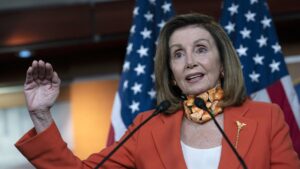
Pelosi unveils reduced $2.2T coronavirus aid bill

WASHINGTON — (AP) — House Democrats unveiled a scaled-back $2.2 trillion aid measure Monday in an attempt to boost long-stalled talks on COVID-19 relief, though there was no sign of progress in continuing negotiations between House Speaker Nancy Pelosi and Treasury Secretary Steven Mnuchin. The latest Democratic measure would revive a $600-per-week pandemic jobless benefit and send a second round of $1,200 direct payments to most individuals. It would scale back an aid package to state and local governments to a still-huge $436 billion, send a whopping $225 billion to colleges and universities, and deliver another round of subsidies to businesses under the Paycheck Protection Program. The proposal represents a cutback from a $3.4 billion bill that passed the House in May, but remains well above what Senate Republicans are willing to accept. Republicans have endorsed staying in the $650 billion to $1 trillion range. Pelosi said Monday that she remains in contact with Mnuchin, with whom she negotiated several earlier relief packages. The two spoke briefly on Sunday and Monday evening and are slated to talk again Tuesday morning, according to Pelosi spokesperson Drew Hammill. “We’ve come down $1 trillion, and they need to come up because we have to crush this virus,” Pelosi said Monday on MSNBC. “It takes money to crush the virus. It takes money to make the schools safe. It takes money to put money in people’s pockets.” Talks over the summer broke down in acrimony and name-calling, and conversations this month haven’t produced visible progress. Even if the rival sides could agree on a “top line” figure from which to negotiate details, dozens of difficult issues would remain to be sorted out. For instance, Senate Majority Leader Mitch McConnell, R-Ky., is insisting that a liability shield against potential lawsuits brought against businesses, schools and universities that reopen during the pandemic be part of the legislation. Pelosi opposes the idea and didn’t include it in Monday’s legislation. Democrats say the purpose of the new draft legislation is to show good faith and spark a more meaningful round of talks. But it also comes after party moderates and “front line” lawmakers in swing districts protested that Democratic leaders were being too inflexible. Pelosi’s office has said she’s considering putting the new measure up for a floor vote if talks this week with the Trump administration prove fruitless. “Democrats are making good on our promise to compromise with this updated bill, which is necessary to address the immediate health and economic crisis facing America’s working families right now,” Pelosi said in a letter to her colleagues. “We have been able to make critical additions and reduce the cost of the bill by shortening the time covered for now.. Nick Note: Step by step they get closer. They are felling the heat for sure. If they get this through it will help in my stock market Zoom Zoom scenario. Now we all want a zoom Zoom ZOOOM before the next bust.

Trump: Vaccine trials’ results to be extraordinary

United States President Donald Trump claimed on Monday that the test results of all coronavirus vaccines produced by American companies will be “very extraordinary.” There are four US firms that have their vaccines in the final stages of the trials, Trump said at a White House press conference, adding that vaccines will be “coming fast.” Earlier, the commander in chief revealed that 150 million rapid coronavirus tests produced by Abbott Laboratories would be distributed in the country in the “coming weeks.” Nick Note: we all know where this is going. See US elections have become little more then 3 ring circus. Barnum would be proud. And Trump well he is producing a reality TV show. The only business he ever made money in.

Pelosi: Trump’s Debt Poses A ‘National Security

WASHINGTON (Reuters) – U.S. President Donald Trump’s debts reported by the New York on Sunday raised national security issues, U.S. House Speaker Nancy Pelosi said on Monday, adding that the public deserves to know to whom he owes money.  Pelosi, in an interview with MSNBC, said it was not clear who held the debts and if it involved different countries, which could hold leverage over the Republican president: “To me this is a national security question.” Nick Note: Trumps debts are massive and he has been compromised because of his debts and sexcapades….


Non-Partisan Watchdog Accuses Trump Campaign Of ‘Laundering’ $170 Million

The Campaign Legal Center, a nonpartisan campaign finance watchdog group, filed a complaint with the Federal Elections Commission Tuesday accusing the Trump campaign of “laundering” $170 million through numerous companies, some with connections to former Trump campaign manager Brad Parscale. “The Trump campaign and Trump Make America Great Again Committee disguised nearly $170 million of campaign spending by laundering the funds through firms,” the complaint claims. It adds that the firms are “headed by Trump’s recent campaign manager, Brad Parscale, and/or created by Trump campaign lawyers.” The complaint alleges that the Trump campaign paid millions of dollars to campaign-connected vendors without reporting those payments to the FEC, specifically honing in on American Made Media Consultants (AMMC), a firm created by Parscale, which has been paid over $106 million, making it the campaigns largest vendor. AMMC was ostensibly created to circumvent media buyers, but the complaint points to FCC records that show the campaign has used media buying firm Harris Sikes to place some of its ads, alleging the campaign is “failing to report payments to the firms and is instead using AMMC as a conduit for its payments to the firms.” The complaint also points to an app called Phunware, which Parscale has said was created and is “directly owned” by the campaign, but which has never appeared in the campaign’s spending reports because, as the complaint alleges, it was paid through AMMC. Trump campaign communications director Tim Murtaugh denied the charges made in the complaint, telling Forbes, “The campaign reports all payments to AMMC as required by the FEC. The campaign complies with all campaign finance laws and FEC regulations.” By failing to report payments to the campaign’s true vendors and employees, the Trump campaign and Trump Make America Great Again Committee have violated, and continue to violate, federal law’s transparency requirements,” the complaint asserts, adding that such activities “undermine the vital public information role that reporting is intended to serve.” Parscale was named as Trump’s campaign manager in February 2018 but was replaced in that role by Bill Stepien earlier this month. Parscale’s firms have long been the object of media scrutiny for receiving large sums from the Trump campaign and for Parscale maintaining a lavish lifestyle well beyond the means of most presidential campaign managers. “Voters have a right to know how campaigns are spending money to influence elections,” CLC founder and President Trevor Potter, a Republican and former FEC Chair, told CNN. “This scheme flies in the face of transparency requirements mandated by federal law, and it leaves voters and donors in the dark about where the campaign’s funds are actually going.” The allegation comes amid reports that the Trump campaign also moved millions in campaign funds to Trump’s private business interests. Forbes’ Dan Alexander and Michela Tindera reported earlier this month that the Trump campaign has pushed nearly $7 million towards Trump’s businesses since the president entered office. The complaint asks the FEC, which regulates campaign finance, to “conduct an immediate investigation” and “seek appropriate sanctions for any and all violations, including civil penalties sufficient to deter future violations.. Nick Note: when this story broke Trump campaign manager “former” Pascale was taken into protective custody this weekend along with over 10 weapons. It turns out he had a ZEN moment and wanted to kill himself. But just could not do it. Well an insanity defense is better then nothing,,,,

Dow climbs over 500 pts as Wall Street rally accelerates

U.S. stock markets started the new week where they left off with the old one, rallying hard on the perception that the September sell-off has gone too far, too fast – albeit with little in the way of fundamental news to support much movement one way or the other over the weekend. By 9:40 AM ET (1340 GMT), the Dow Jones Industrial Average was up 338 points, or 1.2%, at 27.512 points. The S&P 500 and the NASDAQ Composite were both up 1.3%. On a quiet day for economic data, attention is sliding more and more to the looming presidential election, which is now less than six weeks way. .The two candidates, Joe Biden and Donald Trump, hold their first debate on Tuesday, Biden having gained a nice attack line over the weekend with the New York Times’s disclosure of Trump’s tax returns. While the disclosure said little of substance that wasn’t already widely known or assumed to be true, it underlined Trump’s chronic lack of business success in any activity other than his career as a TV reality show host.   Andreas Steno Larsen, a strategist with Nordea, noted that the traditional underperformance of equities ahead of the election is to be expected again this year. “As the uncertainties are even larger than usually this time, the case for equity underperformance ahead of the vote is strong, while a clear result in early November would open the door higher for equities again, Larsen wrote in a note to clients. The market was supported at the margins by some merger and acquisition activity that fed a narrative that corporates will continue to adapt to the changing circumstances and take advantage of the opportunities created by the market sell-off this year. Devon Energy (NYSE:DVN) stock rose 3.4% and WPX Energy (NYSE:WPX) stock rose 4.7% after Devon announced an all-share offer for its rival, a move that will enable the two to operate more efficiently without Devon having to spend precious cash. In the same vein, bank stocks all rose on hopes that the Federal Reserve will not extend its current restrictions on stock buybacks at a meeting later Monday. Morgan Stanley (NYSE:MS) stock rose 2.8%. while JPMorgan  (NYSE:JPM) stock rose 1.5% and Goldman Sachs (NYSE:GS) rose 1.9%. Citigroup (NYSE:C) stock, which had fallen nearly 20% over the last month, rose 3.1%. ADRs in Diageo (NYSE:DEO), the world’s biggest liquor company, rose over 6% to their highest in nearly three weeks after it noted that sales had improved recently – although it noted that the latest turn for the worse with the pandemic was still a threat to its outlook.

Airlines face worst crisis since 9/11 as funding ends


With no return to normal in sight, they are desperate to cut costs and raise financing Airlines have felt the pain of the coronavirus pandemic more than other companies. Almost overnight the bulk of their business ceased. But in mid-2020 there was at least hope that Covid-19 might not be as virulent as first thought; that warmer months would bring some respite; that travel corridors—agreements allowing passengers to fly between two countries without quarantine—might get people back in the air. Now, almost eight months into the pandemic, with cities reentering lockdown and a vaccine likely months away, it’s apparent there will be no quick comeback. International air traffic in July was 92% below 2019 levels, and there was little sign of improvement in August, according to the International Air Transport Association (IATA). More than 400,000 airline jobs have been cut since February, according to data compiled by Bloomberg. “This is lasting longer and is deeper than most people thought,” says Scott Kirby, chief executive officer of United Airlines Holdings Inc. “And our view is demand is not coming back. People are not going to get back and travel like they did before until there’s a vaccine that’s been widely distributed.” British Airways CEO Alex Cruz says the airline is “fighting for survival.” Cathay Pacific Airways Ltd. has said it’s restructure or die. And Singapore Airlines Ltd. boss Goh Choon Phong called the decision to slash 4,300 jobs—about 20% of his workforce—the “hardest and most agonizing” he’s had to make in 30 years with the company. Airlines in the U.S. are expected to lay off thousands of additional workers when the Coronavirus Aid, Relief, and Economic Security Act, or Cares Act, expires on Oct. 1. United Airlines is burning through $25 million a day, and “you just can’t go forever on that,” Kirby says. In Europe a pickup in air traffic in July and August, as vacationers sought to escape monthslong lockdowns, has abruptly gone into reverse as virus flare-ups send people scurrying home before borders close and new quarantine restrictions kick in. Carsten Spohr, CEO of Deutsche Lufthansa AG, is preparing for deeper job and fleet cuts, saying it will “take a marathon to get through the crisis, not a sprint.” Europe’s biggest airline, which accepted a €9 billion ($10.5 billion) German bailout in early June, doesn’t expect to see a full recovery in traffic until the middle of the decade. According to IATA, 25 million jobs are at risk in airlines and associated businesses such as travel and tourism. That’s more than the 22 million the International Labour Organization estimates were lost globally as a result of the 2008 financial crisis. More staff reductions are coming. American Airlines Group Inc. plans to dismiss 19,000 workers on Oct. 1 following the expiration of job guarantees tied to $25 billion of federal payroll aid under the Cares Act. United Airlines is expected to eliminate at least 13,000 posts. Delta Air Lines Inc. is trying to avoid large-scale layoffs until next summer now that thousands of employees have left voluntarily or taken unpaid leave. Government aid has helped, but there may not be much more. Carriers in Europe alone received €29 billion of aid, state-backed loans, and other forms of support through Aug. 27, excluding furlough money, with a further €3.4 billion in the pipeline, according to Greenpeace’s European airline bailout tracker. Airlines in India, until recently the world’s fastest-growing aviation market, are seeking at least $1.5 billion as an interest-free credit line from the government, Civil Aviation Minister Hardeep Singh Puri said on Sept. 17. With airline stock prices plunging, attracting fresh investment is getting harder. Warren Buffett has completely exited his stakes in the four major U.S. airlines, and carriers that are for sale haven’t found any buyers.. Richard Branson’s Virgin Atlantic Airways Ltd. is under­going a £1.2 billion ($1.5 billion) rescue built around a loan from a hedge fund. The pandemic is pushing airline Virgin Australia into the hands of private equity in a deal approved in September. In the U.S., Delta was able to raise $9 billion in the industry’s largest debt sale ever, offering yields as high as 4.5% to lure investors. Delta’s bonds are secured by its frequent-flyer program, and this is one part of airlines’ business that’s holding its value. American Airlines’ loyalty program is worth as much as $30 billion, and United Airlines sold $6.8 billion of debt in June backed by its program.

Aircraft are in a crisis of their own. A third of the world’s 26,000 passenger jets remain grounded, parked in deserts or lined up in rows along the tarmac, aviation data provider Cirium says. Those in the skies are only about half full, according to IATA.

Corporate travel may never recover, as business­people everywhere realize they can close deals and get the job done over Zoom and from home even. Leisure travel is expected to spring back once there’s an effective vaccine, but tourists will probably be more cautious. Jaunts to far-flung places where medical help is remote may hold less appeal. Airlines had hoped for a quick end to the coronavirus crisis, but 2020 continues to provide a litany of woes, and the pain may go on well into next year and beyond. Nick Note: This is Karma. The airlines spread infections among their passengers for years and hid the infection rates. Its why thing to call lung infections “jet Lag”. But now “Jet Lag” is spreading death.  It was the airlines that spread this plague all over the world. Want proof? all you have to do is look at Europe. They had the virus under control. What happened? They open the airlines back up for the August vacation season. And Look Europe is headed back into lockdown again. Wanna kill the virus its simple kill the airlines/ EVERYONE who has flown to me since January either tested positive or got symptoms. One person is suffering debilitating lung damage. You fly you die. It is not worth it. They may go to bars and restaurants and have their crowd fest. But the proof is in the pudding. No matter how much blue sky airlines fly up your ass the truth is most people are smart enough not to enter into the tube of death! “Come Die with me!”

Mr. Trump has paid no federal income taxes for much of the past two decades.

https://gma.abc/2J8lXMt
Long-Concealed Records Show Trump’s Chronic Losses and Years of Tax Avoidance

The Times obtained Donald Trump’s tax information extending over more than two decades, revealing struggling properties, vast write-offs, an audit battle and hundreds of millions in debt coming due. Donald J. Trump paid $750 in federal income taxes the year he won the presidency. In his first year in the White House, he paid another $750. He had paid no income taxes at all in 10 of the previous 15 years — largely because he reported losing much more money than he made. As the president wages a re-election campaign that polls say he is in danger of losing, his finances are under stress, beset by losses and hundreds of millions of dollars in debt coming due that he has personally guaranteed. Also hanging over him is a decade-long audit battle with the Internal Revenue Service over the legitimacy of a $72.9 million tax refund that he claimed, and received, after declaring huge losses. An adverse ruling could cost him more than $100 million.


The tax returns that Mr. Trump has long fought to keep private tell a story fundamentally different from the one he has sold to the American public. His reports to the I.R.S. portray a businessman who takes in hundreds of millions of dollars a year yet racks up chronic losses that he aggressively employs to avoid paying taxes. Now, with his financial challenges mounting, the records show that he depends more and more on making money from businesses that put him in potential and often direct conflict of interest with his job as president. The New York Times has obtained tax-return data extending over more than two decades for Mr. Trump and the hundreds of companies that make up his business organization, including detailed information from his first two years in office. It does not include his personal returns for 2018 or 2019. This article offers an overview of The Times’s findings; additional articles will be published in the coming weeks. The returns are some of the most sought-after, and speculated-about, records in recent memory. In Mr. Trump’s nearly four years in office — and across his endlessly hyped decades in the public eye — journalists, prosecutors, opposition politicians and conspiracists have, with limited success, sought to excavate the enigmas of his finances. By their very nature, the filings will leave many questions unanswered, many questioners unfulfilled. They comprise information that Mr. Trump has disclosed to the I.R.S., not the findings of an independent financial examination. They report that Mr. Trump owns hundreds of millions of dollars in valuable assets, but they do not reveal his true wealth. Nor do they reveal any previously unreported connections to Russia.

Dems may present $2.4T stimulus proposal as bill – Pelosi

https://youtu.be/xc0nCA4vJCs?t=26

House of Representatives Speaker Nancy Pelosi said on Sunday that the Democrats may introduce their latest coronavirus-related economic stimulus proposal as a congressional bill. However, she expressed hope that a bipartisan agreement on the amount of the funds needed for economic aid could still be reached, seemingly confirming that the Dems are planning to propose a package worth $2.4 trillion. “I’d rather have a deal which puts money in people’s pockets rather than to have a rhetorical argument,” Pelosi underlined in an interview for CNN.”I trust [Treasury] Secretary [Steven] Mnuchin to represent something that can reach a solution, and I believe we can come to an agreement,” she concluded. Nick Note: You are watching the start of the socialist empire newest member. The mallenals are demanding a $2000 monthly stimulus check. What happened to the concept of getting a New JOB. HOW ABOUT STARTING A BUSINESS. ONLINE COMES TO MIND.. Wow dude work/ Nah/  I like staying home getting high playing video games and watching Netflix. Reality always comes to a end when the money and ability to borrow runs out.

Trump taps Barrett, launching brawl over Supreme Court’s future

President Donald Trump made it official on Saturday: He wants Amy Coney Barrett to fill Ruth Bader Ginsburg’s vacant Supreme Court seat. And he relishes the upcoming confirmation battle that could solidify the court’s conservative leaning for decades to come. Standing in the White House Rose Garden on an overcast but warm fall day, Trump formally announced the 48-year-old federal judge — a devout Catholic and mom to seven kids who has served on the 7th U.S. Circuit Court of Appeals since late 2017 — as his third Supreme Court nominee in just under four years. Trump vowed Barrett would help ensure “the survival of our Second Amendment, our religious liberty, our public safety and so much more,” nodding to his law-and-order rhetoric of recent months.“We must preserve our precious heritage as a nation of laws,” Trump added, “and there is no one better to do that than Amy Coney Barrett.” Barrett’s nomination has thrilled social conservatives and members of the Trump base, who admire her anti-abortion comments and strict views on the Constitution. Those same views have alarmed Democrats and progressives, who fear she will imperil abortion rights, voting rights and healthcare rights. In her brief remarks, Barrett seemed to allude to those fears, even though there’s little chance any Democrat — or progressive groups — will be won over to Barrett’s nomination. “I will be mindful of who came before me,” she said, referencing Ginsburg’s recent passing. “Judges are not policymakers.” Inside the White House, Barrett had the support of both chief of staff Mark Meadows and top attorney Pat Cipollone, two key aides involved in the selection process. On Capitol Hill, she had the backing of Senate Majority Leader Mitch McConnell. She visited the White House twice this week and had positive meetings, cementing her frontrunner status — which was established nearly two years ago when she was a leading contender during the search that ended in Justice Brett Kavanaugh’s nomination. Even though White House aides spent the week drawing out the selection process, floating other names as a nod key voting blocs, the president made up his mind early. He didn’t even meet with the other leading candidate, Barbara Lagoa, a judge on the 11th U.S. Circuit Court of Appeals, while traveling in her home state of Florida this week. If confirmed by the Senate, Barrett will replace Ginsburg, the longtime liberal justice who died just over a week ago. Her appointment would firmly tilt the court toward the right for the first time in decades, potentially altering the outcome of key upcoming court cases on issues like Obamacare, reproductive rights and even the presidential election. “It solidifies the conservative 6-3 majority,” said Carl Tobias, a law professor and expert on federal judicial selection at the University of Richmond Law School. “Chief Justice [John] Roberts will not be as central as he was last term. I do not see much hope for progressives in the short term. Once Ginsburg’s seat opened up, Trump quickly settled on Barrett. After his first meeting with her, she started filling out the appropriate paperwork, the people added. On Saturday, Trump touted the fact that, if confirmed, Barrett would be the first female justice with school-aged children. Coming just five weeks before Election Day, Barrett’s nomination will ignite the enthusiasm of voters on both the left and right. In less than 48 hours after Ginsburg’s death, the liberal group ActBlue raised roughly $100 million dollars for Democratic candidates, while conservative groups — concerned with deregulation, social issues and abortion rights — prepared tens of millions of dollars in ad buys and grassroots efforts for a contentious confirmation battle. Trump’s 2020 rival, Joe Biden, admonished Trump’s choice shortly after the announcement. In a statement, Biden argued Barrett would erode healthcare protections legalized under Obamacare, such as guaranteeing access to insurance for people with preexisting medical conditions. Nick Note: The fix is in. Trump has a supreme court majority that will give him the rulings he needs. Great for Trump not so good for America