The Election That Could Break America

There is a cohort of close observers of our presidential elections, scholars and lawyers and political strategists, who find themselves in the uneasy position of intelligence analysts in the months before 9/11. As November 3 approaches, their screens are blinking red, alight with warnings that the political system does not know how to absorb. They see the obvious signs that we all see, but they also know subtle things that most of us do not. Something dangerous has hove into view, and the nation is lurching into its path. The danger is not merely that the 2020 election will bring discord. Those who fear something worse take turbulence and controversy for granted. The coronavirus pandemic, a reckless incumbent, a deluge of mail-in ballots, a vandalized Postal Service, a resurgent effort to suppress votes, and a trainload of lawsuits are bearing down on the nation’s creaky electoral machinery. Something has to give, and many things will, when the time comes for casting, canvassing, and certifying the ballots. Anything is possible, including a landslide that leaves no doubt on Election Night. But even if one side takes a commanding early lead, tabulation and litigation of the “overtime count”—millions of mail-in and provisional ballots—could keep the outcome unsettled for days or weeks. If we are lucky, this fraught and dysfunctional election cycle will reach a conventional stopping point in time to meet crucial deadlines in December and January. The contest will be decided with sufficient authority that the losing candidate will be forced to yield. Collectively we will have made our choice—a messy one, no doubt, but clear enough to arm the president-elect with a mandate to govern. As a nation, we have never failed to clear that bar. But in this election year of plague and recession and catastrophized politics, the mechanisms of decision are at meaningful risk of breaking down. Close students of election law and procedure are warning that conditions are ripe for a constitutional crisis that would leave the nation without an authoritative result. We have no fail-safe against that calamity. Thus the blinking red lights. “We could well see a protracted postelection struggle in the courts and the streets if the results are close,” says Richard L. Hasen, a professor at the UC Irvine School of Law and the author of a recent book called Election Meltdown. “The kind of election meltdown we could see would be much worse than 2000’s Bush v. Gore case.” A lot of people, including Joe Biden, the Democratic Party nominee, have mis­conceived the nature of the threat. They frame it as a concern, unthinkable for presidents past, that Trump might refuse to vacate the Oval Office if he loses. They generally conclude, as Biden has, that in that event the proper authorities “will escort him from the White House with great dispatch.” The worst case, however, is not that Trump rejects the election outcome. The worst case is that he uses his power to prevent a decisive outcome against him. If Trump sheds all restraint, and if his Republican allies play the parts he assigns them, he could obstruct the emergence of a legally unambiguous victory for Biden in the Electoral College and then in Congress. He could prevent the formation of consensus about whether there is any outcome at all. He could seize on that un­certainty to hold on to power. Trump’s state and national legal teams are already laying the groundwork for postelection maneuvers that would circumvent the results of the vote count in battleground states. Ambiguities in the Constitution and logic bombs in the Electoral Count Act make it possible to extend the dispute all the way to Inauguration Day, which would bring the nation to a precipice. The Twentieth Amendment is crystal clear that the president’s term in office “shall end” at noon on January 20, but two men could show up to be sworn in. One of them would arrive with all the tools and power of the presidency already in hand. “We are not prepared for this at all,” Julian Zelizer, a Prince­ton professor of history and public affairs, told me. “We talk about it, some worry about it, and we imagine what it would be. But few people have actual answers to what happens if the machinery of democracy is used to prevent a legitimate resolution to the election.” Nineteen summers ago, when counterterrorism analysts warned of a coming attack by al‑Qaeda, they could only guess at a date. This year, if election analysts are right, we know when the trouble is likely to come. Call it the Interregnum: the interval from Election Day to the next president’s swearing-in. It is a temporal no-man’s-land between the presidency of Donald Trump and an uncertain successor—a second term for Trump or a first for Biden. The transfer of power we usually take for granted has several intermediate steps, and they are fragile. The Interregnum comprises 79 days, carefully bounded by law. Among them are “the first Monday after the second Wednesday in December,” this year December 14, when the electors meet in all 50 states and the District of Columbia to cast their ballots for president; “the 3d day of January,” when the newly elected Congress is seated; and “the sixth day of January,” when the House and Senate meet jointly for a formal count of the electoral vote. In most modern elections these have been pro forma milestones, irrelevant to the outcome. This year, they may not be.

“Our Constitution does not secure the peaceful transition of power, but rather presupposes it,” the legal scholar Lawrence Douglas wrote in a recent book titled simply Will He Go? The Interregnum we are about to enter will be accompanied by what Douglas, who teaches at Amherst, calls a “perfect storm” of adverse conditions. We cannot turn away from that storm. On November 3 we sail toward its center mass. If we emerge without trauma, it will not be an unbreakable ship that has saved us. Let us not hedge about one thing. Donald Trump may win or lose, but he will never concede. Not under any circumstance.

Not during the Interregnum and not afterward. If compelled in the end to vacate his office, Trump will insist from exile, as long as he draws breath, that the contest was rigged. Trump’s invincible commitment to this stance will be the most important fact about the coming Interregnum. It will deform the proceedings from beginning to end. We have not experienced anything like it before. Maybe you hesitate. Is it a fact that if Trump loses, he will reject defeat, come what may? Do we know that? Technically, you feel obliged to point out, the proposition is framed in the future conditional, and prophecy is no man’s gift, and so forth. With all due respect, that is pettifoggery. We know this man. We cannot afford to pretend. Trump’s behavior and declared intent leave no room to suppose that he will accept the public’s verdict if the vote is going against him. He lies prodigiously—to manipulate events, to secure advantage, to dodge accountability, and to ward off injury to his pride. An election produces the perfect distillate of all those motives.

Nick Note: I want you prepared. Trump is setting up a circumstance that is he does not win the elections by a BIG margin he will creates a crises like he nation has never seen before and he will engineer in the confusion his continued power as a president. At this point with the virus crises in mind he will in fact be a de-facto Dictator. You have been warned. 
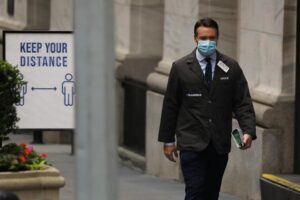
 

US markets end trading in red as Dow falls over 500 points

Major U.S. stock indexes closed lower on Wednesday, sliding in the final hour of trade, as market participants struggled to shake off worries about a lack of a coronavirus aid package and rising COVID-19 cases. How did major benchmarks fare? The Dow Jones Industrial Average (DJIA) tumbled 525.05 points, or 1.9%, to close at 26,763.13, while the S&P 500 (SPX) lost 78.65 points, or 2.4%, ending at 3,236.92. The Nasdaq Composite Index (COMP) shed 330.65 points, or 3%, finishing at 10,632.99, after plunging as low as 3%. That left the Dow 9.4% off its record close in February, the S&P 9.6% lower than its September all-time high and the Nasdaq 11.8% down from its September record, according to Dow Jones Market Data. The losses took the S&P 500 within a whisker of a correction, defined as a 10% pullback from a recent peak. Equities briefly caught a footing in Tuesday’s session, but were pressured again Wednesday amid deep-seated divides in Washington over additional pandemic aid and a resurgence of coronavirus cases in Europe and parts of the U.S., including in Texas, Wisconsin, Oklahoma and Colorado. “But I also think investors are reluctant to keep their feet completely out of the market,” he told MarketWatch, pointing to expectations for a safe and effective vaccine to be available at some point next year. Nick Note: We reversed Tuesdays gains. It looks to me to be a retest of the lows. I am not going to shit you I COULD BE WRONG! But my belief is the stock market is buying into a bounce back before the elections and massive stimulus with the FEDS pumping incredible sums of money into the market. We has a 5 year note auction today at the lowest rates ever. I rate the auction a A+. That tells me underlying sentiment is very very positive. Spreading on a bottom is suicide. Again I COULD BE Wrong But i  believe the selling is pretty close to a temporary end. This will sort itself out this week or next…..


Trump says Supreme Court needs ninth justice to decide election

https://youtu.be/ml5F0JANQ78

President Donald Trump on Wednesday suggested the Supreme Court will have to make a ruling on the Nov. 3 presidential election, so a new justice for the high court should be confirmed before Election Day. “I think it’s better if you go before the election, because I think this scam that the Democrats are pulling — it’s a scam — the scam will be before the United States Supreme Court,” Trump told reporters at the White House, in an apparent reference to efforts to increase mail-in voting during the coronavirus pandemic. “I think having a 4-4 situation is not a good situation, if you get that. I don’t know that you’d get that. I think it should be 8-0 or 9-0, but just in case it would be more political than it should be, I think it’s very important to have a ninth justice.” The Republican-led Senate appears poised to move forward with confirming a replacement for the late liberal Justice Ruth Bader Ginsburg, who died Friday. Four GOP senators could halt a quick confirmation as the party has a 53-47 majority in that chamber, but only two have said they opposed a vote before Nov. 3. Trump on Wednesday said he expects to announce his nominee around 5 p.m. Eastern Time on Saturday. The president has frequently made unsubstantiated claims about fraud with mail-in ballots, and experts have been pushing back. “I want people to know many of us, and I’m one of them, have looked into vote fraud for decades, and there are certainly isolated examples, but it’s just not there. This is made up. It is a fiction,” said Larry Sabato, director of the University of Virginia’s Center for Politics, said in a webcast last week. Sabato also said “turnout is critical, and if you can increase turnout in either party using mail-in ballots, then you’ll do it. The Republicans are trying to do that in Florida.” Nick Note: You know heard from the horses mouth what i have been telling you all along. Trump can win the election 2 ways. Fair and square or by hook and crook. In the event he loses his has a plan B. Say the election was rigged by the mail in ballots and have the issue decided by the supreme court where he is stacking the deck…..

Donald Trump Says It’s A “Beautiful Sight” To See Police Throw Reporter To The Ground

Donald Trump again mocked MSNBC anchor Ali Velshi for the moment when he was struck by a rubber bullet while covering protests in June, and told a rally crowd that it was a “beautiful sight” when police targeted an unidentified reporter and “threw him aside like he was a bag of popcorn.” Speaking at a rally in Moon Township, PA, Trump singled out Velshi, who was struck by a rubber bullet last June while covering protests over the death of George Floyd at the hands of Minneapolis police. Trump incorrectly identified Velshi as working for CNN and wrongly said that he was struck by a gas canister.

“Remember that beautiful sight? The street was a mess. That idiot reporter from CNN got hit with a canister of tear gas. And he went down. ‘I’ve been hit. I’ve been hit.’ He’s been hit,” Trump said, as the rally crowd laughed. Trump then mocked an unidentified reporter who has been targeted by police while covering protests. “Sometimes they grab. They grab one guy. ‘I’m a reporter. I’m a reporter.’ Get out of here. They threw him aside like he was a little bag of popcorn. Honestly, when you watch the crap that we have all had to take so long. When you see it, it is actually a beautiful sight.” The comments were similar to ones that Trump made against Velshi last weekend at a rally in Bemidji, MN. In response, MSNBC said, “Freedom of the press is a pillar of our democracy. When the president mocks a journalist for the injury he sustained while putting himself in harm’s way to inform the public, he endangers thousands of other journalists and undermines our freedoms. Nick Note: Its the FIRST amendment. The reason why its first is because if you lose it all the other amendments are worthless. And you can take that Bill of Rights and wipe you ass with it. Thats why the paper is brown!

House Democrats push to renew efforts for second round of $1,200 stimulus checks

The stimulus stalemate has left lawmakers at odds over how to get more relief to millions of Americans who need it. Earlier this month, Senate Republicans attempted to get a smaller bill through Congress as the standoff between both parties continued. But that relief bill did not include a second round of $1,200 stimulus checks, a measure that both parties had all but signed off on. The bill failed to get the 60 votes it needed to advance. Still, House Democrats pushed back on the stimulus check exclusion on Tuesday during a congressional hearing with Federal Reserve Still, House Democrats pushed back on the stimulus check exclusion on Tuesday during a congressional hearing with Federal Reserve Chairman Jerome Powell and Treasury Secretary Steven Mnuchin.

“The economic impact payments must be made because the rent must be paid,” said Rep. Al Green, D-Texas.

“If we do not do this, we will put persons at risk of being evicted at a time when we are having a pandemic that is still taking lives in this country,” he said.

Green also said a new Government Accountability Office report that found the Treasury Department does not have adequate data on the number of people who qualify for the first stimulus checks, but who have not yet received them, is cause for concern. The number excluded, including gig workers, could be in the millions, he said. The IRS is in the process of mailing letters to about 9 million Americans to notify them that they may be eligible for the money. Rep. Rashida Tlaib, D-Mich., also spoke out about the prospect of a second round of payments, asking Mnuchin, “Yes or no, do you believe another stimulus check could help stabilize the economy?” Mnuchin: Administration does support another stimulus payment “I do,” Mnuchin said. “The administration does support another stimulus payment.” The likelihood and timing of that money still remains unclear. House Democrats and Senate Republicans had both put forward proposals that included a second round of direct payments. Other issues, however, have made it impossible for both sides to come to an agreement, at least for now. “We obviously can’t pass a bill in the Senate without bipartisan support,” Mnuchin said. “Our job is to continue to work with Congress to try to get additional help to the American public.” In response, Tlaib urged Mnuchin to push for more stimulus checks. “I think you need to be very clear with the senators … that direct payments to individuals is critical to preventing economic collapse in our country,” Tlaib said. Some experts have speculated that the death of Supreme Court Justice Ruth Bader Ginsburg, and the ensuing fight over the nomination to fill the now vacant seat, could make it impossible for Congress to come up with another coronavirus stimulus deal now. In a separate interview with CNBC on Tuesday, Larry Kudlow, director of the National Economic Council, dismissed that idea as “not necessarily a given.” The two parties were already at odds before the judicial issues came up, he said. The White House is advocating for another package targeting “kids and jobs,” Kudlow said. That would include more than $100 billion to help schools and another $100 billion to extend Paycheck Protection Program funds to small businesses.  “I wish we could break the stalemate, because even though I think the economy is improving nicely, I think it could use some help in some key targeted places,” Kudlow said. Nick Note: The politicians are felling the heat. I have lived in many dictatorships and banana republics. And before every election they give out free tortillas. America is wealthier so i believe kicking and screaming all the way they will BEFORE the elections pass another happy check bill. You would not want them to have to move back into the basement or find other work… No No NO we will just TRY to create a socialist Utopia. Its been tried for 2000 years. It did not work then and it will not work now.


House passes bill to avoid govt shutdown

House passes spending bill to avoid government shutdown, sends it to Senate
Key Points
  • The House passed a funding bill to avoid a government shutdown, sending the legislation to the Senate ahead of a Sept. 30 deadline.
  • Democrats and the Trump administration earlier reached a spending deal, House Speaker Nancy Pelosi said.
  •  

    The House passed a bill Tuesday that would fund the government into December and avoid a shutdown before a Sept. 30 deadline.  After clearing the House in an overwhelming vote, the legislation heads to the Republican-held Senate. Earlier Tuesday, House Speaker Nancy Pelosi said she reached a spending agreement with Treasury Secretary Steven Mnuchin and Republicans.  Pelosi said the proposal would include $8 billion for nutrition assistance for schoolchildren and families. It renews Pandemic EBT, a program that provides food benefits while schools are closed set to expire at the end of September, for a full year.  It also adds increased accountability for farm aid money to prevent it from gong to large oil companies, according to Pelosi. Senate Majority Leader Mitch McConnell had criticized a lack of farm assistance funds in a bill House Democrats released Monday.  The bill would fund the government through Dec. 11, avoiding a potentially chaotic shutdown during the coronavirus pandemic and before the Nov. 3 election. Lawmakers then aim to hash out an agreement to fund the government through Sept. 30, 2021, the end of the next fiscal year.  Lawmakers have said they want to get past the shutdown threat to focus on passing more coronavirus relief, which they have failed to do for months amid disagreements over the size of a fifth aid package.  Pelosi said the agreement included nutritional assistance for schoolchildren and additional accountability for farm aid. Nick Note: One less worry for the market and the rally back continues. The probelm is a budget showdown might occour in the middle of  electioncrises where the winner at that time will be hotly contested. A big shit storm is coming!

200,000 coronavirus fatalities, U.S. hits Trump’s upper limit for doing ‘a very good job’

The United States witnessed another painful milestone on Tuesday as the tally of coronavirus-related fatalities surpassed 200,000. In March, President Trump said that keeping the nation’s death toll between 100,000 and 200,000 — numbers that seemed inconceivable at the time — would signal that his administration had done “a very good job.” Nick Note: On what parallel universe is the highest infection rate and death rate per cap is a good job? Close to 7 million infected and over  200,000 dead in the US…… Some sick shit!!!

FDA to announce tougher standards for a coronavirus vaccine

The Food and Drug Administration is expected to spell out a tough, new standard for an emergency authorization of a coronavirus vaccine as soon as this week that will make it exceedingly difficult for any vaccine to be cleared before Election Day. The agency is issuing the guidance to boost transparency and public trust as it approaches the momentous decision of whether a prospective vaccine is safe and effective. Public health experts are increasingly worried that President Trump’s repeated predictions of a coronavirus vaccine by Nov. 3, coupled with the administration’s interference in federal science agencies, may prompt Americans to reject any vaccine as rushed and potentially tainted. The stakes are high: polls show the relentless politicization of the race to develop a vaccine is taking its toll. Pew Research Center recently reported that the percentage of people who said they would get the vaccine if it were available today has dropped to just over 50 percent from 72 percent in May.The guidance, which is far more rigorous than what was used for emergency clearance of hydroxychloroquine or convalescent plasma, is an effort to shore up confidence in an agency that made missteps in its handling of those clearances. With the vaccines, the FDA is expected to ask manufacturers seeking an emergency authorization — a far quicker process than a formal approval — to follow participants in late-stage clinical trials for a median of at least two months, starting after they receive a second vaccine shot, according to two individuals familiar with the situation who spoke on the condition of anonymity to discuss information before it is made public.

The agency also is looking for at least five severe cases of covid-19, the disease caused by the coronavirus, in the placebo group for each trial, as well as some cases of the disease in older people, as a sign the vaccine works.

These standards, plus the time it will take companies to prepare their applications and the agency to review the data, make it highly improbable for any vaccine to be authorized before the election. The agency has previously said any vaccine would have to be 50 percent more effective than a placebo.

“It’s hard to imagine how an EUA could possibly occur before December,” said Paul Offit, director of the Vaccine Education Center at Children’s Hospital of Philadelphia and a member of the FDA’s advisory board on vaccines. The guidance is just one way of trying to shore up confidence in the agency. FDA allies, intent on building trust, are also spotlighting agency career scientists, noting that the one overseeing the vaccine-approval process has threatened to quit if he is pressured to greenlight a vaccine before he is convinced it is safe and effective. But, administration critics note, such efforts are undercut on an almost daily basis by overly rosy and contradictory comments by Trump and continued revelations about administration actions to strong-arm government scientists and regulators, and curb their independence.In addition, the FDA guidance is unlikely to satisfy some critics, who say the agency should not use an emergency authorization for a vaccine at all.  “Things are so revved up right now that there is quite a possibility that the American public won’t accept a vaccine because of all the things that are going on,” said Peter Hotez, dean of the National School of Tropical Medicine at Baylor College of Medicine. “U.S. history is littered with good vaccines that get voted off the island because of bad public perceptions.” The FDA career staff itself is trying to reassure the public. In a highly unusual move, Peter Marks, the head of the center that oversees vaccine regulation, and seven other senior career officials vowed in a column to maintain “independence to ensure the best possible outcomes for public health.” The agency also has pledged to take any vaccine data to its panel of outside advisers, called the Vaccine and Related Biological Products Advisory Committee, before making decisions. The agency has scheduled a public meeting of the panel for Oct. 22 and said others sessions can be held as needed, depending on when data is available. But some FDA watchers say those steps are not enough and that the agency should forswear use of an emergency authorization for a vaccine and instead require a full approval. “If we don’t get this right, we’ll see a deep corrosion of trust over the long term — and that will be the darkest legacy for a post-covid world,” said Lawrence Gostin, a public health expert at Georgetown University’s law school.

Eric Topol, founder and director of Scripps Research Translational Institute, opposes using an emergency authorization in the next several weeks or months. “We are not in a high-trust mode, and the last thing you want to do is take a short cut and put everything at risk,” he said.

He said the agency should not consider such an authorization until at least early next year to ensure it has adequate safety data. Nick Note: Their goes Trumps great white hope up in smoke. Thats OK the master at deception is going to get a super conservative as  the next Supreme court judge and energize his base. And and and when the election becomes the crises of the centuary as mail in ballots are contested all the way to the supreme court Trump will have the deck stacked in his favor.

The Debt Crisis Is Mounting For Oil Economies

Dubai. Abu Dhabi. Bahrain. And, of course, Saudi Arabia. The two emirates this year issued debt for the first time in years. So did Bahrain. Saudi Arabia stepped up its debt issuance. The moves are typical for the oil-dependent Gulf economies. When the going is good, the money flows. When oil prices crash, they issue debt to keep going until prices recover. This time, there is a problem. Nobody knows if prices will recover. In August, Abu Dhabi announced plans for what Bloomberg called the longest bond ever issued by a Gulf government. The 50-year debt stood at $5 billion, and its issuance was completed in early September. The bond was oversubscribed as proof of the wealthiest Emirate’s continued good reputation among investors. Dubai, another emirate, said it was preparing to issue debt for the first time since 2014 at the end of August. Despite the fact the UAE economy is relatively diversified when compared to other Gulf oil producers, it too suffered a hard blow from the latest oil price crash and needed to replenish its reserves urgently. Dubai raised $2 billion on international bond markets last week. Like Abu Dhabi’s bond, Dubai’s was oversubscribed. Oversubscription is certainly a good sign. It means investors trust that the issuer of the debt is solid. But can the Gulf economies remain solid by issuing bond after bond with oil prices set to recover a lot more slowly than previously expected? Or could this crisis be the final straw that tips them into actual reforms? No economy, especially not the ones dependent on a single export for most of its budget revenues, can rely on borrowing for long-term survival, let alone growth. In fact, the growth prospects of the Gulf economies are dimming, Reuters’ Davide Barbuscia wrote in a recent analysis of the region. Gulf governments are doing what they have always done: cut public spending and borrow. This time, however, the crisis is like no other before it, and these governments may find themselves in a tight spot while they wait for prices to bounce back. The problem is that public spending is the main growth driver in the Gulf economies, Barbuscia wrote, quoting the chief economist of Abu Dhabi Commercial Bank. If public spending falls, so will consumption and, therefore, growth. This is already happening and, what’s worse, it is happening across industries. Earlier this month, IHS Markit said, as quoted by Arabian Business, that non-oil private sector activity in Saudi Arabia and the UAE had fallen in August below 50—the figure that separates growth from contraction. That was after this indicator had registered improvement in the previous month despite still low oil prices. All Gulf economies—except Qatar—are expected to stay or swing into budget deficits this year, according to the International Monetary Fund. Saudi Arabia, the biggest economy in the region, is seen faring the best, with a deficit of 11.4 percent of GDP, and Oman faring the worst, with a deficit of 16.9 percent. Deficits happen. There is nothing extraordinary about them. What is extraordinary is the lack of wiggle room for the local governments. Investor interest in their new bonds may have been strong, but how likely would it be to remain strong for further debt issues if prices continue hovering around $40 a barrel? This is much below the Gulf economies’ breakeven levels, even the lowest ones. Saudi Arabia’s breakeven alone, according to the IMF, is $76.10 per barrel this year. It could fall to $66 next year, but this will still be too high for comfort with Goldman optimistically projecting Brent to hit $65 a barrel next year. In what is perhaps a cruel twist, this unprecedented situation is stifling the Gulf economies’ attempts to diversify their economies away from oil. This is incredibly obvious in Saudi Arabia, which had the ambitious goal of becoming a diversified economy by 2030. The goal, however, was to be financed with money from oil sales, and these collapsed this year as the pandemic spread globally. Vision 2030 may well be on its deathbed as the Kingdom, which is the Middle East’s largest producer of oil, grapples with the drop in oil revenues that has promoted a tripling of VAT, a hefty cut in public spending, and the removal of state subsidies for public servants. Other oil producers in the Gulf are also cutting public spending because this is pretty much the only thing they can cut, along with privileges for citizens, which is unlikely to be a popular move. Spending cuts and loans are the name of the Gulf game amid the crisis. The risk with this game is that if prices do not recover soon, it could turn into a vicious circle or, rather, a vicious spiral that could destabilize the whole region. Maybe these economies need to try a new playbook, one that prescribes actual economic reforms to make them more resilient to oil crises. Nick Note: When oil hits $10 a barrel they will call those guys in those white robes Delivery boys…. Their will be no more waiter jobs!!

Trump could be facing criminal tax probe, Manhattan DA suggests in new court filing

  • President Donald Trump and his business could be facing a criminal tax probe by the Manhattan District Attorney’s office, prosecutors suggested Monday in a court filing.
  • Prosecutors from Manhattan DA Cyrus Vance’s office raised that possibility as they said that a grand jury subpoena seeking eight years of Trump’s tax returns and other records from the president’s accountants should be allowed by a federal appeals court.
  • The Supreme Court this summer ruled that Trump did not have an absolute right to avoid having his tax returns and other financial records subpoenaed by a state prosecutor while serving in the White House.compass potential tax crimes.Before last month, reports had suggested that Trump’s company was under investigation for how it accounted for hush money payments made to two women who said they had affairs with Trump, who has denied their claims. Trump’s lawyers have argued that the subpoeana is “overbroad” and was issued “in bad faith.” But Vance’s team said in Monday’s court filing that the subpoena is more than justified by news reports that have raised the prospect that Trump and his company misstated the values of their business properties at different times. The filings said that if misstatements about business properties were conveyed from the Trump Organization’s headquarters in New York to business partners, insurers, potential lenders or tax authorities, that could mean the breaking of state laws such as scheme to defraud, falsification of business records, insurance fraud and criminal tax fraud, the filing said. Vance’s office also said in the filing that the scope “of the subpoena is moderate when compared to the temporal scope of misconduct alleged in public reports.”
  • “The New York Times reported that Appellant engagd in ‘dubious tax schemes during the 1990s, including instances of outright fraud’ and that he ‘helped his parents dodge taxes’ by ‘set[ting] up a sham corporation to disguise millions of dollars in gifts’ and undervaluing assets,” the filing said.Trump’s lawyer, Jay Sekulow, did not immediately respond to a request for comment. A spokesman for Vance declined to comment. The Supreme Court ruled this summer that Trump did not have an absolute right to avoid having his tax returns and other financial records subpoenaed by a state prosecutor while serving in the White House. But the Supreme Court also allowed the president to continue to challenge the subpoena, which was issued at Vance’s behest, on other grounds, in lower federal court. A federal judge in Manhattan last month rejected new arguments by Trump’s lawyers to block the subpoena. Trump then appealed that ruling to the U.S. Court of Appeals for the 2nd Circuit.A hearing on the appeal is scheduled for Friday. Nick Note: This will help you to understand why Trump needs to stack his people on the Supreme Court. If he loses the election the supreme court will ultimately decide. And if he loses the election he will be indicted in the Southern District of New York. And that case will eventually be decided by the supreme court. He lives and dies in the Supreme Court