EIA Weekly Petroleum Status Report

Summary of Weekly Petroleum Data for the week ending July 3, 2020

U.S. commercial crude oil inventories (excluding those in the Strategic Petroleum Reserve) increased by 5.7 million barrels from the previous week. At 539.2 million barrels, U.S. crude oil inventories are about 18% above the five year average for this time of year.  U.S. crude oil refinery inputs averaged 14.3 million barrels per day during the week ending July 3, 2020 which was 315,000 barrels per day more than the previous week’s average. Refineries operated at 77.5% of their operable capacity last week. Gasoline production increased last week, averaging 9.0 million barrels per day. Distillate fuel production increased last week, averaging 4.8 million barrels per day. U.S. crude oil imports averaged 7.4 million barrels per day last week, increased by 1.4 million barrels per day from the previous week. Over the past four weeks, crude oil imports averaged about 6.6 million barrels per day, 8.5% less than the same four-week period last year. Total motor gasoline imports (including both finished gasoline and gasoline blending components) last week averaged 729,000 barrels per day, and distillate fuel imports averaged 72,000 barrels per day. Total motor gasoline inventories decreased by 4.8 million barrels last week and are about 8% above the five year average for this time of year. Finished gasoline and blending components inventories both decreased last week. Distillate fuel inventories increased by 3.1 million barrels last week and are about 27% above the five year average for this time of year. Propane/propylene inventories increased by 2.2 million barrels last week and are about 7% above the five year average for this time of year. Total commercial petroleum inventories increased last week by 9.8 million barrels last week. Total products supplied over the last four-week period averaged 17.8 million barrels a day, down by 15.1% from the same period last year. Over the past four weeks, motor gasoline product supplied averaged 8.5 million barrels a day, down by 12.5% from the same period last year. Distillate fuel product supplied averaged 3.5 million barrels a day more than the past four weeks, down by 10.3% from the same period last year. Jet fuel product supplied was down 57.2% compared with the same four-week period last year. Nick Note: Recovery my ass.

US Posts New Daily Virus Case Record Of 60,209: Johns Hopkins

The United States, the country hardest hit by the coronavirus, on Tuesday posted 60,209 new cases, a record for a 24-hour period, according to a tally from Johns Hopkins University. The country was just shy of three million cases, at 2,991,351, the Baltimore-based university said in its latest data as of 8:30 pm (0030 GMT Wednesday).  While a Reuters tally had the U.S. passing 3 million, Johns Hopkins University put the U.S. case total at 2,996,098 on Tuesday evening with 60,209 new cases – a new record for a 24-hour period. The U.S. coronavirus outbreak crossed a grim milestone of over 3 million confirmed cases on Tuesday as more states reported record numbers of new infections, and Florida faced an impending shortage of intensive care unit hospital beds.  Authorities have reported alarming upswings of daily caseloads in roughly two dozen states over the past two weeks, a sign that efforts to control transmission of the novel coronavirus have failed in large swaths of the country. California, Hawaii, Idaho, Missouri, Montana, Oklahoma and Texas on Tuesday shattered their previous daily record highs for new cases. The biggest jumps occurred in Texas and California, the two largest U.S. states, with more than 10,000 each. About 24 states have reported disturbingly high infection rates as a percentage of diagnostic tests conducted over the past week. In Texas alone, the number of hospitalized patients more than doubled in just two weeks. The trend has driven many more Americans to seek out COVID-19 screenings. The U.S. Department of Health and Human Services said on Tuesday it was adding short-term “surge” testing sites in three metropolitan areas in Florida, Louisiana and Texas. In Houston, a line of more than 200 cars snaked around the United Memorial Medical Center as people waited hours in sweltering heat to get tested. Some had arrived the night before to secure a place in line at the drive-through site. In Florida, more than four dozen hospitals across 25 of 67 counties reported their intensive care units had reached full capacity, according to the state’s Agency for Health Care Administration. Only 17% of the total 6,010 adult ICU beds statewide were available on Tuesday, down from 20% three days earlier. Additional hospitalizations could strain healthcare systems in many areas, leading to an uptick in lives lost from the respiratory illness that has killed more than 131,000 Americans to date. At least 923 of those deaths were reported Tuesday, the biggest single-day toll since June 10 but still far fewer than the record 2,806 tallied back in April. A widely cited mortality model from the University of Washington’s Institute for Health Metrics and Evaluation (IHME) projected on Tuesday that U.S. deaths would reach 208,000 by Nov. 1, with the outbreak expected to gain new momentum heading into the fall. A hoped-for summertime decline in transmission of the virus never materialized, the IHME said. “The U.S. didn’t experience a true end of the first wave of the pandemic,” the IHME’s director, Dr. Christopher Murray, said in a statement. “This will not spare us from a second surge in the fall, which will hit particularly hard in states currently seeing high levels of infections.” President Donald Trump, who has pushed for restarting the U.S. economy and urged Americans to return to their normal routines, said on Tuesday he would lean on state governors to open schools in the fall.

Speaking at the White House, Trump said some people wanted to keep schools closed for political reasons. “No way, so we’re very much going to put pressure on governors and everybody else to open the schools.”

New COVID-19 infections are rising in 42 states, based on a Reuters analysis of the past two weeks. By Tuesday afternoon, the number of confirmed U.S. cases had surpassed 3 million, affecting nearly one of every 100 Americans and a population roughly equal to Nevada’s. In Arizona, another hot spot, the rate of coronavirus tests coming back positive rose to 26% for the week ended July 5, leading two dozen states with positivity rates exceeding 5%. The World Heath Organization considers a rate over 5% to be troubling. The surge has forced authorities to backpedal on moves to reopen businesses, such as restaurants and bars, after mandatory lockdowns in March and April reduced economic activity to a virtual standstill and put millions of Americans out of work. The Texas state fair, which had been scheduled to open on Sept. 25, has been canceled for the first time since World War Two, organizers announced on Tuesday. In Ohio, Governor Mike DeWine said the state was ordering people in seven counties to wear face coverings in public starting Wednesday evening. Nick Note: The reality is they blew their WAD. Its now the crying time AGAIN. YOUR YOUR YOUR leaders ALL ALL are clueless at best and sold out liars and thieves in reality. TO busy feathering their own nests to give in 5 minutes of thought about the death and destruction their stupid decisions have wrought. The cold hard ugly truth (the sooner you accept the better)  is trump could not and would not rise to the opportunity and i have serious doubts it America will or even can rise up again.

Total Port Arthur, Texas, refinery operating at 60% capacity: sources

HOUSTON (Reuters) – Total SA’s Port Arthur, Texas, refinery is operating at about 60% of its 225,500-barrel-per-day (bpd) capacity, said sources familiar with plant operations. The refinery is running at reduced capacity because of the loss of demand during the coronavirus pandemic, the sources said.Oil refineries have curbed output since

    Most refiners are operating, 
but many have reduced the number of 
barrels of oil they process as gasoline
and diesel use contracts.

Fuel demand has dropped by about 30% 
as the coronavirus chokes economic 
activity. 
Refinery:       
                                  
 Total SA      Production cut to         
               70% of capacity       
 Royal Dutch  Operating at 80%                  
              capacity              
 Royal Dutch  Running at 87% of      
 Shell Texas  Capicity       
 
 HollyFrontier Cuts production   
 refineries    by 30%     
 
 CVR Energy   Operating refineries
              at near minimum       
                                                                 rates                 
 BP Plc        Operating at about                
               70% capacity   
       
 Total SA      Production cut      
 Port Arthur   by 36%                   

 Marathon   Operating refineries 
 Corp       at minimum rates 
                                                               month from mid-May    
 LyondellBasell Operating between                 
                 85% and 90% Capacity
                                                                           
 Valero Energy Corp   Idled 
 Norco, Louisiana   
                                            
 Husky Energy     All refineries are                
                  running at minimum    
  
 Royal Dutch Shell  Shuts units              
 U.S.          
  
 Marathon Petroleum Shutting Production
 Corp California,    
 
 Phillips 66       Shut gasoline unit                
 Oklahoma, U.S.     
      
 Royal Dutch Shell  Shut Unit
 Louisiana, U.S.  
                                                                 refineries            
 Valero Energy Corp  operating at
  U.S.               minimum capacity      

 BP Plc            operating 80 and 85% 
 U.S.              of capacity
                                 
 Marathon Petrol    temporarily idle               
 Corp  U.S.           
                                                                 on April 15           
 Exxon Mobil Corp    Running two-thirds                   
 Baton Rouge,        of capacity
                                                                 capacity              
 PBF Energy          cut production
 Chaulmet LA         by 45%                
                                              reduced rates         
 Marathon Petroleum   cut production
 Galveston Bay        25%
                                                      August                
 Chevron            Large CDU shut                  
 California 
 
 PBF Energy Inc     several units
 Toledo, Ohio       Shut Down
                                               
 BP Plc         Cuts production at                
 U.S.           three U.S. Units
                                                             60% capacity          
 Royal Dutch    Operating at about    
 Washington    60% capacity          
                             
 Imperial Oil   Cloased for
 Sands Canada  maintenance work      
                                                
 Valero Energy Corp  Cuts production             
 Texas, U.S.         more than 30%         
  
 Exxon Mobil Corp    Shutting CDU  
 Baton Rouge, La                         
                                                    
 Valero Energy       plans to     
 Port Arthur         cut production
 
 Exxon Mobil         Shutting down
 Baytown, Texas      FCC               

 Valero Energy Corp  May cut production
 Mz Tennessee        by 50% of capacity
             
 Exxon Mobil Corp     Cut refinery 
 Baton Rouge          production
                                           
 Chevron             Cuts refinery
 El Segundo          production

 Saudi Aramco       To cut refinery
 Saudi Arabia       runs
                                                             
 Marathon Petroleum Cut production
 L A

 Phillips 66        Cut production
 California         at least 20%             
                                             
 Citgo Petroleum     Shut alkylation  
 Corpus Christi      unit

Nick Note: Refineries are dead meat. And do not let them shit you demand is not Not NOT increasing. Enjoy surfacing the next wave with me.

API Oil inventories in US up by 2 million barrels

API data show an unexpected weekly climb in U.S. crude supplies

The American Petroleum Institute reported today that U.S. crude supplies rose by 2 million barrels for the week ended July 3. The API data also reportedly showed gasoline stockpiles fell by 1.8 million barrels, while distillate inventories declined by about 847,000 barrels. Crude stocks at the Cushing, Okla., storage hub, meanwhile, edged up by 2.2 million barrels for the week. Nick Note: It is VERY unusual to see a crude oil inventory build this time of year. Refiners usually are sucking up crude inventories because 4th of July weekend is the start of the summer driving season. I do not think that will happen this year.

United Airlines sees drop in demand, plans furloughs – report

In an internal presentation, United Airlines has prewarned thousands of employees that furloughs and layoffs may happen come October 1st. The airline has to give employees 60 days’ notice if they are affected. Although today’s warning is not the start of the official notice period, it is alerting staff that formal warnings may be issued soon. According to the terms of the CARES act, US airlines cannot lay off staff until after September 30th. United Airlines has been offering staff early retirement and voluntary leave packages in an attempt to lessen its current costs. The airline previously warned that if too few employees accepted the offers, the airline would be forced to lay off staff come October. United initially gave flight attendants until June 8th to apply for leave but extended this until July 8th. With the deadline tomorrow, today’s warning may be the final push to encourage staff to leave voluntarily with benefits rather than risking being laid off later in the year. According to the Wall Street Journal, the airline has informed staff that official warnings may be issued to thousands of employees in the coming weeks. If United does go ahead with layoffs, it will have to wait until October. The airline accepted a loan under the government CARES act, which prevents it from laying off staff until October 1st. The airline is required to give staff 60 days’ notice, so official warnings could be given out any time from August 2nd. United also released a caution today regarding its current level of advance bookings. The airline said that new travel restrictions, including mandatory quarantines in some states, have caused a significant drop in bookings. New York announced this week a 14-day isolation period for anyone arriving from a virus hotspot. Consequently, United’s Newark base saw a significant decline in bookings after the announcement. According to the airline’s internal presentation, bookings for the short-term are at 16% of last year’s levels. The airline announced just last week that it was planning to add 25,000 flights to its August schedule as demand grew. But upon announcing the new flights, the airline said it remained “flexible” as the situation continues to fluctuate. Now, just one week after this hopeful announcement, it seems as if the situation has indeed changed. Although United is looking to add flights to its schedule, it is, like all airlines, at the mercy of international restrictions. On July 1st, the European Union announced that travelers from the US would not be able to visit Europe. United’s newly announced schedule includes flights to London, Brussels, Frankfurt, Munich, and Zurich. Clearly United is relying on restrictions lifting very soon. If this is the case, then the airline may not need to lay off many, or any, employees. Today’s warning could be a worst-case scenario if the airline cannot increase its schedule as planned over the coming months. At the time of publication, United had not responded to a request for comment. Nick Note: Their is NO safe way to fly. And people will soon figure it out. Airlines are dead meat!

Oil down as U.S. virus spike stokes demand worries


LONDON (Reuters) – Oil prices fell on Tuesday amid concerns that a surge in new coronavirus cases, especially in the United States, will hamper any recovery in fuel demand. Brent crude LCOc1 futures declined by 24 cents, or 0.56%, to $42.86, by 1236 GMT. U.S. West Texas Intermediate (WTI) crude CLc1 futures fell 30 cents, or 0.74%, to $40.33 a barrel. “Oil prices are lower today on concerns that the surge in coronavirus cases in the U.S. will limit a recovery in fuel demand,” bank RBC said. Sixteen U.S. states have reported record increases in new COVID-19 cases in the first five days of July, according to a Reuters tally. Florida is re-introducing some limits on economic reopenings to grapple with rising cases. California and Texas, two of the most populous and economically important U.S. states, are also reporting high infection rates as a percentage of diagnostic tests conducted over the past week. Other parts of the world, such as Australia, have also been hit by a resurgence in new infections. Saudi Arabia raised its August crude official selling prices on Monday in a sign it sees demand picking up. But some analysts said the move could weigh on already poor margins for refiners. “While record output cuts from the Saudis and the rest of OPEC+ support the idea of stronger differentials, this again will not be welcome news for refiners, doing little to help their margins, which are already under significant pressure,” bank ING said. The U.S. crude market faces some uncertainties from a court decision on Monday ordering the shutdown of the Dakota Access pipeline, the biggest artery transporting crude oil from North Dakota’s Bakken shale basin to the Midwest and Gulf Coast regions, due to environmental concerns. Market sources in the Bakken said the closure of the 570,000-bpd pipeline, while an environmental impact statement is completed, will likely divert some oil flows to transportation by rail. Nick Note: People under lockdown don’t drive and they certainly don’t drive. Oil demand is doomed.

Using Hydroxychloroquine and Other Drugs to Fight Pandemic

This is a interview form the Yale school of medicine about a new repORt published June 1st 2020

Using Hydroxychloroquine and Other Drugs to Fight Pandemic

Interview Date June 01, 2020

Professor Harvey Risch, M.D., Ph.D., is a researcher at the Yale School of Public Health with a specialty in cancer etiology, prevention and early diagnosis, and epidemiologic methods.

He recently studied the efficacy of hydroxychloroquine (used in conjunction with two other drugs  Azithromycin and Doxylin) to treat people infected with COVID-19 and concluded that the approach should be “widely available” in the fight against the current pandemic.

The results of his research are published in the American Journal of Epidemiology. Full report published below as a PDF

Describe your findings.

HR: COVID-19 is really two different diseases. In the first few days, it is like a very bad cold. In some people, it then morphs into pneumonia which can be life-threatening. What I found is that treatments for the cold don’t work well for the pneumonia, and vice versa. Most of the published studies have looked at treatments for the cold but used for the pneumonia. I just looked at how well the treatments for the cold worked for the cold. There are five studies done this way, four of hydroxychloroquine plus azithromycin and one with hydroxychloroquine plus doxycycline, and they all show that treating the cold part of COVID-19—the early part—works very well.

Do you think that these drug combinations should be used for all people with COVID-19, or only certain patients?

HR: Most people less than 60 years old who are of healthy weight and who don’t have other conditions like heart disease or diabetes can get by without medications. But if anyone starts to have shortness of breath while doing normal activities like walking around at home, they should get medical care immediately.

But the use of hydroxychloroquine to treat COVID-19 remains highly controversial. Why is there so much disagreement if it is effective?

This pandemic is undoubtedly the biggest public health crisis of our time.

Harvey Risch

HR: I think that there has been confusion about treating the cold versus treating the pneumonia. These medications don’t seem to work so well for treating the pneumonia. As early as possible is crucial, within the first five to six days of symptoms.

Are these drugs safe?

HR: The combination of hydroxychloroquine and azithromycin has been used for decades in hundreds of thousands of people with rheumatoid arthritis. There is a concern that these medications do change the heart pacing a little and could cause cardiac arrhythmias. However, these arrhythmias are still very rare in people using these medications. People who already have heart arrhythmias or are predisposed to them or have family histories of them should discuss this with their health care providers and see if using hydroxychloroquine plus doxycycline or some other medications would be a better choice.

Does hydroxychloroquine have the potential to be a “game-changer” in the fight against this pandemic?

HR: Hydroxychloroquine alone is not the whole story. It needs to be combined with azithromycin or doxycycline and probably with zinc to make it most effective. The game changer is to aggressively treat people as soon as possible, before they are hospitalized, to keep them from becoming hospitalized in the first place. Hydroxychloroquine plus the other medications is what we know about now. In a few months we may have data on other medications that also work. We just have to start with something now.

How widely is the drug currently being used to treat people infected with COVID-19? What do you recommend?

HR: Various places around the world have started using these drugs. An international survey of doctors who treat COVID-19 patients recently showed 72 percent of doctors in Spain say that they have been using them. I think that doctors need to be able to use their own clinical judgement about their patients and have objective information about drugs that can work for the early part of the infection, the cold part.

Why did you study this?

HR: This pandemic is undoubtedly the biggest public health crisis of our time. I started seeing reports of treatment benefit in France and New York and couldn’t understand where the controversy was coming from. So, I did an exhaustive search of studies and data on medication use in COVID-19 outpatients and the paper I wrote just describes everything that I found. Every study has details and the details are important.

China Stocks Hit Record Highs: This WILL NOT Last Long


China-focused exchange-traded funds were on pace for their best day on record after a state-owned newspaper urged investors to purchase equities, saying, according to a translation, that a “healthy bull market” is good for the world’s second-largest economy, attempting to shake off the economic effects of the COVID-19 pandemic. The largest China ETF, the iShares MSCI China ETF [S: MCHI], was up 6.8% at midday, its best performance in its nine-year history. The SPDR S&P China ETF GXC, 6.96% was 7.1% higher, and the Xtrackers Harvest CSI 300 China fund ASHR, 11.18% soared 10.6%, also an all-time high, back to 2013. Some funds that focus on particular sectors of the economy did even better: the Global X MSCI China Information Technology CHIK, +11.75% was nearly 12% higher. In the year to date, the iShares fund and the SPDR fund have both gained a little less than 14%, while the Xtrackers product is up 16.4%, compared to a 2% decline for the S&P 500 SPX, 1.26%. On Monday, the Shanghai Composite Index SHCOMP, +5.71% closed 5.7% higher. Nick Note: This is some crazy shit. Trump is about to increase sanctions on Chins, The rest of the world is pissed that China has turned Hong Kong into a police state. And every day Haweii loses 5G contracts because their systems spy for China. And for the coup de grah the world is sucking shut again. I expect the FUCK FEST to continue as China stock set more records and it will end in disaster. We have a minor trade for that.

Second Covid Wave Could Send Oil Prices Into “Tailspin”

second wave.jpg

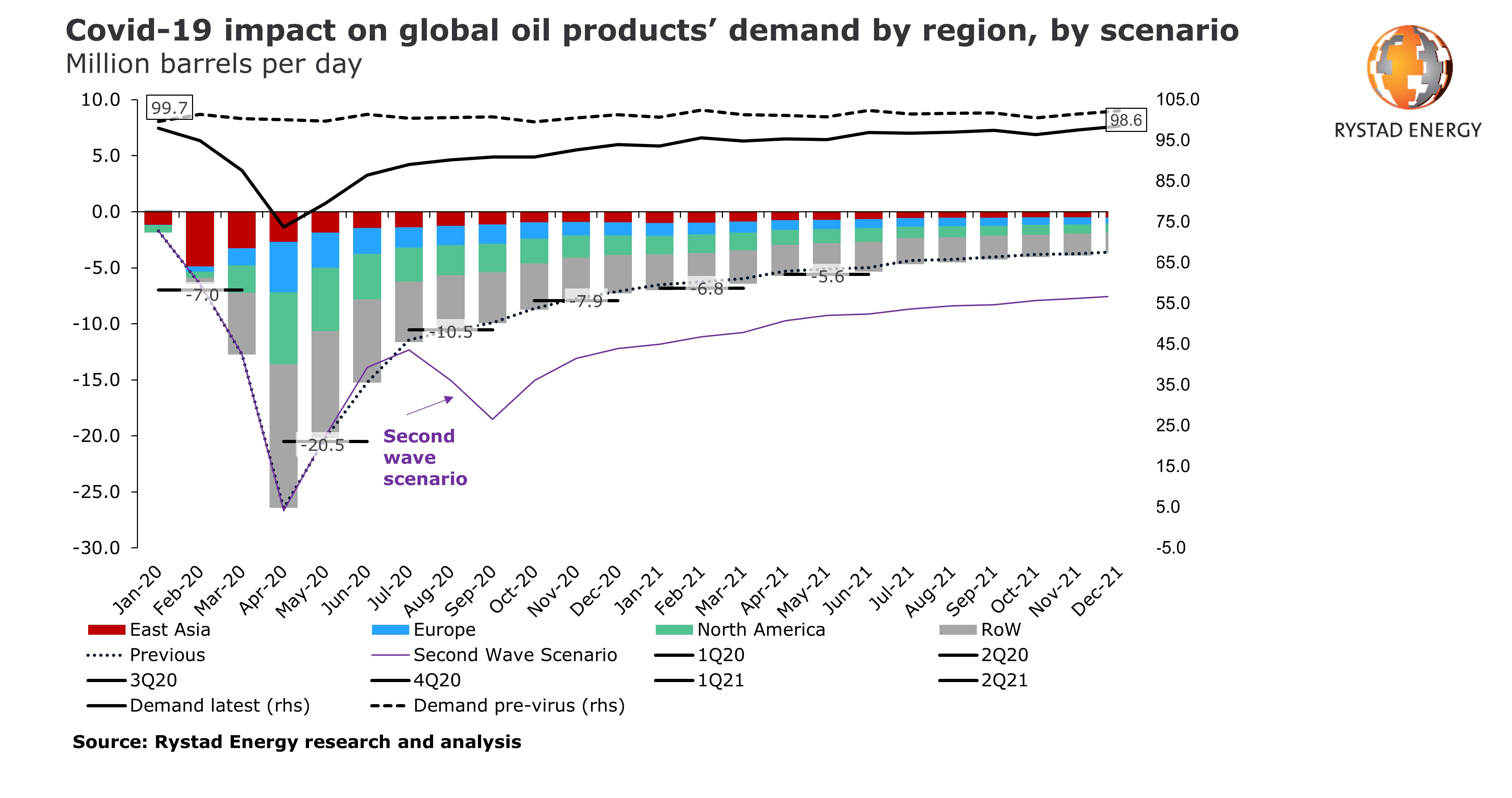
As the number of confirmed new Covid-19 cases surges to new global highs of beyond 200,000 per day, a second wave of the pandemic is increasingly apparent in several countries – most notably in the United States. Modelling the effect of a wider ‘second wave’ scenario, Rystad Energy finds that global oil demand in 2020 could be knocked down to 86.5 million bpd, compared to our current base-case estimate of 89 million bpd. In the second wave scenario, we don’t expect the oil demand impact to be as strong as was seen in the first outbreak, as restrictive measures will be limited to particular regions and sectors. We would expect these “smart lockdowns” to lower the negative demand impact, so as not to repeat the absolute low of 73.7 million bpd in April. The maximum negative demand impact in April 2020 was -26 million bpd, and the peak month in the second wave could come close to this at -18 million bpd, compared to the levels projected prior to the pandemic. We will be revisiting and updating these assumptions as data becomes available. North America (notably the lower US states), the Middle East and Southeast Asia will be hit relatively harder, Rystad Energy’s modelling shows.  The rise of Covid-19 cases in the US is of particular concern for the oil market given the country’s high oil consumption under normal circumstances, as this second wave could paralyze road fuel demand. In China, the authorities’ response to the recent case resurgence in Beijing shows that re-imposing radical lockdown measures is still a viable option. “Covid-19 will also re-emerge in other regions in our ‘second wave’ scenario when the flu season starts in the northern hemisphere in September and October. In general, however, new waves of lockdowns in regions such as Europe, South America and Russia are expected to be more targeted and less strict as health systems will be better prepared than they were in April,” says Rystad Energy’s senior oil market analyst Artyom Tchen. The demand for total oil products would not be shared equally. Similar to the current status quo, jet fuel and gasoline would be dealt the most painful blows. But with more testing and smarter lockdowns, a lot of this destruction can be avoided – international borders and travel can gradually reopen, with travel restrictions on certain countries and regions being imposed as new Covid hotspots appear. More work from home (perhaps as much as 15% of the workforce in developed countries) and less leisure travel will still pinch gasoline demand. But as the economic risks mount, we believe there will be creative solutions for the healthy and not-at-risk parts of the population to return to work and keep the economy going. The second wave scenario assumes a prolonged recovery in the aviation sector due to the downside risk of such a wave occurring in the second half of 2020 and a second negative demand impact spike in all regions in the period from August to October 2020. It is in essence an expansion of a downside scenario that we previously modelled called a “mitigation scenario”. In the base-case that we use for our projections, which we call the “effective retainment scenario”, the spread of Covid-19 is plotted under the assumption that drastic social distancing measures are initially taken, which often means strict quarantines. This scenario suppresses the virus so that the number of cases drops to a low level. Governments can then reopen society in a controlled manner. Any new outbreak will be again nipped in the bud with strict measures. The difference between the two scenarios by the end of the year shows a 5 million bpd gap in December’s oil demand in the case of a second Covid-19 wave. If the second wave materializes, global oil demand will recover much more slowly in 2021, landing between 4 million and 5 million bpd lower per month than it would under our current base case, thus dragging the pandemic’s market effect further in time. Demand is still very much in the driver’s seat in setting the oil price agenda – an unexpected dip of any magnitude will send the oil price into a tailspin, whether swift and sharp, or long and painful. At this point, OPEC+ is the single supply tool to materially tighten the market, but it faces massive storage build-ups as an adversary. And if there is a second wave, that storage headache is going to greatly worsen as implied builds again rise.

A significant oil price boost cannot occur until the massive crude stock builds of recent months are neutralized. This means that oil prices will continue to carry considerable downside risk as long as the supply and demand dynamics are moving in opposing trajectories – with supply up and demand down. A second wave of the virus would prolong the timeline these products sit in storage, and signal to refineries to pull back.

If anything, the whole new range of risk factors that still lie ahead in 2020 and 2021 would actually point to more volatility and downside risk before any “flip” back into a true backwardation happens.
Source: Rystad Energy. Nick Note: No way demand returns this year or next. In fact the next down wave will soon start with demand falling off a cliff again!. It will coincide with the coming 2nd wave of the coronavirus. This next wave will infect and kill far more people then the second wave. GOD HAVE MERCY ON ALL OF US. You can bullshit the masses you can even bullshit yourself if you are so foolish. BUT YOU CANNOT BULSHIT GOD. And the virus goes to retirement homes, apartment buildings, malls, shopping centers, grocery stores. The virus loves  bars, concerts, restaurants, sporting events and campaign rallies. ANd it loves to kill people. And here is another wake uo call your mask will not Not NOT save you.

US registers 43,742 new COVID-19 cases

The total number of novel coronavirus infections in the United States rose by 43,742 over the past 24 hours to stand at 2,836,764 as the country’s health authorities have carried out almost 35 million tests, according to the Johns Hopkins Unversity’s tally. Since the previous update, 252 additional deaths caused by the coronavirus have been registered, taking the overall death count to 129,657. A total of 894,325 people have recovered from the disease so far, the data showed. Most with permanent damage. The World Health Organization has reported a record increase in global coronavirus cases, with the total rising by 212,326 in 24 hours.  The biggest increases were from the United States, Brazil and India. The previous WHO record for new cases was 189,077 on June 28. Deaths remained steady at about 5,000 a day. Florida’s confirmed coronavirus cases rose by a record 11,458 on Saturday, the state’s health department said, the second time in three days that its caseload increased by more than 10,000. Florida’s record rise in cases was more than any European country’s daily peak at the height of the outbreak there. The new record came a day after seven other states also reported record rises in cases of COVID-19,which has killed nearly 130,000 Americans. Nick Note:  Record new infections AND hospitalizations are being recorded every day!