A Defiant Israel Eyes a Full Gaza Takeover Despite Global Isolation

Emboldened by military successes and Trump’s backing, Netanyahu shows no signs of letting up in the face of increased international pressure

Israel is not merely defying the pressure, it is redefining itself. Once a besieged secular outpost with an agrarian economy, it has evolved into a Middle East superpower: an aggressive military and intelligence juggernaut with a GDP per capita higher than the UK, an increasingly populist ethno-religious government with an unflinching security ethos. Israel’s actions of the past year profoundly altered the region’s strategic balance. Facing Iran-backed hostilities from numerous sources, Israel took out the leadership of Lebanon’s Hezbollah while eliminating most of its long-range missiles, sent its air force over Yemen to attack the Houthis and badly damaged Iran’s nuclear and ballistic missile programs. It destroyed military sites across Syria and stationed its troops there and in Lebanon. In the West Bank, where 3 million Palestinians live, it has authorized a massive expansion in Jewish settlement building, and in Gaza blocked aid for months, widely considered violations of international law. In the coming days, Netanyahu’s government is expected to decide whether it will fully occupy Gaza. Israeli media report that a gradual takeover is likely, starting in and around Gaza City, moving hundreds of thousands of inhabitants and lasting months. It’s a move that would further alienate the many countries — and many Israelis — telling it to end the war instead as the UN warns the enclave is on the brink of famine. But the supporter that matters most to Netanyahu — US President Donald Trump — doesn’t seem to be objecting. As his ambassador to Jerusalem, Mike Huckabee, told Bloomberg on Wednesday, Trump “respects Israel’s right to do what it has to do to protect itself, to get the hostages back, to end this.” While much of the world is horrified by Israel’s conduct in Gaza, most Israelis say they’re not. A survey from last month shows 79% of Israeli Jews say they’re not so troubled or not at all troubled by events in Gaza. Weekly protests in Israel focus on returning the hostages rather than concern for Palestinian civilians.  Hamas, which is considered a terrorist group by many Western countries and spurns the existence of Israel, today consistently out-polls the more moderate Fatah movement among Palestinians. Hamas’s refusal to disarm as part of any ceasefire deal has also helped entrench opinion in Israel. Today, Israelis look back ruefully, with a strong majority telling pollsters it was a mistake to leave Gaza. The far right wants to rebuild Jewish settlements there and two of Netanyahu’s far-right allies — Finance Minister Bezalel Smotrich and National Security Minister Itamar Ben Gvir — are themselves settlers on the West Bank who’ve led expansion efforts and called for the resettlement of Gaza. As much of the world turns critical of Israel and its government is increasingly beholden to its right-wing base, Netanyahu has leaned even further into his relationship with Trump, and his country’s links with the American right. “Netanyahu has been gambling purely on Republican support and has abandoned bipartisanship, which is terribly dangerous,” said Eytan Gilboa, an expert on US-Israeli relations at Bar-Ilan University outside Tel Aviv.  Netanyahu, and many of his top ministers and a portion of the public see the Hamas attack as part of a broader Iran-led assault on Israel’s existence. They believe that Israel can’t stop until it has destroyed Hamas both for its own sake and to send an uncompromising message to its enemies. “They cannot have control of Gaza,” Strategic Affairs Minister Ron Dermer, Netanyahu’s closest adviser, said of Hamas in a recent podcast. “That is the minimum. You did October 7, you’ve lost Gaza. When we tell our grandchildren about the horrors of that day, they will know that Hamas lost Gaza. That’s what has to happen.” Dermer advocates using what the US-led Allies did in Germany and Japan after World War II as a model for the future of Gaza and the Palestinian movement — long-term deradicalization with the help of Gulf powers. A wild card in predicting the war’s future is Trump, whose close alliance with Netanyahu grants him special influence. If he decides he wants an end to the war, that could convince Israel to declare victory and move on. So far that hasn’t happened.

That makes some kind of renewed Israeli assault on Gaza and an occupation likely, although it’s a highly controversial move.

For Israelis, the triumphs of the past year have reduced the acute sense of vulnerability that the Hamas attack caused. But it hasn’t gone away — that’s why much of the public sees the future as one of greater vigilance and continued combat.

A key lesson Israel has drawn from October 7 is to guard its borders not only from within but from without to prevent militias from storming in. It now has troops stationed inside Lebanon, Syria and Gaza as well as the West Bank. It’s the kind of posture that infuriates the region. “Israel’s new ‘forward-defense’ policy is a dangerous gamble, causing even its few regional friends to view it as a bigger threat to stability than Iran,” said Dina Esfandiary, Middle East Geoeconomics Lead for Bloomberg Economics. Israeli officials disagree, saying the stronger Israel is, the more respect it earns. They point out that the likes of the United Arab Emirates haven’t broken relations and business ties continue to grow. Moreover, they note that the US and others told it not to enter the southern Gaza city of Rafah, then not to assassinate Hezbollah chief Hassan Nasrallah or to attack Iran. It defied those warnings and came out ahead — the same will be true of Gaza, they argue. “In the Middle East, if you are weak, you are roadkill,” said Dermer on a July podcast. “The only path to peace is through strength.”


NN: Reality is  you have to kill the savages. Take their weapons and destroy their leadership. then peace and prosperity will come for decades. As the Germans and Japanese. 

Russia Says Putin-Trump Summit to Take Place Within Days

Presidents Vladimir Putin and Donald Trump will meet for summit talks within the next few days, the Kremlin said Thursday. Russia and the US have agreed on a venue for the meeting and “together with our American colleagues, we are starting to work on specific issues,” with the aim of holding the talks next week, Kremlin foreign policy aide Yuri Ushakov told reporters. He said the location of the summit would be disclosed later. The announcement came a day after Putin met with Trump’s envoy Steve Witkoff in the Kremlin for nearly three hours of talks as the US pushed for an end to Russia’s war in Ukraine. Trump has threatened to hit purchasers of Russian oil with secondary tariffs unless Putin agreed to a truce by Friday in the war that’s now in its fourth year. While the details around the Trump-Putin meeting are unclear, the apparent progress from yesterday could be seen as an encouraging sign that the hostilities in Ukraine could finally end and a period of recovery could start.” Witkoff raised the idea of a trilateral meeting involving Putin, Trump and Ukrainian President Volodymyr Zelenskiy, though Russia didn’t comment on that proposal, Ushakov said. Russia wants to focus first on the Putin-Trump summit, he said. Trump said Wednesday there was a “very good chance” he would meet with Putin and Zelenskiy soon in another bid to broker peace between the two countries. The US president informed allies that he was considering a summit during a phone call earlier Wednesday that also included Zelenskiy. Trump was positive about the possibility of a ceasefire, according to several people with knowledge of the call. He also suggested that Putin would be open to entering into peace talks in exchange for discussing land swaps, the people said. Ukraine hasn’t reacted so far to the Russian announcement of a summit. Zelenskiy said after the call with Trump that “we all need a lasting and reliable peace” while adding that “Russia must end the war that it itself started,” in a statement posted on social media. Putin has laid claim to Ukraine’s Black Sea peninsula of Crimea, which Russia illegally annexed in 2014, as well as the eastern and southern Ukrainian regions of Donetsk, Luhansk, Zaporizhzhia and Kherson that his troops don’t fully occupy. The US had previously offered to recognize Crimea as Russian as part of any deal, and to effectively cede control of parts of other Ukrainian regions that Russia occupies. As part of those earlier proposals, control over areas of Zaporizhzhia and Kherson would be returned to Ukraine. Putin and Witkoff also discussed Russia-US relations at their meeting and had noted that they could be developed in “a completely different, mutually beneficial scenario,” Ushakov said.

NN: Give up land to Russia for a so called cease fire. This is called surrender and going no where fast. And the oil marketis not buying into this peace deal

Putin, Witkoff end meeting after three hours

Russian President Vladimir Putin finished his meeting with United States Special Envoy Steve Witkoff after around three hours, Putin’s press service said on Wednesday. Russian presidential aide Yuri Ushakov stated it was “useful and constructive,” adding that the topics included the war in Ukraine and prospects for the development of bilateral strategic cooperation. US President Donald Trump suggested that Witkoff’s discussion with Putin will inform his decision on potential tariffs on countries buying Russian energy exports. Trump also set a deadline for agreeing on a ceasefire between Russia and Ukraine, which expires on Friday.

NN: No breakthrough. Russia is having a laugh. He is calling Trumps bluff.

Oil up 1% as Trump seeks to limit Russian exports

Crude gained over 1% on Wednesday after United States President Donald Trump threatened to impose tariffs on countries buying Russian energy. The decision could depend on the meeting between Russian President Vladimir Putin and US Special Envoy Steve Witkoff, currently taking place in Moscow. Meanwhile, the latest American Petroleum Institute report on US crude oil inventories saw a 4.2 million barrel drop in the week ending August 1. West Texas Intermediate (WTI) for deliveries in September increased by 1.50% at 5:13 am ET, selling for $66.15, while Brent for settlements in October added 1.46% and went for $68.62.

US oil inventories down by 4.2M barrels…. $100 oil here we come

Crude oil inventories in the United States decreased by 4.2 million barrels in the week that ended on August 1, private data from the American Petroleum Institute (API) reported  on Tuesday. Distillate inventories reportedly increased by 1.6 million barrels in the reported week, while gasoline stockpiles fell by 900,000 barrels. Reserves in Cushing, Oklahoma, increased by 1.7 million barrels.

NN: Do not let them punk you. Oil tested its well established lows. Its now up a dollar. Peace is Gaza… shit. How about a desperate about to be wiped out Hamas sacrificing more of its Islamic brothers to blame on Israel. While feasting in the Tunnels.

Peace deal with Russia   ha ha ha ha ……………… what a sick nuclear joke

WTI dips almost 2% after Russia air truce report

Crude oil prices slipped almost 2% on Tuesday after reports surfaced claiming that Russia was considering a limited air truce with Ukraine. The halting of drone and missile strikes would reportedly be a gesture to US President Donald Trump to ease pressure from potential US sanctions expected after the August 8 deadline set by him, a Bloomberg report claimed earlier. West Texas Intermediate (WTI) for September’s deliveries dropped by 1.9% at 12:43 pm ET, selling for $65.10 per barrel. Meanwhile, Brent for October’s settlements declined by 1.76% and went for $67.61 per barrel a minute later.

Wall Street Is Warning Investors to Get Ready for Stocks to Drop

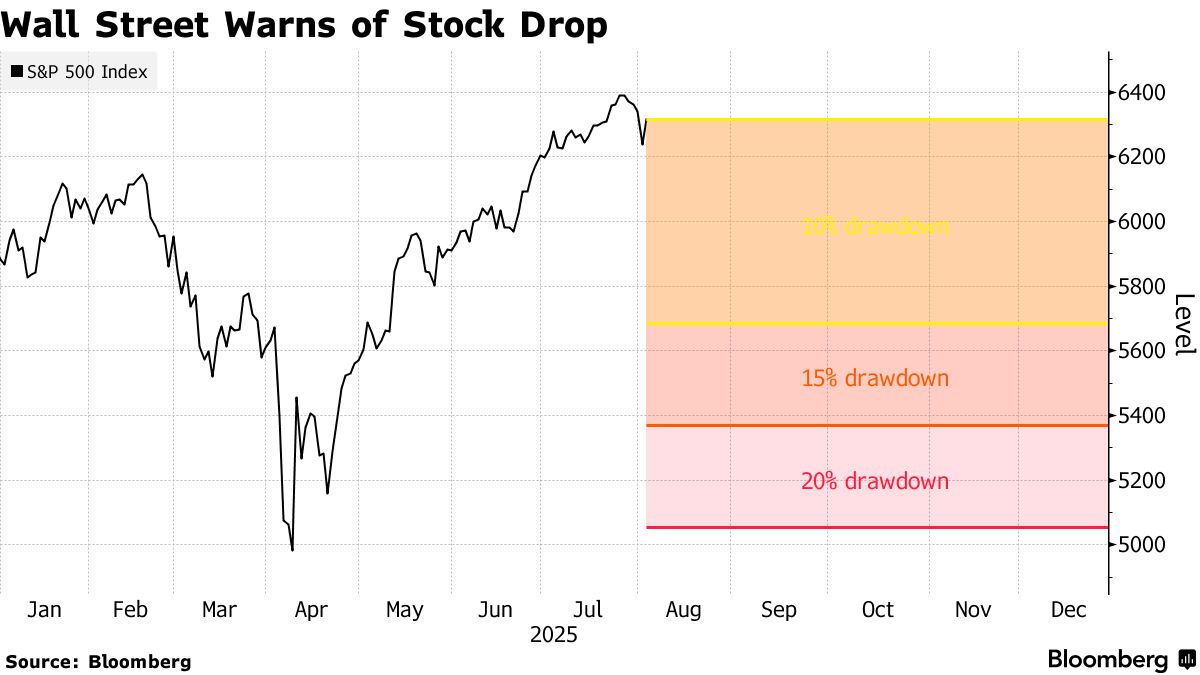
A chorus of stock market prognosticators at some of Wall Street’s biggest firms is warning clients to prepare for a pullback as sky-high equity valuations slam into souring economic data. On Monday, Morgan Stanley, Deutsche Bank AG and Evercore ISI all cautioned that the S&P 500 Index is due for a near-term drop in the weeks and months ahead. The predictions come after a furious rally from April’s lows that propelled the gauge to levels it has never seen before. Morgan Stanley strategist Mike Wilson sees a correction of up to 10% this quarter as tariffs hit consumers and corporate balance sheets. Evercore’s Julian Emanuel is expecting a more substantial decline of as much as 15%. And a team at Deutsche Bank led by Parag Thatte notes that a small drawdown in equities is overdue considering they’ve been on a tear for over three months. “Over the last couple of weeks, we have noted that investors should expect a modest pullback in the third quarter,” Wilson said in his note to clients.

The calls are coming amid mounting concerns about the US economy after data last week showed an uptick in inflation as well as weakening job growth and consumer spending. In addition, stocks are entering what’s usually their weakest time of the year. Over the past three decades, the S&P 500 has performed the worst in August and September, losing 0.7% on average in each month, compared with a 1.1% gain on average across other months, according to data compiled by Bloomberg. In addition, stocks have gotten expensive. The S&P 500’s 14-day relative strength index topped 76 last week — its highest point since July 2024 before US stocks briefly peaked last summer and above the 70 level that market technicians view as a sign of overheating. Options trading is also showing the fear of a downturn, as hedging against another rout becomes more expensive. Contracts protecting against a 10% decline in the SPDR S&P 500 ETF Trust (SPY) over the next 60 days compared to the cost of contracts hedging against a similar rally is hovering around levels not seen since the regional banking crisis in May 2023. Still, despite the near-term concerns, the warnings come with a big bullish caveat: In the event of a dip, buy it. At Evercore, Emanuel emphasizes that the long-term bull market in stocks is still intact despite expectations for volatility, and he advises clients to stay invested, particularly in companies capitalizing on the artificial intelligence boom. Deutsche’s Thatte points out that historically the S&P 500 experiences small pullbacks of around 3% every one-and-a-half-to-two months on average, and larger ones of 5% or more every three-to-four months.

NN: The biggest stock market crash is right around  the corner.

Netanyahu said to hold meeting on Gaza military plans

Israeli Prime Minister Benjamin Netanyahu will supposedly hold a security meeting later today to discuss plans for a military operation in Gaza, Channel 12 reported on Tuesday. According to the news outlet, Israel Defense Forces (IDF) Chief of Staff Eyal Zamir will be in attendance, together with Defense Minister Israel Katz and Minister of Strategic Affairs Ron Dermer and other officials. Channel 12 also shared that Zamir is expected to submit several operational strategies in order to create a military plan regarding Gaza that will be presented later this week to the Israeli military. Just yesterday, Netanyahu announced that he will convene the cabinet meeting later this week to direct the IDF on how to achieve war objectives.

Israel: Over 30 targets hit in past 24 hours

he Israel Defense Forces (IDF) announced on Tuesday that its Fire Brigade 282 attacked more than thirty “terror targets” in the past 24 hours as the army’s Southern Command continued its military operation throughout the Gaza Strip. In its daily update on Telegram, the IDF said its Brigade Combat Team 188 destroyed one of Hamas’s operational centers, while the Givati Brigade Combat Team dismantled a number of weapons and underground shafts. The Fire Brigade 990 eliminated “a number of terrorists,” the IDF added.

NN: All negotiations have failed. Hamas narrative is Israeli gynecide. In reality the gynecide is committed by Hamas on their own people and blamed on Israel. But people are being spoon fed bulllshit on social media and eating the turds whole. 

Hedge Funds Rush Into Bullish Oil Bets as Trump Pressures Russia

Hedge funds boosted their bullish bets on crude oil at the fastest pace in over a month as US President Donald Trump’s threat of additional levies on Russia drove fears about tighter supplies. Money managers increased their combined net-long position on West Texas Intermediate and Brent by 39,779 lots to 299,295, in the week ending July 29, according to data from ICE Futures Europe and the US Commodity Futures Trading Commission compiled by Bloomberg. That was the biggest increase since mid-June, when the conflict between Israel and Iran escalated. Trump announced a shorter deadline for Russia to agree to a ceasefire in Ukraine and threatened again to impose additional penalties on Russia, reigniting worries about tighter supplies and sparking a rally that sent crude prices to their highest in over a month.

Bullish Oil Bets Rise by Most Since June

Hedge funds flocked to long positions amid rising Russian supply risk

Source: CFTC, ICE

Diesel markets continue to remain tight, making speculators even more bullish on the fuel. Speculators increased bullish wagers on gasoil to the highest in more than three years and stepped up net long positions in US diesel futures and options to the highest in almost four years.

OPEC+ agrees to boost oil output by 548,000 bpd in Sept…… As excepted

The Organization of the Petroleum Exporting Countries (OPEC) and its allies decided during a virtual meeting on Sunday to hike oil production for September by 548,000 barrels per day (bpd), energy journalist Amena Bakr reported. “The phase-out of the additional voluntary production adjustments may be paused or reversed subject to evolving market conditions. This flexibility will allow the group to continue to support oil market stability. The eight OPEC+ countries also noted that this measure will provide an opportunity for the participating countries to accelerate their compensation,” the cartel noted in a statement. People familiar with the matter have said Saudi Arabia’s main objective is to recoup the market share OPEC+ has ceded to rivals like US shale drillers during years of output cutbacks. Riyadh’s OPEC+ quota for August, at 9.756 million barrels a day, would roughly put its production at the highest level in two years. The decision comes amid increasing US pressure to bring Moscow to the negotiating table to end their ongoing, full-scale invasion of Ukraine.  Threating to put 100% duty on Russian oil. A disruption to Russian flows would threaten to drive up crude prices and run counter to Trump’s repeated call for cheaper oil, as he pushes the Federal Reserve to lower interest rates. Russia’s Deputy Prime Minister Alexander Novak made a rare visit to Riyadh on Thursday to discuss “cooperation between the countries” with Saudi Arabian Energy Minister Prince Abdulaziz bin Salman. The two countries have jointly led OPEC+ since its creation almost a decade ago.