United States President Donald Trump said on Monday that he will officially announce a new deadline for Russia “probably tonight or tomorrow,” following his previous statement that the ceasefire deadline would be reduced. “We are going to do secondary sanctions [against Russia] unless we make a deal. We might make a deal,” Trump told reporters after meeting with British Prime Minister Keir Starmer in Scotland earlier today and added that the new deadline will be around 10 to 12 days. “There is no reason to wait, if you know what the answer is going to be, why wait,” the US president remarked.
NN: Trump is talking 100% duty on Russian oil. And he serious!
Trump: Not so interested in talking to Putin anymore
United States President Donald Trump said on Monday that he has always had a “great” relationship with Russian President Vladimir Putin, but that he is “not so interested” in talking to Putin. He said a negotiated solution to the war in Ukraine will “still happen, but it’s very late down the process.” He repeated that he is “disappointed” with Putin and said that every time he thought the war might end, Putin “kills people.”
Trump claimed that Putin talks about a trade deal with the US “all the time” and that Russia could be “so rich right now” if it was not spending “all its money on war.” He said he “envisaged” trading with Moscow, including in rare earths, if Russia agreed to a peace process.
NN: Trump is serious here. He is talking 10 to 12 days for Russia to make serious progress to peace.
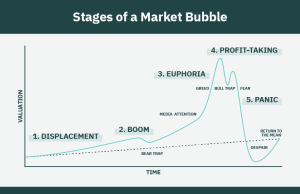
Stock market bubbles are strange animals indeed. I’ve always been amazed at how long they can keep building and building sucking people in like a black hole. This present market mania has created the most overvalued stock market ever. Reminiscence of the dot.Com bubble wipe. But this time the fad is for artificial intelligence and AI chips and data centers. Valuations are far beyond the potential profits the technology can deliver. The reality is its a big unknown which companies will survive and thrive and which will wipe out. For over a year I’ve watched AI hysteria drive the entire stock market higher and higher and valuations hitting 23-24-25 times earnings. Finally the critical oxygen supply that keeps the fires burning is running out. CASH. Market investors and companies have begged borrowed and stolen all the money they could.
They have achieved market valuations that can never be achieved and never be justified. As you know I waited and watched this bubble building mania for over a year for a sell signal. One of the biggest and best signals I use in analyzing bubbles and evaluating the hysteria in the marketplace is margin debt. This is where people throw caution to the wind and borrow vast amounts of money at Sky High interest rates to buy more and more and more stocks. We have finally achieved that threshold of market Mania stock market fever. This is where stocks soar to the moon DRIVING THE STOCK MARKET TO RECORD HIGHS. We are preparing to begin operations shorting the NASDAQ 100. Which is the home of these Bubblicious foaming at the mouth stocks. I will be preparing for you our strategy and I look to begin operations in late August and September. I expect a major market correction sometime in October and a crash in December. Timing these things can be tricky as hell obviosity. The reason why you do it is because there’s nothing more profitable than a bubble stock market crash. In the past we’ve been able to trade thankfully every one of them successfully. And i believe this one will be no different. So consider this you’re two minute warning!!
The reemergence of meme stock mania has professional investors facing a quandary: ride the excitement of retail traders or take it as a warning sign that the markets are due for a pullback.
Some indicators suggest investors are abandoning restraint and betting on further gains, with margin debt reaching a new record, but signs of fatigue are also creeping in, with the latest meme stock rally losing steam and Bitcoin falling back from its record highs.
According to Eric Diton, president and managing director of the Wealth Alliance, “I’m longer-term bullish, but I’m just short-term cautious” because of excessive speculation, and Victor Haghani, chief investment officer of Elm Wealth, says “it’s notoriously difficult to predict when” the market will turn.
The reemergence of meme stock mania last week has professional investors facing a quandary: ride the excitement of retail traders or take it as the latest warning sign that the frothy markets are due for a pullback. The speculative stocks caught up in the frenzy this week, like Opendoor Technologies Inc. and Kohl’s Corp., gave up some of their gains as the week went on, but most are still trading at their highest levels in months. The broader S&P 500 Index and Nasdaq 100 Index are doing even better, sitting at all-time highs after charging back from the early April selloff set off by President Donald Trump’s tariff announcements.
There are indicators that investors are abandoning restraint and betting on further gains. The amount that investors are borrowing to buy stocks on the New York Stock Exchange, known as margin debt, has exceeded the tech-bubble highs to reach a new record, according to data from the Financial Industry Regulatory Authority.
But signs of fatigue are creeping in. The latest meme stock rally seemed to lose steam after just a few days, and Bitcoin, one of the most visible symbols of the speculative fever, has recently fallen back from its record highs. Some Wall Street trading desks have been urging clients to scoop up discounted protection against possible losses. The current run has stretched valuations, with the S&P 500 trading at nearly 23 times forward earnings, well above the ten-year average of around 18, signaling that stocks have gotten significantly more expensive.
Clashes between Thailand and Cambodia over their disputed border region continued for the fourth day, with 33 people confirmed dead and more than 200,000 displaced. New clashes erupted near two ancient temples claimed by both nations. Cambodian Defense Ministry spokeswoman Maly Socheata alleged that Thai forces opened fire first, prompting a military response. Meanwhile, the Thai Army Deputy spokesman, Ritcha Suksuwanon, claimed that Cambodian troops had initiated the fighting with artillery strikes. Earlier, United States President Donald Trump stated that both countries agreed to meet and “quickly” work out a ceasefire after he urged an immediate end to the conflict, warning to cease trade negotiations if violence continued.
NN: Global tensions are rising. War is breaking out all over
Russian defenses downed 99 Ukrainian unmanned aerial vehicles (UAVs) overnight, according to the Russian Ministry of Defense. Of the 99 drones, 36 were destroyed over the region of Bryansk, 21 were intercepted over the region of Smolensk, ten were shot down over the region of Kaluga, nine were brought down over the region of Volgograd, nine were downed over the region of Rostov, four were destroyed over the Republic of Crimea, two were intercepted over the region of Voronezh, Kursk and the Black Sea and one drone was brought down over the regions of Moscow, Nizhny Novgorod, Oryol and Tambov.
The United States National Aeronautics and Space Administration (NASA) announced that 20% of its employees are set to depart the space agency, according to a spokesperson. About 3,870 employees will voluntarily depart the agency in the coming weeks, leaving the staff at around 14,000 people. Earlier this month, around 2,000 senior staff members left NAsSA.
NN: Now you know Elonis secret. He hires top engineers cheap. He then sets them free from mindless government bureaucrats and they invent great things.
Netanyahu: Israel and US are ‘considering alternative options to bring hostages home’
Prime Minister Benjamin Netanyahu says that Israel and the US are weighing ways to secure the release of hostages in Gaza that do not depend on a negotiated agreement with Hamas. “Special Envoy to the Middle East Steve Witkoff got it right,” Netanyahu says in a statement. “Hamas is the obstacle to a hostage release deal. Together with our US allies, we are now considering alternative options to bring our hostages home, end Hamas’s terror rule, and secure lasting peace for Israel and our region.” Netanyahu does not elaborate on what such “alternative options” could entail. Talks hit a major roadblock yesterday after Hamas submitted its response to the latest ceasefire proposal and Israel withdrew its hostage team. But Jerusalem is still interested in a deal, and public statements are understood by many observers to be part of the pressure campaign to push Hamas to agree to a deal. Last night, Witkoff announced that Washington was calling back its negotiators from hostage talks in Doha and will pursue “alternative options” after the latest response from Hamas “clearly shows a lack of desire to reach a ceasefire in Gaza.”
Trump: Hamas didn’t want deal, they wanna die
United States President Donald Trump said on Friday that Hamas did not “really” want to reach a ceasefire and hostage release deal with Israel. “I think they wanna die, and it’s very bad,” he added, stressing they “know what happens after you get the final hostages.” The comments come after Israel and the US both pulled their delegations from talks in Doha after Hamas demanded the release of 200 Palestinians serving life sentences in Israeli prisons and 2,000 Palestinians detained in the Gaza Strip since October 7, 2023, in exchange for 10 living Israeli hostages, despite Israel expressing readiness to free 125 Palestinians from prisons and 1,200 people detained in Gaza. After the failed negotiations, Israeli Prime Minister Benjamin Netanyahu stated his country will consider “alternative options” to retrieve the Israeli hostages.
U.S. commercial crude oil inventories (excluding those in the Strategic Petroleum Reserve) decreased by 3.2 million barrels from the previous week. At 419 million barrels, U.S. crude oil inventories are about 9% below the five year average for this time of year U.S. crude oil refinery inputs averaged 16.9 million barrels per day during the week ending July 18, 2025, which was 87 thousand barrels per day more than the previous week’s average. Refineries operated at 95.5% of their operable capacity last week. Gasoline production increased last week, averaging 9.4 million barrels per day. Distillate fuel production increased by 95 thousand barrels per day last week, averaging 5.1 million barrels per day. U.S. crude oil imports averaged 6 million barrels per day last week, decreased by 403 thousand barrels per day from the previous week. Over the past four weeks, crude oil imports averaged about 6.3 million barrels per day, 7.1% less than the same four-week period last year. Total motor gasoline imports (including both finished gasoline and gasoline blending components) last week averaged 606 thousand barrels per day, and distillate fuel imports averaged 115 thousand barrels per day. . Total motor gasoline inventories decreased by 1.7 million barrels from last week and are slightly above the five year average for this time of year. Both finished gasoline inventories and blending components inventories decreased last week. Distillate fuel inventories increased by 2.9 million barrels last week and are about 19% below the five year average for this time of year. Propane/propylene
inventories decreased by 0.5 million barrels from last week and are 10% above the five year average for this time of year. Total commercial petroleum inventories decreased by 5.2 million barrels last week. Total products supplied over the last four-week period averaged 20.6 million barrels a day, slightly above the same period last year. Over the past four weeks, motor gasoline product supplied averaged 8.8 million barrels a day, down by 4.9 % from the same period last year. Distillate fuel product supplied averaged 3.6 million barrels a day over the past four weeks, down by 1% from the same period last year. Jet fuel product supplied was up 1.5% compared with the same four-week period last year.
NN: Obviously demand is increasing and supplies are falling.
U.S. crude oil inventories fell by 3.169 million barrels in the week ending July 18, the Energy Information Administration (EIA) reported on Wednesday, broadly confirming the earlier API estimate but with a steeper decline. Analysts had expected a more modest draw, reinforcing signs of strong refining activity and steady demand amid peak summer travel. At 10:00 a.m. Central Time, Brent crude was trading at $68.22, down $0.37 (-0.54%) on the day, while WTI was down $0.36 (-0.55%) at $64.95 per barrel.
President Donald Trump reached a trade deal with Japan that will impose 15% tariffs on imports including automobiles from Japan.
The deal includes a $550 billion fund to make investments in the US, with Japan agreeing to provide the funds to invest in projects in America.
Japan will also buy 100 Boeing Co. aircraft, boost rice purchases, and buy $8 billion in agricultural and other products, while hiking defense spending with American firms.
President Donald Trump reached a trade deal with Japan that will impose 15% tariffs on imports including automobiles from the key American ally, while creating a $550 billion fund to make investments in the US. The agreement, touted by Trump after he secured breakthroughs in a final 75-minute Oval Office meeting Tuesday with Japanese negotiators, spares the nation from a threatened 25% tariff that was set to take effect next week. “They had their top people here and we worked on it long and hard, and it’s a great deal for everybody,” Trump said at a White House event Tuesday evening. Under the deal, automobiles and parts would be subjected to the same 15% rate as Japan’s other exports, Prime Minister Shigeru Ishiba said in Tokyo, amid local media reports that he’s planning to step down in the wake of the agreement following a poor showing for his party in an election on Sunday. In return, Japan will accept cars and trucks built to US motor vehicle safety standards, without subjecting them to additional requirements — a potentially major step to selling more American-built vehicles in the country. The auto sector tariff had been one of the main sticking points in the negotiations.
Shares in Japanese carmakers jumped in Tokyo on reports the auto sector rate would be lowered to 15% from 25% for Japan. Toyota Motor Corp. rose as much as 16%, compared with gains of around 3% in the Topix benchmark index in the early afternoon. The yen strengthened against the dollar at first, before weakening after the reports of Ishiba’s intention to resign.
A centerpiece of the pact with Japan is the $550 billion investment pledge. A senior US administration official, speaking on condition of anonymity to outline the agreement, said the pledge was akin to a sovereign wealth fund under which Trump himself could steer investments inside the US. Final terms of the agreement still need to be enshrined in a formal proclamation. Legal particulars and other details surrounding the pledge are still being hammered out, according to the official. The investment timeline is not certain, and it’s not clear whether Trump would be able to allocate the full sum during his term.
NN: The oil market has been range bond for weeks. Trading within a $2.00 range. Fearing that tariff wars would slow oil demand. Trump is NOT going to kill global trade. Proof he just did a deal with one of Americas biggest trading partners Japan.