Ukraine staged a dramatic series of strikes across Russia, deploying drones hidden in trucks deep inside the country to hit strategic airfields as far away as eastern Siberia. Around the same time, Moscow launched one of its longest drone and missile attacks against Kyiv, escalating tensions ahead of crucial peace talks this week. More than 40 Russian aircraft, including the Tu-95 and Tu-22 M3 long-range bombers capable of deploying conventional and nuclear weapons as well as the A-50, were reportedly damaged in Sunday’s operation, an official in Ukraine’s Security Service said on condition of anonymity as the details are not public. Ukraine’s Security Service chief Vasyl Malyuk led the operation and losses are assessed to be at least $2 billion, the person said. Drones were released remotely from wooden mobile houses that were transported on trucks inside Russian territory, according to the official. Ukrainian President Volodymyr Zelenskiy revealed details of the operation, saying it was “one year, six months, and nine days from the start of planning to effective execution.” He added, “Our most long-range operation. Our people involved in preparing the operation were withdrawn from Russian territory in time.” In a separate post on Telegram, Zelenskiy said Ukraine used 117 drones with people operating inside Russia across three time zones, adding that “34% of strategic cruise missile carriers at the airfields were hit.” Russia’s Defense Ministry confirmed in a Telegram statement that attacks occurred at five military airbases across the nation from the Far East and eastern Siberia to locations just several hundred miles from Moscow. Earlier on Sunday, Ukraine came under one of the longest barrages from Russian missiles and drones, with air sirens lasting for more than 9 hours. At least 12 people were killed in a strike on a military training center, prompting Ukraine Ground Forces Commander Mykhaylo Drapatyi to announce his decision to resign due to the cas The incidents occurred just as Moscow and Kyiv prepare to send delegations to Turkey for a second round of peace talks on Monday. The opening round on May 16 — the first in more than three years — ended with a prisoner exchange agreement and discussions on a potential ceasefire. So far, Russia has not signaled if the attacks may affect the talks.
Oil climb no OPEC and Proof Iran is building NUKESS
The prices of oil continued to rise on Monday, with West Texas Intermediate jumping by more than 3.5% as investors’ concerns of a higher increase in the output from the Organization of the Petroleum Exporting Countries and allies (OPEC+) were relieved after the organization’s meeting on Saturday brought expected hike in production of 411,000 barrels per day for the month of July, in line with the previous two months.
OPEC is not the main event here… its Iran and their belief they are at a historic moment in time. Where they nuke Israel and the Mahdi (their savior comes) Islam takes over the world.
Hamas responds to ceasefire proposal, adds conditions….. Israel said to see Hamas answer as deal rejection…..
Hamas said on Saturday that it submitted its response to mediators regarding United States Special Envoy to the Middle East Steve Witkoff’s proposal on a ceasefire and hostage release. “We have submitted our response that includes a permanent ceasefire, a comprehensive withdrawal from the Gaza Strip, and ensuring the flow of aid to our people in Gaza,” the group said. Hamas agreed to release ten Israeli hostages and the bodies of 18 deceased hostages, but noted that the number of Palestinian prisoners to be freed should “be agreed upon.” Egyptian media reported that the group asked to release Israeli hostages in five stages, rather than two as suggested by the US. Israel reportedly already accepted the original proposal that would include a 60-day ceasefire in Gaza, during which Hamas would hand over living and deceased hostages in return for 125 Palestinian prisoners serving life sentences and 1,111 detained Gazans.
Israel said to see Hamas answer as deal rejection
Israel considers Hamas’ response to United States Special Envoy to the Middle East Steve Witkoff’s proposal on a ceasefire and hostage release an “effective rejection” of the plan, The Times of Israel reported on Saturday, citing an unnamed Israeli official. Hamas said it submitted its response to the plan, stressing an agreement must aim to achieve “a permanent ceasefire, a comprehensive withdrawal from the Gaza Strip, and ensuring the flow of aid to our people in Gaza.” According to some reports, the group also asked to release Israeli hostages in five stages, rather than two as suggested by the US. Israel’s lead negotiator and Strategic Affairs Minister Ron Dermer earlier accepted Witkoff’s initial proposal.
Witkoff: Hamas’ answer to proposal totally unacceptable
United States Special Envoy to the Middle East Steve Witkoff said on Saturday that Hamas’ response to his proposal for a ceasefire and hostage release agreement was “totally unacceptable.” Witkoff added the move by the group “only takes us backward” and urged Hamas to “accept the framework proposal we put forward as the basis for proximity talks, which we can begin immediately this coming week.” The US official claimed that Hamas agreeing to this is the “only way we can close a 60-day ceasefire deal in the coming days in which half of the living hostages and half of those who are deceased will come home to their families and in which we can have at the proximity talks substantive negotiations in good-faith to try to reach a permanent ceasefire.” Earlier in the day, Hamas submitted a response that reportedly included the release Israeli hostages in five stages and demands for a “permanent ceasefire.”
Damning IAEA report spells out past secret nuclear activities in Iran
VIENNA, May 31 (Reuters) – Iran carried out secret nuclear activities with material not declared to the U.N. nuclear watchdog at three locations that have long been under investigation, the watchdog said in a wide-ranging, confidential report to member states seen by Reuters. The findings in the “comprehensive” International Atomic Energy Agency report requested by the agency’s 35-nation Board of Governors in November pave the way for a push by the United States, Britain, France and Germany for the board to declare Iran in violation of its non-proliferation obligations. A resolution would infuriate Iran and could further complicate nuclear talks between Tehran and Washington.
Using the IAEA report’s findings, the four Western powers plan to submit a draft resolution for the board to adopt at its next meeting the week of June 9, diplomats say. It would be the first time in almost 20 years Iran has formally been found in non-compliance.
Iran’s foreign ministry and the Iranian nuclear agency rejected the report, calling it “politically motivated” in a joint statement. They said Tehran will take “appropriate measures” in response to any effort to take action against the country at the Board of Governors meeting, state media reported, without elaborating.
Tehran says it wants to master nuclear technology for peaceful purposes and has long denied accusations by Western powers that it is seeking to develop nuclear weapons. While many of the findings relate to activities dating back decades and have been made before, the IAEA report’s conclusions were more definitive. It summarised developments in recent years and pointed more clearly towards coordinated, secret activities, some of which were relevant to producing nuclear weapons.
It also spelled out that Iran’s cooperation with IAEA continues to be “less than satisfactory” in “a number of respects”. The IAEA is still seeking explanations for uranium traces found years ago at two of four sites it has been investigating. Three hosted secret experiments, it found.
The IAEA has concluded that “these three locations, and other possible related locations, were part of an undeclared structured nuclear programme carried out by Iran until the early 2000s and that some activities used undeclared nuclear material”, the report said. Nuclear material and/or heavily contaminated equipment from that programme was stored at the fourth site, Turquzabad, between 2009 and 2018, it said.
“The Agency concludes that Iran did not declare nuclear material and nuclear-related activities at three undeclared locations in Iran, specifically, Lavisan-Shian, Varamin, and Turquzabad,” the report said. At Lavisan-Shian in Tehran, a disc made of uranium metal was “used in the production of explosively-driven neutron sources” at least twice in 2003, a process designed to initiate the explosion in a nuclear weapon, the report said, adding that it was part of “small-scale” tests.
The report is likely to lead to Iran being referred to the U.N. Security Council, though that would probably happen at a later IAEA board meeting, diplomats said. More immediately, it is likely to lead to Iran again accelerating or expanding its rapidly advancing nuclear programme, as it has done after previous rebukes at the board. It could also further complicate talks with the United States aimed at reining in that programme.
A separate IAEA report sent to member states on Saturday said Iran’s stock of uranium enriched to up to 60% purity, close to the roughly 90% of weapons grade, had grown by roughly half to 408.6 kg. That is enough, if enriched further, for nine nuclear weapons, according to an IAEA yardstick. Both IAEA reports said enrichment to such a high level was “of serious concern” since it is the only country to do so without producing nuclear weapons.
Israel, which has long urged strong action against Iran’s nuclear programme, said the IAEA report showed Tehran was determined to complete its nuclear weapons programme. Prime Minister Benjamin Netanyahu’s office said the world should act now to stop Iran from doing this.
U.S. intelligence agencies and the IAEA have long believed Iran had a secret, coordinated nuclear weapons programme that it halted in 2003. Iran denies ever having had one.
In Washington, White House press secretary Karoline Leavitt said later on Saturday that President Donald Trump’s special envoy Steve Witkoff “has sent a detailed and acceptable proposal to the Iranian regime, and it’s in their best interest to accept it.” She declined to provide further details. Araqchi said in a post on X that Iran “will respond to the U.S. proposal in line with the principles, national interests and rights of people of Iran”.
more in depth coverage
Hamas responds to ceasefire proposal, adds conditions
Hamas said on Saturday that it submitted its response to mediators regarding United States Special Envoy to the Middle East Steve Witkoff’s proposal on a ceasefire and hostage release. “We have submitted our response that includes a permanent ceasefire, a comprehensive withdrawal from the Gaza Strip, and ensuring the flow of aid to our people in Gaza,” the group said. Hamas agreed to release ten Israeli hostages and the bodies of 18 deceased hostages, but noted that the number of Palestinian prisoners to be freed should “be agreed upon.” Egyptian media reported that the group asked to release Israeli hostages in five stages, rather than two as suggested by the US. Israel reportedly already accepted the original proposal that would include a 60-day ceasefire in Gaza, during which Hamas would hand over living and deceased hostages in return for 125 Palestinian prisoners serving life sentences and 1,111 detained Gazans.
nn: deal…. no deal
Israel calls on world to ‘act now to stop Iran’
The office of Israeli Prime Minister Benjamin Netanyahu called on the global community to take action to stop Iran from building its nuclear program after the latest report by the International Atomic Energy Agency (IAEA) showed Tehran is continuing to enrich uranium. “The report strongly reinforces what Israel has been saying for years – the purpose of Iran’s nuclear program is not peaceful. This is evident from the alarming scope of Iran’s uranium enrichment activity. Such a level of enrichment exists only in countries actively pursuing nuclear weapons and has no civilian justification whatsoever,” Netanyahu’s office stated. “The international community must act now to stop Iran,” it added. The IAEA report said that Iran increased its stockpile of 60%-enriched uranium by about 50% since early February to 408.6 kilograms, but Tehran has insisted it is not interested in acquiring a nuclear weapon.
nn: a decision and attack is close
Iran has amassed even more near weapons-grade uranium, UN watchdog says
VIENNA (AP) — Iran has further increased its stockpile of uranium enriched to near weapons-grade levels, a confidential report by the U.N. nuclear watchdog said Saturday and called on Tehran to urgently change course and comply with the agency’s probe. The report comes at a sensitive time as Tehran and Washington have been holding several rounds of talks in the past weeks over a possible nuclear deal that U.S. President Donald Trump is trying to reach. The report by the Vienna-based International Atomic Energy Agency — which was seen by The Associated Press — says that as of May 17, Iran has amassed 408.6 kilograms (900.8 pounds) of uranium enriched up to 60%. That’s an increase of 133.8 kilograms (294.9 pounds) — or almost 50% — since the IAEA’s last report in February. The 60% enriched material is a short, technical step away from weapons-grade levels of 90%. A report in February put this stockpile level at 274.8 kilograms (605.8 pounds). There was no immediate comment from Tehran on the new IAEA report.
The IAEA report raised a stern warning
Iran is now “the only non-nuclear-weapon state to produce such material” — something the agency said was of “serious concern.” Approximately 42 kilograms of 60% enriched uranium is theoretically enough to produce one atomic bomb, if enriched further to 90%, according to the watchdog. The IAEA report, a quarterly, also estimated that as of May 17, Iran’s overall stockpile of enriched uranium — which includes uranium enriched to lower levels — stood at 9,247.6 kilograms (20,387.4 pounds). That’s an increase of 953.2 kilograms (2,101.4 pounds) since February’s report. Iran has maintained its nuclear program is for peaceful purposes only, but the IAEA chief, Rafael Mariano Grossi, has warned that Tehran has enough uranium enriched to near-weapons-grade levels to make “several” nuclear bombs if it chose to do so. Iranian officials have increasingly suggested that Tehran could pursue an atomic bomb. U.S. intelligence agencies assess that Iran has yet to begin a weapons program, but has “undertaken activities that better position it to produce a nuclear device, if it chooses to do so.” Israel said Saturday’s report was a clear warning sign that “Iran is totally determined to complete its nuclear weapons program,” according to a statement from Prime Minister Benjamin Netanyahu’s office. It said IAEA’s report “strongly reinforces what Israel has been saying for years — the purpose of Iran’s nuclear program is not peaceful.” It also added that Iran’s level of enrichment “has no civilian justification whatsoever” and appealed on the international community to “act now to stop Iran.” Grossi said Saturday that he “reiterates his urgent call upon Iran to cooperate fully and effectively” with the IAEA’s years long investigation into uranium traces discovered at several sites in Iran. The IAEA also circulated to member states on Saturday a second, 22-page confidential report, also seen by the AP, that Grossi requested following a resolution passed by the 35-member IAEA Board of Governors last November.
In this so-called “comprehensive report,” the IAEA said that Iran’s cooperation with the agency has “been less than satisfactory” when it comes to uranium traces discovered by IAEA inspectors at several locations in Iran that Tehran has failed to declare as nuclear sites.
Western officials suspect that the uranium traces discovered by the IAEA could provide evidence that Iran had a secret military nuclear program until 2003. One of the sites became known publicly in 2018 after Netanyahu revealed it at the United Nations and called it a clandestine nuclear warehouse hidden at a rug-cleaning plant. Iran denied this but in 2019 IAEA inspectors detected the presence of manmade uranium particles there. After initially blocking IAEA access, inspectors were able to collect samples in 2020 from two other locations where they also detected the presence of manmade uranium particles. The three locations became known as Turquzabad, Varamin, and Marivan. A fourth undeclared location named as Lavisan-Shian is also part of the IAEA probe but IAEA inspectors never visited the site because it was razed and demolished by Iran after 2003. In Saturday’s comprehensive report, the IAEA says that the “lack of answers and clarifications provided by Iran” to questions the watchdog had regarding Lavisan-Shian, Varamin and Marivan “has led the agency to conclude that these three locations, and other possible related locations, were part of an undeclared structured nuclear program carried out by Iran until the early 2000s and that some activities used undeclared nuclear material.” Saturday’s comprehensive report could be a basis for possible further steps by European nations, leading to a potential escalation in tensions between Iran and the West. European countries could move to trigger snap-back sanctions against Iran that were lifted under the original 2015 nuclear deal ahead of October, when the deal formally expires. On Thursday, senior Iranian officials dismissed speculation about an imminent nuclear deal with the United States, emphasizing that any agreement must fully lift sanctions and allow the country’s nuclear program to continue. The comments came a day after Trump said he has told Netanyahu to hold off on striking Iran to give the U.S. administration more time to push for a new deal with Tehran. Trump said on Friday that he still thinks a deal could be completed in the “not too distant future.”
“They don’t want to be blown up. They would rather make a deal,” Trump said of Iran. He added, “That would be a great thing that we could have a deal without bombs being dropped all over the Middle East.”
NN: don’t be so sure
Hedge Funds Rush Into Oil Short Bets as OPEC Supply Risk Looms…….OPEC+ agrees to boost output by 411K bpd in July
Hedge funds loaded up on the most bearish bets against Brent crude since October as the market braced for a fresh injection of OPEC+ supply. Money managers upped their short-only bets on Brent by 16,922 lots to 130,019 lots in the week ended May 27, the most in eight months, according to figures from ICE Futures Europe. At the same time, short-only bets against West Texas Intermediate rose to a three-week high, data from the Commodity Futures Trading Commission show.
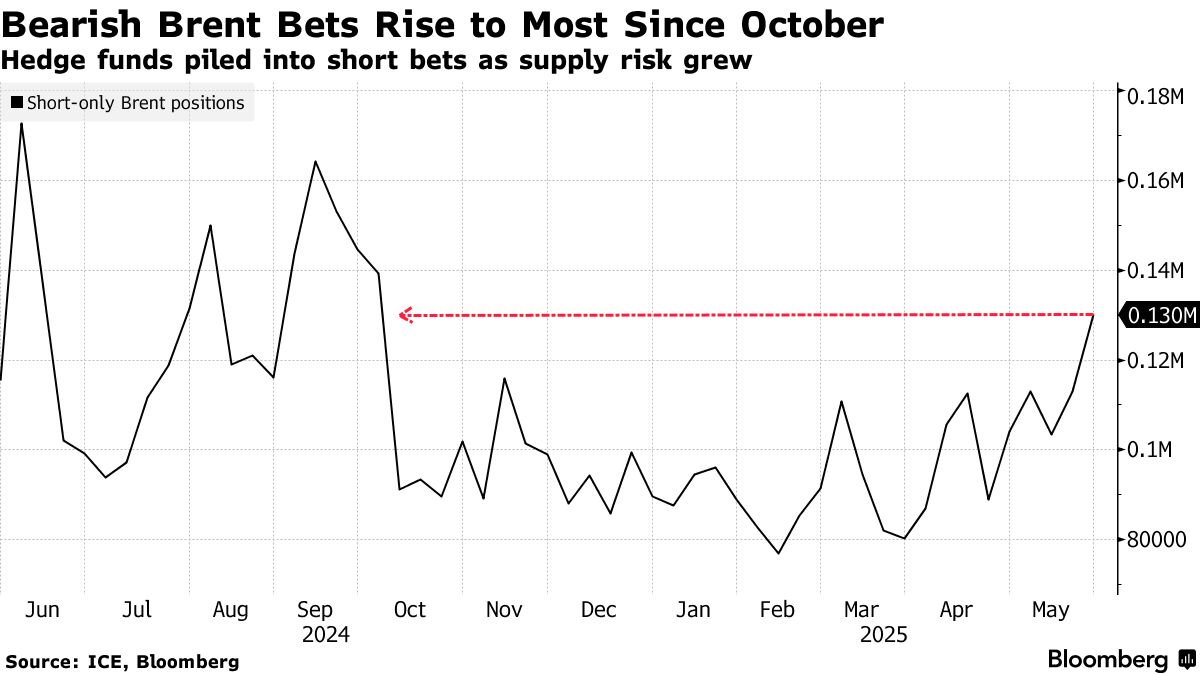
Oil slipped last week as the prospect of another major OPEC+ production hike raised concerns about a supply glut. A sub-group led by Saudi Arabia is set to meet on Saturday to decide on July output levels, following preliminary talks last week on a third consecutive supply increase. Adding to headwinds, investors’ assessed some optimistic signals out of Washington on a nuclear deal between the US and Iran. Relaxed sanctions on the OPEC member stand to boost supplies, hurting prices. Short-only bets against gasoline also rose to a four-week high even with the summer driving season underway, data from the Commodity Futures Trading Commission show.
OPEC+ agrees to boost output by 411K bpd in July as expected and priced
The Organization of the Petroleum Exporting Countries (OPEC) and its allies, including Russia, agreed during a video call on Saturday to boost production by 411,000 barrels per day in July, energy journalist Amena Bakr reported. The output increase will be implemented for the third month in a row by eight key nations, including Saudi Arabia and Russia, after they earlier agreed to make the same moves in May and June. The group will hold its next meeting on July 6, when 8it is set to decide on its policy for August.
NN: a well telegraphed and priced move
Katz to Hamas: Accept US proposal or ‘be destroyed’
Israeli Defense Minister Israel Katz on Friday called on Hamas to accept United States Special Envoy Steve Witkoff’s latest proposal for a ceasefire and hostage deal if it does not want to be demolished.
“The Hamas murderers must now choose: accept the terms of the ‘Witkoff deal’ for the release of the hostages, or be destroyed,” Katz said in a statement.
The minister reiterated that the Israel Defense Forces (IDF) is carrying out its operation in the Gaza Strip “with full force,” destroying Hamas strongholds. “After eliminating the terrorists and clearing the area, the IDF will remove all threats according to the Rafah model, and remain to hold the area,” he warned.
Dimon: You are going to see crack in bond market
“You are going to see a crack in the bond market. It is going to happen,” JPMorgan Chase & Co. CEO Jamie Dimon warned on Friday while speaking at the 2025 Reagan National Economic Forum. He shared that while some investors are likely to panic, JPMorgan won’t, adding that the business “will be fine” and “will probably make more money.” He insisted that, unlike what some might think, his company doesn’t like crises. “We can make everything better by just changing and modifying certain rules and regulations,” he added. While he is uncertain if a crisis will happen in “six months or six years,” Dimon expressed hope that the trajectory of the debt will change. Talking about the Federal Reserve’s monetary policy decision, Dimon remarked that the United States central bank is right to wait with interest rate cuts. “The Fed has a tough job,” he commented.