EIA  Weekly Petroleum Report for week ending January 10, 2020

U.S. commercial crude oil inventories (excluding those in the Strategic Petroleum Reserve) decreased by 2.5 million barrels from the previous week. At 428.5 million barrels, U.S. crude oil inventories are at the five year average for this time of year.  U.S. crude oil refinery inputs averaged 17.0 million barrels per day during the week ending January 10, 2020, which was 76,000 barrels per day more than the previous week’s average. Refineries operated at 92.2% of their operable capacity last week. Gasoline production increased last week, averaging 9.3 million barrels per day. Distillate fuel production decreased last week, averaging 5.2 million barrels per day. U.S. crude oil imports averaged 6.6 million barrels per day last week, down by 179,000 barrels per day from the previous week. Over the past four weeks, crude oil imports averaged about 6.6 million barrels per day, 13.1% less than the same four-week period last year. Total motor gasoline imports (including both finished gasoline and gasoline blending components) last week averaged 443,000 barrels per day, and distillate fuel imports averaged 202,000 barrels per day. Total motor gasoline inventories increased by 6.7 million barrels last week and are about 5% above the five year average for this time of year. Finished gasoline and blending components inventories both increased last week. Distillate fuel inventories increased by
8.2 million barrels last week and are about 3% below the five year average for this time of year. Propane/propylene inventories decreased by 0.9 million barrels last week and are about 21% above the five year average for this time of year. Total commercial petroleum inventories increased last week by 14.5 million barrels last week. Total products supplied over the last four-week period averaged 19.9 million barrels per day, down by 1.0% from the same period last year. Over the past four weeks, motor gasoline product supplied averaged 8.7 million barrels per day, down by 0.9% from the
same period last year. Distillate fuel product supplied averaged 3.5 million barrels per
day over the past four weeks, down by 6.9% from the same period last year. Jet fuelproduct supplied was up 2.0% compared with the same four-week
period last year.

Wells Fargo EPS drops 50% in Q4

Wells Fargo said on Tuesday that its revenue in the fourth quarter of 2019 was $19.9 billion, falling from $21 billion in the same quarter a year ago. Diluted earnings per share (EPS) came in at $0.60 in the same three-month period, declining 50% year-on-year. Net income in the fourth quarter of 2019 was $2.9 billion, which compared to net income of $6.1 billion in the last three months of 2018. In the full-year 2019, net income was $19.5 billion on diluted EPS of $4.05. Net income fell 12.7% and diluted EPS declined 5.4% year-on-year. The bank’s revenue was reported at $85.1 billion for the entire 2019, declining 1.5% year-on-year. CEO Charlie Scharf said: “Even in my short time at the company, it is clear that our opportunities to improve our performance are substantial when we finish this work. Our cost structure is too high, and I believe there are many areas where we will be able to increase our rate of growth. ” Nick Note: This is one of the largest mortgage originates, Credit card issuers and If you have a drivers licence (even if its expired) car loans at twice what the car is with lenders.

Kindness Comes Naturally To Parrots: Study Shows Their Extraordinary Selfless Behavior

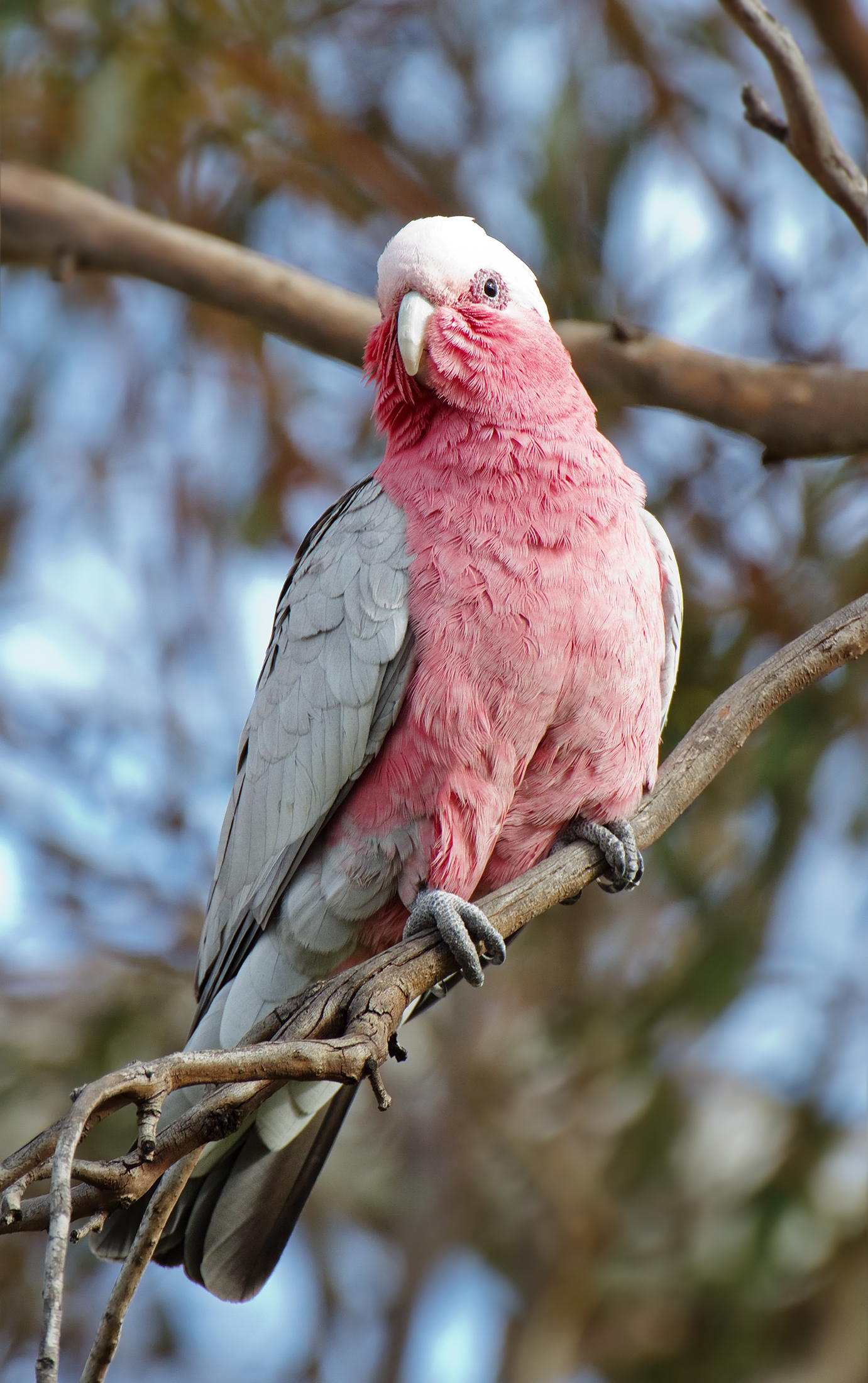
The galah /ɡəˈlɑː/ (Eolophus roseicapilla), also known as the pink and grey, is one of the most common and widespread cockatoos, and it can be found in open country in almost all parts of mainland Australia.

TENERIFE, Spain — Parrots have long been considered intelligent birds, but a new set of research focusing on African gray parrots finds that besides just being smart these fascinating animals are also very kind to one another. Over the course of the experiments, the studied parrots exhibited selfless tendencies, prosocial behavior, and cooperativeness — even when there were no obvious opportunities for reciprocation. Furthermore, these extraordinary birds returned favors or good deeds amongst one another, and never became jealous whenever a particular bird received a larger reward than others. These traits are exceedingly rare in the animal kingdom, with only great apes behaving in similarly selfless ways.

All in all, these findings make a strong case that parrots are among the smartest animals on the planet, rivaling crows, apes, and dolphins in terms of overall and social intelligence.

Prosocial parrots
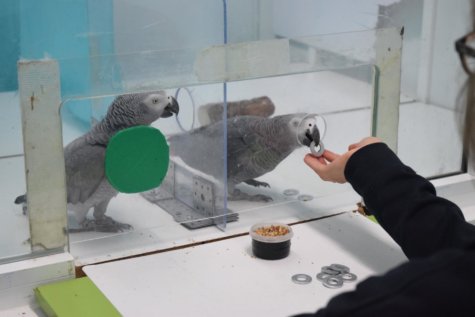
In the behavioral experiments, the parrots receive metal tags, which they can then exchange for food. (Photo credit: Comparative Cognition Group)

The research team hailed from the Max PlanckInstitute for Ornithology in Germany, but had been stationed at the outpost for parrot comparative cognition in Spain. Let’s take a look at a female parrot, Bella, as an example. Bella has learned to accept metal tokens given by researchers, and exchange them with another researcher for food. However, Bella’s exchange opening has been blocked off. So, she has some metal tokens but can’t use them at the moment. Instead of hoarding her tokens, Bella decides to give them to her neighbor, Kimmi. Kimmi and Bella’s living spaces are connected via an additional opening, and while Kimmi’s exchange hole connecting him to the researchers is still open, he doesn’t have any tokens. Selflessly, Bella gives her tokens to Kimmi, and watches in a relaxed manner as Kimmi exchanges the tokens and eats the food he receives in return. The research team were astounded by Bella’s altruistic actions, especially given the fact that she didn’t appear to become jealous at all of the food Kimmi enjoyed using her tokens. This is especially noteworthy because there were no clear signs that Kimmi would reciprocate in the future and do something nice for Bella. “Our parrots indeed seem to have grasped that another individual requires their help in order to achieve a goal,” comments first author Désirée Brucks in a statement. Moreover, when researchers recreated the same situation but with both Bella and Kimmi’s exchange openings blocked off, Bella didn’t bother to give her tokens to Kimmi. A surefire sign that the parrots understood the situation, and were able to recognize when a fellow bird would actually benefit from sharing tokens. A second experiment was conducted that illustrated the parrots’ overall prosocial attitude, or willingness to help and care for one another. This experiment also revealed that parrots are capable of reciprocating good deeds from one to another, a trait that is considered an integral building block in the evolution of cooperation. In this scenario, the parrots were given an option of choosing two different types of tokens: one token that only provided food for themselves, and another that provided food to both the subject and their immediate neighbor. “Initially the parrots chose randomly, without paying any attention to the wellbeing of their neighbor”, explains first author Anastasia Krasheninnikova. “As soon as the parrots were tested alternatingly with their neighbor, they very rapidly learned to choose the token that benefitted both birds.” A third experiment revealed that parrots rarely, if ever, become jealous of one another. In this setting, two parrots performed the same task, but one bird was given a larger reward than the other. “At first, this finding came as a surprise, given that a ‘sense of fairness’ is considered a prerequisite for the evolution of cooperation,” says Auguste von Bayern, the leader of the comparative cognition research group. Even primates become frustrated when faced with unfair situations like the one described above, and usually end up boycotting the entire activity. Researchers theorize that parrots don’t react in this way because they usually stay bonded with a single partner throughout their entire life, while primates tend to move on from one partner to another. “Given that parrots are so closely bonded with a single individual and thus so mutually interdependent, it does not make any difference if one of them gets a better pay-off once in a while. What counts is that together, they function as a unit that can achieve much more than each of them on their own (in addition to raising their joint offspring). This is probably why parrots are much more tolerant towards unequal treatment than species that are not long-term monogamous, while still being excellent cooperators,” Auguste von Bayern explains. Nick Note: Phoenix is my best friend. She is a parrot in the cockatoo family. She by far is the most intelligence animal on the farm. Come to think of it she is smarter and for sure kinder then most people i know. I inherited from the kids when they went off to school.  She lives in my office and is content to watch me work. When i get excited like on a tape you can hear her joining in the fun. She perches on her branch or my microphone boom. She comes for hugs a few times a day. She likes to lift up her wings so i can scratch her feathers. And she does not like anyone else touching her.  When i have strawberries she goes crazzy for the stems. When night comes i cover her. She has done an amazing thing. She cut a hole in the cover at her eye level so she can watch me at night. Sometimes she hops off the branch or the boom and walks around on my desk. When on the desk if i ask her to she will bring me a pen. What a incredible animal!

As Justice Department Pressures Apple, Investigators Say iPhone Easier to Crack

Security experts question necessity of latest battle over encryption as new tools emerge

Forensic tools used to hack into iPhones have been enhanced recently, making iPhones like this iPhone 7 easier to crack. Photo: regis duvignau/Reuters

The escalation of a long-running encryption conflict between the Justice Department and Apple Inc. AAPL -1.35% has puzzled security experts who say that new hacking tools have made it possible to gain access to many of the company’s devices in criminal investigations. Attorney General William Barr ratcheted up pressure on Apple on Monday, painting the company as unhelpful to the government as it seeks to unlock two iPhones belonging to an aviation student from Saudi Arabia who authorities say killed three people at a Florida Navy base last month. Mr. Barr described the phones as “engineered to make it virtually impossible to unlock them without the password.” “We are helping Apple all of the time on TRADE and so many other issues, and yet they refuse to unlock phones used by killers, drug dealers and other violent criminal elements,” President Trump said in a Tweet Tuesday evening. He called on the company to help “NOW!” Justice Department officials said they spent a month seeking ways to access two phones used by Second Lt. Mohammed Alshamrani, a member of the Saudi air force who allegedly opened fire in a classroom at Naval Air Station Pensacola on Dec. 6 before being shot and killed by sheriff’s deputies. After consulting with experts and vendors and failing to break into the devices—an iPhone 5 and an iPhone 7—investigators reached out to Apple directly, officials said. In a statement Monday, Apple said the company was notified a week ago that the Federal Bureau of Investigation needed additional assistance. Apple was contacted on the day of the shooting and provided iCloud backups, account information and transactional data for one iPhone, a spokesman said. On Wednesday, Jan. 8, Apple received a subpoena related to a second iPhone, he said. Just a few years ago, many iPhones were almost impossible to crack, but that is no longer true, security experts and forensic examiners say. Companies including Grayshift LLC, Israel’s Cellebrite Mobile Synchronization Ltd. and others offer methods to retrieve data from recent iPhones. “We’ve got the tools to extract data from an iPhone 5 and 7 now,” said Andy Garrett, a chief executive of Garrett Discovery, a forensics investigation firm. “Everybody does.” Four years ago, in the final year of the Obama administration, the Justice Department tried to force Apple to create a software update—a “backdoor”—that would allow law enforcement to gain access to a phone linked to a dead gunman responsible for a 2015 terrorist attack in San Bernardino, Calif. Apple refused, and it continues to refuse to grant access via a software update, saying it could be exploited by others. The FBI turned to a third party, spending more than $1 million to obtain data from an encrypted Apple iPhone 5C. Today, the bureau could likely obtain that data for $15,000 or less, thanks to new forensics tools it has purchased over the past two years that have made breaking into an iPhone much less daunting. The changing security dynamics have undermined the Justice Department’s argument that Apple’s security is hampering investigations, forensics experts say. “It’s a cat-and-mouse game. Apple locks things, but if someone wants to find a way to get into these devices, they will find a way,” said Sarah Edwards, a digital forensics instructor with the SANS Institute, an organization that trains cybersecurity investigators. In 2018, Grayshift began selling an iPhone hacking device for as little as $15,000 to law enforcement customers in the U.S. The Grayshift device leveraged bugs in Apple’s products to access the phone. Today, Israel’s Cellebrite offers software that can also retrieve data from recent iPhones. In the past two years, Grayshift has sold its products to the U.S. Bureau of Prisons, the Drug Enforcement Administration, the Internal Revenue Service and the FBI. The FBI has spent more than $1 million on Grayshift products, according to federal procurement records. Georgia’s Gwinnett County, for example, started using the Grayshift device in 2018 and gained access to about 300 phones that year. Now, Chris Ford, an investigator with the district attorney’s office, is using the device to reopen cases that had gone cold due to phones that were previously unreadable. His office is now producing about three times as much forensics data as it did before Grayshift, Mr. Ford said. “It’s really opened the door for us in our investigation,” he said. Grayshift representatives didn’t return messages seeking comment. Cellebrite representatives didn’t return messages seeking comment for this article. Cellebrite has been able to gain access to data on the iPhone 5 since at least 2015, according to forensic investigators and an online training video. The other phone involved in the Pensacola shooting—an iPhone 7, according to people familiar with the investigation—is also more easily readable than it once was. Forensic tools used to hack into iPhones have been enhanced recently, thanks to software called Checkm8 that exploits a vulnerability in Apple’s hardware. It allows forensics tools to download data, such as deleted files, that is often hidden from even the users of the iPhone, security professionals say. A forensics tool built with Checkm8 works on all iPhone devices from the iPhone 5s to the iPhone X, and exploits a hardware bug that Apple is unable to patch, they say. Investigators caution that there are many factors that can limit the data available to investigators on an iPhone, such as the version of the operating system, the complexity of the user’s passcode and the state of the iPhone itself. If the phones were powered off when the FBI obtained them, then investigators would have to crack the iPhone’s passcode before they could obtain detailed data on the phone, said Ms. Edwards, the digital forensics instructor. But cracking the passcode is something that both Cellebrite and Grayshift’s device are designed to do, forensics experts say. “It may just take a while to crack the passcode,” Ms. Edwards said.

API  show a small weekly climb of 1.1 million barrels in U.S. crude supply

The American Petroleum Institute reported late Tuesday that U.S. crude supplies rose by 1.1 million barrels for the week ended Jan. 10, according to sources. The API data also reportedly showed a stockpile climb of 3.2 million barrels for gasoline, while distillate stocks rose by 6.8 million barrels. Inventory data from the Energy Information Administration will be released Wednesday. The EIA data are expected to show crude inventories climbed by 500,000 barrels last week, according to analysts polled by S&P Global Platts. They also forecast supply increases of 3.3 million barrels for gasoline and 1.3 million barrels for distillates. February West Texas Intermediate crude CLG20, +0.10% was at $58.25 a barrel in electronic trading. It settled at $58.23 Tuesday on the New York Mercantile Exchange.

Pompeo reiterates claim of “imminent” attacks Soleimani was plotting

POOL

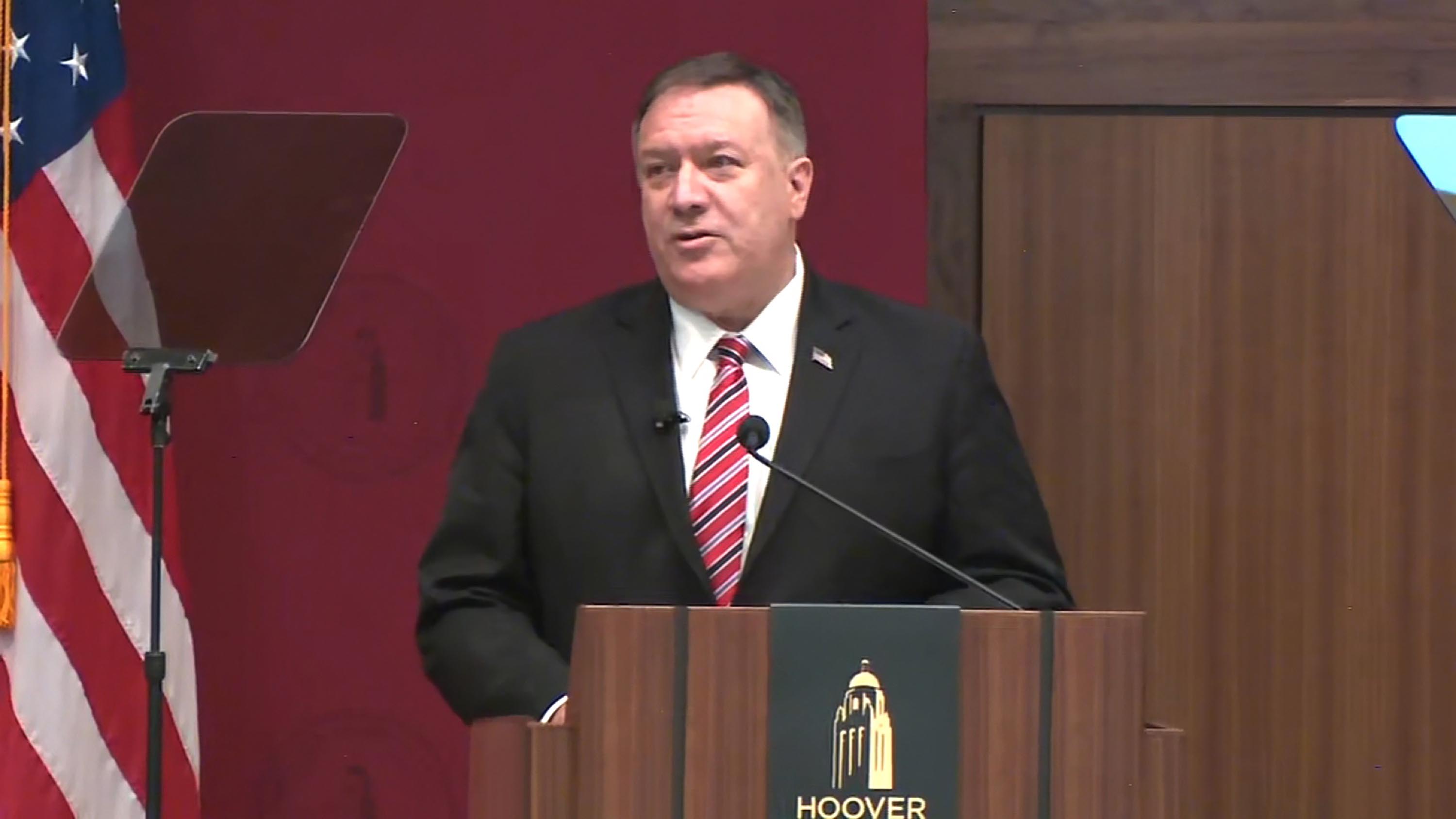
Although he did not mention “imminent” attacks in his remarks at the Hoover Institution today, Secretary of State Mike Pompeo did reference such attacks during the Q&A portion of the event. Responding to a question about why the American people should trust the intelligence about the reported “imminent” threats from Qasem Soleimani, Pompeo said, “There was in fact a set of imminent attacks that were being plotted by Qasem Soleimani.”  “It was unmistakable,” he said. Pompeo said the intelligence community’s view was “that the risks were real and growing and that the actions that we took that day reduced that risk. It never eliminates it. But it reduced that risk.” However, Pompeo, a former CIA director, told the audience that “the intelligence community makes mistakes, all the time.”

“Right? It happens. But the depth and breadth and intellect, the capacity and reach of America’s intelligence capability is enormous. And they do their level best to present this accurately,” he said. “I can say to the American people, you should have enormous confidence in the intelligence community, that their efforts are genuine, they are real, they are authentic, they are trying to provide good data sets to, now I’m on the other side, as the policy adviser for the president, receiving this intelligence, informing our decision-making.”

Iraqi Prime Minister’s office says there is “no agreement with the US” to keep troops in Iraq

Iraq has no agreement to keep US troops in Iraq to continue the fight against ISIS, the Iraqi Prime Minister’s office spokesman William Warda said today. Warda told CNN the Iraqi government would back the Iraqi Parliament’s Jan. 5 vote to expel American troops from the country, in response to a Turkish official saying otherwise in an interview with CNN on Monday.  Earlier today, İbrahim Kalın, a spokesman for the Turkish president, said, “Although the Iraqi parliament passed an recommendary resolution, I think they [the US and Iraq] have or they are about to reach an agreement to continue the fight against ISIS.” Warda said, “Until this moment, the Iraqi government is committed to implement the Iraqi Parliament decision, which states that all foreign troops should withdraw from Iraq. Foreign troops does not mean only American troops but all other foreign troops presence in Iraq.” He added, “There is no agreement with the US administration on keeping the troops and the government is on the track to implement the decision of the Iraqi parliament.”

U.S. coal-fired power plants closing fast despite Trump’s pledge of support for industry

SUCKER:

(Reuters) – U.S. coal-fired power plants shut down at the second-fastest pace on record in 2019, despite President Donald Trump’s efforts to prop up the industry, according to data from the federal government and Thomson Reuters. Power companies retired or converted roughly 15,100 megawatts (MW) of coal-fired electricity generation, enough to power about 15 million homes, according to the data, which included preliminary statistics from the Energy Information Administration and Reuters reporting. That was second only to the record 19,300 MW shut in 2015 during President Barack Obama’s administration. The replacement of coal with power generation from natural gas and renewables has cut total U.S. carbon emissions in four of the past five years. Gas emits about half the carbon dioxide, a leading contributor to global warming, as coal. The coal industry has been in steep decline for a decade due to competition from cheap and abundant gas and subsidized solar and wind energy, along with rising public concern over coal’s contribution to climate change. Trump has downplayed climate change threats and sought to revive the coal industry to fulfill pledges to voters in coal mining states like West Virginia and Wyoming, mainly by rolling back Obama-era environmental protections. Still, since entering office in 2017, an estimated 39,000 MW of coal-fired power plant capacity has shut. If that trend continues, more coal plants will have shut during the first four years (2017-2020) of the Trump administration – an estimated 46,600 MW – than during Obama’s second term (2013-2016) – around 43,100 MW. Last week, Tri-State Generation and Transmission announced it would accelerate the retirement of two of its coal-fired power plants in Colorado and New Mexico as both states pursue ambitious targets to slash carbon emissions. In 2019, U.S. emissions linked to climate change fell 2.1% as coal-fired electricity output dropped 18% to the lowest level since 1975, according to an estimate by independent researcher Rhodium Group. But Rhodium said further big emissions reductions from coal retirements would be harder to achieve because many of the remaining facilities are commercially competitive. Nick Note: Do I not seem to recall that TRUMP was going to make COAL great again. Can you believe those assholes believed him….. Well you get what you pay for. The stupids are rising up they are taking your money… Soon they will come for you and kill you . you have been warned! This will be much worse then a zombie apocalypse

The real price of Occidental’s ‘costless’ oil hedge is it will cost them EVERTHING

WHAT THE FUCK WERE THEY Thinking>>>>> Biggest oil company hedge ever….. WIPE OUT!


(Reuters) – In just 12 days, Occidental Petroleum Corp pulled off one of the biggest hedges against falling oil prices ever placed by a U.S. energy company. It characterized the transaction as “costless” but a Reuters review of regulatory filings, market data and interviews shows that’s not the whole story. The aim of the complex financial maneuver, the company said, was to help preserve Occidental’s generous dividend to shareholders as it sought to take over rival Anadarko Petroleum for $38 billion last summer in the biggest industry deal for years. “With the additional leverage from the Anadarko acquisition, these new hedges will strengthen our 2020 cash flow in a low oil price environment, and provide additional assurance that our dividend is safe, while we are deleveraging,” Occidental’s Chief Financial Officer Cedric Burgher told an earnings call in August. However, to secure the hedge swiftly and discreetly and to avoid paying its bankers a fee for arranging it, the company took a bigger potential hit to future revenues with only limited protection against falling oil prices, according to a source with direct knowledge of the transaction. While Occidental disclosed the financial details of the hedge in filings, fulfilling its regulatory obligations, the fact that the company took on the additional risk to secure the transaction fast and to avoid banker fees has not been previously reported.

Occidental declined to comment for this story.

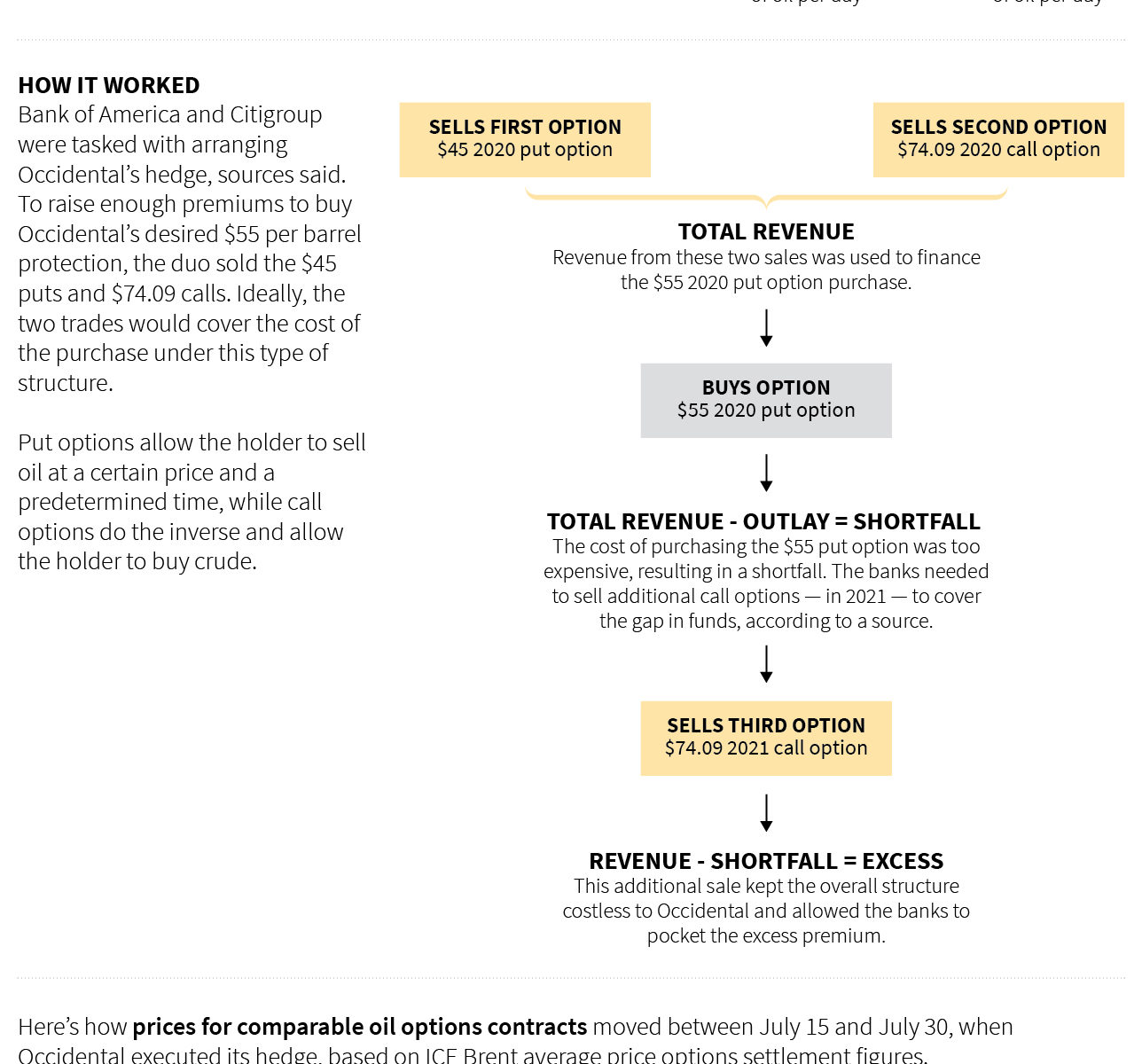
Occidental used a complex series of transactions for its hedge, which was arranged by Bank of America Merrill Lynch and Citigroup, according to six sources with direct knowledge of the trades. The summer hedge covered nearly 110 million barrels of oil, or 300,000 barrels a day, each for 2020 and 2021, nearly enough to meet the annual oil imports of Australia.

Bank of America Merrill Lynch and Citigroup declined to comment.

The hedge meant the firm could sell the oil at a minimum of $55 a barrel in 2020, even if crude prices fell below that, to a limit of $45 a barrel; but the company’s selling price was capped at $74.09, and it would lose out on any revenue earned from oil prices rising beyond that mark.

Occidental capped revenues for 2020 and also 2021 but only got downside protection for 2020

a lopsided deal sometimes referred to as a naked hedge. Limiting future revenue without getting a guarantee against falling prices is unusual in the energy sector. While Occidental has disclosed the details of the 2020 hedge in regulatory filings, the absence of a hedge against falling oil prices in 2021 was not explicitly mentioned. The company said the 2021 options were meant to increase the maximum selling price it would receive for 2020 sales.

“Occidental entered into the 2021 call options to substantially improve the ceiling price that the Company will receive for the contracted commodity volumes in 2020,” it said in a filing.

Some analysts said investors should have been given more information about the potential implications of the hedge.

“It seems very strange that they left a naked hedge in 2021 which capped upside but offered no downside protection,” said David Katz, president and CIO of Matrix Asset Advisors, which owns 0.3% of Occidental’s shares.

However, other analysts said Occidental needed to secure a hedge quickly to defuse some of the pressure from investors.“Doing this gives Oxy a lot of flexibility in 2020 with cash flow,” said Trisha Curtis, President of PetroNerds, an energy analytics and advisory firm specializing in U.S. shale. “You can’t have an acquisition that big and then willy-nilly hope that oil prices hold up. Regardless of what it cost them, it was needed for a number of reasons.” Nick Note: nI essence they bet the company… Stupid. In essence they  get minimal protecton from falling oil price this year and are betting on BIG increases in price next year that will NEVER HAPPEN!  They have wiped out the company…..

Video of Moment Missile Fired at Doomed Ukrainian Plane Released

On Saturday, the Iranian Guards Corps Troops announced they had taken down Ukraine International Airlines Boeing 737 plane en route from Tehran to Kiev, mistaking it for a missile. At the same time Ukrainian authorities have called on Iran to take full responsibility for the incident that claimed 176 lives. A new video allegedly showing a moment the missile that hit a Ukrainian airliner was launched has been making round on the internet. Posted by Foreign affairs editor of Walla News, Guy Elster, the footage shows what seems to be a missile firing that is filmed during the night at a parking lot. Mere seconds after the launch, the night sky gets flashed. Ukrainian Airlines Boeing 737-800 bound to Kiev crashed soon after it took off in Tehran airport on Wednesday morning. The catastrophe left no one from 176 people aboard the aircraft alive. Among initial versions of the incident were technical malfunction and collision with a flying object. However, on Saturday the commander of the Aerospace Force of the Islamic Revolutionary Guard Corps, Amir Ali Hajizadeh announced that the plane was downed bu Iranian military after it had been “mistaken” for a cruise missile. Nick Note: A cruise missile my ass NOT POSSIBLE. The radar center on the SAM located near the airport knows the difference between a Jetliner and a cruise missile a fraction of the size. Besides the jetliner was a regularly sqeudialed flight and its transponder was squeaking its altitude, direction, flight number, heading indicating its direction (away from any targets) and Altitude The fact it was climbing into the radar envelope. Cruse missiles hug the ground especially as they get close to their targets., This was not a accident. But a take down of escaping agents involved in the assignation of Qassem Soleimani. The people who died in the downed jet liner were being evacuated. Their cover blown. These were the people that provided the intelligence that Iran was targeting 4 US embassies. AND they gave the travel planes that were top secret of the date and time General Soleimani was to land at Baghdad airport. With out that inside information the assignation would not have been possible. Thats OK the powers that be want to make you stupid

US troops knew Al-Asad air base would be attacked and sheltered in bunkers, exclusive tour reveals

Al-Asad, Iraq (CNN)United States troops at the Al-Asad air base in Iraq were aware that an Iranian attack was imminent, allowing them to take shelter two-and-a-half-hours before missiles struck on Wednesday, CNN has been told during an exclusive tour of the devastated site. Most troops were either flown out of the base or sheltering in bunkers by 11:00 p.m. local time Tuesday — shortly before the first of four volleys of missiles began at just after 1:30 a.m. on Wednesday, officers said during the first tour by journalists of the air base.

A bunker at Al-Asad air base where US personnel sheltered.
A bunker at Al-Asad air base where US personnel sheltered…… You need one of these!… Simple and cheap to make… Especially since you will be nuked,,,someday. Not real soon.
The attack lasted around two hours, only targeting the US areas of the air base, which comprise around a quarter of the Iraqi base. Officers called it a “miracle” that there were no casualties at the blasted site, with missiles landing just a few meters from bunkers, and some essential personnel remaining outside throughout. It is the first time troops at the base have spoken in detail of the moments before the attack, revealing that they were able to seek shelter in bunkers shortly before missiles struck. US troops knew there was going to be an attack on their base — they just didn’t know what the nature of the attack would be.
The ruined remains of the living quarters where soldiers were evacuated.

Lieutenant Colonel Staci Colemsan said it was a "miracle" there were no casualties.

The Al-Asad air base, which houses US troops, is one of the largest and oldest military bases in Iraq.
It is located in Anbar province, a hotbed of ISIS activity in western Iraq between 2014 and 2017. Anbar was the birthplace of Sunni extremism in the aftermath of the US invasion of Iraq in 2003.
In December 2018, Trump visited troops at Al-Asad. “We came in, we felt very safe coming in. It was a pretty difficult journey in certain ways, but we felt very, very good, very safe,” Trump said, according to a White House transcript. Nick Note: For a FACT this  “attack” was a staged even. The fix was in. I have seen this a few times… Strickley for public consumption,,,,,,,,