The United Arab Emirates (UAE) is pushing for a multinational force to secure and reopen the Strait of Hormuz, the Financial Times reported on Friday, citing three people familiar with the matter. Officials said Abu Dhabi is urging allies, including the United States, to form a broad coalition to escort vessels and ensure safe passage, with the UAE ready to contribute its navy. “The focus is on creating as broad an international force as possible,” a source said, adding that the goal is not escalation but restoring global trade flows. The country is also working with Bahrain on a United Nations Security Council resolution to provide the mission with a mandate, though Russia and China could oppose the move, according to one of the sources. Meanwhile, Gulf states and Washington increasingly see naval escorts as necessary, while the White House said there is no timeline for tanker traffic.
Oil jumps over 5% after Trump’s comments on Iran
Crude oil prices continued to grow on Thursday, rising by more than 5% after United States President Donald Trump said that his country may not be “willing” to make a deal with Iran anymore, even though they are “begging” for one. He also noted that Washington has other targets it wants to hit in Iran “before leaving,” and that seizing the Middle Eastern country’s oil is “an option.” The US president’s comments followed reports that Iran sent their official response to the American 15-point peace plan to Washington through intermediaries, and that Tehran views Trump’s five-day deadline for reaching a deal as “a new Trump deception.”
West Texas Intermediate (WTI) for May’s deliveries jumped by 5.4% to go for $95.20 per barrel at 12:33 pm ET. Meanwhile, Brent for the same month’s settlements soared by 6.51% and went for $108.87 per barrel at 12:33 pm ET.
Blackrock Oil may still spike to $150 a barrel
BlackRock Inc. President Rob Kapito said investors may be underestimating the risks stemming from the Iran war, which are likely to weigh on growth and drive inflation higher even if the conflict ends soon. Growth could be hit by as much as two percentage points, while inflation may rise by a similar margin even if the war ends shortly, warned Kapito at the Asia Pacific Financial and Innovation Symposium in Melbourne on Thursday.
Oil may still spike to $150 a barrel even “if we announce tomorrow the war is over,” as it would take time for disrupted supply chains to return to full capacity.
“What if this disruption is a week, six months, a year — what is it going to mean for the companies that I own?” Kapito said. “My biggest concern is that people aren’t looking at this – they’re just making the assumption” for an optimistic outcome. The S&P 500 index of US stocks has fallen less than 5% since the war began almost a month ago, while some defensive trades have misfired. Gold has fallen almost 15%, and Treasuries — which typically offer portfolio ballast — have declined as rising oil prices trigger inflation concerns.
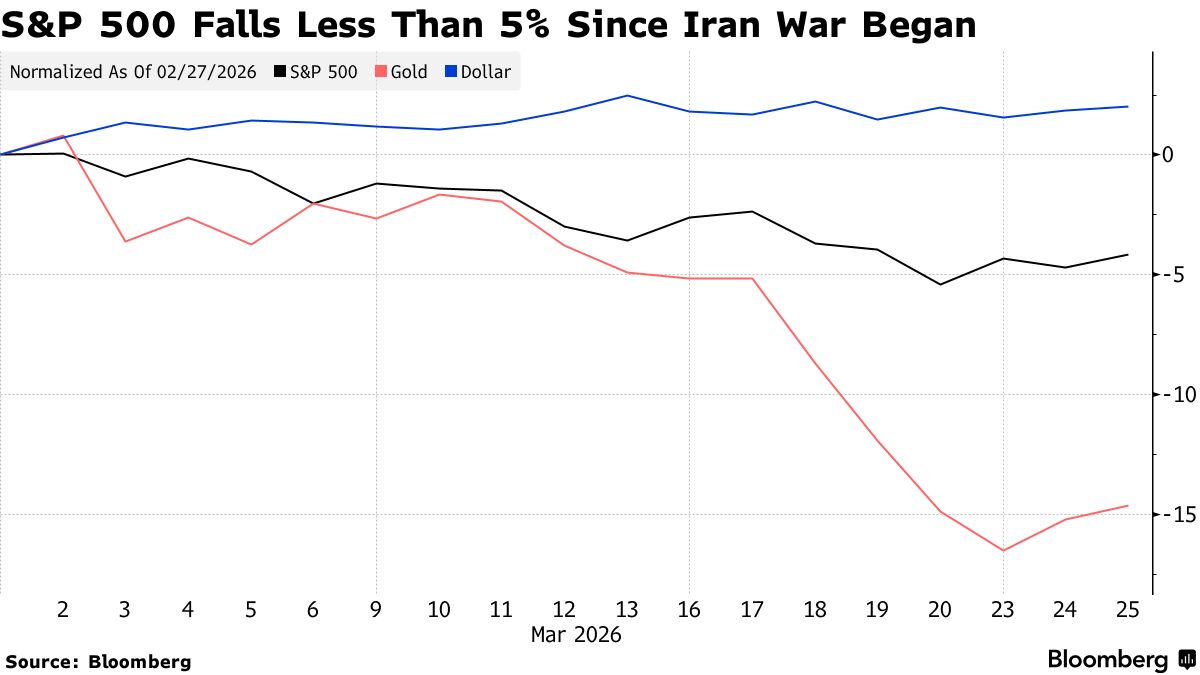
In the past, “when there was a conflict like this, you bought short-term Treasuries, you bought gold and you shorted the equity market,” Kapito said, highlighting the uneven market response to the war. At the same event in Melbourne, Apollo Global Management’s President Jim Zelter also cautioned about a heightened risk of a US recession and to the credit cycle from a prolonged conflict. The warnings highlight growing concern that markets are too complacent about the economic fallout from the conflict, particularly the potential for prolonged disruptions to energy and shipping that may ripple across global supply chains. Zelter said US consumers who have been a bulwark of the economy for the last few years are already showing signs of distress. Consumer confidence in the first two months of the year had been waning, and higher oil prices will cause further pain to their pockets, he added. “It’s not really a rates shock, it’s a confidence shock on spending in the largest economy in the world,” Zelter said. Despite the prospect of slower growth and higher inflation linked to the war, Kapito said he remains upbeat over the long term, citing themes such as AI and the rise of private markets as key tailwinds for investors.
Trump says Iran must get serious on deal
United States President Donald Trump said on Thursday that Iranian negotiators were “begging” for a deal with Washington. In a post on Truth Social, Trump described the Iranian side as “very different” and “strange”.
“They better get serious soon, before it is too late, because once that happens, there is NO TURNING BACK, and it won’t be pretty,” he added.
The remarks came as reports emerged that the United States was considering other military options, further pressuring the talks.
US said to review more Iran war options, including bombing
The United States Department of Defense is discussing new options for dealing the “final blow” to Iran, including deploying ground forces there and launching a high-pressure bombing campaign, Axios reported on Thursday. According to two US officials and two other sources familiar with the matter, such moves will become more likely if the latest effort to have Washington and Tehran negotiate fails. US President Donald Trump insisted that the talks are ongoing on the proposed 15-point plan for Iran’s nuclear status, while the other side dismissed such claims. Trump later said that the Iranian leadership is “afraid to say it because they figure they’ll be killed by their own people.” The outlet’s sources now said that potential options for intensifying pressure on Iran were discussed during a Zoom meeting. However, they pointed out that all the prospects are still “hypothetical” and that Trump has not decided on going for either of them yet.

NN: Shit I can’t decide lets do all 4
Gold down 2%, silver dips 3%
The price of precious metals fell on Thursday as investors awaited clearer evidence of progress in efforts to ease tensions in the Middle East. Financial markets remained uneasy due to conflicting statements from the US and Iran over possible peace negotiations. Washington claimed Iran was desperate to reach an agreement, while ordering the deployment of thousands of troops to the Middle East, contradicting the Iranian foreign minister, who claimed his country had no intention of holding talks to end the conflict and instead set its own conditions, including sovereign control over the Strait of Hormuz.
Gold lost 2% at 7:15 am CET, going for $4,416.14 per ounce, while silver fell by 3.01% and went for $69.13 per ounce a minute later. Platinum dropped by 1.09% at 7:16 am CET to go for $1,918.74 per ounce, while palladium lost 0.76% to sell for $1,398.57 per ounce.
NN: I sure hope you get in on our great precious metals short trade
Oil up 2% as war de-escalation hopes fade
Crude oil prices rose on Thursday amid conflicting signals and fading hopes of de-escalation in the Middle East conflict, following Iran’s dismissal of US President Donald Trump’s claim that the sides were holding talks to end the conflict.
West Texas Intermediate (WTI) for settlements in May climbed by 2.21% to go for $92.27 per barrel at 2:28 am ET. Meanwhile, Brent for the same month’s deliveries advanced by 2.27% and went for $104.39 per barrel at 2:27 am ET.
Iran Rejects Ceasefire Proposal, Calls US Talks ‘Illogical’
- Iran rejected a ceasefire proposal and called US talks “illogical,” according to the nation’s semi-official news agency Fars
- The US had tabled a 15-point plan which covers sanctions relief, civilian nuclear cooperation, a rollback of Iran’s nuclear program, missile limits and access for shipping through the Strait of Hormuz, according to AP
- Iran has kept up attacks on Arab Gulf states and Israel overnight, with were no reports of casualties in any of the incidents
- Vessels seeking to transit the Strait of Hormuz under Iranian protection are being asked to provide lists of crew and cargo, along with voyage details and bills of lading
- Oil prices slumped, with Brent crude below $100 a barrel. It remains on track for a substantial monthly surge
Oil down by 3% on Middle East ceasefire “HOPES…. IRGC says US is ‘negotiating with itself'”…
The prices of oil futures sank by more than 3% on Wednesday after it was reported that the United States would soon propose a plan for a one-month ceasefire with Iran. Meanwhile, US President Donald Trump claimed that Iran had agreed not to work on a nuclear weapon. He also insisted on his country’s and Israel’s victory in the conflict in the Middle East. West Texas Intermediate (WTI) for deliveries in May decreased by 3.29% at 3:02 am ET to $89.3 per barrel. Meanwhile, Brent for the same month’s settlements declined by 3.72% to $100.6 per barrel, having slid by almost 4% moments earlier
NN: Their is no deal and IF they get a deal it will be a joke. And if when they open the straights wells and refineries are so damaged product will be limited
Iran’s Islamic Revolutionary Guard Corps (IRGC) declared on Wednesday that the United States is “negotiating with itself,” following US President Donald Trump’s previous remarks. “There will be no news of your investments in the region, nor will you see the previous prices of energy and oil, until you understand: stability in the region is guaranteed by the powerful hand of our armed forces. Stability through power,” a spokesperson for the IRGC’s Khatam al-Anbiya Central Headquarters addressed Washington directly in a video message. Furthermore, the IRGC told the US not to call its “failure an agreement” and claimed that until its objectives are fulfilled, the current situation in the region will not return to “the previous order.”
“No one like us will come to terms with anyone like you. Not now, not ever,” the spokesperson rebutted
QatarEnergy Missile Strikes May Cause $100B Revenue Loss
In a statement posted on its website recently, QatarEnergy said it expects the damage to its Ras Laffan Industrial City caused by missile strikes to cost about $20 billion a year in lost revenue and to take up to five years to repair. The company – which highlighted that the strikes occurred on March 18 and March 19 – outlined that the damage will impact supply to markets in Europe and Asia. The attacks damaged two liquefied natural gas (LNG) producing trains – Trains 4 and 6 – totaling 12.8 million tons per annum (MTPA) of production, according to the statement, which pointed out that this represents approximately 17 percent of Qatar’s exports. QatarEnergy noted that Train 4 is a joint venture between QatarEnergy, which holds a 66 percent stake, and ExxonMobil, which holds a 34 percent interest, and that Train 6 is a joint venture between QatarEnergy, which holds a 70 percent stake, and ExxonMobil, which holds a 30 percent interest. The attacks also targeted the Pearl GTL (Gas-to-Liquids) facility, according to the statement, which stated that this is a production sharing agreement operated by Shell that converts natural gas into high-quality cleaner burning drop-in fuels and produces base oils used to make premium engine oils and lubricants, and paraffins and waxes. QatarEnergy outlined in its statement that there will be a loss of associated product production due to the outage as follows:
• Condensates: 18.6 million barrels, which the company said is around 24 percent of Qatar’s exports.
• LPG: 1.281 million tons, which QatarEnergy highlighted is around 13 percent of Qatar’s exports.
• Naphtha: 0.594 million tons, which is around six percent of Qatar’s exports, according to the company.
• Sulfur: 0.18 million tons, which is around six percent of Qatar’s exports, QatarEnergy pointed out.
• Helium: 309.54 MCFA, which the company said is around 14 percent of Qatar’s exports.
Saad Sherida Al-Kaabi – the Minister of State for Energy Affairs, and the President and CEO of QatarEnergy – revealed in the statement that no one was injured by the strikes, which he described as not “just an attack on the State of Qatar but attacks on global energy security and stability”. “This was an attack on all of us who stand for development and human progress that is sustained by a fair, reliable, and secure access to energy,” he added.“The damage sustained by the LNG facilities will take between three to five years to repair.