Roughly half of all U.S. workers stand to earn more in unemployment benefits than they did at their jobs before the coronavirus pandemic shut down swaths of the U.S. economy, a result of government relief that employers say is complicating plans to reopen businesses. The package of coronavirus stimulus laws Congress passed and President Trump signed in March included a $600 boost to weekly unemployment benefits through July 31. As that support is added to state benefits over the coming weeks, the average weekly payment to a laid-off worker should rise to about $978 from the nearly $378 the Labor Department said was paid on average late last year. Qualified workers will receive the government payout every week through July, and in most cases, the combined $978 weekly payout amounts to better pay than what many workers received before the crisis hit. Labor Department statistics show half of full-time workers earned $957 or less each week in the first quarter of 2020. The stimulus measure means that in coming months many low-wage workers will avoid both significant harm to their finances and the potential health risks—and further virus spread—of returning to crowded workplaces. That money in consumers’ pockets in turn puts the U.S. economy on firmer footing to rebound once authorities allow businesses to reopen. Figures on prior earnings of the more than 26 million Americans who sought unemployment benefits from March 15 through April 18 aren’t yet available, but the initial wave of job losses were concentrated among restaurant, hospitality and retail workers, whose median hourly pay is less than the minimum now paid under enhanced unemployment benefits. The $600 bonus payment was intended to make sure the average worker had full wage replacement in the months following mass layoffs caused by the pandemic. Last year, states’ unemployment benefits replaced about 45% of laid-off workers’ wages, according to the National Employment Law Project, which advocates for low-wage workers. Congress opted for a flat amount because decades-old technology underpinning state unemployment systems didn’t allow for payments to be calibrated to each worker’s lost wages. “If we waited for the systems to be set for 100% wage replacement, the payments wouldn’t go out until June,” said Michele Evermore, a NELP senior policy analyst. She added that under the existing system, many laid-off workers waited weeks to have their unemployment claims processed and some still are waiting for the enhanced payments. The $600 payment aligns with working full time at $15 an hour—the minimum-wage level many Democrats in Congress support. The federal minimum wage—followed by 21 states—is $7.25 an hour and has been unchanged for a decade. Restaurant and front-end retail workers in those states, including Texas and Georgia, are likely to receive more in benefits than from their jobs. Nick Note: For the record the masses are sitting fat and sassy. they are chomping at the bit to spend their happy checks. They have no rent to pay, their mortgage payments are suspended. The charge card companies are letting them delay payments same thing with car payments even the damn internet company is letting them off the hook. And the limit on their credit card has been lifted. Banks and lenders are chockablock full of cash to loan out in vast amounts on any fool thing. GENTLEMAN START YOUR SPENDING SPREE!
Self Employed? Step-by-Step Guide to Free Stimulus Money (4 Ways)
Many of you have a LLP or a sub S corporation or are 1099 earners. You are eligible for happy checks. And n]the loans will be forgiven. SO check this out!
OPEC Sees Oil Rising To $40 In Second Half Of 2020
Oil prices are set to recover with the OPEC+ production cuts and gradual lifting of lockdowns around the world in the second half of 2020, when oil prices “will be $40 starting from the third quarter,” Mohamed Arkab, Energy Minister of OPEC’s rotating president Algeria, said on Sunday. The global economy will not stay paralyzed for too long, and together with the 9.7 million bpd cuts that OPEC and its allies pledged for May and June, these factors are set to lift the price of oil in H2 2020, Arkab told Algeria’s national radio, as quoted by Turkey’s Anadolu Agency. In China, which was hit first by the coronavirus, and which exited the lockdown first, the return to normalization in the transportation sector “is driving up global demand,” according to Algeria’s energy minister. Just a few days before the OPEC+ deal enters into force, oil prices crashed again early on Monday, as the market continues to see the imminent storage shortage problem as a bigger factor for prices than the potential effect of the OPEC+ cuts and the potential easing of the lockdown measures. Last week, OPEC’s fourth-largest producer, Kuwait, said it had already started to reduce crude oil supply to international markets ahead of May 1, “sensing a responsibility responding to market conditions.” Saudi Arabia, OPEC’s top producer and the world’s top oil exporter, has also begun to reduce production earlier, a Saudi industry official with knowledge of the issue told Bloomberg over the weekend. Despite solemn commitments from OPEC+ producers and tentative schedules for reopening economies and easing the lockdowns, including in Italy, oil market participants continue to focus on the imminent threat of global storage overflowing rather than on the effect of the cuts and eased lockdowns two to three months down the road. Nick Note: Brent oil at $40 is a doubling in price. I believe we will get that and more try $50 Brent by year end.
Fauci: ‘Bad fall’ in US if virus treatment not found
Director of the National Institute of Allergy and Infectious Diseases Dr. Anthony Fauci stated on Tuesday that the United States may encounter an unfavorable situation during the fall months if an effective treatment for the novel coronavirus isn’t discovered by then. Speaking in an interview with The Economic Club of Washington, DC, Fauci stressed that the disease will not simply vanish, adding that he thinks “it’s inevitable that we will have a return of the virus” if it even disappears at some point, as cited by CNBC. The states should not restart its local economy and businesses too early as it could cause the reemergence of the same problems the country has been having over the past several weeks, Fauci underlined. Nick Note: I promised you their will be a “vaccine” before the elections. See radio Free Wall Street posted today for the inside skinny
Trump to sign executive order to address food supply liability
https://youtu.be/W4I1Ot00d00
President Donald Trump plans to order meat-processing plants to remain open, declaring them critical infrastructure as the nation confronts growing disruptions to the food supply from the coronavirus outbreak, a person familiar with the matter said. Trump plans to use the Defense Production Act to order the companies to stay open during the pandemic, and the government will provide additional protective gear for employees as well as guidance, according to the person. Nick Note: the restaurants will open, steaks will be sizzling on the barbe. And the blood will flow from the slaughter houses. Get you head rapped around the fact its over for now!
Trump signaled the executive action at the White House on Tuesday, saying he planned to sign an order aimed at Tyson Foods Inc.’s liability, which had become “a road block” for the company. He didn’t elaborate.
The order, though, will not be limited to Tyson, the person said. It will affect many processing plants supplying beef, chicken, eggs and pork.
Trump’s order sets the stage for a showdown between America’s meat giants, who’ve been pressing to reopen plants hit by mass outbreaks, and local officials and labor unions who’ve called for closures and are trying to prevent the virus from spreading. The president himself has long agitated for Americans to return to work and restore a U.S. economy crippled by social distancing measures.
The White House decided to make the move amid estimates that as much as 80% of U.S. meat production capacity could shut down. Meat stocks rose on the news.
‘Breaking’ Supply Chain
Tyson Foods extended gains, jumping as much as 5.6% for the biggest intraday advance in three weeks. Hormel Foods Corp. rose 1%, while JBS SA’s
American depositary receipts climbed 4.6%.
On Sunday, Tyson Foods Chairman John Tyson said in a blog post that the U.S. food supply chain “is breaking,” with millions of pounds of meat set to “disappear” as plants close.
Illnesses in the meat-processing industry and shifts in demand after restaurants closed have disrupted the supply chain. Dairy farmers are dumping milk that can’t be sold to processors, broiler operations have been breaking eggs to reduce supplies and some fruit and vegetables are rotting in fields amid labor and distribution disruptions.
Many low-income Americans, meanwhile, have been waiting in long lines at food banks, which have reported shortages.
Asked about the country’s food supply, Trump said: “There’s plenty of supply.”
The Defense Production Act allows the government broad power to direct industrial production in crises. Trump has previously invoked the law — or threatened to invoke it — in order to increase the supply of medical gear including ventilators, masks and swabs to test for coronavirus infection.
The White House has been discussing the order with meatpacking executives to determine what they need to operate safely and stay open, in order to prevent shortages, the person said. White House General Counsel Pat Cipollone worked with private companies to design a federal mandate to keep the plants open and to provide them additional virus testing capacity as well as protective gear.
Trump acted one day after Iowa’s two U.S. senators and its governor urged the administration to invoke the DPA to keep meatpackers open and reopen closed facilities “as soon as it is possible to do so safely.” Iowa produces one-third of the nation’s pork supply, according to the state officials.
The officials also asked for federal assistance in euthanizing pigs and reimbursing hog farmers for their losses due to closures of processing facilities.
Sick Workers
Across the country, at least 6,500 meat processing employees have been impacted by the virus, meaning they either tested positive for the disease or had to go into self-quarantine, according to the United Food and Commercial Workers Union, the largest private-sector union. Twenty workers have died.
At least 22 meat plants have closed within the past two months, reducing pork processing capacity by 25% and beef processing capacity by 10%, according to UFCW. Farmers have animals with nowhere to go as a result, and the situation is so dire that the U.S. Department of Agriculture is setting up a center to help growers with “depopulation and disposal methods” for animals.
Experts have warned the U.S. could be just weeks away from fresh meat shortages. While inventories can provide some cushion, stockpiles are limited.
Total American meat supplies in cold-storage facilities are equal to roughly two weeks of production. With most plant shutdowns lasting about 14 days for safety reasons, that further underscores the potential for deficits.
And the shutdowns are happening at a time when global meat supplies were already tight. China, the world’s top hog producer, has been battling an outbreak of African swine fever, which destroyed millions of the country’s pigs.
— With assistance by Mike Dorning
(Updates with additional information beginning in fourth paragraph)
Oil Slides After Crude ETFs Move Into Later-Dated Contracts
(Bloomberg) — Oil fell after the biggest oil ETF said it would sell out of its June WTI futures position as physical oil storage levels continue to balloon. Futures in New York slid as much as 30%, snapping a four-day recovery as the United States Oil Fund LP said it will move all the money it invested in the front-month June WTI oil contract starting today, triggering a massive swing in the price relationship between the June and July contracts. At the same time, the global oil market is on track to test storage capacity limits in as little as three weeks, requiring the shut-in of nearly 20% of global production, according to Goldman Sachs Group Inc. “Some of this downward pressure particularly in the June contract is an increasing lack of liquidity,” said John Kilduff, a partner at hedge fund Again Capital LLC. This is not coming only from the USO, but also due to brokerage firms, like Marex Spectron and TD Ameritrade, restricting client’s abilities to add new positions to certain crude contracts, according to Kilduff. “It’s going to exacerbate the whole marrying of the June contract with the over supplied physical conditions and the lack of storage,” Kilduff said. While U.S. drilling is sliding and Saudi Arabia has started reducing output ahead of the start date for OPEC+ supply cuts, an immense surplus of oil means storage tanks are close to capacity around the world. OPEC+ expressed frustration by the lack of oil cuts by other nations. Equatorial Guinean Oil Minister Gabriel Obiang Lima said on a conference call that producers such as the U.S., Mexico and Norway need to chip in with supply cuts. In order to avoid Cushing storage from becoming over 90% full in May and June, total production shut-ins would have to equate to 1 million barrels a day in May, according to a JPMorgan Chase & Co. note. A further 500,000 barrels a day of shut-ins may be needed in June as well, the report said. South Korea, which holds the fourth-biggest commercial storage capacity in Asia, was said to have run out of onshore space. Singapore’s coastline has become even more congested as the number of oil-laden tankers anchored offshore wait to be redirected to a willing buyer. Some vessels are being used to hoard fuel at sea as onshore tanks fill up. At least three tankers from Baltic and Black Sea ports with a combined 280,000 tons of Urals is heading to Malaysia, likely for storage, according to ship tracking data compiled by Bloomberg. With a number of producers commencing output cuts, some of the huge discounts seen in physical markets have eased, particularly in Europe. Swaps markets in the North Sea and Russia were trading stronger last week, though there’s still plenty of cause for pessimism. On a global level, the swelling glut is set to test storage capacity limits in as little as three weeks, according to Goldman Sachs Group Inc., with traders, refiners and infrastructure providers seeking novel ways to hoard crude, including on tiny barges around Europe’s petroleum-trading hub, and in pipelines. There were tentative signs at the weekend that the coronavirus outbreak might be loosening its grip, with death tolls slowing by the most in more than a month in Spain, Italy and France. Reported fatalities in the U.K. and New York were the lowest since the end of March. Nick Note: AH yes dancing the cotango tango is a dangerous game. But its what we do. Right now its their turn at the switch and they are beating up on the spot contract. Let them enjoy their party for….now. All that has to happen is the Department of Energy open up the salt domes in Louisiana for oil storage and the tango becomes a Bango as in bang their balls against the solid wall of the contango. wait watch and see. To many votes in the oil patch and junk bond funds for Trump to ignore their cries of pain. And lets suppose the Trump administration does nothing. The glut disappears as frackers 5 million barrel a day largess turns to shit as the fracked wells are played out and their is no more money to frack around the clock like in the good ole days!
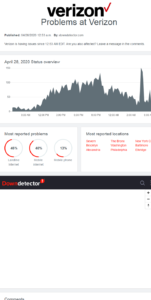
Verizon Troubles….. Again
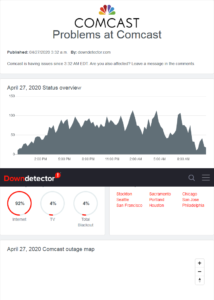
Comcast Service is spotty on both coasts
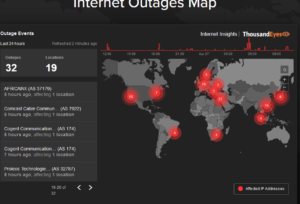
Comcast outages coast to coast
Russia Cuts European Sea Ports Oil Exports To 20-Year-Low
Russia is preparing to significantly reduce the oil supply to the market from its Baltic and Black Sea ports—to the lowest in two decades in May when the OPEC+ production cut deal begins, Reuters reported on Friday, quoting a preliminary loading schedule it has seen. Russian seaborne oil exports from the port of Novorossiysk on the Black Sea and the Baltic ports Primorsk and Ust-Luga are set to drop next month by 43 percent on a daily basis compared to the oil export levels in April, according to Reuters estimates.
As part of the new OPEC+ deal, Russia has pledged to cut its production in May and June to 8.5 million bpd—or by 2.5 million bpd from a baseline level of 11 million bpd. These would be the largest cuts that Russia will ever attempt to make as part of the OPEC+ group.
In the previous deals, Russia hasn’t fully complied with its quotas, attributing non-compliance to weather, complex geology, or the fact that condensate was considered (until December) as part of its oil production. While Russia is likely to struggle to hit that reduction target, the slashed exports from the European seaports suggest that Moscow will be limiting the oil supply to international markets at a time when global inventories of crude and gasoline threaten to overflow amid the massive demand collapse in the pandemic. Exports of Russia’s key export blend Urals are expected to slump to the lowest level since at least the early 2000s, according to data from Refinitiv Eikon, cited by Reuters. Production of crude oil and condensate in Russia has been unchanged so far in April compared to March. According to data from the Russian energy ministry, seen by Bloomberg, Russia’s crude and condensate production averaged 11.289 million bpd between April 1 and 23—a week before Russia is set to reduce its production under the new agreement. In March, Russia produced 11.29 million bpd of crude oil and condensate. Nick Note: Just as the world goes back to work and gentleman start your engines becomes the battle cry. Oil production cuts and well shut ins will bite hard. Get ready to party