Long-dated Treasuries fell on Monday as investor attention turned to the US’ ballooning debt after Moody’s Ratings stripped the nation of its last top credit rating. The 30-year yield increased as much as nine basis points to 5.03%, the highest since November 2023, while the 10-year rate reached 4.56%, approaching last month’s high. Both retreated from those levels and were higher by less than two basis points shortly before midday in New York. The dollar remained weaker against all of its Group-of-10 peers, after the euro surged more than 1% to $1.1288. Moody’s announced Friday it was downgrading the US to Aa1 from Aaa, reinforcing Wall Street’s growing worries over the nation’s fiscal outlook as Capitol Hill debates even more unfunded tax cuts. The company, which trailed rivals, blamed successive presidents and congressional lawmakers for a ballooning budget deficit it said showed little sign of narrowing. “I wouldn’t overemphasize the importance of this downgrade – but it adds to the ‘de-dollarization’ theme that was already in place,” said Jordan Rochester, head of macro strategy for EMEA at Mizuho International Plc.
nn: our beloved zeroes are getting closer by the day
Long-dated Treasuries fell on Monday as investor attention turned to the US’ ballooning debt after Moody’s Ratings stripped the nation of its last top credit rating.
The 30-year yield rose as much as eight basis points to 5.02%, the highest since November 2023. The benchmark 10-year rate climbed seven basis points to 4.55%. The dollar fell against all of its Group-of-10 peers, with the euro surging over 1% to $1.1284.
Moody’s announced Friday evening it was downgrading the US to Aa1 from Aaa, reinforcing Wall Street’s growing worries over the nation’s fiscal outlook as Capitol Hill debates even more unfunded tax cuts. The company, which trailed rivals, blamed successive presidents and congressional lawmakers for a ballooning budget deficit it said showed little sign of narrowing. “I wouldn’t over emphasize the importance of this downgrade – but it adds to the ‘de-dollarization’ theme that was already in place,” said Jordan Rochester, head of macro strategy for EMEA at Mizuho International Plc.
Angst around government spending is likely to remain a focus for investors around the world, with fiscal strains evident in nations from Japan to the UK. Japanese Prime Minister Shigeru Ishiba said the country’s financial conditions are worse than Greece’s on Monday, and even historically austere Germany is set to dramatically ramp up spending. The latest downgrade was anticipated by many given it came when the US federal budget deficit is running near $2 trillion a year, or more than 6% of gross domestic product. The government is also on track to surpass record debt levels set after World War II, reaching 107% of GDP by 2029, the Congressional Budget Office warned in January. “We view this latest credit action as a headline risk rather than a fundamental shift for markets,” said Mark Haefele, chief investment officer at UBS Global Wealth Management. “While the downgrade may lean against some of the recent ‘good news’ momentum, we do not expect it to have a major direct impact on financial markets.” “The synchronized selling of USD, Treasuries and US stocks highlight the growing loss of confidence in the US economy,” Elias Haddad, a currency strategist at Brown Brothers Harriman & Co. wrote in a note. A key US House committee on Sunday advanced Trump’s giant tax and spending package after Republican hardliners won agreement from party leaders to speed up cuts to Medicaid health coverage. Mizuho’s Rochester adds this was also weighing on US Treasuries on Monday.
Moody’s said it expects “federal deficits to widen, reaching nearly 9% of GDP by 2035, up from 6.4% in 2024, driven mainly by increased interest payments on debt, rising entitlement spending, and relatively low revenue generation.”
nn: this is not a big deal…. the dust will settle in a few a days
The Israel Defense Forces (IDF) launched on Sunday Operation Gideon’s Chariots, expanding its ground campaign in Gaza to the northern and southern parts of the strip. “Over the past week, the Air Force launched an opening strike, striking more than 670 Hamas targets across the Gaza Strip in order to disrupt enemy preparations and assist ground operations. Among the targets attacked were weapons depots, terrorists, an underground route, and anti-tank missile launch sites,” the IDF tweeted. “So far, the forces have eliminated dozens of terrorists, destroyed terrorist infrastructure above and below ground, and are now occupying controlled areas in the Gaza Strip.” The announcement came after Israeli Prime Minister Benjamin Netanyahu’s office said that the country’s negotiating team in Doha is “working to exhaust every possibility” for a deal with Hamas, including one that stipulates ending the fights in Gaza.
Mohammed Sinwar’s body likely found in Gaza tunel
The body of the late Hamas leader Mohammed Sinwar was found in a tunnel in Gaza when the Israel Defense Forces (IDF) targeted the city of Khan Younis, Al-Hadath reported on Sunday. Allegedly, the bodies of ten associates of his were also discovered by Sinwar’s. Mohammed Sinwar was the brother of the late Hamas Political Bureau Chairman Yahya Sinwar.
Investors face yet another bumpy start to the trading week, although it’s mounting concern over US debt rather than tariffs likely generating the volatility this time. Financial markets reopen in Asia on Monday after Moody’s Ratings announced Friday evening it was stripping the US government of its top credit rating, dropping the country to Aa1 from Aaa. The company, which trailed rivals, blamed successive presidents and congressional lawmakers for a ballooning budget deficit it said showed little sign of narrowing. The downgrade risks reinforcing Wall Street’s growing worries over the US sovereign bond market as Capitol Hill debates even more unfunded tax cuts and the economy looks set to slow as President Donald Trump upends long-established commercial partnerships and re-negotiate trade deals.In a potential sign of things to come on Monday, 10-year Treasury yields rose as high as 4.49% in thin volumes on Friday and an exchange-traded fund tracking the S&P 500 fell 0.6% post-market. “A Treasury downgrade is unsurprising amid unrelenting unfunded fiscal largesse that’s only set to accelerate,” said Max Gokhman, deputy chief investment officer at Franklin Templeton Investment Solutions. “Debt servicing costs will continue creeping higher as large investors, both sovereign and institutional, start gradually swapping Treasuries for other safe haven assets. This, unfortunately, can create a dangerous bear steepener spiral for US yields, further downward pressure on the greenback, and reduce the attractiveness of US equities.” Michael Schumacher and Angelo Manolatos, strategists at Wells Fargo & Co., told clients in a report that they expect “10 year and 30 year Treasury yields to rise another 5-10 basis points in response to the Moody’s downgrade.” A 10 basis point increase in the 30-year yield would be enough to lift it above 5% to the highest since November 2023 and closer to that year’s peak, when rates reached levels unseen since mid-2007.
While rising yields typically boost a currency, the debt worries may add to skepticism over the dollar. A Bloomberg index of the greenback is already close to its April lows and sentiment among options traders is the most negative in five years.
‘Loss of Confidence’
European Central Bank President Christine Lagarde told La Tribune Dimanche in an interview published on Saturday that the dollar’s recent decline against the euro is counterintuitive but reflects “the uncertainty and loss of confidence in US policies among certain segments of the financial markets.”
Rising Treasury yields would also complicate the government’s ability to cut back by running up its interest payments, while also threatening to weaken the economy by forcing up rates on loans such as mortgages and credit cards.
US Treasury Secretary Scott Bessent downplayed concerns over the US’s government debt and the inflationary impact of tariffs, saying the Trump administration is determined to lower federal spending and grow the economy. Moody’s move was anticipated by many given it came when the federal budget deficit is running near $2 trillion a year, or more than 6% of gross domestic product. The US government is also on track to surpass record debt levels set after World War II, reaching 107% of GDP by 2029, the Congressional Budget Office warned in January. Moody’s said it expects “federal deficits to widen, reaching nearly 9% of GDP by 2035, up from 6.4% in 2024, driven mainly by increased interest payments on debt, rising entitlement spending, and relatively low revenue generation.” “Credit downgrades of the US government have lost political significance after S&P downgraded the US in 2011, and there were limited, if any, repercussions,” said Michael McLean, Anshul Pradhan and Samuel Earl of Barclays.
Coinbase Global said it’s working with law enforcement to track down an unknown “threat actor” that paid its contractors working in support roles for the company outside the U.S. to obtain personal information of its customer base. Coinbase did not say how many of its clients were affected, but it had already informed them about the breach after it detected it months ago and fired the contractors involved. Coinbase said customer passwords and private keys were protected by its systems, and “at no time were any of the targeted contractors or employees able to access customer funds.” However, the affected data included names, home and email addresses, phone numbers, the last four digits of Social Security numbers, masked bank-account numbers and some bank-account identifiers. The breach also included government-ID images such as passports and driver’s licenses, account data such as balance snapshots and transaction history and limited Coinbase corporate data such as documents, training materials and communications to support agents. Coinbase said it plans to open a new support hub in the U.S. as well as take other prevention measures. It estimated expenses of $180 million to $400 million for remediation costs and voluntary customer reimbursements related to the problem, and said the dollar figure could change as it assesses the impact. It did not say if the cost estimates include the price of launching a U.S. service center. “The threat actor appears to have obtained this information by paying multiple contractors or employees working in support roles outside the United States to collect information from internal Coinbase systems to which they had access in order to perform their job responsibilities,” the company said. Coinbase said it has already terminated the personnel involved and “implemented heightened fraud-monitoring protections” in previous months after its security monitoring detected the trouble.
The United States President Donald Trump’s administration is rolling out a plan to relocate up to 1 million Palestinians from the Gaza Strip to Libya, NBC News reported on Friday, citing five people familiar with the plans. According to the report, the US intends to unfreeze billions of dollars of Libyan funds, frozen more than ten years ago, if Libya accepts the relocation of Palestinians. Furthermore, US representatives have already discussed the plans with Libyan officials, but no agreement has been reached yet, two sources told the news agency. Meanwhile, senior Hamas official Basem Naim told NBC that he was not informed of US plans and discussions with Libya. Palestinians “are exclusively the only party who have the right to decide for the Palestinians, including Gaza and Gazans, what to do and what not to do,” he said.
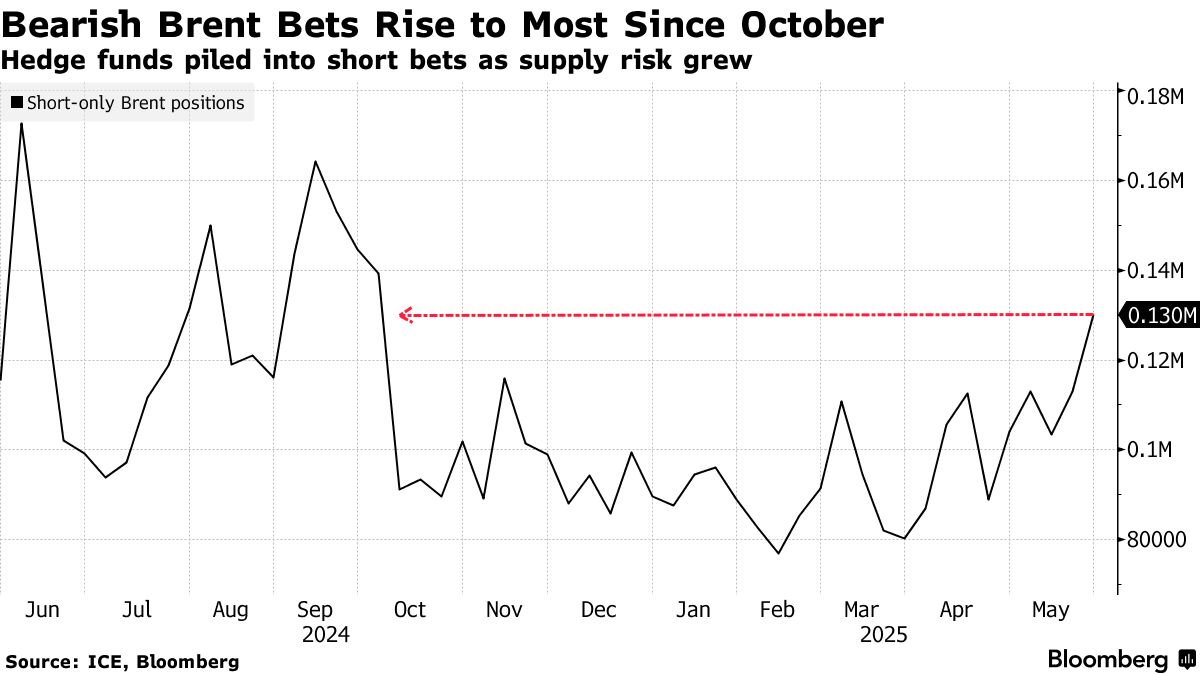
Oil is riding high on the euphoria of not having debilitating tariffs on US imports to China, managed to lift ICE Brent around $65 per barrel towards the end of the week. And the failure of peace talks in the Ukraine and gaze.
Oil prices climbed on optimism over eased U.S.-China trade tensions, with ICE Brent nearing $65 per barrel by week’s end as fears of punishing tariffs faded.
Donald Trump’s comments on a potential Iran nuclear deal have been the defining bearish moment of this week, however inertia from the market’s robust recovery last week, still riding high on the euphoria of not having debilitating tariffs on US imports to China, managed to lift ICE Brent around $65 per barrel towards the end of the week. With the Russia-Ukraine ceasefire negotiations dragging on, next week could see more of the same.
OPEC Pins Hopes on Lower non-OPEC Supply. OPEC kept its 2025 oil demand growth forecast of 1.3 million b/d unchanged in its May monthly report, all the while trimming the outlook of non-OPEC supply growth to 800,000 b/d against the background of lower oil prices, cutting mostly US shale production.
Saudi Aramco Unveils US Investment Bonanza. Saudi Aramco (TADAWUL:2222) announced 34 preliminary deals with US energy companies potentially worth $90 billion during President Trump’s visit to Saudi Arabia, including multi-billion MOAs with LNG developer NextDecade and utility firm Sempra.
Lower Demand Outlook Saps IEA’s Ambition. Amidst weakening US electric vehicle sales (just 10% in 2024), the International Energy Agency downgraded its impact assessment of oil demand replacement coming from EVs to 5.4 million b/d by 2030, down from 6 million b/d from last year’s forecast.
EU to Slap Tariffs on Ukraine. According to the Financial Times, the European Commission is preparing to raise tariffs on Ukraine, seeking to end the regime of duty-free imports formalized after the Russia-Ukraine war started, with Central European countries taking issue with Kyiv’s agricultural exports.
Mexico Eyes More Crude for Domestic Use. PMI, the trading arm of Mexico’s state oil company Pemex, has announced a decline in crude oil exports over the upcoming period as the long-delayed 340,000 b/d Dos Bocas refinery is finally able to receive crude and should take in some 100,000 b/d of Mexican oil.
Traders Bet on Russia-Ukraine Ending Soon. As negotiators from Russia and Ukraine met in Istanbul this week, global trading house Mercuria Energy has reportedly built up a huge position in aluminium on the London Metal Exchange, expecting that sanctions relief vis-à-vis Moscow would tighten the market.
Eni Found an Investor for Its Renewables Behemoth. Italy’s oil major ENI (BIT:ENI) announced that it had entered exclusive talks with investment firm Ares Alternative Credit Management (NYSE:ARES) to sell a 20% stake in its renewables and retail unit Plenitude in a deal valued at more than $12 billion.
Congo Holds the Keys to Cobalt Prices. With benchmark LME three-month cobalt prices rising to $33,700 per metric tonne lately, the Democratic Republic of Congo could push even higher as it considers imposing stricter export restrictions after the current four-month export ban ends in June.
Western Majors Want to Keep Venezuelan Projects. US oil major Chevron (NYSE:CVX) and several European upstream companies participating in Venezuelan oil projects are currently in negotiations with the Trump administration to ensure they can keep their respective stakes in joint ventures with PDVSA.
US Court Finds CFTC Behaviour Inexcusable. A New Jersey court found that the lawsuit filed by the Commodity Futures Trading Commission (CFTC) against trading firm My Forex Funds was unlawful and in bad faith, falsely claiming that its tax payments to Canadian authorities amounted to fraud.
IEA Reiterates Its Oversupply Warnings. Doubling down on expectations of oversupply, the International Energy Agency (IEA) has lifted global supply growth this year to 1.6 million b/d, up almost 400,000 b/d from its previous forecast, arguing that expedited OPEC+ cuts will continue over 2025.
Canadian Oil Sands Roiled by Hostile Takeover Bid. Canada’s upstream firm Strathcona (TSE:SCR) is seeking to launch a $4.25 billion hostile takeover bid for peer oil sands producer MEG Energy (TSE:MEG), potentially making it the country’s fifth-largest producer, following a direct offer dismissal from MEG’s board.
Denmark Mulls Lifting 40-Year Nuclear Ban. The government of Denmark is considering lifting its ban on nuclear power imposed back in 1985, following the pro-nuclear Swedes, with Energy Minister Lars Aagaard claiming that the country cannot have a power grid ‘based on solar and wind alone’.
Elliott Forces US Major to Divest Assets. Under pressure from activist investor Elliott Investment Management, US refining giant Phillips 66 (NYSE:PSX) agreed to sell a 65% stake in its German and Austrian retail fuel business to private equity firms EEP and Stonepeak for $2.8 billion.
The US was stripped of its last top credit rating by Moody’s Ratings, reflecting deepening concern that ballooning debt and deficits will damage America’s standing as the preeminent destination for global capital and increase the government’s borrowing costs. Moody’s lowered the US credit score to Aa1 from Aaa on Friday, joining Fitch Ratings and S&P Global Ratings in grading the world’s biggest economy below the top, triple-A position. The one-notch cut comes more than a year after Moody’s changed its outlook on the US rating to negative. The credit assessor now has a stable outlook.
“While we recognize the US’ significant economic and financial strengths, we believe these no longer fully counterbalance the decline in fiscal metrics,” Moody’s wrote in a statement.
Moody’s blamed successive administrations and Congress for swelling budget deficits that it said show little sign of abating. On Friday lawmakers in Washington continued to work towards a massive tax-and-spending bill that’s expected to add trillions to the federal debt over the coming years.
US Debt Burden Heads Toward Uncharted Territory
Source: Congressional Budget Office
Note: The latest CBO projections don’t incorporate an extension, or expansion, of the 2017 tax-cut package. Forecasts measure debt held by the public at year-end.
The White House on Friday cast the move as a political decision. Steven Cheung, a spokesman for President Donald Trump, singled out Mark Zandi, an economist for Moody’s Analytics, in a post on X, accusing him of being a long-time critic of the administration’s policies. Joseph Lavorgna who worked at the White House National Economic Council in the first Trump administration, said the timing of the downgrade is “very strange,” given that Congress is in the midst of working that major bill. The 100% debt-to-GDP ratio is also “not unusual” in the world, said Lavorgna, who’s now SMBC Nikko Securities chief US economist.
The US is the fastest-growing industrialized nation and has the best productivity per capita, so the downgrade doesn’t make sense, he said.
United States President Donald Trump responded to a question by Fox News’ Bret Baier during an interview, saying that he wasn’t frustrated with Israeli Prime Minister Benjamin Netanyahu. “He’s got a tough situation. You have to remember there was an October 7 that everyone forgets. It was one of the most violent days in the history of the world,” Trump stated.
nn: trump does not understand if iran is allowed ti have a “nuclear” program in any shape or form they will have nukes.
French President Emmanuel Macron said on Friday that the European allies are preparing a new package of sanctions against Russia “in coordination with the United States.” Speaking from Tirana, Albania, Macron disclosed that US President Donald Trump intends to “hold discussions with the Russian side in the coming hours or days” to push forward negotiations between Moscow and Kiev. Additionally, he reiterated his support for “an unconditional 30-day ceasefire.” Furthermore, the French leader addressed the situation in Gaza, describing it as “unbearable,” and expressed hope that he will discuss the war in the Palestinian enclave with Trump and Israeli Prime Minister Benjamin Netanyahu “soon.”
Macron: Moscow ‘buying time’ to continue war
French President Emmanuel Macron said on Friday that Russian President Vladimir Putin’s refusal to respond to the “unconditional ceasefire” proposal shows that Moscow is not ready for peace and is “merely trying to buy time by continuing the war.” “In this context, as the European Political Community gathers for a summit in Tirana, we will continue to coordinate with our European partners, the United States, and the Coalition of the Willing to define a united response,” he wrote in a post on X. European leaders previously held a phone conversation with US President Donald Trump, with Ukrainian President Volodymyr Zelensky reiterating that his country remains ready to negotiate and British Prime Minister Keir Starmer insisting that Russia’s stance is “clearly unacceptable.”
nn: i don’t think putin is worried…. he has a hugh stash of french champaign to celebrate his conquering of ukraine