United States Department of Defense (DoD) press secretary Air Force Brig. Gen. Pat Ryder confirmed on Tuesday that the Houthis attacked American ships in the Bab-el-Mandeb strait. Two American destroyers, USS Stockdale and Spruance, “were attacked by at least eight one-way attacks and two unmanned aerial systems, five anti-ship ballistic missiles, and three anti-ship cruise missiles,” Ryder said at the press conference, adding that no personnel was injured in the attacks.
OPEC Cuts Global Oil Demand Growth Forecasts For a Fourth Consecutive Month
OPEC cut its oil demand growth forecasts for this year and next for a fourth consecutive month as it belatedly recognized a slowdown in top consumer China. Global oil consumption will increase by 1.8 million barrels a day — just under 2% — in 2024, the Organization of Petroleum Exporting Countries in a monthly report. That’s 107,000 barrels a day less than previously forecast after data from across Asian nations like China and India, as well Africa, arrived below expectations, it said. OPEC has scaled back this year’s demand growth projections by almost a fifth since July, in keeping with a sharp retreat in crude prices. Yet the cartel’s outlook remains significantly more bullish than other forecasters — from Wall Street banks and trading houses, and even Saudi Arabia’s oil company, Aramco. It’s roughly double the rate anticipated by the International Energy Agency. The group’s members have shown a lack of confidence in the Vienna-based secretariat’s forecasts. Led by Saudi Arabia, OPEC and its allies have twice delayed the restart of production halted since 2022. A series of modest monthly increases is due to start early next year — pushed back from October — and will be reviewed at a meeting on Dec. 1.
OPEC Retreats Again
Cartel cuts demand forecasts a fourth time
International crude futures have declined roughly 18% since early July, trading near $72 a barrel in London, as traders grow increasingly confident that conflict in the Middle East won’t disrupt the region’s exports. Instead, they’ve focused on a slowdown in China, where demand contracted several months in a row as Beijing grapples with an array of economic challenges.The outlook may be shaken by the return next year of President-Elect Donald Trump, who has threatened to impose severe trade tariffs on China and other countries. During his previous term, Trump choked oil exports from OPEC member Iran in a dispute over Tehran’s nuclear program, and often scolded the cartel for keeping prices high. In the meantime, OPEC+’s leadership may take consolation from the improving performance of some members that have lagged in implementing their output cutbacks.Kazakhstan reduced production by 292,000 barrels a day to 1.29 million a day in October, according to the report. That’s below its quota, meaning the country has made a start on the additional curbs it pledged as compensation for previous overproduction. The reduction may simply reflect temporary maintenance at the nations’s giant Kashagan oil field. Iraq is also gradually falling in line with the quota agreed at the start of year, while still pumping above it and showing no sign of compensating for previous cheating. It reduced daily output by 66,000 barrels to 4.068 million barrels in October, still a bit higher than its target of 4 million barrels. Russia remained a little above its agreed ceiling, the report showed. OPEC predicts that world oil consumption will average 104 million barrels a day this year. Daily demand will increase by a further 1.5 million barrels in 2025, or 103,000 barrels less than the organization previously forecast. OPEC’s rival institution, the Paris-based IEA, will release its latest monthly assessment of global oil markets on Thursday. It has predicted that demand growth will slow as the world shifts away from fossil fuels toward electric vehicles, in a bid to avert disastrous climate change. NN: The world has changed. The war premium has been replaced by the Trump Drill baby surplus
Trump meets with Netanyahu’s envoy on Middle East issues
United States President-elect Donald Trump met Israeli Minister of Strategic Affairs Ron Dermer (pictured) at Mar-a-Lago on Sunday to discuss major Middle East issues, Axios reported, citing two US officials familiar with the meeting. The agenda included the ongoing Gaza and Lebanon conflicts and concerns over Iran, as Trump prepares for his upcoming presidency. According to CNN, Dermer, a close ally of Israeli Prime Minister Benjamin Netanyahu, sought to understand Trump’s approach to these regional matters. NN: Notice how quite Iran has gotten. They realized that the WOK JOKE president is gone replaced with a real man itching to send them to their virgins.
WTI Under $70 on Demand Concerns
WTIbroke below $70 per barrel on Monday as Hurricane Rafael weakened to a storm that is unlikely to cause any damage to U.S. oil production in the Gulf of Mexico. Separately, oil benchmarks got depressed by trader pessimism about Chinese oil demand after the country’s ruling party announced its latest stimulus package, which underwhelmed, according to Reuters. At the time of writing, Brent crude was trading at $73.30 per barrel while WTI had dropped to $69.69 per barrel. “The market will now shift focus to the Politburo meeting and Central Economic Work Conference in December, where we expect more pro-consumption countercyclical measures to be announced,” ANZ analysts wrote about China. Beijing on Friday announced additional stimulus measures that focused on the real estate sector and consumer demand for goods. Apparently, this was not good enough for oil analysts. “The crude market has hit a fair value and feels incredibly comfortable at the $70 level,” Chris Weston, head of research at Pepperstone Group, told Bloomberg. “Granted, we have US election risk that could impact growth expectations, but we’re not expecting that battle to bite and impact this week.” China, of course, remains in the focus of traders’ attention as the second-biggest consumer of the commodity and top importer. Just last week, Vitol’s head of research noted that this focus will remain in place as China continues to drive growth in oil demand thanks to petrochemicals. These, Giovanni Serio said, will replace transport as the main source of demand growth in the coming years. NN: This rout has nothing to do with China. Its all about “Drill Baby Drill” and the back log of permits Biden and his merry band of tree huggers have been stone walling. Its a gusher.
“The growth just next year is entirely capable of satisfying the total demand globally for plastics,” Serio said at the FT Asia Commodities conference, as quoted by Reuters. “There is no doubt that this is going to be the driving force of oil demand in China and globally because it is less of a decarbonisation story in that space,” he added.
By Irina Slav for Oilprice.com
More Top Reads From Oilprice.com
Iran did not plot to assassinate Trump, FM reiterates
Iranian Foreign Minister Abbas Araghchi insisted on Saturday that his country did not orchestrate an assassination attempt on former and incoming United States President Donald Trump. “Now, with another election, a new scenario is fabricated with the same goal: as a killer does not exist in reality, scriptwriters are brought in to manufacture a third-rate comedy. Who can in their right mind believe that a supposed assassin SITS IN IRAN and talks online to the FBI [Federal Bureau of Investigation]?!” the diplomat tweeted. He insisted that Tehran respects the US citizens’ electoral choice and is open to dialogue, stressing that “Iran is NOT after nuclear weapons, period.” Earlier this week, the FBI was reported to have charged Farjad Shakeri with receiving instructions from Iran to try to assassinate Trump in an attempt that did not come to materialize. Later, the Iranian Foreign Ministry rejected the claims, describing them as a “malicious conspiracy orchestrated by Zionist and anti-Iranian circles.”
nn audio file: kill or be killed
Trump flips Arizona, completes swing-state sweep
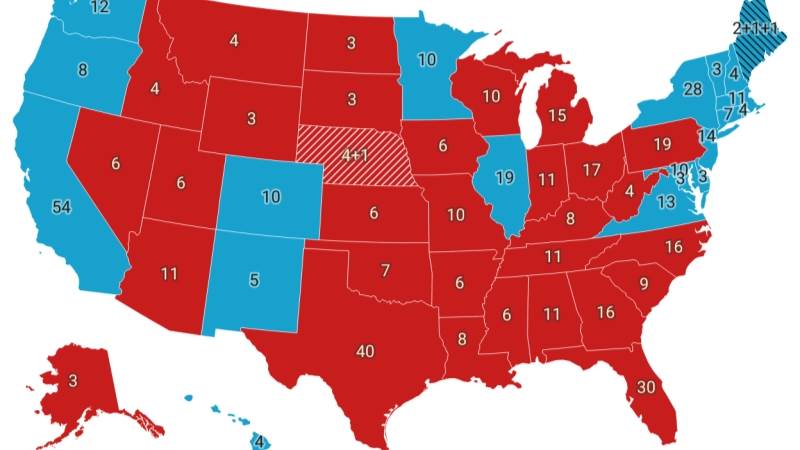
Donald Trump has won Arizona, securing all seven swing states in the 2024 election and flipping the state back to the Republican side, CBC News and CNN projected late Saturday. This result concludes the count with Trump securing 312 Electoral College votes, while Kamala Harris finishes with 226. With Arizona’s 11 votes, Trump’s victory represents a significant shift in a state that had leaned Democratic in recent years, with many statewide offices held by Democrats. Trump’s campaign in Arizona focused on border security and immigration, pledging mass deportations and advocating for 10,000 new border agents. Arizona is the sixth state in which Trump has reversed Biden’s Electoral College victory in 2020. The other states that Biden won and that Trump triumphed in this year are Georgia, Michigan, Nevada, Pennsylvania, Wisconsin and North Carolina. NN: Need a place to live? Pick a blue one.
Pentagon confirms US strikes on Houthi facilities in Yemen…… Hezbollah launches rocket barrage at northern Israel
US warplanes launched targeted strikes against advanced weapons storage sites controlled by Iran-backed Houthi forces in Yemen on Saturday night, the Pentagon confirmed. Officials emphasized that the strikes were precise and intended to minimize risk to nearby areas, though further details on the extent of damage remain undisclosed.
Hezbollah launches rocket barrage at northern Israel
Hezbollah fired at least 10 rockets at the Galilee region in northern Israel from Lebanon, the Israel Defense Foreces (IDF) said on Sunday. The military pointed out that some of the rockets were intercepted, while the others fell in open areas. Meanwhile, Galilee Medical Centre in Nahariya revealed that three people were injured by the blast of a rocket impact in the Kibbutz Kabri area in Western Galilee.
Trump Set to Renew Maximum Pressure Policy on Iran
Donald Trump plans to renew the so-called ‘maximum pressure’ campaign against Iran, to further isolate Tehran and hamper its ability to support its proxies in the Middle East, The Wall Street Journal reported, quoting sources briefed on the president-elect’s early plans During his first term in office, Trump tore up the so-called Iran nuclear agreement, formally known as the Joint Comprehensive Plan of Action (JCPOA), and re-imposed sanctions on Iran’s oil industry and exports. President Joe Biden and his Administration, while keeping all sanctions on Iran in place, haven’t monitored strictly the compliance of the sanctions as they were keen to keep oil flowing amidst crises elsewhere such as the Russian invasion of Ukraine. Now Trump could have a personal issue with Iran and is likely to seek a maximum pressure policy, which could stifle Iranian oil exports that had just hit a six-year high earlier this year. Trump now knows that a man with ties with Iran plotted to assassinate him earlier this year, in retaliation for the U.S. drone strike in 2020 which killed Iranian military general and hardliner Qassem Soleimani. Commenting on Trump’s policy in the second term, A major drop in Iranian oil exports, if the U.S. ratchets up the sanctions, could lead to higher oil prices, other things being equal, analysts say. NB: Bullshit!! the Saudis will rush in a New York minute to fill in the gap!!
Mick Mulroy, a top Pentagon official for the Middle East during Trump’s first-term administration, told the Journal, “If he’s going to be hawkish on any particular country, designated major adversaries, it’s Iran.”
Its personal…. see next story
FBI foils Iranian murder-for-hire plot against Trump
United States Department of Justice unsealed federal charges in connection with a foiled Iranian scheme aimed at assassinating President-elect Donald Trump prior to this week’s presidential election, the Associated Press said on Friday. The criminal complaint, submitted in Manhattan’s federal court, claims that an unidentified member of Iran’s Revolutionary Guard Corps provided instructions to an associate in September to devise a strategy for monitoring and eventually assassinating Trump. According to the complaint, if Farjad Shakeri, the man identified in the report, could not devise a strategy by November 5, Iran would halt its plans until after the presidential election. This decision was based on the official’s belief that Trump would likely lose, making it more feasible to target him afterward. NB: This is an act of WAR!!
NN + audio file: it’s Time to Kill the right PIG. Trump is capable of anything. Ask former friend Epstein. Who said he was scared to death of Trump before his “suicide” while he was in Federal custody during Trumps first term in office.
audio file Kill or Be Kilned
Citi Sees Oil Prices Dropping to $60 Under Trump
- Citi analysts forecast lower oil prices next year due to potential import tariffs and increased oil production encouraged by the incoming US administration.
- The new administration’s influence on OPEC+ and domestic energy policies could further impact oil prices.
- While pro-growth energy policies might lead to higher production, they could also depress prices due to increased supply.
Citi analysts have forecast that Brent crude would average $60 per barrel next year driven lower by the energy policies of the incoming U.S. administration. The bank noted import tariffs and higher oil production as the driving factors behind this forecast for oil prices. Analysts also suggested Trump may use his “influence on OPEC+” to convince the group to bring supply back, including production and oil from floating storage. They also said Trump’s presidency could lead to a decline in geopolitical tensions, further contributing to lower prices. At the same time, energy policies at home could see stronger government support for oil and gas investments, potentially boosting production, Citi analysts also wrote, as quoted by Reuters. “Still, despite the more supportive oil and gas agenda, its immediate impact on physical oil markets is likely to be limited,” they said. “Conceptually, the impact of a potential second Trump term on oil prices is ambiguous, with some short-term downside risk to Iran oil supply … and thus upside price risk,” Goldman Sachs analysts wrote in a note earlier in the week, before the elections. They did add, however, that there was downside risk to demand and prices stemming from Trump’s stated trade policies. There is also the question of prices and production growth motivation because pro-growth energy policies may well lead to more production but they would also depress prices and that, in turn, would lead to lower production as has happened since the oil and gas industry came into being.
“If the Trump administration opens up federal leases for oil and gas, Federal lands would get 25% per barrel of revenues. You will have a lot of trouble finding an oil company that can make money at $52.50 per barrel with what they have left from a $70 barrel,” Smead Capital president Cole Smead told CNBC.
Liberal women going on sex strike over Trump win
Mr Trump swept to victory in Tuesday’s presidential race that Democrats cast as a referendum on abortion rights and protections for women. Some women are now threatening to punish men for voting for Trump, taking inspiration from a Korean feminist movement that vows to withhold sex from men in order to redefine the gender power balance. Interest in the “4B movement” spiked since Kamala Harris’s defeat, with women sharing videos of themselves on social media pledging to commit to its four “no’s” — no sex, no dating or marriage and no having children with men — for the next four years. In one video shared on TikTok, a young woman pledges to go celibate and encourages others to delete dating apps in order to “exercise sovereignty” over their bodies. “As a woman, my bodily autonomy matters and this is my way to exercise sovereignty over that,” she says. “So I highly encourage any other women who are single and still care about progressing women’s rights and still fighting for our bodily autonomy to do the same. Delete your dating apps.” The woman also encourages others to seek out their female friends for comfort “if you need somebody to cuddle” and describes the 4B movement, which originated in South Korea, as a “point of inspiration”. The US election revealed a gender divide in the electorate, with 55 per cent of men turning out for Mr Trump and 53 per cent of women voting for Ms Harris. The president-elect touted his role in overturning Roe v Wade, a ruling that ended the nationwide right to abortion, throughout his election campaign and has been repeatedly accused of making offensive comments about women. In response, some have blamed sexism for America’s decision to return Mr Trump to the White House. “Men will always be against women,” read the caption in one TikTok video of a young woman crying in a car, encouraging women to join the 4B movement. “Women are just as capable to be presidents as a man.” In another video, a woman says that “for the next four years I am going to abstain from sex with men” A separate video was captioned: “I think it’s time for American women to participate in our own 4B movement.” Many of the videos addressed concerns over abortion, which was on the ballot in 10 states and was central to the Harris campaign. “If men won’t respect our bodies, they don’t get access to our bodies,” one woman said. “All I have to say is, good luck getting laid. Especially in Florida, because me and my girlies are participating in the 4B movement.” In a further video, one woman said: “I personally think if all these men are voting to take our rights away, they don’t deserve to touch a woman for the next four years. So, hope you thought that through you guys.”