Republican lawmakers demanded the U.S. launch a retaliatory strike against Iran for the drone and missile attacked launched against Israel. On Saturday, Iran launched hundreds of suicide drones toward Israel and later ballistic missiles in a retaliatory attack for an airstrike on the Iranian consulate building in Syria that killed Tehran’s top commanders. President Joe Biden vowed prior to the attack to do everything possible to protect Israel. However, aid to Israel amid the country’s war with Hamas has been delayed due to division within the Republican party. Following the attack, Rep. Steve Scalise (R-LA) announced the House will move forward next week to consider a bill that will provide Israel with an aid package. “In light of Iran’s unjustified attack on Israel, the House will move from its previously announced legislative schedule next week to instead consider legislation that supports our ally Israel and holds Iran and its terrorist proxies accountable,” Scalise wrote. “The House of Representatives stands strongly with Israel, and there must be consequences for this unprovoked attack.” Sen. Linsday Graham (R-SC) praised the decision by House leadership while adding that Iran must face consequcnces for attacking a U.S. ally. Prayers for our ally, Israel, who is under attack by the Ayatollah and his henchmen. It is long past time for Iran to pay a heavy price for the terrorism they sow throughout the world. I’m glad to see the House will take up the Israel aid package next week and hope they will do the same for Ukraine, making it a loan as President Trump suggested,” Graham wrote on X. He added, “The world is a dangerous place, and we have to show resolve for our friends and determination against our enemies.” Sen. Marsha Blackburn also took to X, formerly Twitter, to demand Biden launch an immediate “aggressive retaliatory strikes on Iran.”
Mideast Enters Dangerous New Phase With Iran’s Attack On Israel
Israel and allies including the US, UK and France managed to mostly foil an unprecedented attack by Iran on the Jewish state. The Islamic Republic fired more than 300 drones and missiles against Israel on Saturday evening. Almost all were intercepted before they reached Israeli airspace and there were no fatalities reported. A 10-year-old girl in Israel was badly injured by falling shrapnel, while an army base was lightly damaged. US President Joe Biden said he condemned the assault — the first from Iranian soil against Israel — in the strongest terms and Israeli officials warned it was “a severe and dangerous escalation” from Tehran. Yet neither said they would retaliate against Iran, which had promised an attack against Israel after its embassy compound in Syria was hit by missiles on April 1, killing seven Iranian officers Israel Defense Minister Yoav Gallant says hundreds of missiles and drones fired by Iran were blocked by Israel, the US and others “with great success.” Iran said it would not carry out further assaults in the absence of a strong reaction from Israel. Stock markets in Israel, Saudi Arabia and elsewhere in the Middle East fell on Sunday, but only slightly. “We see this operation as achieving a complete result and there’s no intention to continue” it, the chief of staff of Iran’s military, Mohammad Bagheri, told state TV on Sunday. Iran was capable, he said, of an attack “tens of times” bigger but deliberately limited it. Biden will speak with Group of Seven leaders on Sunday “to coordinate a united diplomatic response,” according to a White House statement.
He spoke to Israeli Prime Minister Benjamin Netanyahu and reiterated Washington’s support for the country was “ironclad.” However, he said the US wouldn’t support an Israeli counterattack against Iran, Axios reported, citing an unidentified White House official. Israel’s cabinet is expected to meet on Sunday afternoon to discuss the country’s response. “This campaign is not over yet and we need to remain prepared,” Israel’s defense minister, Yoav Gallant said. “Israel withstood the attack tonight. The IDF blocked this attack in the most impressive way, together with our partners. The entire world saw tonight what Iran is, a country of terror.” Oil prices rose in the wake of the Syria strike, with Brent climbing above $90 a barrel and analysts saying it could reach $100 on a direct conflict between Iran and Israel. The Israeli shekel weakened and neared its weakest level this year. On Sunday, Israeli stocks increased as much as 0.7% in early trading, but reversed those gains as of 11:40 a.m. in Tel Aviv. Saudi Arabia, which said it had “deep concern over the military escalation developments in the region,” saw its main bourse drop 0.5%.
“Iran designed its retaliation to cause maximum symbolism, but minimum damage,” said Ziad Daoud, chief emerging-markets economist for Bloomberg Economics. “By itself, it shouldn’t move markets. But if it triggers an Israeli counter-response, then we’re spiraling into somewhere very dangerous. Key to what happens next is whether the US can restrain the Israeli reaction.”
Israel’s military said Iran launched about 170 drones, 30 cruise missiles and 120 ballistic missiles. Only the latter penetrated Israeli airspace and in “very small numbers,” according to the Israel Defense Forces. The drones and cruise missiles were all intercepted before they got to Israel.
Iran’s Attack on Israel
A US defense official confirmed its forces in the region — bulked up since the Israel-Hamas war erupted on Oct. 7 — shot down Iranian-launched drones. UK and French forces were also involved. “Thanks to these deployments and the extraordinary skill of our servicemembers, we helped Israel take down nearly all of the incoming drones and missiles,” Biden said. Israel has upgraded its air defenses considerably over the past decade and a half, adding new systems for interceptions of ballistic missiles fired from as far away as 2,400 kilometers (1,500 miles). That range includes Yemen, Syria and Iraq, where militant groups allied with Iran are based, as well as Iran.
Israel reportedly yet to decide on Iran response
The Israeli government has not yet decided on how it will respond to Iran’s retaliatory overnight attacks on its territory, the Times of Israel reported on Sunday, citing an Israeli official. According to the report, Israel’s war cabinet will discuss its potential response at a meeting scheduled for 3:00 pm local time (2:00 pm CET). After launching the strikes, Iran said the action was a “legitimate response” to Israel’s attack on its consulate in Damascus, while reports claimed Israel is planning a “significant response” to Tehran’s drone and missile attacks. NN: It would be a colossal fuck up if Israel does not attack Iran’s nuclear facilities.
Over 300 projectiles fired toward Israel, 99% inteIran tells UN it’s not looking for ‘escalation’rcepted……
More than 300 projectiles were heading toward Israel on Sunday, The New York Times reported citing two Israeli officials, which was later confirmed by Israeli Defense Forces (IDF) spokesman Daniel Hagari. According to the officials, while most of the projectiles were fired from Iran, a small number also came from Iraq and Yemen. The officials further detailed that Iran launched 185 drones, 110 surface-to-surface missiles, and 36 cruise missiles. Hagari said that 99% of these projectiles were neutralized by air defenses. Meanwhile, another Israeli official, cited by Channel 12, said that “Iran’s attack was a strategic failure,” adding that now they should get ready “and not sleep in peace.”
Iran tells UN it’s not looking for ‘escalation’
Iran’s Permanent Mission to the United Nations told the agency that it has no intention to escalate the conflict in the Middle East. In a letter, Iranian representatives said that the operation against Israel was launched due to the UN Security Council’s “inaction and silence, coupled with its failure to condemn the Israeli regime’s aggressions.” “Certain countries’ precipitous condemnation of Iran’s exercise of its legitimate right suggests a reversal of roles, equating the victim with the criminal,” it was further written. Meanwhile, the UNSC has decided to hold a meeting over Tehran’s actions.
NN: audio file
its war

Iran launches drone attack against Israel
Iran has initiated a significant aerial attack on Israel, deploying dozens of drones and potentially missiles, as confirmed by both US and Israeli officials this Saturday.
In a televised address, Israeli Prime Minister Benjamin Netanyahu stated that “in recent years, and even more so in recent weeks, Israel has been preparing for the possibility of a direct attack from Iran.” The attack was widely anticipated by US and Israeli intelligence agencies, which have been on high alert, expecting a forceful response from Tehran to last week’s attack on Iran’s embassy in Damascus, Syria.
According to Iranian media, the drones were launched from Yemen and may have been Iran’s HESA Shahed 136, a type of kamikaze uncrewed aerial vehicle designed to attack ground targets from a distance. The Shahed 136, also known as Geran-2, is intended to overwhelm enemy air defenses by being fired in salvoes.
Iran launches drone attack against Israel
- Iran launched an attack on Israel, escalating long-standing tensions between the two nations.
- Iran accused Israel of perpetrating a strike on its consulate in Damascus on April 1, and pledged to retaliate.
- Israel also threatened a counterattack if Iran made any retaliatory moves, though Israel has neither confirmed nor denied its involvement in the Damascus strike.
Iran on Saturday launched attacks against Israel, according to the Israel Defense Forces, escalating long-standing tensions between the two nations that have the potential to trigger a regional war. Strains between Iran and Israel have been heating up since the start of the war in Gaza in October, and especially over the past several weeks after Iran accused Israel of perpetrating an attack on its consulate in Damascus on April 1.Iranian leaders, including Ayatollah Ali Khamenei, pledged to retaliate against Israel for the Damascus strike and Israel, in turn, threatened a counterattack of its own. Israel has neither confirmed nor denied its involvement in the Damascus attack.“If Iran attacks from its territory, Israel will react and attack in Iran,” Israeli Foreign Affairs Minister Israel Katz wrote in a Wednesday post on X, tagging the Ayatollah’s X account. Given Iran’s various warnings, the White House had been expecting an Iranian strike and had been communicating with Israel to ensure they would be prepared to defend themselves. On Friday, President Joe Biden said he anticipated that Iran might strike Israel “sooner than later.” Ahead of the attacks on Saturday, Biden was en route back to the White House, earlier than initially scheduled, to meet with his national security team amid the growing prospect of an Iranian strik.Earlier on Saturday, Iran’s Revolutionary Guard seized a Portuguese-flagged cargo ship with links to Israel in the Strait of Hormuz, a key shipping route. The White House condemned the move shortly after. Ahead of the attack, Israel also announced that beginning on Sunday, it would close schools and limit gatherings to 1,000 people in certain areas.
This is breaking news.
US moves warships closer to Israel after Hamas attack
The U.S. rushed warships into position to protect Israel and American forces in the region, hoping to head off a direct attack from Iran on Israel that could come as soon as Friday or Saturday. The moves by the U.S. that are part of an effort to avoid a wider conflict in the Middle East came after a warning from a person familiar with the matter about the timing and location of the potential Iranian attack. A person briefed by the Iranian leadership, however, said that while plans to attack are being discussed, no final decision has been made. Army Gen. Erik Kurilla, the head of U.S. Central Command, discussed a possible Iranian attack with Israeli Defense Minister Yoav Gallant in Israel on Friday. “We are prepared to defend ourselves on the ground and in the air, in close cooperation with our partners, and we will know how to respond,” Gallant said, according to Israel’s Defense Ministry. The U.S. moves included repositioning two destroyers, one of which was already in the region and another that was redirected there, U.S. officials said, adding that at least one of the vessels carried the Aegis missile-defense system. President Biden, asked Friday when an Iranian strike on Israel may occur, said, “My expectation is sooner than later.” Asked if he had a message for Iran, Biden said: “Don’t.” “We are devoted to the defense of Israel. We will support Israel and help defend Israel and Iran will not succeed,” Biden said. U.S. Moves Warships to Defend Israel in Case of Iranian Attack© Provided by The Wall Street Journal U.S. officials fear that an Iranian strike against Israel could prompt an Israeli response inside Iran that could spark a regional conflict and draw in the U.S., whose forces and allies in the Middle East could be targeted by Tehran if its territory is hit.Washington is asking Israel to carefully weigh its response to any Iranian attack and to keep in mind the potential that it could spark further escalation, according to a senior U.S. official.the US believes a direct strike from Iran could be
John Kirby, the White House’s national security spokesman, said Friday that Iran’s threats to strike Israel remain “real” and “viable.” Lt. Gen. Herzi Halevi, chief of Israel’s general staff, met with Kurilla about a possible Iranian attack after a separate meeting with commanders on the readiness of Israeli forces. Late Thursday, U.S. Defense Secretary Lloyd Austin had called Gallant to reassure him Washington would defend its closest ally in the region if Tehran struck on its soil. Austin told Gallant “Israel could count on full U.S. support to defend Israel against Iranian attacks, which Tehran has publicly threatened,” a Pentagon spokesman said. Iran has threatened to retaliate for an attack last week in Damascus, Syria, that Tehran said was an Israeli airstrike on a diplomatic building. The strike killed several top Iranian military officials, including a senior member of the Islamic Revolutionary Guard Corps’ elite Quds Force. An Iranian strike on Israel could inflame the region as Israeli Prime Minister Benjamin Netanyahu’s government is under growing international pressure to wrap up its military campaign against Hamas militants in the Gaza Strip. Hamas’s Oct. 7 attacks in Israel, which killed around 1,200 people, and Israel’s subsequent offensive in Gaza, which has claimed more than 33,000 lives, have ratcheted up tensions in the Middle East to a level not seen in decades. In their phone call on Thursday, Gallant told Austin that “a direct Iranian attack would require an appropriate Israeli response against Iran,” the Israeli Defense Ministry said. U.S. officials, frustrated by Israel’s decision to not inform them about the Damascus strike, have pushed their Israeli counterparts to share information about how Israel could respond to an Iranian strike, U.S. officials said, in part to protect forces in the region. Netanyahu met Friday with senior security officials, including Gallant, to discuss Israel’s readiness for an Iranian response, according to Israeli officials. In Tel Aviv, residents went about their day on Friday, flocking to cafes and shops on the first day of the Israeli weekend. The scenarios for a potential attack on Israel that have been presented to Khamenei include strikes by Tehran’s proxies in Syria and Iraq, according to advisers to the Iranian Revolutionary Guard and the Syrian government. To avoid an attack within Israel’s internationally recognized territory, Iran and its allies could also attack the Golan Heights, a disputed territory annexed by Israel from Syria in 1981, the advisers said. Another option would be to hit Israeli embassies, notably in the Arab world, to show them that friendly ties with Israel could be costly, these people said. In recent days, social-media accounts associated with Iran’s Revolutionary Guard have stepped up messaging around a potential attack on Israel. Several widely shared posts include satellite images of prominent locations in Israel, such as Ben Gurion Airport, surrounded by Iranian attack drones. “What place do you love? The choice is in your hands,” the posts, which were picked up by several Israeli media, say in Hebrew. Another post includes a video showing an Iranian hypersonic missile with the Farsi caption “5 minutes to Haifa and Tel Aviv.”
Iran Seizes Israel-Linked Container Ship Near Hormuz Strait
Iran’s Islamic Revolutionary Guard Corps seized an Israel-linked container ship near the Strait of Hormuz between the Persian Gulf and Gulf of Oman on Saturday, the state-run Islamic Republic News Agency reported. IRGC special forces boarded the MSC Aries from a helicopter and directed it toward Iranian territorial waters, the Islamic Republic News Agency said, without giving a reason for the seizure. The vessel’s beneficial owner is Zodiac Maritime Ltd., part of Israeli businessman Eyal Ofer’s Zodiac Group, according to data compiled by Bloomberg. No one responded to a call to Zodiac’s office in London, outside of normal business hours. The vessel last called at the United Arab Emirates’ Khalifa Port and was sailing east toward the Strait of Hormuz as of Friday evening local time. Security and intelligence firm Ambrey Analytics said it received information of a “boarding” around 50 nautical miles northeast of the UAE’s Fujairah. The seizure comes as Israel braces for an Iranian response to a suspected Israeli attack on Iran’s embassy in Syria on April 1. Potential scenarios had included an unprecedented drone and missile strike on Israeli territory as early as this week, Bloomberg reported. Zodiac’s ships have been repeatedly targeted in attacks in the same area in recent years that the US and Israel have blamed on Iran. Tehran previously denied involvement.
Iran readying 100 drones & missiles for Israel strikes
Iran readies more than 100 cruise missiles and drones for deadly Israel strike, US intelligence officials reveal, as Pentagon moves aircraft carrier into the Red Sea amid fears of full-scale war
- Iran has reportedly readied an arsenal of cruise missiles and drones as the country reportedly prepares to launch an attack on Israel
- The country has threatened to hit back at Israel over an attack in Syria last week that Tehran say was an Israeli airstrike on a Iranian diplomatic building
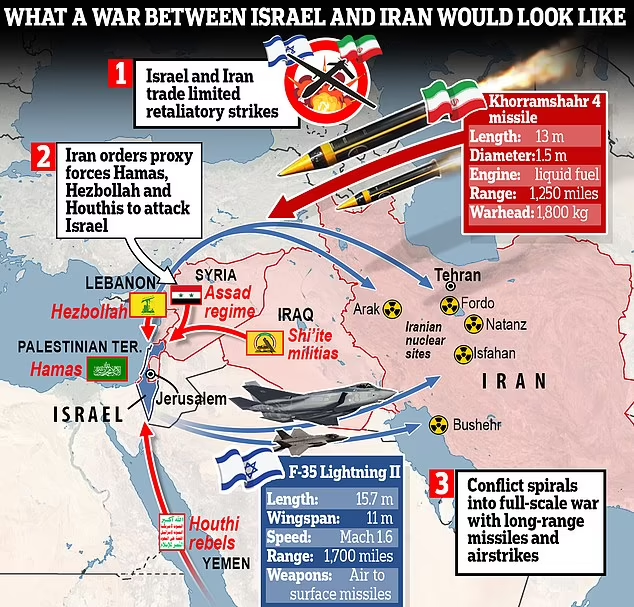
Iran has reportedly readied more than 100 cruise missiles as part of an ‘imminent’ strike on Israel after the US moved more forces into the Middle East over fears an attack could spark a full-scale war. Military officials briefed on the matter told both ABC News and CNN that the US has observed Iran readying at least 100 cruise missiles, indicating they could be ready to attack. ABC also reported that a large number of drones that could be used in an attack on Israel have also been readied by the nation. Iran has publicly threatened to hit back at Israel over an attack in Syria last week, which Tehran say was an Israeli airstrike on a Iranian diplomatic building in Damascus. Iran’s Supreme Leader Ali Khamenei vowed retribution in the wake of the Damascus attack, for which Tel-Aviv has yet to take responsibility.
Hezbollah drones attack Israeli Ramot Naftali base
Hezbollah announced on Friday that, in retaliation for what the group describes as “zionist aggressions” against southern villages and civilian homes, their fighters launched a drone attack on the Israeli Ramot Naftali base. Earlier, the Israeli Defense Forces (IDF) reported that approximately 40 rockets were launched from Lebanon towards northern Israel. The IDF claimed it intercepted some of these rockets, while others struck open areas or fell short within Lebanese territory.
NN: AUDIO NEWS FILE
Iron Dome Failed The Test