The International Energy Agency (IEA) cautioned on Thursday that the “sharp” escalation of tensions in the Middle East has put global oil markets “on edge,” as the region accounts for more than one-third of the world’s seaborne oil trade. In its latest monthly oil market report, the agency underlined that although the geopolitical turmoil in the region did not yet have “direct impact on physical supply,” markets are expected to remain on “tenterhooks as the crisis unfolds.” The global oil demand growth is anticipated grow by 2.3 million barrels per day (bpd) this year, the agency revealed, adding that global demand is projected to average 900,000 bpd in 2024 due to slower economic recovery. The global supply is projected to reach 1.5 million bpd in 2023 and 1.7 million bpd in 2024. The agency cautioned that voluntary output cuts could keep oil market in deficit.
Oil, gas prices rise after S. Arabia, IEA remarks
The prices of oil futures increased on Thursday after Saudi Arabia hinted at the possibility of additional extensions of its crude production cut. Moreover, the International Energy Agency (IEA) warned that the clashes between Israel and Hamas and the prospect of the conflict spreading to the entire Middle East endangered the stability of the global oil market. Meanwhile, the prices of European gas futures went up amid concerns about the supply of the commodity amid the uncertainty of its transport through Israel and the damage done to the Balticconnector pipeline. West Texas Intermediate (WTI) for deliveries in November grew by 0.93% at 6:38 am ET to sell for $84.26 per barrel. At the same time, Brent for settlements in December advanced by 1.14%, going for $86.86 per barrel. UK Natural Gas for December’s deliveries jumped by 8.19% at 6:45 am ET to sell for 137.980 pence per therm. A minute later, Dutch TTF for November’s settlements surged by 11.% to go for €51.25 per megawatt hour.
Hamas’ military wing Al-Qassam Brigades claimed on Wednesday that it targeted the Israeli city of Haifa with R160 long-range missiles.Sirens went off in the city in northern Israel amid the attack and, according to witnesses, people were seen running for cover. Earlier, Israeli Armed Forces (IDF) said it received a report of an aerial infiltration from Lebanon.
Israel reports ‘suspected infiltration’ from Lebanon
The Israeli Defense Forces (IDF) said on Wednesday that it received reports of a “suspected infiltration” into its airspace from Lebanon. “A report was received regarding a suspected infiltration from Lebanon into Israeli air space,” IDF said on Telegram. “Following the initial report regarding a suspected infiltration from Lebanon into Israeli air space, all civilians in the areas where sirens were sounded are asked to enter shelters and stay in them until further notice,” the Israeli army added. NN: Things are heating up. A big AWH SHIT could be coming
The prices of oil futures declined on Wednesday after Saudi Arabia reportedly informed the United States it might increase its crude production in early 2024. West Texas Intermediate (WTI) for November’s settlements slid by 1.49% at 10:01 am ET to sell for $84.68 per barrel. A minute later, Brent for December’s deliveries decreased by 1.08% to go for $86.66 per barrel.
Iran was not aware of Hamas’s Attack Plans….HAHAHA
Prices of oil futures continued to decrease sharply on Wednesday after The New York Times reported that early data collected by the United States intelligence agencies showed that Iran was not aware of Hamas’s plans to attack Israel on October The lack of evidence that would link Tehran and Hamas seemingly assured investors that Iran, a significant oil producer, will not be dragged into the armed hostilities in the region and that the supply of the commodity is not in danger at the moment. West Texas Intermediate (WTI) for settlements in November was down 2.91% to $83.61 per barrel and Brent for deliveries in December declined 2.38% to $85.72 per barrell. N N: And these t wo reports just happened to be released at the same time. All i can say is bullshit and bullshit
Oil prices soared in the aftermath of Hamas’ attack on Israel, with WTI climbing by 3.68% and Brent up 3.42%.
The attack by Hamas will likely undermine efforts to normalize relations between Israel and Saudi Arabia.
So far, the oil price movement has been driven by increased geopolitical risk rather than any tangible impact on supply. Oil prices jumped by nearly 4% early on Monday after the weekend attack by Hamas on Israel rekindled tensions in the Middle East. Price increases have stuck this morning. With Brent Crude trading around $88.00, and WTI Crude trading $86.00. The Saturday attack by Hamas on Israel and Israel’s declaration of war on Hamas reignited the always-simmering tensions in the Middle East, which had just seen a rapprochement in the relations between some Arab states and Israel. Before the attack, the U.S. was also negotiating the normalization of the relations between Israel and Saudi Arabia. With no impact on oil supply, the first response on the market has been driven by traders “adding a geopolitical risk premium back in the price and fresh demand following last week’s strong correction which drove a significant amount of long liquidation, especially in Brent,” Hansen added.All eyes will be on whether Israel will point the finger at Iran for the Hamas attack and a potential response, the strategist noted.
Iran has raised its oil production and exports in recent months, as the U.S. hasn’t enforced the sanctions as strictly as before. “Should the spotlight turn towards Iran, there’s a possibility of stricter sanctions being imposed, potentially leading to supply constraints and tightening conditions within the market,” Hansen said. According to Kelvin Wong, senior market analyst at OANDA, “Given that Israel is a strategic stakeholder in international relations within the Middle East region, a further escalation of the current armed conflict may see a rise in oil price supply disruptions which tends to be used as a “choice strategic weapon” for potential bargaining chips among the stakeholders that are involved in the conflict.” NN: This ain’t over till its begins. And the real fun has not begun yet. Sit back and enjoy the coming miracle.
Saudi Arabia’s de facto ruler told Palestinian president Mahmud Abbas he was working to prevent “an expansion” of conflict after the surprise Hamas attack on Israel, Saudi state media said early Tuesday.
Crown Prince Mohammed bin Salman also told Abbas the Gulf kingdom continued “to stand by the Palestinian people to achieve their legitimate rights to a decent life, achieve their hopes and aspirations, and achieve just and lasting peace,” the official Saudi Press Agency reported.
Reeling from the Palestinian Islamist group’s unprecedented ground, air and sea attacks, Israel has counted 1000 dead and launched a withering barrage of strikes on Gaza that have raised the death toll there to 687.
The spiralling violence kicked off amid speculation that Saudi Arabia, which has never recognised Israel, would agree to normalise ties as part of a deal in which it would obtain security guarantees from the United States as well as assistance developing a civilian nuclear programme.
However Prince Mohammed told Fox News last month that the Palestinian issue was “very important” for Saudi Arabia, home to the holiest sites in Islam in Mecca and Medina. “We need to solve that part. We need to ease the life of the Palestinians,” Prince Mohammed said.
Analysts say any progress towards normalisation has now been dealt a heavy blow by the ongoing fighting.
Prince Mohammed has also spoken about the crisis by phone with Egyptian President Abdel Fattah al-Sisi and Jordan’s King Abdullah II, SPA reported. NN: Try like the Triade Nuclear y party is over. Not today not tomorrow but soon Hamas and Hezbollah will attack. And the oil fields of the middle east will go up in flames.
Iran aims to involve the United States in a larger conflict amid the current Middle East crisis, Fox News Chief National Security Correspondent Jennifer Griffin reported on Monday.
“Iran’s goal is to draw the US into a broader conflict: a senior intelligence source tells me,” she posted on X, formerly known as Twitter.
In addition, although the Wall Street Journal previously reported that officials from Iran’s Islamic Revolutionary Guard Corps (IRGC) were involved in planning the attack on Israel, the White House asserted that there is no intelligence evidence(bullshit! confirming Iran’s participation in the conflict. NN: as stated previously Iran’s pecker marks are all over the savage attack on the innocent. Their is a time for war. And this is just such a time!
Lebanon’s Hezbollah group claimed responsibility for the latest attacks launched on Sunday from Lebanese territory towards Israel. “The radar sites, Zibdin and Ruwaisat Al-Alam were bombed with large numbers of artillery shells and guided missiles. We targeted three Israeli occupation sites in the occupied Lebanese Shebaa Farms area,” Hezbollah said in a statement. The group added that the attacks were conducted as a sign of solidarity with the “Palestinian resistance.” Earlier, the Israeli Defense Forces (IDF) revealed that they carried out strikes on positions in southern Lebanon after mortar shells were fired from Lebanon. NN: We are on the edge of the abyss. US troops and aircraft carrier are on the way. This attack has Iran’s DNA all over the crime scene. I guess you could say the Nuclear triaide deal is off the table.
Hamas launched a second attack on Israel on Saturday afternoon, launching a new round of 150 rockets into the country, the group said in a statement. However, despite the Iron Dome being active, several of the missiles were spotted in the vicinity of Tel Aviv, and the barrage of rockets directly hit buildings and cars. This strike comes after the unexpected morning attack which, according to official figures, left 70 Israelis dead, but unconfirmed death tolls range between 100 and 200.
Biden speaks to world leaders on Israel’s situation
United States President Joe Biden stated on Saturday that he has been in contact with world leaders to assess the current situation in Israel following the unexpected attack by Hamas. In a brief televised statement, the US president said he had directed his team to stay in close contact with leaders in Egypt, Turkey, Qatar, Saudi Arabia, Jordan, Oman, the UAE, as well as with “European partners” and the Palestinian Authority. He also took the opportunity to reiterate his support for Israel. “I personally am going to remain in close contact with Prime Minister Netanyahu as this situation continues to develop,” Biden said. NN: It is critical you understand what you are seeing here. This is the Palestinians working for their mater the Iranians to stop the triad nuclear deal. That is where the US for oil, The Saudis for nukes and Israel to become part of a middle east NATO to stop Iran. The nuclear Triade deal is now off the table. One more thing we need to watch here. Will Hezbollah from Lebanon join the war and attack Israel from the north. If that happens all hell in the middle east will break loose.
Starlink Broadband Internet is Elon Musk’s SpaceX project to fully connect the world to the World Wide Web from anywhere in the world. Let’s explore the up and running technologically of this disruptive way to concoct to the high speed internet and why you want in on it.
The existing Starlink network of over 5000 satellites offers low-latency and high-speed internet to any location worldwide. SpaceX is launching hundreds of satellite each month. Starlink has been licensed for and will soon have 15,000 satellites in orbit. This breakthrough technology is making obsolete fiber optics, cable modems, DSL and 4G/ 5G cell phone internet.
In fact next year Starlink will partner with cell phone companies to offer a smart phone that has worldwide Starlink broad band.
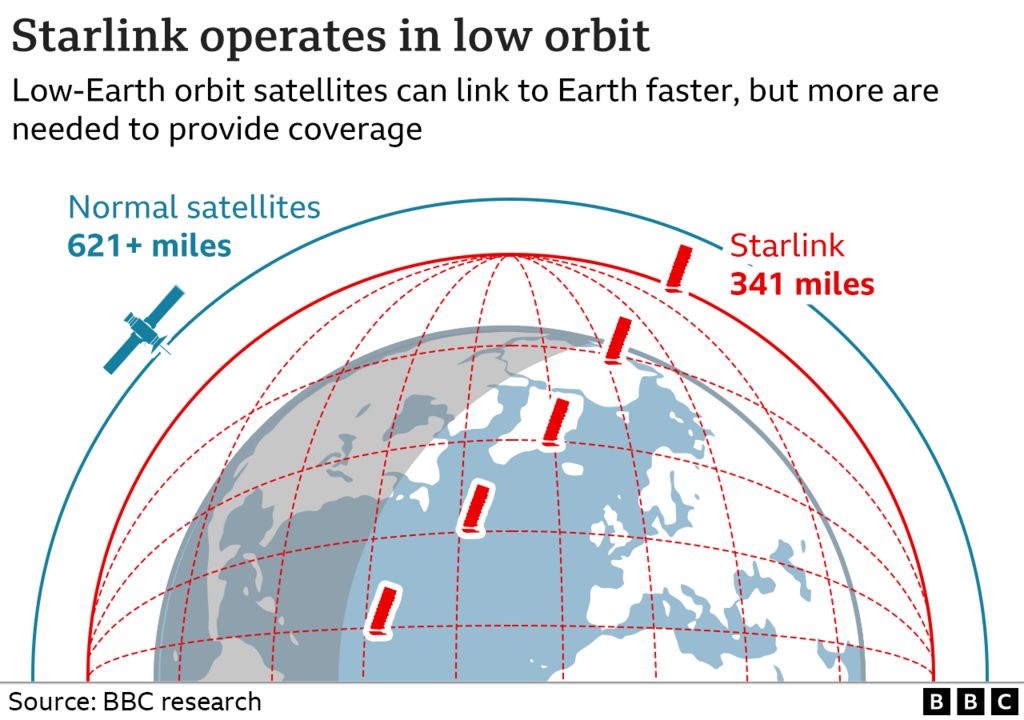
What makes the Starlink system so reliable and fast? The secret is latency and lots of satellites. Latency is the time it takes for the satellite signal to reach the earth. Each Starlink ground dish on Earth communicates with a large number of satellites in low earth orbit, only 340 miles aloft. That’s significantly closer than a traditional TV satellite Internet, which use 1 satellite that orbits at an altitude of approximately 22,000 miles, 36,000 kilometers.
In old fashoned internet systems users connect to 1 satellite that is far away. And very very slow. That is why the dish must be so big and be precisely aimed at the satellite. Starlink satellites are much closer and their are thousands of them. This proximity means the dish is much smaller and able to point and track hundreds of satellite automatically. And receive massive amounts of data at broadband and close to real world fiber optic speeds. Without out fiber, cable or wires.
As you can see by the above diagram because their are so many satellites in low earth orbit Starlink service is incredible fast, reliable and coverage is universal. And because the satellites are in motion, the dish constantly automatically readjusts throughout the day to switch between satellites as they pass overhead, letting users maintaining a constant high speed data connection. The satellites can service several users within a specific area, and these satellites, in turn, connect to larger ground stations that then connect users to the rest of the internet.
Starlink Installation: is truly plug and play
The dish needs to be set up outdoors, with a clear view of the sky overhead. The Starlink app includes a camera mode that lets you use a smartphone to scan the sky above your intended installation spot, letting you check beforehand that it’s sufficiently free of obstructions. The included mount is usable on either flat ground or rooftops,
Starlink satellites orbit close to the earth. Obsolete single satellite slow data systems orbit at 21,000 miles
See how easy Starlink is to setup:
here is how to get starlink for free
We have been using Starlink for the past two years. At 5 locations across the US and Europe. Its is the best and as far as we are concerned the best and only way to access the internet. We have cancelled DSL lines, Cable modems, Fiber optic and I Direct, Immersat among other old fashoned satellite connections.
The combined net savings have been enormous and the increased internet speeds is truly amazing.
It is a proven reliable, consistent high speed broadband internet connection. Without the tricks where they throttle your internet speeds down.
We have a business license. Which means we get priority, higher data speeds and unrestricted access at all locations in the US, Canada, Europe and Mexico. Which means with our Mobil Business license and the Roam service you can use your Starlink Satellite Broadband internet anywhere.
Its free free free free
Now here is the good part you will really really like. We want to provide you with the new rectangle high speed dish, A Mobil roam license, which means you have unrestricted access to Starling anywhere in the continental US, Europe, Canada and Mexico and a full year service absolutely free. Please note this system is small 20 x 18 inches and fits in a suitcase stowable in the overhead baggage compartment. And it weighs less then 5 pounds. It will be delivered to your door.
It is critical that you are connected at all times no matter the weather, infrastructure, social conditions or location you are at.
So as part of your paid subscription or early bird renewal we will provide you the Starlink dish and hardware. And paid internet Roam service for a year at any location nationally absolutely FREE.And you can change locations anytime you want. And to sweeten the offer we will renew you Starlink Service every year as part of your yearly subscription.
When you calculate it the savings are great, since you can tell your exiting internet provider to kiss you ass and cancel service. And now you will have broadband internet coverage anywhere you go. Its no brainier so sign up today.
call jim at: 866-924-0607
Silent Circle: rocketman99
BlackCryptoPhone: 1212
Of course this is covered by our 100% money back guarantee if you are unhappy for any reason….
Despite economic slowdown concerns, China’s demand for major commodities, driven by its clean energy sector, is growing at robust rates.
China’s operating solar capacity has reached 228 GW, more than the rest of the world combined, indicating its dominance in global clean energy markets.
The U.S. clean energy sector faces hurdles due to rising interest rates and remains dependent on China for raw minerals essential in EV manufacturing.
Worries about the waning strength of China’s economy have been weighing heavily on many commodity and financial sectors in the current year. Economic pundits have warned that China’s rapid growth since the global financial crisis are unlikely to be replicated in the next decade, particularly in sectors of property construction and local government investment. Indeed, China’s economic slowdown has mainly manifested in the property sector’s decline, hardly surprising considering that the industry represented 20 to 25 percent of GDP at its peak. Unfortunately, new annual housing starts are now down 57 percent, with the sector expected to remain below half of its previous size over the next decade. Wall Street investment bank Goldman Sachs has reported that China’s demand for many major commodities has actually been growing at “robust rates,” thanks in large part to its booming clean energy sector. According to GS,
China’s demand for copper is up 8% Y/Y, while demand for iron ore and oil are up by 7% and 6%, respectively, exceeding the bank’s full-year expectations. China’s green copper demand rose 71% in July from a year ago
“This strength in demand has largely been tied to a combination of strong growth from the green economy, grid and property completions. The most significant strength has come on the renewables side where related copper demand is up 130% y/y year-to-date, led by surging solar related demand,” the Goldman report has observed. China’s hegemony in global clean energy markets does not appear in any imminent danger. A June report by the Global Energy Monitor revealed that the country’s operating solar capacity has hit 228 GW, more than the rest of the world combined. China is now on track to double its wind and solar capacity a good five years ahead of its 2030 target. NN: Its back to the binary trade China demand. With a new wrincle….. Russia and Saudi supply cuts/