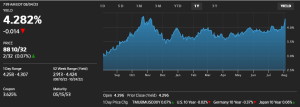
US Core Inflation rose 0.4% Running 5.3% YoY

Core inflation — a measure excluding food and energy items, which the Fed views as a better gauge of underlying price pressures — has been persistently elevated. Those prices rose 0.4% for a third-straight month, according to the data from the Bureau of Labor Statistics, which is roughly double the pre-pandemic pace. Running at 5.3%.

Here are some of the main figures in the report:

Metric Actual Median Estimate
CPI MoM +0.1% +0.1%
Core CPI MoM +0.4% +0.4%
CPI YoY +4% +4.1%
Core CPI YoY +5.3% +5.2%

Fed officials like to look at an even narrower category of core inflation, services excluding housing, to assess the trajectory of the stickiest price pressures. That metric climbed 0.2% from a month earlier, according to Bloomberg calculations, which in line with pre-pandemic trends. It was up 4.6% from a year ago, representing ongoing moderation after peaking late last year. Several Fed policymakers, including Chair Jerome Powell, have signaled they prefer to skip a rate hike at the June 13-14 policy meeting, while still leaving the door open to future tightening if needed.  And regardless of whether or not the Fed hikes again, it’s likely to resist cutting rates any time soon. Investors also marked down the odds of a rate cut by the end of the year, according to swaps. For now, economists generally agree the central bank will leave rates unchanged Wednesday, but the next CPI report due in July will play a key role in determining what the Fed will do at its next meeting a couple weeks later. “Such rapid headline disinflation will make it harder for the Fed to justify raising rates again, but we can’t rule out a July hike yet,” Ian Shepherdson, chief economist at Pantheon Macroeconomics, said in a note. “Our base case remains that the Fed is done. But it will be close.” NN: Unfortunately the Fed will pause and inflation will bite them in the ass in the coming quarters.  A core inflation rate at 5.3https://youtu.be/9yoEJdZcbZ0% is certainly is not 2%. And rising 3 months in a row is not inflation coming down,.,,,,,


China’s central bank cut short-term policy interest rate

China’s central bank surprised most economists and market participants by cutting a short-term policy interest rate, a sign that officials are increasingly concerned about faltering growth and are stepping up stimulus to boost the recovery. The People’s Bank of China lowered the seven-day reverse repurchase rate by 10 basis points to 1.9% on Tuesday, the first reduction in the rate since August 2022. That increases the likelihood the central bank will reduce its one-year loan rate on Thursday, with banks expected to lower their lending rates shortly after.

Short-Term Policy Rate Cut | PBOC cuts seven-day reverse repo rate ahead of MLF rate decision

Tuesday’s move underlines heightened concern about a slowdown in growth: recent economic indicators showed inflation remained near zero in May, manufacturing activity contracted and an early rebound in the property market has fizzled. Speculation is growing that the PBOC may cut interest rates even further this year, while Beijing is considering a broad package of stimulus measures.  “Policymakers are finally acknowledging the economic weakness,” said Michelle Lam, Greater China economist at Societe Generale SA. “There should be more interest rate and reserve requirement ratio cuts in the second half of 2023.” Goldman Sachs Group Inc. economists forecast a 25 basis-point cut to the reserve requirement ratio for lenders — which will free up more money for banks to boost lending — in the third quarter. Another cut to the ratio or policy rates could happen in the fourth quarter depending on the economy’s performance, they wrote in a research note Tuesday.  Macquarie Group Ltd. expects a 10 basis-point cut in the one-year medium term lending facility rate in the third quarter after a cut later this week. The timing of Tuesday’s move suggests the PBOC may be trying to get “ahead of the curve” and the US Federal Reserve’s upcoming policy meeting “to mitigate the rate cut impact on the yuan,” said Ken Cheung, chief Asian FX strategist at Mizuho Bank Ltd. in Hong Kong. Economists expect the Fed to finally pause its aggressive rate-hiking cycle this week. PBOC may be worried about the potential shocks to the market and so it took this opportunity to try to appease concerns in advance.” NN: China is lowering rates the rest of the world is raising them. China has virtually no inflation and all the money in the world to stimulate its economy. As it reopens from years of lockdowns….


Oil rises by 1% amid Bargain Hunters and OPEC 2023 global growth forecast at 2.6%

  • Oil prices were higher on Tuesday morning as bargain hunters moved in, with WTI trading at $67.86 and Brent changing hands at $72.83.
  • Oil prices ended trade on Monday with another loss as demand concerns continue to dominate markets due to doubts over China’s economic recovery.
  • The Fed meeting begins today and most analysts expect a pause in rate hikes, a move that might stop the recent collapse in oil prices at least temporarily.
  • OPEC l2023 global growth forecast is 2.6%

The prices of oil futures pared the previous day’s losses and went up by more than 1% on Tuesday ahead of the Organization of Petroleum Exporting Countries’ (OPEC) newest report on global crude demand and economic growth. West Texas Intermediate (WTI) for settlements in July grew by 1.15% at 5:29 am CET to sell for $67.91 per barrel. At the same time, Bent for deliveries in August gained 1.42% to go for $72.87 per barrel. Crude oil prices climbed early on Tuesday morning after ending trade on Monday with yet another loss, driven by demand concern. As the latest Fed meeting begins today, however, eyes will be on the U.S., with most analysts expecting the central bank to announce a pause for rate hikes. That would have a positive effect on prices although how durable that effect would be in the context of continued doubts about China’s rate of economic recovery is anyone’s guess. The government announced the purchase of 3 million barrels of crude last week alongside plans for the purchase of another 3 million later in the year. “These 3 million barrels are being purchased for an average price of about $73 per barrel, lower than the average of about $95 per barrel that SPR crude was sold for in 2022, securing a good deal for taxpayers,” the Department of Energy said, as quoted by Reuters, last week. Even so, oil prices have generally remained subdued, whetting bargain-hunting appetites among traders, per Reuters. “Some investors looked for bargains after the previous day’s heavy selling while others held back their positions with speculation that Saudi Arabia may cut production additionally,” a Nomura Securities economist told the news outlet.

OPEC  2023 global growth forecast at 2.6%

The Organization of Petroleum Exporting Countries (OPEC) said in its monthly report released on Tuesday that it sees the global economy growing by 2.6% in 2023, unchanged from its previous forecast. The United States GDP growth was revised up to 1.3% for this year, while the Eurozone economy is still seen growing 0.8% in 2023. China’s economic growth outlook was also unchanged 5.2% in 2023, while the Russian economy is expected to contract 0.5%. The report stressed that economic activities have been steady in the first half of the year but warned uncertainties persist, including high inflation, higher interest rates in the US and the Eurozone, as well as high debt levels in many regions.

Hedge Funds Place BIG Bullish Bet on Saudi’s 1 Million Barrel a day Production CUT

Saudi Arabia’s surprise move to cut 1 million barrels a day of its own output has emboldened markets bulls, while the kingdom’s ominous warning on short-selling seems to have sent some bears into hiding.  Hedge funds boosted bullish bets on Brent and WTI crude in the week ended June 6, with long positions on the global benchmark reaching a six-week high. At the same time, money managers unwound bearish bets. The shift comes as Saudi Arabia pledged to cut output to “stabilize” the market, shorthand for halting a price slump. Prior to that, Saudi Energy Minister Prince Abdulaziz bin Salman warned that speculators betting on falling prices better “watch out.” In the lead up to last weekend’s OPEC+ meeting, non-commercial players such as hedge funds had amassed the most bearish stance in over a decade across major oil contracts such as crude, diesel and gasoline. Despite the output cuts, oil prices have failed to rally as investors remain focused on the global economic outlook.

Oil Traders Are Daring to Defy Market Kingpin Saudi Arabia

Oil traders are starting to ignore the most important person in the market. It could prove a risky gambit. A week ago, Saudi Arabian Energy Minister Prince Abdulaziz bin Salman pledged to unilaterally cut the country’s July oil production to the lowest in over a decade, excluding Covid-19 era curtailments. He described the move as a “lollipop.”

Deep Cuts | Saudi Arabia is set to cut output to about 9 million barrels a day in July

While there’ve been bigger output cuts in recent months, its symbolism was important, and Prince Abdulaziz left open the possibility of extending the curb. It also came on the back of a litany of comments that suggest the prince wants to hurt those who speculate on lower prices. Yet, traders are becoming less responsive. The immediate price gain from the curbs he announced on last Sunday lasted a day. By Friday at 5 p.m. in London, Brent futures were around $76 a barrel — almost exactly where they were a week earlier. A previous output cut in April took less than a month to wear off on prices. Speaking on Sunday, the prince said the OPEC+ agreement was about being proactive and precautionary. “I think the physical market is telling us something and the futures market is telling us something else,” he said at the Arab, China Business Conference in Riyadh. “To understand OPEC+ today, it’s all about being proactive, preemptive and precautionary.” Despite expectations that oil demand will outstrip supply in the coming months, several things are fueling the bears’ confidence. Two negatives really stand out: the first is that Russian shipments have boomed in the face of expectations that western sanctions would curtail them. The second is concern about the fate of China’s economy, for years the bedrock of demand growth. “There are many uncertainties, as usual, when it comes to the oil markets, and if I have to pick the most important one it’s China,” Fatih Birol, executive director at the International Energy Agency, said in a Bloomberg TV interview. “If the Chinese economy weakens, or grows much lower than many international economic institutions believe, of course this can lead to bearish sentiment.”

Goldman Sachs Group Inc. made its third downward price revision for the global benchmark in six months, trimming its Brent forecast for December to $86 a barrel, versus its previous estimate of $95 a barrel, on rising supplies and waning demand.

Since January, the IEA — whose supply and demand balances serve as a benchmark for the world’s oil analysts — has shaved its anticipated demand increase from second to fourth quarters by 900,000 barrels a day. It still expects it to expand by a robust 1.8 million barrels a day, though some are dubious of whether it can be achieved. Beyond China, there is a global concern about industrial production, a close proxy for diesel demand. Manufacturing has been in contraction worldwide for each of the last nine months, according to JPMorgan data, while a gauge of US trucking is at the weakest since September 2021. Last week, the US cut its outlook for consumption of the road fuel.  Those dynamics are, perhaps, part of why the cuts by Saudi Arabia and its OPEC+ allies are having less of an impact. “The producer group is in a multiple bind: demand is looking weaker and non-OPEC supply stronger by year-end than many analysts had forecast,” Citigroup Inc. analysts including Francesco Martoccia wrote. “Both OPEC and IEA forecasts have had an air of wishful thinking about accelerating demand growth.”

Stubbornly high oil flows are not helping.

While they have slipped in the past few months, observed seaborne oil shipments are still up sharply compared with where they were in May 2022, a month when Chinese buying was being undermined by the country’s efforts to contain Covid.  Tracking by Bloomberg shows shipments from the bulk of the world’s exporters were up 1.13 million barrels a day year on year. Russia’s cargoes, in particular, are soaring. The nation’s crude exports were within 100,000 barrels a day of a record in the four weeks to June 4, according to data compiled by Bloomberg. That has led to a torpor in the face of supply cuts. Likewise, markets for physical barrels are — for now at least — showing little sign of major tightness, though there’s still a month before Saudi Arabia’s cut takes effect. US crude oil was last week sold in Europe at the weakest in a month. Prior cuts by some members of OPEC+ began in May.

Risky Position
Despite all that, it’s far from a risk-free bet for the bears.

With the kingdom effectively backstopping any decline in prices, some investors remain hopeful of meaningful market tightening in the second half of the year.  China’s Unipec bought oil from the US and Norway last week, a possible sign that OPEC+’s moves will boost buying of cargoes in other markets and tighten them up. Indonesia’s PT Pertamina also plowed into the market, snapping up millions of barrels of west African oil.

Booming oil refining capacity in China and the Middle East looks set to come up against a “structural dearth of crude in the coming years,” Saad Rahim, chief economist of trading giant Trafigura Group, said in the company’s interim report.

The supply cuts by OPEC+, coupled with emerging market demand growth, should lead to “material draws in inventories later this year” he said, adding that US shale may not be able to balance the market. But even if the market does turn, it may take time to filter through, as traders continue to wrestle with the slew of economic concerns and robust supplies that have hobbled prices for months now.  “No one wants to take risk in flat price given the macro uncertainty,” said Richard Jones, an analyst at consultant Energy Aspects. “Ultimately they are waiting to see physical markets tighten as the cuts take effect.” NN BlaskMask Blog:

Throwing rocks at a fire breathing dragon

Oil falls more than 1% ahead of US Federal Reserve rate decision

June 12 (Reuters) – Oil prices declined on Monday ahead of a U.S. Federal Reserve meeting as investors tried to gauge the central bank’s appetite for further rate hikes, while concerns about China’s fuel demand growth and rising Russian crude supply weighed on the market. Brent crude futures fell 97 cents, or 1.3%, to $73.82 a barrel by 0437 GMT. U.S. West Texas Intermediate (WTI) crude was at $69.24 a barrel, also down 1.3%. Both benchmarks notched their second straight weekly decline last week as disappointing China economic data raised concerns about demand growth in the world’s largest crude importer, offsetting a boost in prices from Saudi Arabia pledging to cut production by 1 million barrels per day (bpd) in July.

“Oil prices are caught in a clash between two opposing forces, bearish asset allocators who point to monetary contraction and bullish oil speculators expecting lower inventories in 2H23,” Bank of America Global Research’s Francisco Blanch said in a note.

“The bearish allocators will maintain the upper hand for now, as oil prices struggle to rally until the Fed eases money supply,” Blanch said. The bank still expects Brent crude to average about $80 a barrel in 2023. The Fed’s rate hikes have strengthened the greenback, making dollar-denominated commodities more expensive for holders of other currencies and weighing on prices. Most market participants expect the U.S. central bank to leave interest rates unchanged when it concludes its two-day monetary policy meeting on Wednesday. “We maintain our call for a soft landing in the U.S., but policy could tighten further if growth does not slow, and funding pressures in the banking system keep risks skewed to the downside,” Morgan Stanley economist Seth Carpenter said in a note. On the supply side, while Saudi Arabia has cut oil production four times in the past year, Russian supply has held up as sanctions were engineered in a way to have less of an impact on output, Blanch said. Russian oil exports to China and India have grown despite the implementation of the European Union’s embargo and the Group of Seven’s price cap mechanism that started in early December. Goldman Sachs cut its oil price forecasts on higher-than-expected supplies from Russia and Iran and raised 2024 supply forecasts for the two producers and Venezuela by a total 800,000 bpd. The bank’s December crude price forecast now stands at $86 a barrel for Brent, down from $95, and at $81 a barrel for WTI, down from $89. NN: China is a big factor in this oil trade. We insist that China is coming back alive. As the rest of the world is raising rates China is lowering them. Its a huge economy and  is  reawakening. You need to grasp what the draconian shut down of the economy did to the psychicie of the Chinese masses.  Without a doubt they are not firing on all cylinders. But record breaking imports of oil are a harbinger for whats to come.

Trump Indictment is OBVIUOSLEY political and Highly Divisive……. Smoking gun Trump admits he has classified document he DID NOT declassify

Prosecutors unsealed the indictment against Donald Trump on Friday, and attorney Alan Dershowitz says it contains “strong evidence.” Below is a video that refers to the  transcript Federal prosecutors leaked to CNN

Smoking gun Trump admits he has classified document he DID NOT declassify

CNN obtained a transcript of former President Donald Trump saying on tape in 2021 that he didn’t declassify “secret information,” seemingly rebutting his claims made about his ability to declassify documents. The new details come as Trump was indicted on seven counts in the special counsel’s classified documents probe. NN BlackMask Blog:

Bad day at Mar-a-Lago


Trump charged with 37 counts in documents case……. DeSantis accuses DoJ of political bias after Trump’s indictment

Former United States President Donald Trump has been charged with 37 counts in total in an indictment unsealed on Friday. The charges followed an investigation by Special Counsel Jack Smith into Trump’s handling of classified, secret and top-secret government documents. Thirty-one counts are related to willful retention of national defense information, while the remaining six accuse the ex-president of conspiracy to obstruct justice, withholding a document or record, corruptly concealing a document or record, concealing a document in a federal investigation, scheme to conceal and to false statements and representations. Four counts threaten a maximum sentence of 20 years in prison and each of the 37 counts carries a fine of up to $250,000. NN: This is political. He had a right to these documents to begin with,,,,,, Biden and Pence also had classified documents they were not entitled to… Do i dare mention Hillary. This has stink all over it. A lot more to come on this.

DeSantis accuses DoJ of political bias after Trump’s indictment

United States Florida Governor Ron DeSantis took to Twitter to criticize the Department of Justice’s move to indict former President Donald Trump in classified documents probe. DeSantis joined his Republican colleague Kevin McCarthy in condemning the precedent to go forward with federal charges against a former president, promising that the “DeSantis administration will bring accountability to the DOJ, excise political bias and end weaponization once and for all.” He underscored that the “weaponization of federal law enforcement” amounts to a “mortal threat to a free society,” accusing the DoJ of not pursuing similar actions against former United States Secretary of State Hillary Clinton or the current president’s son Hunter Biden.

Saudi crown prince threatened ‘major’ economic pain on U.S. amid oil feud

top secret documents reveal  oil price war
After President Biden vowed to impose ‘consequences’ on Saudi Arabia for slashing oil production last year, Mohammed bin Salman privately threatened to sever ties and retaliate economically, according to a classified U.S. intelligence document

Last fall, President Biden vowed to impose “consequences” on Saudi Arabia for its decision to slash oil production amid high energy prices and fast-approaching elections in the United States. In public, the Saudi government defended its actions politely via diplomatic statements. But in private, Crown Prince Mohammed bin Salman threatened to fundamentally alter the decades-old U.S.-Saudi relationship and impose significant economic costs on the United States if it retaliated against the oil cuts, according to a classified document obtained by The Washington Post.  The crown prince claimed “he will not deal with the U.S. administration anymore,” the document says, promising “major economic consequences for Washington.”

The Discord Leaks
Dozens of highly classified documents have been leaked online, revealing sensitive information intended for senior military and intelligence leaders. In an exclusive investigation, The Post also reviewed scores of additional secret documents, most of which have not been made public.

Eight months later, Biden has yet to impose consequences on the Arab country and Mohammed has continued to engage with top U.S. officials, as he did with Secretary of State Antony Blinken in the seaside Saudi city of Jiddah this week. It is unclear whether the crown prince’s threat was conveyed directly to U.S. officials or intercepted through electronic eavesdropping, but his dramatic outburst reveals the tension at the heart of a relationship long premised on oil-for-security but rapidly evolving as China takes a growing interest in the Middle East and the United States assesses its own interests as the world’s largest oil producer. The U.S. intelligence document was circulated on the Discord messaging platform as part of an extensive leak of highly sensitive national security materials. A spokesperson with the National Security Council said “we are not aware of such threats by Saudi Arabia.” “In general, such documents often represent only one snapshot of a moment in time and cannot possibly offer the full picture,” the official said, speaking on the condition of anonymity to discuss an intelligence matter.

Oil Prices Plunge Then REVERSE As U.S. Says No Deal With Iran Over Oil

Don’t let artificial intelligence make you a Genuine  idiot

The White House has refuted claims on Thursday that the United States was close to a deal with Iran over its nuclear program that would entail lifting sanctions on Iran’s oil exports. Despite the assurances from the White House that Iran’s oil exports will continue under current sanctions for the foreseeable future, oil prices were still trading down, although earlier losses were significantly larger. At 2:26 p.m., WTI was trading at $71.29 per barrel—down $1.24 (-1.71%) on the day. Brent crude was trading at $75.92 per barrel, or down $1.03 (-1.34%) on the day. The drop in crude oil prices also comes despite Saudi Arabia’s pledge to voluntarily cut another 1 million barrels per day from its current oil production quota, a move designed in part to punish oil speculators.

Reports surfaced earlier in the day on Middle East Eye saying that two unnamed sources claimed that Iran and the United States were coming close to reaching a temporary deal that would reduce or lift at least some of the sanctions against Iran in exchange for Iran curtailing its uranium enrichment program.

“This report is false and misleading,” a spokesperson for the National Security Council said. Other oil price headwinds include rising oil product stocks in the United States and the ever-present stench of disappointing Chinese economic data. U.S. sanctions have failed to cut Iran’s exports to zero, with the country finding dark ways to move its crude around the globe. Iran also hasn’t let the sanctions stop it from attempting to forge ties with Iraq on energy matters, signing an agreement last month to expand ties and establish a joint office to boost cooperation between the two countries.