Leader of the mercenary Wagner Group Yevgeny Prigozhin has refused to sign a contract with the Russian Defense Ministry, meaning that Wagner could have to pull out of Ukraine, Russian media reported on Thursday. According to the Chairman of the State Duma Committee on Defense Andrey Kartapolov, Prigozhin was told that “all formations that perform combat missions must sign a contract” days before his attempted rebellion against the government. Kartapolov said that Prigozhin was the only one who did not agree to the contract and that he was informed Wagner will no longer receive funding or equipment from the Russian Defense Ministry.
US economy grows by 2% in Q1…… US initial jobless claims down by 26,000 to 239,000…… The FED is NOT happy
The United States gross domestic product (GDP) increased by 2% in the first quarter, according to the third estimate by the Bureau of Economic Analysis on Thursday. The previous estimate put the annual Q1 growth at 1.3%. “The updated estimates primarily reflected upward revisions to exports and consumer spending that were partly offset by downward revisions to nonresidential fixed investment and federal government spending,” the report stated. The personal consumption expenditures (PCE) price index increased 4.1%, revised down 0.1 percentage point. The PCE price index excluding food and energy prices increased 4.9%, also down 0.1 percentage point from the previous estimate. The price index for gross domestic purchases increased 3.8%, unchanged from the previous report.
US initial jobless claims down by 26,000 to 239,000
The number of initial jobless claims in the United States for the week ending June 24 went down by 26,000 compared to the previous week’s revised rate to land at 239,000, US Labor Department reported on Thursday. The figure was well below analysts’ expectations. The 4-week moving average increased by 1,500 from the previous week’s revised average to stand at 257,500, the highest since November 2021. Meanwhile, the advance seasonally adjusted insured unemployment rate stood at 1.2% for the week ending June 17, unchanged from the previous week’s unrevised rate. Insured unemployment during the same week fell by 19,000 to 1,742,000. The four-week moving average was 1,757,500, decreasing by 13,000 compared to the week prior. The number of initial jobless claims in the United States for the week ending June 24 went down by 26,000 compared to the previous week’s revised rate to land at 239,000, US Labor Department reported on Thursday. The figure was well below analysts’ expectations. The 4-week moving average increased by 1,500 from the previous week’s revised average to stand at 257,500, the highest since November 2021. Meanwhile, the advance seasonally adjusted insured unemployment rate stood at 1.2% for the week ending June 17, unchanged from the previous week’s unrevised rate. Insured unemployment during the same week fell by 19,000 to 1,742,000. The four-week moving average was 1,757,500, decreasing by 13,000 compared to the week prior. NN: Hot economy, hot job growth and how inflation….. And a hot stock market…. The FED is not happy. And a unhappy FED continues to raise rates until the numbers go south and make them happy..
oil, Oil, OIL… Damn OIL. What a pain in my ass…
-
Crude inventories fall by 9.6 million barrels last week: EIA
-
WTI trades over $69 a barrel after rising 2.8% on Wednesday
Oil steadied in Asia after a big decline in US crude stockpiles provided some optimism for a market weighed down by demand concerns. West Texas Intermediate traded near $69 a barrel after closing 2.8% higher in the previous session. Crude inventories shrunk by 9.6 million barrels last week, the largest draw in more than a month, according to the Energy Information Administration. Gasoline demand also surged to the highest since 2021.
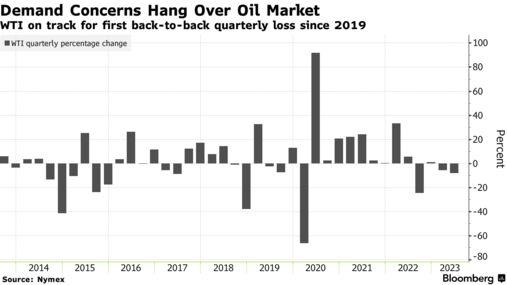
The US benchmark is still on track for its first back-to-back quarterly decline since 2019 as China’s lackluster economic recovery and aggressive monetary tightening by the Federal Reserve weighed on prices. Supply has also been plentiful, bolstered by resilient exports from Russia, despite sanctions.
US jet fuel demand rose to the highest since 2019 last week, the EIA reported on Wednesday. Consumption should continue to climb as the nation heads into the July 4th weekend, with a record number of motorists set to hit the road. Both benchmarks gained about 3% on Wednesday after the U.S. Energy Information Administration (EIA) said crude inventories dropped by 9.6 million barrels in the week ended June 23, far exceeding the 1.8-million barrel draw analysts had forecast in a Reuters poll. “The jury is still out on whether the second part of 2023 will bring with it the long-anticipated decline in inventories. Nonetheless, the impact that stocks have on oil prices was on display yesterday on a smaller scale,” PVM Oil analyst Tamas Varga said. Adding to pressure on oil, annual profits at industrial firms in China, the world’s second-biggest oil consumer, extended a double-digit decline in the first five months as softening demand squeezed margins. “The lack of prospects for fuel demand growth has limited the gain in oil prices, even with supply curbs by oil producers,” said Tetsu Emori, CEO of Emori Fund Management Inc. Facing falling prices, Saudi Arabia this month pledged to sharply cut its output in July, adding to a broader OPEC+ deal to limit supply into 2024. Brent’s six-month backwardation reached its lowest since December, but still indicated higher demand for immediate delivery. NN: Its sure looks to me like a very important technical and fundamental bottom has been put in. The oil market has a chance to do a zoom Zoom ZOOM because of the incredible number of short positions. It would not take much of a upmove to start tr buy triggering stops.
Top Russian generals are gone…. Maybe Dead
LONDON, June 29 (Reuters) – Russia’s most senior generals have dropped out of public view following a failed mercenary mutiny aimed at toppling the top brass, amid a drive by President Vladimir Putin to reassert his authority and unconfirmed reports of at least one arrest. Valery Gerasimov, Russia’s top general, has not appeared in public or on state TV since the aborted mutiny on Saturday when mercenary chief Yevgeny Prigozhin demanded Gerasimov be handed over. He has not been mentioned in a defence ministry press release since June 9 either. Gerasimov, 67, is the commander of Russia’s war in Ukraine, and the holder of one of Russia’s three “nuclear briefcases,” according to some Western military analysts. Absent from view too is General Sergei Surovikin, nicknamed “General Armageddon” by the Russian press for his aggressive tactics in the Syrian conflict, who is deputy commander of Russian forces in Ukraine. A New York Times report, based on a U.S. intelligence briefing, said on Tuesday he had advance knowledge of the mutiny and that Russian authorities were checking if he was complicit. The Russian-language version of the Moscow Times and a military blogger reported Surovikin’s arrest, while some other military correspondents who command large followings in Russia said he and other senior officers were being questioned about their possible role in the mutiny.
Rybar, an influential channel on the Telegram messaging application run by a former Russian defence ministry press officer, said a purge was underway.
He said the authorities were trying to weed out military personnel deemed to have shown “a lack of decisiveness” in putting down the mutiny amid some reports that parts of the armed forces appear to have done little to stop Wagner fighters in the initial stage of the rebellion. “The armed insurgency by the Wagner private military company has become a pretext for a massive purge in the ranks of the Russian Armed Forces,” said Rybar. Such a move, if confirmed, could alter the way Russia wages its war in Ukraine — which it calls a “special military operation” — and cause turmoil in the ranks at a time when Moscow is trying to stymie a Ukrainian counteroffensive. It could also cement or elevate the positions of other senior military and security figures regarded as loyal. Some Russian and Western military and political analysts believe Defence Minister Sergei Shoigu, a veteran Putin ally who Prigozhin wanted to bring down with Gerasimov because of his alleged incompetence, may actually now be safer in his job. “I think he (Prigozhin) actually expected something would be done about Shoigu and Gerasimov, that Putin would rule in his favour,” Michael Kofman, a Russian military specialist at the Carnegie Endowment think tank, wrote on Twitter. “Instead, his mutiny may have ensured their continued tenure, despite being universally recognised as incompetent, and widely detested in the Russian Federation’s armed forces.” Viktor Zolotov, head of the National Guard who used to be Putin’s bodyguard, appears to be another beneficiary after appearing in public to say his men were ready to “stand to the death” to defend Moscow from Wagner. He has spoken of the possibility of getting heavy weaponry and tanks for his forces in the wake of the mutiny. Gerasimov was conspicuous by his absence when Putin on Tuesday thanked the army for averting a civil war, unlike Shoigu who has made several public appearances since. Surovikin, Gerasimov’s deputy, was last seen on Saturday when he appeared in a video appealing to Prigozhin to halt his mutiny. He looked exhausted and it was unclear if he was speaking under duress.
There were unconfirmed Russian media and blogger reports on Wednesday evening that Surovikin was being held in Moscow’s Lefortovo detention facility after being arrested.
Alexei Venediktov, a well-connected journalist, said – without citing his sources – that Surovikin had not been in touch with his family since Saturday and that his bodyguards had gone silent too. Prigozhin, who had spent months vilifying Shoigu and Gerasimov for their alleged incompetence in the Ukraine war, had frequently praised Surovikin who is widely respected in the army for his experience in Chechnya and Syria. Surovikin, who did a stint as overall commander of the Ukraine war before Gerasimov was appointed to take over, is regarded by Western military analysts and by parts of the Ukrainian military as an effective operator. He had been spoken of by Russian war correspondents as a potential future defense minister. NN: Can you imagine the unspeakable things they are doing to those “missing” generals. Putin is ruthless. BUT the questions is what plot has he not uncovered. Putin’s days are numbered. Ukraine is his Waterloo. What the world has to worry about the crises for mankind Russian instability means. Anything and i do me ANYTHING could happen. I am afraid a lot of his rage will be vented on the Ukraine.
Powell wouldn’t rule out moving at consecutive meetings
United States Federal Reserve Chair Jerome Powell said on Wednesday, speaking at a panel at the ECB Forum for Central Banking, that he wouldn’t take hiking interest rates at consecutive meetings “off the table.” Nonetheless, Powell noted that the central bank hasn’t made any decisions yet when it comes to the upcoming meetings and the future monetary policy path. “The only thing we decided was not to raise rates in June,” he stressed. Looking at the data from the latest quarter, with “stronger than expected growth, tighter than expected labor market and higher than expected inflation,” the Fed policymaker stated that it is evident the policy “hasn’t been restrictive for very long,” repeating that future rate hikes should be expected. NN: Wall Street is really fucking up here. The FED is not Not NOT done raising rates. WALL STREET is dumping stocks on the public and into funds they manage before the crash…
Oil is on the Launch pad…… Maybe a moon shot?
Its over. It looks like the Bottom is in. Prices rising and inventories are falling. Demand is rising. And production is falling.
BlackMask Blog:
Oil shorts the grim reaper is coming for you

US Oil inventories down 2.41M barrels….. Oil Retests Triple Bottom
Crude oil inventories in the United States decreased this week by 2.408 million barrels, the American Petroleum Institute (API) data showed on Tuesday, after falling by 1.246 million barrels in the week prior. Analysts were expecting a smaller 1.467-million-barrel draw in U.S. crude-oil inventories. The total number of barrels of crude oil gained so far this year is nearly 36 million barrels according to API data, although the net draw in crude inventories since April is more than 8 million barrels. On Monday, the Department of Energy (DoE) reported that it sold another 1.4 million barrels of crude in the week ending June 23 from the Strategic Petroleum Reserve (SPR), for the 13th consecutive weekly drop in the stockpile to a 40-year low of 348.6 million barrels. The price of WTI and Brent were both trading up on Tuesday in the run-up to the data release—although prices are fairly flat compared to a month ago. At 4:09 pm ET, WTI was trading down $1.71 (-2.47%) on the day at $67.66 per barrel—a $5 per barrel dip on the week. The Brent crude oil benchmark was trading down $1.92 (-2.59%) at $72.26 per barrel. By 4:39 p.m. EST, WTI was trading down 2.29%, at $67.78 per barrel, while Brent crude was trading down 1.622.40% at $72.40 shortly after the data release. Gasoline inventories fell by 2.85 million barrels, undoing the 2.935 million barrel build in the week prior. Distillate inventories rose by 777,000 barrels, more than offsetting the 301,000 barrel loss in the week prior. Crude oil production in the United States fell back to 12.2 million bpd for the week ending June 16, according to EIA data, matching the previous low for this year. WTI is on track for its first back-to-back quarterly decline since 2019, due to a sluggish economic recovery from China and aggressive interest-rate hikes from the US Federal Reserve. Resilient Russian exports have added to the price pressures. Prices have been largely rangebound since early May, but have often swung rapidly within that range. “It’s not just macro, but fundamental weakness is being priced into the curves,” said Keshav Lohiya, founder of consultant Oilytics Ltd. “The confidence of the buy-the-dip crowd continues to get eroded away oil. NN: the constant testing of the triple bottom will soon be history. The price action you are seeing is typical at major market truing points. I will cover this in the next oil story and accompanying Blog which will be streamed live.
Oil rises softens supply worries, U.S. summer demand
June 27 (Reuters) – Oil prices edged lowerr on Tuesday, spurred by worries about political instability in Russia and possible supply disruptions, as well as U.S. demand hopes ahead of the summer driving season. A clash between Moscow and Russian mercenary group Wagner was averted on Saturday after the heavily armed mercenaries withdrew from the southern city of Rostov under a deal that halted their rapid advance on the capital. Following the weekend’s events, ANZ analysts said, the complacency among traders about Russian oil continuing to seep into the international market could no longer be assumed to the same extent.
“This is likely to lead to a risk premium being applied to the oil price amid the risk of further civil unrest,” they added in a note.
The challenge has fed questions about President Vladimir Putin’s grip on power and some concern about possible disruption of Russian oil supply, although loadings have kept on schedule. Lower supply has already been on investors’ minds, after
Saudi Arabia’s pledge to cut output from July. “An additional 1 million barrels per day (bpd) unilateral cut by Saudi Arabia, set to take effect in July, coupled with seasonally stronger demand, should help to physically tighten the market in Q3,” BMI Research analysts said in a client note.
Fragile market sentiment was likely to cap any price upside, however, they warned. Oil fell about 3.6% last week on worries that further interest rate hikes by the U.S. Federal Reserve could sap demand as China’s economic recovery disappoints investors. Traders were also watching for signs of a pickup in demand for transport fuels, such as gasoline, in the United States ahead of the peak summer driving season.
“The American Automobile Association estimates 43 million motorists will drive 50 miles or more from their homes this Independence Day weekend. That is 4% more than 2019,” the ANZ analysts added.
Global gasoline demand grew by 365,000 bpd year on year, driven by strong U.S. gasoline data, with consumption at an eight-week high of 9.4 million bpd in the week of June 17, JP Morgan analysts said in a note. NN: Gentleman start your Engines. Its North America driving season and consumption of all transportation fuels has already started to climb. How long can the markets deny demand is anyones guess.
Oil, Natural Gas And Wheat Prices Climb On Russia Coup Attempt
Crude oil prices for front-month deliveries climbed over 1% on Monday . Crude prices could be under pressure after Russian President Vladimir Putin decided to extend measures until the end of the year, restricting the sale of the country’s oil and oil products to “unfriendly” nations. West Texas Intermediate (WTI) for August contracts rose 1.11%, selling at $69.93 per barrel at 1:18 pm ET. Brent for the same month’s settlements added 1.10%, going at $74.70 per barrel. In Europe natural gas prices and the wheat futures in Chicago rose on Monday, following a chaotic weekend in Russia where the Wagner mercenary group staged a short-lived revolt and a march on Moscow that never reached the Russian capital. Early on Monday, Chicago wheat futures gained 2.5%, while European natural gas prices jumped by more than 5%. Oil bases West Texas Intermediate (WTI) for August contracts rose 1.11%, selling at $69.93 per barrel at 1:18 pm ET. Brent for the same month’s settlements added 1.10%, going at $74.70 per barrel.markets. On Tuesday European open oil continued to climb with WTI up .40 cents trading at $70 a barrel and Brent up .30 cents trading close to $75 a barrel.
Russia Mutiny Throws New Risk Into Already Volatile Gas Market
Gas traders are bracing for more volatility after a short-lived rebellion in Russia poses yet another risk to supply. Northeast Asian spot liquefied natural gas prices rose to $12 per million British thermal units on Monday, while swap values were pegged above that level, according to traders and brokers. That’s about 50 cents to $1 higher than on Friday, they said. In Europe, benchmark futures jumped as much as 14%. Even as the uprising by Yevgeny Prigozhin, leader of the Wagner mercenary group, has been defused, the crisis still represents the biggest threat so far to President Vladimir Putin’s control over Russia. Traders are watching for any signs of further instability in Russia that could affect the country’s gas production and exports. The turmoil comes as European gas is already seeing the highest volatility since Russia invaded Ukraine early last year.
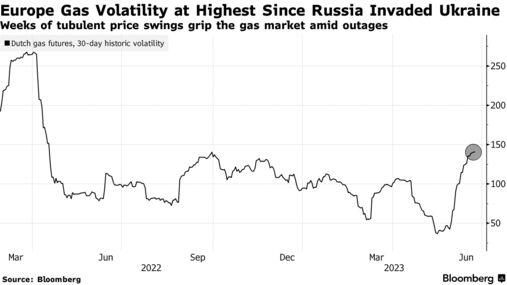
Ongoing outages in Norway and plans to close a gas field in the Netherlands have led to turbulent price swings this month. While Russian gas deliveries to Europe are dwindling, some nations, including Austria and Slovakia, still rely on the fuel flowing via Ukraine. “Russian geopolitical risk now is significantly higher than before the weekend,” said Tom Marzec-Manser, head of gas analytics at ICIS in London. “The uncertainty of what could happen in the coming weeks within Russia itself – rather than within Ukraine – is likely to push markets higher on Monday.” To be sure, oil and gold markets were relatively calm on Monday in the wake of the weekend’s geopolitical shock. NN: See Market News and commentary published today.