New Canadian Pipeline To Boost Oil Prospects

  • Canadian oil industry’s new hope is the Trans Mountain conduit which is set to begin operating next year.
  • The pipeline expansion will help Canada increase its pipeline capacity, overcome constraints and open new markets in Asia, improving price for crude.
  • The pipeline will transport around two times as much oil as previously, with capacity at 890,000 bpd, and it is expected to reinvigorate the industry and boost oil prospects.

Canadian oil producers have repeatedly pushed for new oil transportation links and pipeline expansion projects in recent years without much avail. The massive Keystone XL pipeline project was halted by President Biden in 2021, leading Canada to be more pessimistic about its North American oil potential. However, the Trans Mountain conduit, which is set to start up next year, is expected to help Canada overcome its constrained pipeline capacity and open new markets. Calgary-based TC Energy, the sponsors of the Keystone XL pipeline, decided to bring an end to the construction of the partially built line after President Biden rejected plans for it to run through the U.S., transporting crude from the oil sand fields of western Canada to Steele City, Nebraska. Keystone was set to measure 1,200 miles, having been approved by President Trump after years of delay under the Obama administration. It was supposed to transport 830,000 bpd of oil to Nebraska and onwards to the Gulf of Mexico. Biden cancelled the permit on the grounds that burning oil sands crude could worsen climate change, going against U.S. climate pledges.  For many, the cancellation of Keystone was the nail in the coffin for Canada’s new oil pipeline ambitions. However, a new project, the Trans Mountain conduit, is bringing hope to the oil and natural gas industry once again. The expansion of the conduit could open Canada to new markets in Asia and help the country get better prices for its crude. Prime Minister Justin Trudeau bought the project for $3.3 billion from Houston-based Kinder Morgan in 2018 to lessen oil-sands producers’ dependence on U.S. refiners that drive down the price of their crude. In previous years, Canada’s constrained pipeline capacity meant that it relied heavily on U.S. oil refiners, who bought Canadian crude at discounted prices due to the lack of other market options. The difference in price per barrel between Western Canada Select and West Texas Intermediate has been significant over the years, standing on average between $10 and $20 and spiking several times over the last six years, with a peak difference of $50 in 2018.  The new Trans Mountain expansion will help Canada overcome its pipeline capacity constraint. The $22.9 billion Trans Mountain conduit will transport around two times as much oil as previously, with a total capacity of 890,000 bpd. The country’s biggest oil producer, CNRL, hopes to shop 94,000 bpd on the route – around 16 percent of the line’s total capacity – starting in the first months of 2024. Companies are aiming to establish new markets in Asia and the U.S. West Coast. This will also help producers transport crude from new oilfield expansion projects, such as Exxon Mobil’s 15,000 bpd Cold Lake facility expansion. It is expected to reinvigorate the industry and encourage operators to reconsider paused expansion projects.  Despite optimism around the opening of the new pipeline, the project has faced significant criticism. The cost of the pipeline has risen sixfold since the original proposal in 2013, from around $4 billion to over $22.9 billion. The pipeline has faced opposition from several actors, which has contributed to the repeated construction delays.   Even now, the pipeline continues to face opposition, particularly in terms of climate change, as the world undergoes a green transition. Tens of thousands of people have demonstrated against the pipeline, with hundreds being arrested. It could also encourage reliance on fossil fuels rather than renewable alternatives at a time when North America is supposed to be transitioning to green. The Trans Mountain conduit expansion is expected to boost Canadian oil production and help the country expand its crude markets to bring oil prices up to the regional average. But following years of delays and the significantly increased costs incurred, it continues to face criticism, with many suggesting the need for an improved regulatory system to prevent these types of challenges from happening again. NN: its a sad day when a fuciking fool that in the good old days was  locked up in a dungeon and brought after dinner for amusement or a gladiator was kept in a cage under the arena until the next flight is suddenly a expert on everything. AND if you shake your ass, run fast with a ball or sing a song the masses make you a god and hang on your every word. The fools, minstrials and gladiators are setting the agenda….. That is NOT the case in China where they have financed and completed the worlds longest pipelines.

China’s trade surplus up to $1.44T in Q1

China’s trade surplus stood at 9.89 trillion yuan ($1.44 trillion) in the first quarter of 2023, rising 4.8% compared to the same period a year earlier, the country’s General Administration of Customs said on Thursday. Exports climbed 8.4% to 5.65 trillion yuan with exports of electric vehicles, lithium batteries and solar products contributing most to the increase. Meanwhile, imports were up 0.2% year on year and amounted to 4.24 trillion yuan. In March, foreign trade rose 15.5% compared to the same month in 2022.

China Balance of Trade

China’s trade surplus widened to USD 88.19 billion in March 2023 from USD 44.35 billion in the same period a year earlier, easily beating market forecasts of USD 39.2 billion. Exports unexpectedly jumped by 14.8% yoy, the first increase in six months and the fastest pace since last July, while imports dropped a smaller-than-expected 1.4%, amid weakening domestic demand. Meanwhile, the politically sensitive trade surplus with the United States narrowed to USD 27.6 billion in March from USD 41.3 billion in February. NN: China is back bigger and badder then ever, And in order to have a trillion dollar plus trade surplus you got to sell a lot of shit… And to make the shit you sell you got to use a lot of energy. I  love these balance of trade reports… they are the most accurate since they are based on customs cleared goods.

Tighter Supplies Driving Oils to the HIGHS of the year

  • Cushing inventories are at the lowest since January: EIA
  • WTI climbs above $82, reaching the highest this year

Oil rose to the highest intraday price this year as slowing flows from Russia, production cuts by OPEC+ and falling US inventories pointed to a tightening market.  West Texas Intermediate rallied above $82 a barrel, bolstered by a broader relief rally triggered by signs of moderating US inflation. Russian shipments slid below 3 million barrels a day for the first time in eight weeks, after Moscow vowed to cut production. And, in the US, oil inventories at the key Cushing, Oklahoma, storage hub slid for a sixth week to hover near the lowest since January. Oil prices are likely to “move a bit higher from here as a result,” said Rob Thummel, a portfolio manager at Tortoise Capital Advisors.

Oil Rallies to 2023 Highs | Crude rose the highest price this year on signs of market tightening

Crude has rebounded from the 15-month low seen in March, after the Organization of Petroleum Exporting Countries and its allies cut output. Traders are also sticking to the view that Chinese demand will pick up. In the Middle East, pipeline flows from Iraq’s semi-autonomous Kurdistan region remain halted. The commodity’s strength is also reflected in measures tracking the oil market’s structure. WTI’s prompt spread — the difference between its two nearest contracts — is trading near 9 cents in backwardation, the highest this year on a closing basis. NN: Its a binary trade. $120 oil here we come.. and if you stuck to your guns and had the 3 things to throw at this trade your dancing a JIG. What are these 3 things you might ask. Why its the 3 B’s. BRAINS ,BALLS AND BUCKS!!

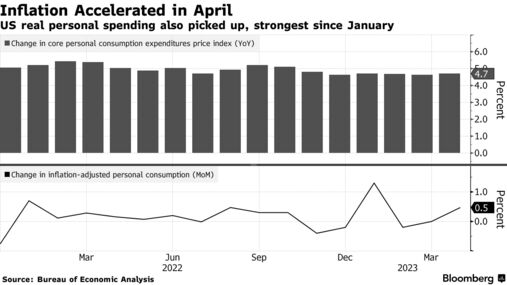
Fed’s Barkin Says There’s More Work to Do to Rein in Inflation….. Core inflation UP!… rose 0.4% from the prior month……

The core CPI, which economists view as the better indicator of underlying inflation, was up 5.6% from a year ago. It’s the first time in over two years that the core came in above the overall measure, which was up 5%. Investors initially reacted positively to the report before a rally in stocks and Treasuries cooled. See when you read the whole report it was a disaster. The headline number picked up the drop in energy prices now reversing….  Inflation, however, remains too high.

The core CPI, which economists view as the better indicator of underlying inflation, was up 5.6% from a year ago. It’s the first time in over two years that the core came in above the overall measure, which was up 5%.

That’s a sharp slowdown from the previous month because the figure is now compared with March 2022, when energy prices spiked immediately after Russia’s invasion of Ukraine. NN: the report is a disaster. Inflation is not Not NOT moderating… Look at the year over year… the FED Does and they will for sure without a doubt continue to raise rates…..

Fed’s Barkin Says There’s More Work to Do to Rein in Inflation

Federal Reserve Bank of Richmond President Thomas Barkin said policymakers still have more work to do to tame prices after fresh data Wednesday showed inflation remained well above the Fed’s 2% target.  “I certainly think we are past peak on inflation, but we still have a ways to go,” Barkin said in a CNBC interview from Roanoke, Virginia, where the bank was hosting a conference. Barkin said he sees signs that demand is cooling, but said he was wary of declaring victory on inflation too soon, and noted that prices excluding food and energy were still too high. “There’s still more to do I think to get core inflation back down to where we’d like it to be,” he said, but he stopped short of saying whether he would support a rate hike at the Fed’s May 2-3 policy meeting. The Fed official made his comments after the March consumer-price report showed inflation was moderating. US consumer prices rose 0.1% in March, just below economists’ forecast of 0.2% and was up 5% from a year earlier. The closely watched core CPI number — which excludes food and energy — increased 0.4%,  Up 5.7% year over year. Most Federal Open Market Committee officials have emphasized that even amid the uncertainties created by the banking-sector stress, the Fed has more work to do to bring inflation down to its 2% target. Markets are pricing in the likelihood of an additional hike on May 3.

OPEC+ Oil Production Sees Biggest Drop In 10 Months

In March, OPEC+ producers saw the biggest decline in their collective production in 10 months, as output fell by 680,000 barrels per day (bpd) to 37.64 million bpd, an assessment by Energy Intelligence showed this week. Russia, which said it was cutting oil production in March, as well as Nigeria accounted for most of the OPEC+ oil production drop. Declines in Russian and Nigerian oil production accounted for 440,000 bpd, or two-thirds, of the March drop in OPEC+ output, according to Energy Intelligence.  In March, oil production from the OPEC+ group fell to levels last seen in May 2022, with the alliance 2.5 million bpd below its targeted collective production quota. That is the largest gap between overall quota and actual production since October last year, per Energy Intelligence’s assessment. Just after the end of March, several major OPEC+ producers, led by the top producers in the Middle East, announced on April 2 a total of 1.16 million bpd of fresh production cuts between May and December this year. Saudi Arabia, OPEC’s de facto leader and top global crude exporter, will cut 500,000 bpd and said that the move was “a precautionary measure aimed at supporting the stability of the oil market.” Apart from Saudi Arabia, OPEC heavyweights Iraq, the United Arab Emirates (UAE), and Kuwait, plus OPEC’s Algeria and Gabon, and non-OPEC Oman and Kazakhstan, announced the 1.16 million bpd cut. That’s on top of Russia’s current 500,000 bpd cut which was extended until the end of the year. From within OPEC, Iraq is set to cut 211,000 bpd of its supply, the UAE – 144,000 bpd, and Kuwait – 128,000 bpd. Added to the Saudi cut of 500,000 bpd, nearly 1 million bpd of supply from the Middle East will disappear from the market as of next month. NN: Oil producers are not fucking around here. As i told you loudly and longly OPEC would not tolerate $70 a barrel oil. And in the blink of a eye brought oil to $85. And you wanna here the really good part. They are not done. See how fast the Saudi’s an Iranian’s jumped back in bed together….. Price is everything……

Oil Prices Return To Recent Highs

The price of crude oil returned on Tuesday to the recent highs seen after OPEC+ announced it would cut production by another 1.6 million barrels per day. On April 2, OPEC+ announced that it would cut its crude oil production by another 1.66 million barrels per day (including the 500,000 bpd Russian production cut) on top of its 2 million bpd cut. Naturally, oil prices spiked following the news, reaching gains of 8% at the Monday open. Brent was trading at more than $86 per barrel, with WTI trading at nearly $81. Further gains were made after opening, with WTI reaching $81.69 Today, the price of WTI has climbed by more than 2% on the day to $81.37, with Brent climbing 1.50% to $85.44. And prices were still rising at the time of writing. A Tuesday report by Energy Intelligence showed that OPEC+’s total March production was 680,000 fewer barrels per day than the month prior, falling to 37.64 million bpd. Most of the production drop was attributed to Nigeria and Russia, which together accounted for 440,000 bpd of the production decline. Fears of tighter supply as a result of the ever-elusive but always-present China reopening schtick clashing with OPEC+’s supply decreases are most likely behind the Tuesday price moves. U.S. gasoline prices continue to tick upward as well, along with the price of oil. Tuesday’s national average gasoline prices were $3.608 per gallon, according to AAA—an increase of more than $0.10 from a week ago, accounting for most of the $0.134 per gallon rise over the last month. While Brent and WTI prices were climbing on Tuesday, WCS prices were falling, losing 1.61% and reaching $58.49.Citigroup said on Tuesday that it is estimating that prices will fall below $80 on China’s slower-than-expected recovery. NN: IF the FEDS caves in to wallstreet pressure to even pause interest rate hikes we will get a burns moment. As in Arthur Burns whose pausing rate increases  when  inflation was easy to stamp out gave us the Volcker moment.  And Fed Funds rates at 20%.  You really do not want to live in that hell.

Fed’s Williams: We need to watch retail sales, CPI data

Federal Reserve Bank of New York President John Williams remarked on Tuesday that the central bank has brought the monetary policy to a “restrictive stance” and that, for any future decisions, it should monitor retail sales, inflation and other data. “We will see what we need to do on hikes by assessing the data,” Williams told Yahoo Finance. “One more rate hike is a reasonable starting place but we will be driven by the data. … If inflation comes down, we will have to lower rates.” Commenting on the labor market, he noted “some slowing in demand for labor,” but insisted that “job growth is still quite strong.” Earlier this week, Williams predicted inflation will go back to its target of 2% by 2025 and previously go down to around 3.75% in 2023.

China’s inflation down to 0.9% in March

China’s consumer price inflation fell below one percent in March, official figures showed Tuesday. The March consumer price index (CPI) — the main gauge of inflation — came in at 0.7 percent, down from the one percent seen a month earlier, according to the country’s National Bureau of Statistics (NBS). Beijing is targeting an average inflation rate of three percent for 2023, which is still far below the current rates of many developed economies. Analysts had expected a faster pace in March, with economic activity picking up again after the abandonment of zero-Covid restrictions at the end of 2022. The producer price index (PPI), which measures the cost of goods leaving factories, shrank for the sixth consecutive month, with prices falling 2.5 percent — indicating lower margins for businesses.

“Economic recovery is on track but not strong enough to push up prices,” Zhiwei Zhang of Pinpoint Asset Management wrote in a note.

“This suggests the economy is still running below its potential,” he added, suggesting the data made an interest rate cut more likely. Fresh fruit prices rose 11.5 percent year-on-year, and pork, the most consumed meat in the country, jumped 9.6 percent.

The cost of fuel for transport fell 6.4 percent.

Globally, commodity and food prices are rising, though China has remained relatively unscathed by increases linked to the war in Ukraine. “We think consumer price inflation will rebound in the coming months as the labour market tightens again,” analysts from Capital Economics said in a note. “But it will be well below the government’s ceiling of around three percent, and the increase in inflation will be far smaller than what was seen elsewhere when they opened up.” China is targeting five percent economic growth this year, one of the lowest targets in decades. NN: Chinese central bank has played this perfectly. Plenty of real cash…. huge foreign currency reserves, and the high tech factory to the world,… How did this happen. Well ticktock in China is not  dribble a basket ball, shake your booty, wiggle your titties and deal with weighty issues like what sex your are or wanna be. In china try pulling off that shit and you will be dragged off in the night. Something to be said for a police state. Ticktock in china is about science and engineering and getting a degree in serious science.  As versus  in the US climate change, comparitive religions .. or my favorite sitting in the desert with a paint brush (digging up dried turds) getting a degree in anthropology. This is if the America student be bothered to  read in between climate change protest, demonstrating for slave representations or going to the latest rainbow rally……

Inventory Draws Across The Board Push Oil Prices Higher

Oil prices climbed higher today, after the Energy Information Administration reported a crude oil inventory draw of 3.7 million barrels for the week to March 31.

At 470 million barrels, inventories are about 4 percent above the five-year average for this time of the year, the authority said.

Last week’s draw compares with a draw of 7.5 million barrels estimated for the previous week, which helped push oil prices higher. Of course, this week’s breaking news about OPEC+ deciding to reduce oil production by another million barrels daily had an even stronger effect on prices, pushing both Brent crude and West Texas Intermediate above $80 per barrel in a matter of hours.

Meanwhile, the EIA also reported an inventory decline in gasoline and another one in middle distillate inventories for the last week of March.

In gasoline, inventories fell by 4.1 million barrels in the period, with production averaging 9.9 million barrels daily. This compared with an inventory draw of 2.9 million barrels for the previous week, with production then averaging 10 million barrels daily.In middle distillates, the EIA estimated an inventory decline of 3.6 million barrels for the last week of March, with production at 4.7 million bpd. This compared with a distillate stock build of 300,000 barrels for the previous week, when production averaged 4.6 million bpd. Meanwhile, after the initial surge in prices on Monday, following the OPEC+ announcement, benchmarks stabilized, with Brent crude a bit over $84 a barrel and West Texas Intermediate at over $80 per barrel, slightly retreating from earlier today. Analysts explained the stabilization with continued questions about the immediate future of oil demand. “We will need to see demand hold and grow to push crude into the upper $80’s,” BOK Financial, senior vice president for trading Dennis Kissler told Reuters.