The United States and Israel launched a massive, coordinated military strike across Iran, including the capital of Tehran, marking a major escalation in the regional conflict.
The attack, which included strikes on cities like Isfahan and Qom, led Israel to declare a state of emergency and close its airspace.
Analysts expect significant volatility and a sharp “war premium” to be priced into crude oil when markets open, as the Strait of Hormuz, a vital chokepoint for 20 percent of the world’s oil supply, is now considered a war zone. Global energy markets are set to see significant volatility following a United States-Israel coordinated wave of military strikes across Iran early this morning. The attack, which targeted multiple cities including the capital of Tehran, marks a huge escalation in a regional conflict that has simmered for months. Israeli Defense Minister Israel Katz confirmed the “preemptive strike” as a state of emergency was declared across Israel. U.S. officials described the operation as “not a small strike,” involving attack planes from regional bases and aircraft carriers. On Friday, crude prices rose more than 2% as traders considered the likelihood of a strike after the meeting between Iran and the U.S. in Switzerland failed to produce any meaningful progress. The strikes come during a period of extreme domestic instability within Iran. Human rights groups estimate that over 5,000 protesters have been killed in a recent government crackdown. President Donald Trump cited both the nuclear program and the treatment of protesters as justifications for the assault. Anticipating the attack, Iranian authorities reportedly spent the last several days rushing to ship as much crude oil as possible out of the country. Satellite imagery and shipping data indicated an unusual surge in tanker activity at Iranian terminals throughout the week. Tehran sought to maximize its revenue and clear storage facilities before the potential destruction of infrastructure or the implementation of even stricter maritime blockades. This is the second time the U.S. has struck Iranian soil in less than a year. In June 2025, American warplanes bombed three nuclear sites, including the Fordo enrichment facility. While that conflict ended in a brief ceasefire, the current operation appears far more extensive. Israel has closed its airspace and suspended all civilian flights. The Home Front Command has ordered the public to cease non-essential activities, prohibiting gatherings and closing schools. In Iran, the strikes occurred on a Saturday morning, the start of the work week, leading to reports of chaos as millions were already in offices and classrooms. With the Strait of Hormuz, a vital chokepoint for 20 percent of the world’s oil supply, now effectively a war zone, analysts expect a sharp “war premium” to be priced into crude at the Monday market open.
United States President Donald Trump confirmed that US forces are conducting “major combat operations” in Iran. He described the campaign as “massive and ongoing” and said the effort aims to stop Iran from threatening US lives and national security. Trump said the operations respond to Iran’s efforts to rebuild its nuclear program after previous US strikes. “They rejected every opportunity to reach their nuclear ambitions, and we can’t take it anymore,” he said. The operations were coordinated with Israel, with Israeli Defense Minister Israel Katz confirming the strikes first.
IRGC confirms ‘first wave of missiles’ against Israel
The Iranian Revolutionary Guard Corps (IRGC) confirmed on Saturday the “first wave of missiles” launched against Israel, following a joint attack from Tel Aviv and Washington. The blasts come “in response to the hostile and criminal enemy’s aggression against the Islamic Republic of Iran,” the military’s statement reads. Several reports confirmed Iran’s blasts against Israel, targeting Tel Aviv and Jerusalem
Houthis said to resume attacks on Red Sea
The Yemen-based Houthis said they will resume attacks on ships in the Red Sea corridor, AP reported, citing rebel officials. The announcement follows a series of strikes by the United States and Israel against Iran, with Tehran responding by targeting Israeli sites after attacks on Iranian positions. The Houthis, an Iran-backed group, control large parts of northern Yemen, including the capital Sanaa.
NN: Trump will go down in history as one of the great leaders of all time,,, with all his warts and pimples.
United States President Donald Trump told reporters on Friday that while he is “not happy” with Iran, he has yet to make a decision on Washington’s actions regarding the matter. When asked about using military force against Tehran, the US head of state reiterated that while he wouldn’t like to, “sometimes you have to [use force].” He added that Iran is not saying “the golden words: No nuclear weapons.” Trump once again advised Iran to make a deal, as this would be a “smart” choice. He noted that more talks are expected on Friday. On regime changes in Iran, the US president said that that may or may not happen.
United States President Donald Trump received a briefing on potential military options for Iran from Navy Admiral Brad Cooper, head of US Central Command (CENTCOM), ABC News reported, citing a person close to the president. Joint Chiefs Chairman General Dan Caine attended the briefing as the president’s top military adviser, a second person familiar with the discussion told the news agency. The briefing, which took place on Thursday, comes amid renewed indirect nuclear negotiations between the US and Iran in Geneva, where delegations from both countries are trying to avert conflict.
Economists and oil market analysts have hiked their oil price forecasts for 2026 amid rising geopolitical tensions and heightened war premium due to the U.S.-Iran standoff. Both crude oil benchmarks are now expected to average above $60 per barrel this year, with price forecasts higher by about $1.50 per barrel compared to a month ago, the monthly Reuters poll showed on Friday. Despite ongoing concerns about an oversupplied market, the 34 analysts and economists surveyed by Reuters in February raised their projections in view of uncertainties in how the Iran crisis would unfold in the coming weeks and months. In the February poll, Brent Crude prices are expected to average $63.85 per barrel in 2026. This month’s estimate is higher compared to the January forecast of $62.02. The analysts in the poll expect the U.S. benchmark, WTI Crude, to average above $60 per barrel this year, too—at $60.38 a barrel, up from $58.72 expected in January. Year to date, Brent price have averaged $70.48 per barrel and WTI – $65.01 a barrel. Early on Friday, both benchmarks were trading 3% higher, with Brent near $73 and WTI at $67, after the United States and Iran adjourned the Thursday talks with plans for another round of negotiations next week. Oman’s Foreign Minister, Badr Albusaidi, who was mediating the indirect talks in Geneva, said the parties had made “significant progress” in the nuclear talks. Next week, negotiations are set to be held in Vienna, Austria. It is the ongoing U.S.-Iran standoff that has been the main driver of oil analysts in the Reuters poll to raise their oil price forecasts for this year. Currently, the geopolitical risk premium already baked in the price of oil is about $4-$10 per barrel, analysts say. The war premium, the OPEC+ supply policy, and the fundamentals in supply-demand balances will steer the direction of oil prices this year, they note.
Crude oil prices rose by more than 1.8% on Friday after Iranian Foreign Minister Abbas Araghchi confirmed that his country’s delegation will meet the American negotiating team next week for another round of nuclear talks. Meanwhile, United States President Donald Trump was reportedly briefed on potential military options for Iran, following reports of US Special Envoy Steve Witkoff and Trump’s son-in-law, Jared Kushner, being “disappointed” with the latest negotiating round. West Texas Intermediate (WTI) for settlements in April climbed by 1.84% at 5:04 am ET, going for $66.40 per barrel. Meanwhile, Brent for the same month’s deliveries advanced by 1.81% and went for $71.93 a barrel at 5:03 am ET.
White House Special Envoy for Middle East Peace Steve Witkoff and Presidential Advisor Jared Kushner expressed disappointment with the Iranian Foreign Minister Abbas Araghchi’s position during the negotiations in Geneva, Axios reporter Barak Ravid reported on Thursday, citing a source familiar with the details. The two sides engaged in direct talks in addition to those facilitated by Omani mediators, but no details concerning the substance or even the length of the discussions were provided in media reports.
USS Gerald R. Ford was spotted leaving the Greek island of Crete on Thursday and reportedly sailing toward the Eastern Mediterranean. The military vessel is rumored to dock at an Israeli port, as Washington continues to increase its military presence in the Middle East. Previously, the US had already deployed another aircraft carrier, USS Abraham Lincoln, to the Arabian Sea, along with three destroyers. Moreover, recent satellite data indicated that strategic bombers, surveillance, and refuelling aircraft have been deployed to the Diego Garcia military base in the Indian Ocean, which US President Donald Trump suggested could be used to strike Iran in case of conflict.
The latest talks in Geneva between the U.S. and Iran on the nuclear issue are ongoing. The U.S. has been increasing military presence in the Gulf as pressure, while both sides are under time constraints to reach a deal. The U.S. wants permanent restrictions, while Iran seeks enrichment rights. The outcome could influence oil markets—a diplomatic solution may ease prices, while escalation could push oil past $100 a barrel.
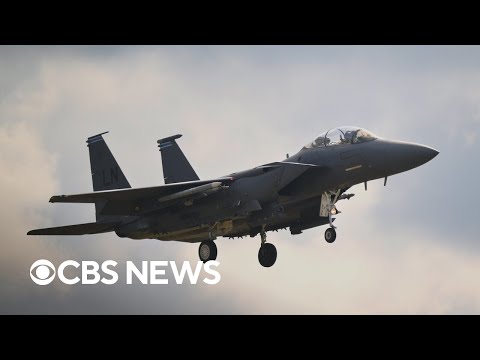
The United States has begun moving another six F-22 stealth fighter jets toward the Middle East, The Times of Israel reported on Wednesday, citing analysts monitoring open-source flight tracking data. According to the report, the new batch of American fighter jets took off earlier today from the US and flew alongside their accompanying refuelling aircraft, heading for the Royal Air Force base at Lakenheath, England. The six additional fighters are expected to be deployed to an Israeli Air Force base in southern Israel, where another 11 F-22 Raptors landed yesterday. The movement of fighter jets comes as the US is building up its military assets in the Middle East, while US President Donald Trump weighs whether to launch strikes against Iran.
American F-22 stealth fighter jets, which departed from the United Kingdom earlier today, landed at an Israeli Air Force base in southern Israel, Israeli media reported on Tuesday, claiming that the total number of US aircraft deployed to the country is 12. According to the reports, the US fighters deployed in Israel are intended to help intercept missiles and drones launched by Iran in case the United States decides to mount a military operation against this Middle Eastern country. The US has been building up its military assets in the Middle East in recent weeks as President Donald Trump weighs whether to take military action against Iran. Meanwhile, Iranian Foreign Minister Abbas Araghchi claimed that a nuclear deal with Washington is possible if “diplomacy is given priority.”