Oil prices fell more than two per cent on as concerns about Chinese cities in lockdown due to coronavirus outbreaks tempered a rally driven by strong import data from the world’s biggest crude importer and U.S. plans for a large stimulus package. Brent crude fell $1.32, or 2.34 per cent, to settle at $55.10 per barrel, after gaining 0.6 per cent on Thursday. U.S. West Texas Intermediate crude settled $1.21, or 2.26 per cent, lower at $52.36 per barrel, having risen more than 1 per cent the previous session. Both benchmarks, which hit their highest in nearly a year earlier in the week, were are heading for their first weekly declines in three weeks. While producers are facing unparalleled challenges balancing supply and demand equations with calculus involving vaccine rollouts versus lockdowns, financial contracts have been boosted by strong equities and a weaker dollar, which makes oil cheaper, along with strong Chinese demand. These positives were called into question on Friday as the dollar rose and China ramped up lockdown measures. A nearly $2 trillion COVID-19 relief package in the United States unveiled by President-elect Joe Biden may increase oil demand from the world’s biggest crude consumer. Still, some analysts said the move may not be enough to stoke demand. NN: As i said at the start of this oil trade OPEC 5 times held off supply and got prices to ZOOM. And everytime they overplayed their hand and prices crashed. It will be no different this time. This morning BRENT broke under $80. My only regret is we did not get $100 WTI… But you can’t have everything…..
S&P, Nasdaq end at record peaks on strong earnings
US. stock indexes closed mostly at records in a choppy Thursday session, buoyed by upbeat earnings from chip company Nvidia Inc. and major retailers, while concerns about a seasonal rise in COVID-19 cases were seen capping gains. It wasn’t all good news on the earnings front, however, with the Dow Jones Industrial Average weighed down by a steep loss for Cisco Systems Inc.
- The Dow closed down 60.10 points, or 0.2%, at 35,870.95.
- The S&P 500 rose 15.87 points, or 0.3%, to end at a record 4,704.54.
- The Nasdaq Composite climbed 72.14 points, or 0.5%, finishing at a record 15.993.71
On Wednesday, the Dow, S&P 500 and Nasdaq Composite all lost ground in a subdued trading session. The S&P 500 remained just 0.3% away from its record close, with the Nasdaq Composite just 0.4% its all-time high finish. Stocks drifted between small gains and losses into the midday, before firming up in the afternoon and into the close. Analysts said concerns over a renewed rise in COVID-19 cases in Europe weighed on the market. Germany has seen the highest number of daily cases seen over the course of the pandemic, while other countries have weighed renewed lockdown measures. U.S. cases continue to average more than 88,000 a day, and more than 48,000 people were hospitalized. Michigan and Minnesota lead the U.S. by new cases as measured on a per capita basis. “The fourth wave is hitting our country with full force,” Merkel said in a speech on Wednesday. “The daily death toll is also frightening.” Stocks have noticed, said Tom Essaye, founder of Sevens Report Research, in a note, with cruise line names and hotel companies suffering modest declines in recent sessions. Essaye wrote that he doubted a rise in cases would result in renewed U.S. lockdowns, but if cases continue to rise, “we could see temporary headwinds on the ‘Get Out and Spend’ name such as cruise lines, theme parks, hotels and live-event companies.” Corporate earnings have beaten Wall Street estimates in the third quarter, as strong demand has helped to offset the pressure from supply-chain disruptions. New York Federal Reserve President John Williams on Wednesday defended the central bank’s new inflation-targeting strategy from critics who say it is holding the central bank from taking obvious moves to bring cool prices. Chicago Fed President Charles Evans said late Wednesday that the disruptions have lasted longer than he anticipated, though he still expects the central bank to end its bond-buying program in the middle of 2022 as currently planned. “The reason why I think momentum will be good going into next year is because I think the supply-chain issues are going to be rectified,” said Evans on Thursday. Markets will be highly tuned into any signals on who President Joe Biden will pick to chair the Fed. Biden on Tuesday said a decision would come “in about four days.” The decision is widely seen as coming down to a choice between renominating Chairman Jerome Powell or choosing Fed Gov. Lael Brainard. “Stock markets have been resilient all year; they have looked through upside surprises in inflation, downside surprises in growth, and a dramatic change in central bank pricing,” said strategists at Barclays led by Ajay Rajadhyaksha. The Barclays strategists see limited upside to U.S. equities but also don’t expect a major selloff, as there’s significant downside hedging. NN: No doubt a 10% to 20% correction is coming. And then later on something much much uglier. Its a matter of timing. What may kick off the fun is Europe may be going into a 4th wave lockdown.
Exclusive: China reserve bureau working on crude oil release
BEIJING (Reuters) – China’s state reserve bureau said on Thursday it is working on a release of crude oil reserves although it declined to comment on a U.S. request to the world’s top consuming nations to tap stockpiles to ease global energy prices. The National Food and Strategic Reserves Administration told Reuters when asked to comment on the U.S. request that it would disclose the details of the move on its website. “We are carrying out the work of releasing crude oil reserves. And for any details related to the releasing, we will put out a statement on our website,” a reserve bureau spokeswoman said. China, the world’s biggest oil importer, rolled out its first public auction of state crude oil reserves to a select group of domestic refiners in September, aiming to stabilise energy prices. Beijing also said earlier this month it would tap its state fuel reserves to tame the soaring diesel and gasoline prices. China keeps its strategic reserve level a secret. The last public update was in 2019 when the National Energy Administration disclosed the country had oil inventories, including state reserves and stocks at oil firms and commercial tanks, to last 80 days. “Physical oil markets in Asia remain tight … A coordinated SPR release could have a larger impact, even if also temporary,” said analysts from Citi in a note on Thursday. NN: Its the OPEC equivalent of Sophie’s Choice. Do they let their clients strategic reserve draws supply the market. Or should they relent and increase their oil output. OPEC is making a colossal strategic mistake by forcing its customers to supply oil and drive prices lower. The smartest thing they can do is relent, increase production and settle for $60 oil.
S&P, Nasdaq end at record peaks on strong earnings
U.S. stock indexes closed mostly at records in a choppy Thursday session, buoyed by upbeat earnings from chip company Nvidia Inc. and major retailers, while concerns about a seasonal rise in COVID-19 cases were seen capping gains. It wasn’t all good news on the earnings front, however, with the Dow Jones Industrial Average weighed down by a steep loss for Cisco Systems Inc.
- The Dow closed down 60.10 points, or 0.2%, at 35,870.95.
- The S&P 500 rose 15.87 points, or 0.3%, to end at a record 4,704.54.
- The Nasdaq Composite climbed 72.14 points, or 0.5%, finishing at a record 15,993.71.
On Wednesday, the Dow, S&P 500 and Nasdaq Composite all lost ground in a subdued trading session. The S&P 500 remained just 0.3% away from its record close, with the Nasdaq Composite just 0.4% its all-time high finish. Stocks drifted between small gains and losses into the midday, before firming up in the afternoon and into the close. Analysts said concerns over a renewed rise in COVID-19 cases in Europe weighed on the market. Germany has seen the highest number of daily cases seen over the course of the pandemic, while other countries have weighed renewed lockdown measures. U.S. cases continue to average more than 88,000 a day, and more than 48,000 people were hospitalized. Michigan and Minnesota lead the U.S. by new cases as measured on a per capita basis. “The fourth wave is hitting our country with full force,” Merkel said in a speech on Wednesday. “The daily death toll is also frightening.” Stocks have noticed, said Tom Essaye, founder of Sevens Report Research, in a note, with cruise line names and hotel companies suffering modest declines in recent sessions. Essaye wrote that he doubted a rise in cases would result in renewed U.S. lockdowns, but if cases continue to rise, “we could see temporary headwinds on the ‘Get Out and Spend’ name such as cruise lines, theme parks, hotels and live-event companies.” A strong quarter from graphics chip maker Nvidia Corp. which reported a 50% jump in revenue late Wednesday, helped to buoy sentiment. Shares closed up 8.3%. Corporate earnings have beaten Wall Street estimates in the third quarter, as strong demand has helped to offset the pressure from supply-chain disruptions. In U.S. economic data, new filings for jobless benefits slipped by 1,000 to 268,000 in the seven days ended Nov. 13, the government said. Economists polled by The Wall Street Journal had estimated initial jobless claims would total a seasonally adjusted 260,000. The Philadelphia Federal Reserve Bank’s manufacturing index jumped in November to 39 from 23.8. While the Conference Board’s Leading Economic Index jumped 0.9% in October and pointed toward a pickup in growth toward the end of 2021. New York Federal Reserve President John Williams on Wednesday defended the central bank’s new inflation-targeting strategy from critics who say it is holding the central bank from taking obvious moves to bring cool prices. Chicago Fed President Charles Evans said late Wednesday that the disruptions have lasted longer than he anticipated, though he still expects the central bank to end its bond-buying program in the middle of 2022 as currently planned. “The reason why I think momentum will be good going into next year is because I think the supply-chain issues are going to be rectified,” said Evans on Thursday. Markets will be highly tuned into any signals on who President Joe Biden will pick to chair the Fed. Biden on Tuesday said a decision would come “in about four days.” The decision is widely seen as coming down to a choice between renominating Chairman Jerome Powell or choosing Fed Gov. Lael Brainard. “Stock markets have been resilient all year; they have looked through upside surprises in inflation, downside surprises in growth, and a dramatic change in central bank pricing,” said strategists at Barclays led by Ajay Rajadhyaksha. The Barclays strategists see limited upside to U.S. equities but also don’t expect a major selloff, as there’s significant downside hedging.
- The yield on the 10-year Treasury note fell 1.8 basis points to 1.586%. Yields and debt prices move in opposite directions.
- The ICE U.S. Dollar Index a measure of the currency against a basket of six major rivals, was down 0.3%.
- Oil futures bounced higher, with the U.S. benchmark up 0.8% to settle at $79.01 a barrel, while gold futures fell 0.5% to settle at $1,861.40.
- The Stoxx Europe 600 fell 0.5%, while London’s FTSE 100 was down 0.5%.
- The Shanghai Composite fell 0.5%, while the Hang Seng Index declined 1.3% and Japan’s Nikkei 225 was off 0.3%. NN: Its Irrational Exuberance all over again. Be prepared to make a drug kingpins fortune. Elvis and the stupid money is in the room. Why can’t they find low level workers… Why that’s because they got a job. Staying stoned in the basement trading Robin Hood…. It pays more and they can sleep all day and party all night… Now if they can figure out how to never grow old and never die they got their dream life. Soon very very soon the rocky mountain horror show will start. The greastest transfer of wealth in stock market history
Investor Ackman says U.S. facing ‘classic bubble’ fueled by Fed’s easy money policy
https://youtu.be/vN1QJKoIpW0?t=118
(Reuters) – Investor William Ackman, whose views are widely watched on Wall Street, said on Thursday that the U.S. central bank’s ultra-easy monetary policy has created a “classic bubble” and that he thinks the Federal Reserve will need to tighten rates more quickly to fight inflation.
“We are in a classic bubble which has been driven by the Fed,” Ackman, who runs hedge fund Pershing Square Capital Management, said at a conference sponsored by S&P Global Ratings.
Ackman was speaking days after the government announced that U.S. consumer prices in October surged 6.2% over the last 12 months, outpacing many economists’ forecasts.
“Every indicator is flashing red,” Ackman said, citing surging prices in real estate, the art market and the stock market.
He called inflation the biggest risk for his hedge fund this year and said he expects the central bank will have to raise rates soon, echoing warnings he made on Twitter several weeks ago. “I think the Fed will be forced to tighten much more quickly,” Ackman said, adding that he does not see much reason to keep interest rates at their current low levels, arguing that easy monetary policy was not bringing people back into the workforce. He also said higher prices are being fueled by structural changes and that recent increases may not be transitory, as some policy makers, economists and many corporations have said. ESG initiatives, including a switch to cleaner energy and demands for higher wages, are here to stay and are costly, Ackman said, noting they will fuel higher prices for some time. Ackman said on Twitter last month that he had been invited to give a presentation to the Federal Reserve Bank of New York to share his views on inflation and that he said policy makers should “taper immediately and begin raising rates as soon as possible.”
He said again on Thursday that he has hedged his portfolio, fearing higher rates could negatively impact the hedge fund’s long-only equity portfolio. Ackman’s Pershing Square Holdings Fund has returned 26.1% since January after a 70.2% gain last year.
NN: The end is neigh
United States Kansas Fed Manufacturing Activity down to 17 in November from previous 25
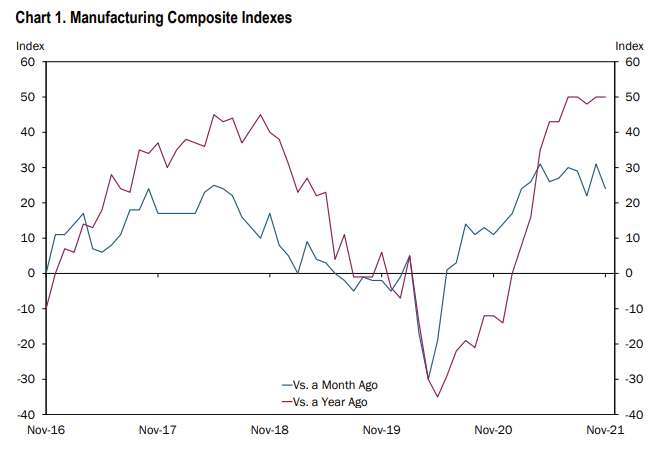
- manufacturing index 17 versus 25
- composite index 24 versus 31
- shipments 2 versus 28 last month
- new orders -4 versus 27 last month
- backlog of orders 10 versus 23 last month
- employees 27 versus 34 last month
- average employee workweek 10 verse 15 last month
- prices received for finished products 50 the versus 47 last month
- prices paid for raw material 77 versus 87 last month
- new orders for exports seven versus five last month
- supplier delivery time 57 versus 50 last month
- inventories materials 21 versus 20 last month
- inventories finished goods -2 versus six last month
Comments from the Kansas City Fed on the report:
- The composite index is an average of the production, new orders, employment, supplier delivery time, and raw materials inventory indexes.
- Factory growth was driven by increased activity at durable goods plants, particularly machinery manufacturing, electrical equipment, transportation equipment, and furniture production. Month-over-month indexes remained mostly positive, but the pace of growth slowed compared to October. While production and employment were strong in November, supplier delivery time increased, and the volume of new orders decreased. Finished goods inventories also declined, but materials inventories inched up. Year-over-year factory indexes expanded at a steady rate, and the year-over-year composite index was 50 again in November. Compared to a year ago, supplier delivery time was much higher, and employment and capital expenditures increased slightly. The future composite index was 35 in November, similar to 34 in October, with higher production and shipments expected moving forward.
Austria’s focus shifts to full lockdown as COVID-19 cases keep rising
As winter approaches, cases have surged across Europe, prompting governments to consider reimposing unpopular lockdowns. The Netherlands has imposed a partial lockdown that applies to all, but Austria has sought not to impose extra restrictions on the fully vaccinated.
“We have very, very little room for manoeuvre,” the conservative governor of Upper Austria, Thomas Stelzer, told the province’s parliament, referring to its strained intensive-care units. Upper Austria, a stronghold of the far-right and vaccine-criticising Freedom Party, has the country’s highest infection rate and its lowest vaccination rate. It and neighbouring Salzburg are the hardest-hit of Austria’s nine provinces. Both border Germany. “If no national lockdown is ordered tomorrow, there will definitely have to be a lockdown of several weeks in Upper Austria together with our neighbouring province Salzburg as of next week,” Stelzer said. The conservative-led provincial government of Salzburg, which this week said it was preparing for a possible triage situation in which the number of people needing intensive-care beds exceeds supply, confirmed in a statement that it is planning a joint lockdown with Upper Austria. Austria’s governors are holding a meeting on Friday with conservative Chancellor Alexander Schallenberg and Health Minister Wolfgang Mueckstein. Daily infections on Thursday reached a new record of 15,145. The biggest wave before this peaked at 9,586 a year ago, when Austria went into full lockdown.
Booster shot confusion as California goes against CDC and FDA reccomendations
EAGLE ROCK (CBSLA) – As families across the southland prepare to ring in a second holiday season during a pandemic, the state of California is now suggesting that everyone who is vaccinated against COVID-19 should also get a booster shot. “In the short run, I am worried that until we vaccinate more children and our behavior changes with the holidays coming that there’s going to be a spike in cases,” CBS Medical Contributor, Dr. David Argus said.
California is one of the states seeing the highest number of new COVID infections, promoting health officials to issue stern warnings.
“We should anticipate an increase of cases, an increase in hospitalizations, an increase in people in ICU’s, and, tragically, the likelihood, if we don’t take seriously this moment, an increase in the number of people that will lose their lives,” Governor Gavin Newsom said.
The governor visited the Central Valley on Tuesday to promote the state’s new guidelines on COVID-19 booster shots. “Anyone who wants a booster can get a booster sho. If you have been vaccinated and it’s been six months, now you can get a booster shot, 18 and over,” he said.
That goes against the Centers for Disease Control and Prevention and the Food and Drug Administration, which said last month that only seniors and adults at high risk should get boosters.
Some say boosters are a necessary step in beating back the pandemic, pointing to data that shows protection from the COVID-19 vaccines wanes months after a person’s last dose. “This is the right policy,” said Dr. Argus. “I believe in it. I think the data initially out of Israel and now out of the United States certainly makes sense to do this.” However, California’s expanded eligibility for booster shots has led to some confusion, with some saying they’ve tried to schedule booster appointments, but are still being told they’re not eligible. “I also tried CVS and Walgreens and it may take them some time to get caught up, but right now, even when you call Kaiser, they’re still adhering to CDC guidelines for a little bit more stricter requirements,” said Eric Doeding, who has been attempting to schedule a booster shot. An Orange County resident, Doeding said as of Tuesday afternoon, he still couldn’t get a booster. “I was trying to get my booster shot to just, you know, try to do my part, just trying to get it scheduled. So, hopefully they get caught up soon,” he said. Dr. Argus said that with the Delta variant, people need a significantly higher level of immunity for protection.“So, in order to get that high level of immunity, you need a booster shot,” he said.
There is still no timeline on when the FDA might amend its emergency use authorization to make all adults eligible for a COVID-19 booster shot across the U.S., mirroring what California has done, but a spokesperson for the administration said it’s a high priority issue. HAHAHAHAHAHA
NN: If you wait for these clueless fuckers to fiddle fuck around you could die: It is settled science after 6 months you need a booster shot!
Germany recommends booster shots for all adult population
It said the boosters should be given six months after the last vaccine shot. However, that could be shortened to five months if there is enough capacity.
The committee also “urgently calls on all previously unvaccinated persons to take advantage of the COVID-19 vaccination offer.” The goal in administering booster shots is to reduce instances of infection and transmission as Germany and Europe battle a new, record setting wave of COVID-19 cases Over the past 24 hours, Germany has registered a daily record of more than 65,000 new infections. Currently 67.8% of the German population is fully vaccinated. NN: It is nothing short of criminal with all the published science that the 3rd booster shot was not given to the masse in August…… Its nothing short of incompetence that extends to criminal negligence.
More Infectious Covid Delta Sub-Variant sub-variant AY.4.2 Spreading Fast in U.K.
Here is the cdc spin on the new variant… they have no credibility:
A more infectious new version of Covid-19’s delta variant is spreading fast in the U.K., accounting for about 12% of the samples gathered in the most recent government survey. That represents a 2.8% daily growth rate for sub-variant AY.4.2 over the course of the REACT survey, from Oct. 19 to Nov. 5, the researchers said. Still, the new sub-variant seemed less likely to cause symptomatic Covid. Outside researchers cautioned that it’s too early to say for sure whether the new sub-variant is really less likely to make people sick, or whether there are other factors at work. If AY.4.2 was spreading among people who were younger or in places with broad vaccine coverage, “these factors could account for the observed difference,” Simon Clarke, an associate professor in cellular microbiology at the University of Reading, said in a briefing distributed by the Science Media Centre.
About one in 20 school-aged children had the virus over the survey period. Prevalence also doubled in people over the age of 65.
NN: I have been following the spread of the under-reported AY.4.2 MUTATION for a little over a year now. When it was first sequences the mutations on the spike proteins worried me. i have watched as it spread it pail of death starting as a new breakout in China. Now Europe is going back into lockdown. And early evidence points to this mutation as the culprit. It will take the “researchers” 6 months after the fact to understand its this new variant. Remember few samples are collected from the infected and dead. And even fewer are DNA sequenced to scientifically identify the mutation. And even fewer scientists are going to step in front of this and warn that the varient unless your anybodies are high can defeat your vaccine