Powell: Fed will make sure not to startle markets

The Federal Reserve will start easing its vast support for financial markets this month, marking a highly anticipated policy change as central bank leaders grapple with major price increases in some parts of the economy but plenty of room to grow in the labor market. The Fed’s announcement, made after its two-day policy meeting Wednesday, comes as the economy continues to shift more than 18 months after the pandemic first hammered U.S. labor and financial markets. The S&P 500 and other stock indexes closed at record highs Wednesday amid fresh optimism about the economy’s direction, but other concerns persist, including inflation, supply chain issues and a disconnect between many unfilled jobs and unemployed workers. The coronavirus’s delta variant appears to be finally easing, leading to a pickup in hiring. But inflation concerns that the Fed has long labeled as “transitory,” or temporary, haven’t yet receded. Fed leaders Wednesday pointed to the persistence of “sizable price increases in some sectors,” and Chair Jerome H. Powell said at a news conference that inflation and related supply chain issues “will persist well into next year.” The Fed had provided extraordinary support to the economy since the height of the pandemic to help money flow through the economy, limit bankruptcies and try to stopgap the wave of layoffs that washed across the United States last year.  For months, the Fed had set the stage to start winding down this sprawling bond-buying program — which includes $120 billion a month in asset purchases — in November. Those purchases have helped stimulate the economy and made borrowing easier by holding down long-term rates, and the expectation was that the purchases will be fully drawn down before the Fed raises interest rates. On Wednesday, the Fed announced it would be cutting purchases by $15 billion each month. That decision reflected optimism within the Fed that the economy is on the right track. But tremendous uncertainty still hangs over the economy, especially when it comes to how long prices will keep rising faster than wages, a phenomenon many Washington policy makers did not expect to last so long. Following the Fed’s policy meeting, officials released a statement saying that the mismatch of supply and demand, plus the reopening of the economy, has contributed to high prices.

Powell said he didn’t expect that inflation will have a permanent imprint on the economy, and added that the central bank will use its tools “to make sure that doesn’t become a permanent feature of life,” especially for households most sensitive to higher prices for groceries, rent, gas and more.

Now that the Fed has started its long-awaited “taper,” the markets are hungry for signals about when the central bank will raise interest rates for the first time since the pandemic. But Powell emphasized patience, arguing that the Fed would wait to cool the economy down until as many people as possible have gotten back into jobs. He said that it is “certainly within the realm of possibility” that the economy could reach full employment by the second half of next year. But reflecting on the recent surge of the delta variant, which had a harsher toll on the economy than the Fed expected, Powell reiterated that “we have to be humble about what we know about this economy.”  “There’s still ground to cover to get to maximum employment, and we don’t want to stop that when there’s good reason to think — although it’s been delayed — that the economy will reopen if we do get past significant outbreaks of covid,” Powell said. NN: Stock market indices closed at new record highs. Celebrating the start of their destruction….. Their was nothing good in what the FED reserve announced……. In essence Quantum Easing  is over…. And it will be sooner they the markets think. Although the Fed refused to fess up publicly to the reality. They have no choice, begging for mercy along the way,  they will Will WILL raise interest rates 300 to 500 bases points. And when the markets gets a sniff of this it will devastating…

China is suffering its most widespread Covid-19 outbreak since Wuhan

China is suffering its most widespread Covid-19 outbreak since the virus first emerged at the beginning of the pandemic in Wuhan in 2019.  The country’s new locally transmitted Covid cases have spiked to a near three-month high amid what the Chinese government called a ‘serious’ new outbreak of the highly infectious Delta variant. Now, more than 600 locally-transmitted cases have been found in 19 of the country’s 31 provinces, reports Bloomberg.  The National Health Commission confirmed on Wednesday 93 new local symptomatic cases for Tuesday, up from 54 a day earlier and the highest daily count since August 9 at the peak of China’s last major outbreak. Most of the local cases were found in Heihe, a city in the northern province of Heilongjiang, where 35 infections were recorded on Tuesday. Three new provinces detected cases: central Chongqing, Jiangsu and Henan, reported Bloomberg. The spread and rise in Covid infections comes despite the Chinese government enforcing tighter curbs to contain the cases.

Officials have backed the government’s with officials still sticking to their Covid zero approach, with one expert insisting the current outbreak will be contained ‘within a month’. Zhong Nanshan, a leading expert in China’s respiratory disease research, told China Global Television Network that China will continue with its zero-transmission policy against Covid, because the global Covid fatality rate of 2% is too high. ‘I think the zero-transmission policy will remain in place for a long time,’ Nanshan said. ‘Exactly how long depends on the global and regional Covid-19 control situations in coming months.’  Strict restrictions are expected in the capital Beijing in the run-up to a key gathering of the highest-ranking members of the Communist Party next week. On Tuesday, China’s government urged citizens to stock up on daily necessities and for authorities to take steps to ensure adequate food supplies as the country adopts increasingly tight measures to contain the latest outbreak. A notice posted on the website of the Ministry of Commerce late on Monday urged ‘families to store a certain amount of daily necessities as needed to meet daily life and emergencies’. The directive made no mention of a food shortage or of whether the instructions were motivated by fears that Covid measures could disrupt supply chains or leave locked-down citizens in need of food. But China, which has kept its infection numbers relatively low through a Covid-zero strategy of border closures, targeted lockdowns and long quarantine periods, is increasingly adopting tough measures to contain the latest outbreak, especially ahead of the Beijing Winter Olympics beginning on February 4. On Tuesday, Beijing reported four cases of Covid-19 among one family – a couple, their daughter, and the daughter’s grandmother.   The cases triggered an instant response, with a major primary school and a secondary schools conducting Covid tests for all teachers and students. Another 16 schools suspending in-person classes on Tuesday.     By Tuesday morning, 596 people from the primary school and 1,329 people from the middle school had tested negative. The remaining people were waiting for results. The Commerce Ministry notice also told authorities to take measures to facilitate agricultural production, keep supply chains smooth, ensure that regional food reserves were adequate and maintain stable prices. The government has restricted some inter-provincial travel, ramped up testing, and urged people to postpone social gatherings like weddings and banquets. In an example of the extreme measures taken, the Shanghai Disneyland theme park closed temporarily from Sunday night and prevented visitors and park personnel from leaving until they underwent Covid testing, all due to a single coronavirus case. More than 38,000 people were tested as a result. NN: When you got a billion people packed asshole to elbow you better take extreme measures… A versus the European and US model where you close your eyeys and hope it will go away….. It won’t!!!

Oil accelerates losses, plunges 3%

Russia saw its crude oil and condensate production rise in October for a second consecutive month as it increased output under the OPEC+ agreement to ease the collective production cuts. Total crude and condensate production at the leader of the non-OPEC countries in the OPEC+ deal rose by 1.1 percent from September to stand at 10.843 million barrels per day (bpd) in October, according to Bloomberg estimates based on data from the Russian energy ministry. However, Russia’s condensate production—estimated at around 800,000 bpd-900,000—is not part of the OPEC+ production cuts, so it’s not easy to assess how much crude oil Russia is really pumping. The energy ministry’s data does not discriminate between crude oil and condensate production, so the market and analysts assess crude output by estimating condensate production levels. Per Bloomberg calculations, if Russia pumped in October the September volumes of condensate of around 910,000 bpd, Russian crude production was 9.93 million bpd, or 120,000 bpd above the October quota. Last month, Russian Deputy Prime Minister Alexander Novak said that Russia was pumping 9.9 million bpd of crude oil in October, but had the capacity to increase production to up to 11.4 million bpd. Russia’s oil production in October will be 9.9 million bpd, as Moscow is aligning its output with the OPEC+ agreement, Novak said in the middle of last month. Russia expects its crude oil plus condensate production to return to pre-pandemic levels by May 2022, Russian officials, including Novak, have said in recent months. As per the latest quota distribution of the OPEC+ group, Russia has a ceiling of 9.913 million bpd for November—the same as OPEC’s de facto leader and top producer, Saudi Arabia. The energy ministers of the OPEC+ alliance are meeting on November 4 to decide output quotas for December, amid pressure from consuming nations—including the United States—to increase supply to the market by more than the 400,000 bpd monthly additions they have agreed to so far.

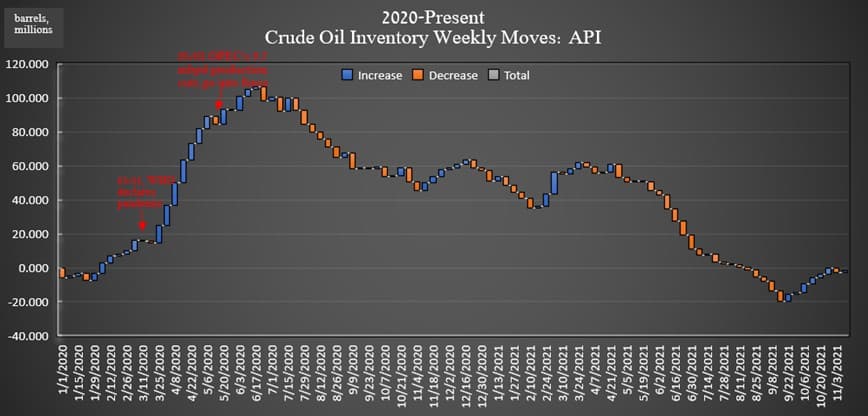
US oil inventories up by 3.6M barrels….. Sixth Straight Crude Inventory Build Tempers Prices

https://youtu.be/wZvm75xKklE

Investing.com – U.S. crude stockpiles rose more than expected last week at a time when uncertainty over the supply outlook continued to weigh on prices ahead of the OPEC+ Alliance’s meeting later this week. West Texas Intermediate, the benchmark traded at $83.06 a barrel on the news, after settling down 14 cents at $83.91 a barrel. U.S. crude inventories increased by 3.6 million barrels for the week ended Oct. 39. That compared with a build of 2.3 million barrels reported by the API for the previous week. Economists were expecting a build of about 1.6 million barrels. OPEC+ is expected to maintain its plans to gradually lift monthly production by 400,000 barrels per day despite pressure to ramp-up production to ease the energy crisis. The API data also showed that gasoline inventories fell by 552,000 barrels last week, and distillate stocks increased by 573,000 barrels. The official government inventory report due Wednesday is expected to show weekly U.S. crude supplies increased by about 2.2 million barrels last week. U.S. oil production for the week ending October 22—the last week for which the Energy Information Administration has provided data—stayed the same at 11.3 million bpd—still 1.8 million bpd below the all-time high of 13.1 million bpd reached right before the pandemic took hold in the United States. NN: This is the 6th week in a row inventories have increased. If we did not have enough oil inventories would be dropping…. They are not…. which means their is no oil shortage… Their is manipulation and their is hysteria. As a fundamental trader these are clarion calls to me.

Biden: OPEC+ refusal to pump more oil caused high prices

https://youtu.be/HGxNmegYjAM

(Bloomberg) — U.S. President Joe Biden kept up the pressure on OPEC+ to combat high oil prices, blaming it for inflationary pressure at home just two days before Saudi Arabia, Russia and the rest of the cartel meet to discuss oil policy. “If you take a look at gas prices, and you take a look at oil prices, that is a consequence of, thus far, the refusal of Russia or the OPEC nations to pump more oil,” Biden told reporters at a news conference at the United Nations climate summit in Glasgow. “And we’ll see what happens on that score sooner than later.”

The pressure on OPEC+ is unusually strong. U.S. Secretary of State Antony Blinken spoke with Sheikh Abdullah Bin Zayed, the foreign minister of the United Arab Emirates on Tuesday to press for increased production. Other oil-consuming nations are pushing hard as well, with Japan and India wanting more production as the energy crisis threatens to undermine the economic recovery in Europe and Asia.

As gasoline prices pose increasing domestic political risks, the issue came up on the sidelines of the Group of 20 meeting over the weekend in Rome, with Biden administration officials calling for more production when producers meet on Thursday. Members including Kuwait, Iraq, Algeria, Angola and Nigeria have indicated that they want OPEC+ to stick with its current plan to increase output gradually.Biden said Sunday he was “reluctant to say” what he and other leaders would do if major producers opted not to pump more oil. His national security adviser, Jake Sullivan, said Biden had a “broad discussion about the tools available with other energy consumers” about potential steps, but pointed to the president’s comments in declining to say whether the U.S. and other nations were considering a coordinated release from their petroleum reserves.Biden came under criticism from activists at the climate summit, who said he was being hypocritical by pushing for higher oil output even as he attended a meeting where leaders said they wanted to transition to cleaner fuel sources. But Biden has said high fuel prices are imposing costs on working- and middle-class Americans commuting to work, and that prices should be held lower as consumers transition to alternate energy sources to power their vehicles

Drill, Moscow, drill: Team Biden goes on defense over mixed signals on energy, climate

the above video from January  is Biden putting the screws to domestic oil . Biden now  turns to overseas producers after targeting domestic drilling

Team Biden had to play defense Monday after suffering a self-inflicted dent to his reputation ahead of the U.N. climate conference in Glasgow, Scotland, when he urged other major energy producers to pump more oil. Climate czar John Kerry insisted there was “no inconsistency” between the administration’s aggressive climate change position and Mr. Biden’s effort to persuade OPEC and Russia to open up supply amid a global energy crisis. “It’s just not inconsistent,” Mr. Kerry said in a conference call with reporters. “If it were, if he were asking them to boost their production over five years, I’d quit. But he’s not. He’s asking them to boost production in this immediate moment.” The day before, Mr. Biden played defense at the end of the Group of 20 meeting of leaders of industrial and emerging-market nations in Rome, where he made the plea for more fossil fuel. Although he agreed that “on the surface, it seems like an irony,” he said it wasn’t inconsistent at all. “But the truth of the matter is — you’ve all known; everyone knows — that the idea we’re going to be able to move to renewable energy overnight and not have — from this moment on, not use oil or not use gas or not use hydrogen is just not rational,” Mr. Biden said. He said that the world is “going to stop subsidizing those fossil fuels,” but that it wasn’t realistic to stop using them immediately. He added that “the idea that Russia and Saudi Arabia and other major producers are not going to pump more oil so people can have gasoline to get to and from work, for example, is not right.”

What galls his critics, led by Republicans, is the specter of Mr. Biden pleading with the OPEC nations and Moscow to turn on the spigots amid a pandemic surge in demand after taking a scythe to U.S. producers.

Shortly after taking office, Mr. Biden canceled the Keystone XL pipeline project and placed a moratorium on new fossil-fuel leases on federal lands and waters, undercutting domestic production and depressing investment. Since January, U.S. gasoline prices have soared by 40%, creating pain at the pump for U.S. consumers and taking a toll on Mr. Biden’s poll numbers. “And, by the way, when the cost of a gallon of gasoline gets to above … $3.35 a gallon, it has [a] profound impact on working-class families just to get back and forth to work,” Mr. Biden said. “So, I don’t see anything inconsistent with that.” Kathleen Sgamma, president of the Western Energy Alliance, blasted what she described as the Biden administration’s “rank hypocrisy” on energy. “It’s rank hypocrisy to do everything to squelch American oil production, which sends working-class jobs overseas while asking Russia and OPEC to increase their production,” she said. “The effects of President Biden’s climate policies — high prices, scarcity, lost jobs — are already coming home to roost.” She said Americans could “expect more of the same if these policies are not reversed and the House’s reconciliation bill passes.” “American is following the misguided climate lead of Europe which will only boost our enemies in China and Russia who aren’t buying into failed policies that kill manufacturing and energy production,” Ms. Sgamma said.

Sen. John Barrasso of Wyoming, the ranking Republican on the Energy and Natural Resources Committee, accused Mr. Biden of “punishing America’s economy while pretending to protect the environment.”

“The president wants to kill abundant and affordable U.S. energy sources like oil, natural gas, and coal that Americans depend on,” he said in a Monday statement. “The White House’s plan is a recipe for disaster. It will result in skyrocketing power bills, less reliable energy, and fewer jobs for the American people. Shutting down the United States’ economy won’t fix climate change. It will only enrich China.” NN: Talk about shooting yourself in the dick. The Grennennieewinnees were convinced the age of fossil fuels was over. Of course with the world shut down energy demand collapsed… I was not the success of alternatives. But that is to difficult for climate change retards to comprehend. And all of a sudden demand started to return to normal and Wind farms and solar were revealed for the fraud they really are. And the US put a knife in the back of its oil industry. Rather then admiting their mistake and bringing back US oil. Biden et all are happy to go to our enemies for our energy needs,,, Like Russia and let Iran to get nukes and let the Kerry sell out continue

Biden: U.S.’continuing to suffer’ from Trump’s decision to pull out of Iran deal

President Biden said he and other world leaders agree that diplomacy is the best way to keep Iran from gaining a nuclear weapons. He also blamed the U.S. exit from the Iran nuclear deal on former President Trump’s ‘very bad judgments.’

President Biden said  that the U.S. is “continuing to suffer” from former President Trump’s decision to pull out of the Iran nuclear deal. Mr. Biden’s comments come a day after he and three European leaders signaled that he was ready to return to the Obama-era deal that eased sanctions against Iran, in exchange for the country limiting its nuclear program and allowing inspections. “We’re continuing to suffer from the very bad judgments that President Trump made in pulling out of the [nuclear deal],” Mr. Biden said during a press conference at the end of the Group of 20 summit in Rome.

He said the future of the deal is dependent on whether the original partners in the deal, known as the Joint Comprehensive Plan of Action (JCPOA),  will “stick with us and make sure there is a price to pay economically” if Iran doesn’t return to the negotiating table.

Mr. Biden also vowed to “continue to respond” if Iran launches drone strikes or provokes the U.S. in any way. Secretary of State Antony Blinken warned Sunday on CBS’ “Face the Nation” that Iran’s nuclear program is “starting to be a problem” and that the U.S. and its allies have limited time to strike a deal with Tehran before it stockpiles enough material for a nuclear bomb. The nuclear deal was brokered in 2015 among the U.S., Germany, France, United Kingdom, China, Russia, and Iran. But Mr. Trump pulled the U.S. out of the deal three years later, imposing tough sanctions that have damaged Iran’s economy. In response, Iran bolstered its nuclear program, pushing it past previously agreed to limits under the Obama-era deal. On Saturday, the U.S., Germany, UK and France issued a statement that made it clear they wouldn’t ease sanctions until Iran scales back its plans to develop a nuclear weapon. Iran has repeatedly denied that it wants a nuclear weapon. “We are convinced that it is possible to quickly reach and implement an understanding on returning to full compliance and to ensure for the long term that Iran‘s nuclear program is exclusively for peaceful purposes,” the statement said. “This will only be possible if Iran changes course,” it added. “We call upon [Iranian President Ebrahim] Raisi to seize this opportunity and return to a good faith effort to conclude our negotiations as a matter of urgency. That is the only sure way to avoid a dangerous escalation, which is not in any country’s interest.”

The allies said they have a “grave and growing concern” that Iran has stepped up its pace of producing “highly enriched uranium and enriched uranium metal,” which have no civilian uses.

Tehran has yet to commit to a date to return to nuclear talks, which have been suspended since June, when Iranian President Ebrahim Raise came to power. Mr. Biden has repeatedly expressed his belief that the U.S. could return the deal, despite increased tensions between the two nations.  An Iran equipped with nuclear bombs would be a national security and foreign policy nightmare for the U.S. and its longstanding regional ally Israel. Such a development also would reshape the balance of power in the Middle East and immediately make Iran the region’s most influential player. NN: Biden will throw Israel under the bus. Why… He needs the oil   (to get democrats  reelected)  that Iran is eager to supply…. As far as the nukes…. He will send medical supplies to Israel after they get nuked……

US closes with gains, major indices notch record highs

Shares on the major stock market benchmarks in the United States closed in the green on Monday, while the Dow Jones Industrial Average ended the session with another record high, along with the tech-heavy Nasdaq 100 and the S&P 500. US Senator Joe Manchin denied, once again, to support the $1.75 trillion reconciliation framework, while Treasury Secretary Janet Yellen forecasted that the ongoing pandemic will have a long-lasting impact on the state of employment in the country. President’s Working Group on Financial Markets asserted there is room for broader use of stablecoins in the country, with a proper, and stricter, regulation. The Dow Jones rose 0.26% as the session came to an end, led by Boeing’s jump of 3.65%. The Nasdaq 100 increased by 0.35% at the same time, with Tesla skyrocketing 8.52%. The S&P 500 concurrently gained 0.18%, as Franklin Resources soared 11.62%. The euro jumped 0.38% versus the dollar, selling for 1.16062 at 3:59 pm ET. NN: This market is doomed!

Biden: OPEC And Russia Must Pump More Oil To Help America’s Working Class

  • Biden: The refusal of OPEC+ to increase crude oil production is affecting America’s working class
  • Energy Secretary Jennifer Granholm blames OPEC+ for high crude prices

“I do think that the idea that Russia and Saudi Arabia and other major producers are not going to pump more oil so people can have gasoline to get to and from work, for example, is not, is not, right,” Biden said as quoted by Russian TASS. “It [OPEC+’s decision to keep a lid on output increases] has profound impact on working class families just to get back and forth to work,” the U.S. President added, as quoted by NPR. The comments made by the U.S. President were later the same day echoed more bluntly by Energy Secretary Jennifer Granholm, who directly blamed the OPEC cartel for keeping prices high. “Gas prices, of course, are based on a global oil market. That oil market is controlled by a cartel. That cartel is Opec,” Granholm told NBC’s Meet the Press. “So that cartel has more say about what is going on.” At the same time, Granholm noted that the oil industry could not “flip a switch” for production as it recovers from the effects of the pandemic and this, too, contributed to higher prices resulting from the tight supply. Even if factors influencing gas prices at the pump in the United States may be outside the country, the effects of price movements are already costing Biden approval among voters. According to NPR, his rating is well below 50 percent, with 70 percent of Americans believing the country is not going in the right direction. Also at the news conference, the U.S. President said he was confident the country could meet his administration’s goal of emission cuts, which is 50 percent from 2005 by 2030. Yet, the president acknowledged that the renewable shift cannot happen overnight.

“On the surface, it seems like an irony,” Biden said, referring to his call on OPEC+ to add more oil production while heading for COP26 to discuss the reduction of global emissions

“But the truth of the matter is … everyone knows that idea that we’re going to be able to move to renewable energy overnight … it’s just not rational.”NN:It is amazing to me how they speak out of both sides of their mouths…. Their is a global energy shortage. We all agree on that fact. Here is where i get confused… If fossil fuels are  the enemy and the world is ready for renewables…. Why is Biden asking OPEC and other suppliers to produce MORE oil.  If he believes the load of crap he is peddling why is he not asking solar companies to screw solar more panels to roof tops, And while he is at get the cranes to set up more wind farms Its not that hard its a big pole in the ground with a propeller on top!

Yellen: US economy is not overheating

United States Treasury Secretary Janet Yellen said on Monday that the US economy is not overheating and that it is still some five million jobs short of the pre-pandemic levels


Treasury Secretary Janet Yellen dismissed recent moves in the bond market that have signaled concern about monetary policy makers squelching economic growth, and expressed confidence in the continuing recovery from the Covid-19 pandemic. She attributed the labor situation to COVID-19 and lack of childcare, estimating more workers will rejoin the market if the pandemic fades. Asked in an interview with Bloomberg News Sunday if she was worried by sharp movements in Treasury yields, she responded, “No, not me. I think what we’re going to see is a good, solid recovery. The unemployment rate has gone down considerably, and this is nothing like the recovery from the 2008 financial crisis.” The U.S. yield curve — as measured by the gap between two-year and 10-year Treasury yields — flattened the most last week since the summer of 2020. The move has been triggered in part by expectations the Federal Reserve will start raising interest rates sooner than previously anticipated, to quell inflation. Yellen, who was chair of the Fed from 2014 to 2018, declined to comment directly on monetary policy, but offered an oblique vote of confidence in how the U.S. central bank plans to approach the issue of removing its stimulus. “The Fed has a framework that it’s using to decide what to do,” she said. “They’ve made clear they’re going to begin tapering asset purchases,” she noted. She spoke days before the Fed’s Wednesday policy decision, where it’s forecast to unveil the phasing out of its quantitative-easing program — a precondition for raising rates. Yellen noted that Fed Chair Jerome Powell has said he believes the current bout of inflation will diminish over time, a view that aligns closely with hers. Yellen spoke during a flight departing Rome, where she attended a Group of 20 summit capped by leaders of the world’s biggest developed and emerging economies endorsing a global corporate-tax deal. She was heading to Dublin for meetings with Irish government officials, who until recently opposed that tax agreement

     President Joe Biden and his Treasury chief attended the Rome meetings amid the backdrop of a sharp slowdown in U.S. job growth, undermined by the spread of the delta variant of Covid-19.

While the 4.8% unemployment rate is well down from the near-15% recorded in April last year, and not too far off the pre-pandemic level 3.5%, that’s partly thanks to Americans having left the workforce. The proportion of working-age Americans who have jobs or are looking for work is lower now than any pre-Covid readings since the 1980s. Many economists have said some who lost work during the pandemic may have permanently left the job market. Yellen said the longer-term economic programs that Biden is pressing Congress to enact could help strengthen the rebound from the Covid-19 crisis. “The main impact is going to be on long-term potential output,” Yellen said of the social-spending package that lawmakers are negotiating. “I’m seeing especially from the child-care subsidies, the universal pre-K, I’m seeing support for participation, particularly of women, and that tends to boost growth.” Competing wings of the president’s Democratic party have been wrangling over the elements to include in a $1.75 trillion social-spending bill, paid for mostly with tax hikes. Progressives have effectively blocked a vote on a $550 billion bipartisan infrastructure package passed by the Senate, using it as leverage to shape the bigger bill. Yellen said the twin packages should create jobs and help lure many Americans off the sidelines of the labor market. She also expressed confidence that job-market conditions are improving. “Households are reporting — and we’re seeing in the data — that people feel good about their ability to get a job,” Yellen said. “There are people who are out of the labor force who haven’t come back in — whether it’s for health-related reasons or childcare or schooling. Eventually some of those people I would expect will return to the labor market.” NN: And the idiots still are arguing their is no embedded inflation. And despite a stock market that hits a new high every other day and a real estate bauble the biggest ever they want to keep interest rates at zero and pump more and more money into stimulus…… As inflation sets records…….. They have gone start raving mad