R(Bloomberg) — Investors’ faith in the Federal Reserve has become so unshakable that not even the highest inflation in three decades is enough to cause a sell-off in assets, said Jeremy Grantham. “We’ve never seen anything like this,” Grantham told Bloomberg Television’s “Wall Street Week” with David Westin. “Every bull market before this one had low inflation.” The 6.2% increase in the consumer price index in October “would have been enough in any market since 1925 — and for all I know long before that — it would have been enough to have crashed the market,” said the value-investing giant and co-founder of Boston-based asset manager GMO. “But this time the faith in the Fed is so complete that when they say it is temporary we believe it.” Higher prices for energy, shelter, food and vehicles fueled the rise in consumer prices, putting pressure on Fed officials to consider ending near-zero interest rates sooner than expected and potentially taper bond-buying faster than announced last week. Grantham, 83, said the U.S. central bank has overstimulated the economy repeatedly, inflating the tech bubble in 2000, the housing bubble before the 2008 financial crisis and creating “craziness” in today’s stock market with wild moves in meme stocks. “Have they learned? Absolutely not,” said Grantham. “The Fed in my opinion, hasn’t done a thing right since Paul Volcker.” In order to explain
today’s “market you have to assume 100% ignoring of rising inflation, which is quite remarkable.” Grantham, who co-founded GMO in 1977, has gained a reputation as a perma-bear for warning regularly of asset bubbles and who sometimes misses rallies in markets. In a third-quarter market commentary issued last month, GMO told investors that today’s surging stock markets recalls the period before the tech bubble burst when clients and consultants were losing patience with GMO’s performance. NN: Grantham is a great market analysts. His timing has always sucked. He has gotten creamed this year trying prematurely to short this rally… For the record i am up 100% earlier this year….. And wisely stood aside. As hard as it is I know how to let a bubble run its course before we start operations…….
Nov 12 (Reuters) – The number of Americans voluntarily quitting their jobs rose to a record high in September while job openings stayed stubbornly above pre-pandemic levels, a sign that businesses may have to continue to raise wages in order to attract workers. The Labor Department’s monthly Job Openings and Labor Turnover Survey, or JOLTS report, released on Friday, reflects an uneven economy with strong demand grinding against labor and goods shortages, driving overall inflation to its biggest annual gain in 31 years. Wage inflation shows few signs of abating even as the daily case rate of coronavirus infections ebbs, with employers in almost every industry competing to lure workers and three million fewer people in the labor force compared to pre-pandemic levels. The scramble for workers boosted wage growth to an annual increase to 4.9% in October, although this has been outstripped by overall inflation, leading to a fall in real earnings.
A separate survey by the University of Michigan, also on Friday, showed consternation among consumers with sentiment on the economy falling to a decade low, with few believing policymakers are taking sufficient steps to tackle inflation.
Quits rose by about 164,000 in September, lifting the total to a record high of 4.4 million. The quits rate is seen as a good measure of labor market confidence as workers leave when they are more secure in their ability to find a new job. There were 56,000 people who quit in the arts, entertainment and recreation industry while 47,000 left in the other services category. State and local government education saw 30,000 departures. “The continued surge in quits points to wage growth of between 4.5%-5.0%, well above rates that would be consistent with inflation falling sustainably back towards the Fed’s 2% target,” said Michael Pearce, senior U.S. economist at Capital Economics in New York, following the report. The Federal Reserve has so far resisted calls to take stronger action to combat higher-than-expected inflation, arguing that it remains transitory even if it persists well into next year. The central bank announced at its last meeting that it will begin to taper its massive bond buying program this month, seen as precursor move to raising interest rates from their current level near zero. Investors currently expect a rate liftoff in mid 2022. Job openings, a measure of labor demand, edged down by 191,000 to 10.4 million on the last day of September. Hiring also remained largely unchanged at 6.5 million in September. The number of job openings was little changed in all four regions with vacancies increasing most in healthcare and social assistance, and state and local government, excluding education. The government reported last Friday that nonfarm payrolls increased by 531,000 in October after posting gains of 312,000 in September. Job growth has averaged 582,000 per month this year. Labor shortages could persist a while longer even as the Delta wave of COVID-19 infections slide from their mid-September high. All-time high savings fueled by government aid, as well as a strong stock market and record house price gains, look set to continue to provide a short-term buffer as workers weigh up when to re-enter the jobs market. Higher-than-normal early retirements are also playing a role. That said, there is hope that with infections declining and schools fully reopened for in-person learning, more people will rejoin the labor force once excess savings helped by the generous government aid, some of which has ended, is depleted. Fewer Americans are feeling better about the economics outlook, at least in the short term. U.S. consumer sentiment plunged in early November to the lowest level since November 2011 as surging inflation cut into households’ living standards, the University of Michigan’s consumer sentiment survey showed. Its index dropped to 66.8 in its preliminary November reading from October’s final reading of 71.7. Economists polled by Reuters had forecast a reading of 72.4.
“One-in-four consumers cited inflationary reductions in their living standards in November, with lower income and older consumers voicing the greatest impact,” Richard Curtin, the survey’s director, said in a statement.
There is a “growing belief among consumers that no effective policies have yet been developed to reduce the damage from surging inflation,” he added.Consumers see inflation in the year ahead accelerating at a 4.9% pace, the fastest since 2008, though they continue to expect it to abate over the medium term, with the five-year outlook at 2.9%, the survey showed.The survey’s consumer expectations index fell to 62.8 – the lowest since October 2013 – from 67.9 in October. Its gauge of current conditions slid to 73.2 – the lowest since August 2011 – from 77.7. NN: Its not what they are saying.. We have see a record breaking run on Wall Street with record volume. The masses are all in and its the wealth effect. Reality is they are working but not at their waitress and hamburger flipper job. Why drive a cab when you can make more trading on Robin hood. This party will not last much longer. Once the fools rush in its time to short. Everyone is a genus in bubble markets. And the old adage applies here more then ever. What Wall Street gingivitis it taketh away and then some. We are on the verge of the biggest wipe out ever. Hence we announced our Boss Black Mask Trade. This is you 2 minute warning. Now you see why we stood aside. This stock market still has some more work to the upside… But soon very son we will start operations
Production in the Permian seen at highest since at least 2015
Natural gas production forecast to climb to most in six years
Surging oil and natural gas prices are spurring production increases from West Texas to the Upper Great Plains that probably will lift output to levels not seen since the early days of the pandemic, according to Rystad Energy AS. U.S. shale-oil production is expected to reach 8.68 million barrels a day in December, which would be the highest since March 2020, analyst at the Oslo-based research house said. Meanwhile, nationwide gas output is on its way to a 6-year high. NN: I have watched them count out US oil 5 times now. And it always comes back bigger then ever. It will be no different this time…. Biden and his lefty liberals are putting a hit on oil. They tried the same shit in Germany and England and they are now paying the price. Realty is non fossil fuel deployment and technology is not their yet,,, says the may who has a zero carbon footprint and runs his world on solar…..
The Biden Administration is still not decided whether the U.S. should act now to try to reduce the highest gasoline prices in America in seven years or to wait for the market to run its course, Bloomberg reported on Friday, quoting sources with knowledge of the ongoing debates.
President Joe Biden is considering a release from the SPR as a possible move to reduce gasoline prices after OPEC+ ignored calls for putting extra barrels on the market, Secretary Granholm told Bloomberg last week.
“Hopefully there will be an announcement or so this week,” Granholm told MSNBC in an interview on Monday. “He’s certainly looking at what options he has in the limited range of tools a president might have to address the cost of gasoline at the pump, because it is a global market,” the energy secretary added. As of early on Friday, the Biden team was still debating what options to choose and whether to choose those options now, according to Bloomberg’s sources. Some officials at the U.S. Department of Energy are reportedly against an SPR release, while some White House aides part of the talks favor a release and even the “nuclear option” of a crude oil export ban, the sources told Bloomberg. Eleven Democratic Senators urged the Administration this week to consider all options—including an SPR release and a crude export ban—to try to lower the high gasoline prices. If President Biden approves an intervention now, it could likely consist of several tools, according to Bloomberg’s sources. The three most debated options include an SPR release which analysts see as likely but not very effective. Another would be relaxing the biofuel standards so that refiners process more crude into gasoline. The third option is a ban on U.S. crude oil exports, which analysts see as an unlikely move that would upend global oil flows, sink WTI prices, and at the same time raise the price of foreign oil which refiners import anyway, and diminish the U.S. role on the global energy market.
OSLO (Reuters) – Norway will offer a third COVID-19 vaccine dose to everyone aged 18 and older and will give municipalities the option of using digital “corona passes” as a way to beat back a surge in COVID-19 infections, the government said on Friday. Norway has so far only given a third dose to those aged 65 and older.
“Everyone aged 18 and older will be offered a third dose next year,” Prime Minister Jonas Gahr Stoere told a news conference.
Norway in late September ended the last of its domestic coronavirus lockdown measures, which for 18 months had restricted social interaction and hobbled many businesses.
But while 87% of adults in Norway have received at least two vaccine doses against COVID-19, and 70% of the overall population has been inoculated, infections and hospitalisations are now rising rapidly.
The Nordic country is not going back into lockdown, however, opting instead for digital passes as a way to keep bars, restaurants, concert venues and sports arenas in business, Stoere said, something it had briefly experimented with at one point but then discontinued as infections fell. Those who are not vaccinated must test frequently to maintain a valid COVID pass, the government added. Authorities will also increase testing for unvaccinated health personnel. “We want a regular testing regime, twice a week, for unvaccinated health personnel and they must wear a face mask,” Health Minister Ingvild Kjerkol told the news conference. She did not say what the penalty would be if they refused. The government wants local authorities to increase testing in schools and universities, which is not the case currently. Students will continue not to wear face masks. Norway uses vaccines made by BioNTech, Pfizer and Moderna in its national rollout, which since September includes everyone aged 12 and over. NN: Its not politically expedient to tell the public their vaccine wears off in 6 months. Come clean with the public. The idiots believe if it becomes common knowledge people will not get vaccinated,,,WRONG!
Drilling activity in the United States continues to pick up, according to Baker Hughes, with a 6-rig rise to the number of active drilling rigs this week, according to Baker Hughes.
The total rig count is now at 556—a figure that is 244 up from this time last year. Nevertheless, active rigs are still hundreds less than the 790 active rigs that were drilling in the pre-covid world.
The U.S. oil rig count rose this week to 454—a 4-rig increase since last week, and a 218 rig increase since this time last year The number of gas rigs increased by 2 to 102, while miscellaneous rigs stayed the same at zero. The EIA’s estimate for oil production in the United States for the week ending November 5 held fast at 11.5 million bpd. Oil production is still well below the 13.1 million bpd record set last year before the pandemic took hold in the United States. Canada’s overall rig count increased by 8. Active oil and gas rigs in Canada are now at 168, up 79 on the year. The rig count in the Permian Basin increased by 1 this week, with 118 rigs added since last year. The number of rigs in the nation’s second most prolific basin, the Eagle Ford, also added 1 rig this week. The Permian’s total rig count is now 272, with 41 total in the Eagle Ford. Primary Vision’s Frac Spread Count, which tracks the number of completion crews finishing off previously drilled wells, shows that completion crews stayed the same this week at 266 for week ending November 5. The frac count is up by more than 130 since the start of the year. NN: Producers are gearing up very quickly….. Bankers do not run the world. They just think they do. Bankers do not loan money to Cocaine cartels… But their product is in demand so they find the funding… The world runs on oil and the market to invest in bringing oil to market is their…..
NEW YORK (Reuters) – A record-setting run in U.S. stocks has made some investors wary as concerns grow over the market’s vulnerability to surging inflation, tighter Federal Reserve policy and moderating corporate profit growth. The S&P 500has gained about 24% so far in 2021, and on Monday finished a streak of eight straight all-time closing highs, the longest such stretch since 1997. The benchmark index has more than doubled since its March 2020 low at the onset of the coronavirus pandemic, minting 65 all-time highs in 2021 alone, the second-most of any year on record, according to LPL Financial. With those gains have come potential pockets of excess that some investors worry are emblematic of a market that is overheating, even as inflation soars to its highest levels in decades and the Fed prepares to tighten monetary policy next year. Some examples include the eye-popping gains for Tesla Inc and Nvidia, the blockbuster initial public offering of electric vehicle maker Rivian, which garnered a valuation over $100 billion despite having little revenue, as well as Bitcoin’s surge to an all-time peak. More broadly, the S&P 500 tech sector’s valuation, based on forward price-to-earnings ratios, is near a 17-year high. “There are very reasonably valued stocks and portions of the market, and so that is what I am trying to gravitate to,” said Walter Todd, chief investment officer at Greenwood Capital in South Carolina. “But as somebody who has been doing this for a while, (the market) seems… excessive in certain respects.” His firm owns stocks such as pharmaceutical company Pfizer and tech stalwart Cisco for its clients. Some of the worries may be starting to take their toll. Stocks have wobbled in recent days, endangering a sixth week of positive returns for the S&P 500. The CBOE Market Volatility index, known as Wall Street’s fear gauge, on Wednesday hit its highest level in a month. Based on the level of the 10-year U.S. Treasury yield, Morgan Stanley strategists said in a note on Monday that the S&P 500 should be trading at about 20.5 times forward earnings estimates, as opposed to its current level of 21.5 times. “We think retail flows, seasonal strength and institutional ‘FOMO’ (Fear Of Missing Out) have taken valuations above fair value,” the Morgan Stanley strategists said, using the acronym for “fear of missing out.” NN: I want to short this insanity more then any market i have ever seen…BUT the time is not right just yet… Be warned its getting close
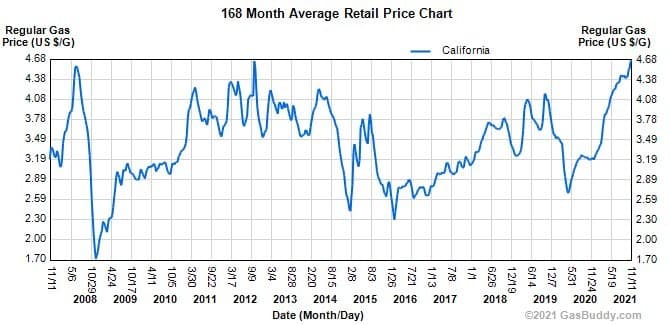
Gasoline prices in California have reached fever pitch, hitting their highest prices ever recorded, according to data from Gas Buddy. Average prices hit $4.68 per gallon today in California, beating out previous records set in 2008 and 2012.
Gasoline prices in the United States have continued to climb as stockpiles of the fuel continue to dwindle. Gasoline inventories in the United States fell 1.6 million barrels this week, according to EIA data, to 212.7 million barrels, which is 4% below the five-year average. Soaring gasoline prices have put immense pressure on the Biden Administration, who have promised to make high prices a priority. One of the tools that the White House may consider to alleviate rising crude oil and gasoline costs is a release from the nation’s Strategic Petroleum Reserve. Industry analysts, however, have suggested that releasing millions of barrels from the SPR would do little to bring down the price of gasoline at the pump.
But a SPR release is only one of the tools that the White House is considering. According to U.S. Energy Secretary Jennifer Granholm, President Biden could make an announcement on how the Administration will address soaring prices as early as next week.
It is unknown what other tools the Administration is considering, but President Biden said that he was dealing with other countries on the matter. “He’s certainly looking at what options he has in the limited range of tools a president might have to address the cost of gasoline at the pump, because it is a global market,” Granholm said earlier this week. The national average price of a gallon of gas on Thursday was $3.417 per gallon, according to AAA data. NN: The Biden has a great big problem. No matter how they spin it this is a prolem of their own making. US is the worlds largest oil producer…… Biden and his gang of merrie lefties have done EVERYTHING in their power to shut down as much US oil production possible……. Soon the VOTING public will firgure this out and they will have their say as they vote their anger
Waterford, in southeastern Ireland, epitomizes the country’s coronavirus conundrum. Why is there an increase in COVID-19 in a nation where about 92% of adults are fully vaccinated? A massive 99.5% of adults over the age of 18 in Co Waterford are double-jabbed. That’s thought to be one of the highest rates of any region anywhere in the world. But, according to the Health Protection Surveillance Centre, the county now tops the national infection league table, with a 14-day incidence rate of 1,294 per 100,000. Tom Gallagher can’t believe his native Waterford City is the current epicentre of Ireland’s fourth COVID wave. Earlier in the pandemic, he was nearly killed by the disease. Tom spent 66 days in the local hospital, including two stints on a ventilator in intensive care. His brother and sister also caught the disease. “I walk past the hospital all the time”, he tells Sky News. “I look up at it and just think…there are still people in there with this virus.” Tom now suffers from long COVID, and scans have shown his lungs are scarred from his bout with the disease. The 55-year-old agrees that almost everyone he knows in Waterford has been fully vaccinated, but thinks that that has led to a degree of behavioural complacency setting in. NN: It is painfully obvious that the most innoculated people on the planet are getting infected at an alarming rate. What the authorities refuse to acknowledge is the FACT that after 6 months in most people the vaccine is less then 50% effective. Why are they dancing around this issue. Three reasons,
FIRST: They are afraid of the fact antivaccers will claim the vaccine is not effective. And asking people to get a third shot will meet with resistance
SECOND: They are afraid to be the Grinch who stole Christmas. The masses are in a ugly moos and their is great resistance to mask and social mandates. And the masses are in no mood for another lock down.
THIRD: Jim does not want to lose his bet with me and have to pay up.
As the Delta variant became the dominant strain of the coronavirus across the United States, all three COVID-19 vaccines available to Americans lost some of their protective power, with vaccine efficacy among a large group of veterans dropping between 35% and 85%, according to a new study. Researchers who scoured the records of nearly 800,000 U.S. veterans found that in early March, just as the Delta variant was gaining a toehold across American communities, the three vaccines were roughly equal in their ability to prevent infections.But over the next six months, that changed dramatically.
By the end of September, Moderna’s two-dose COVID-19 vaccine, measured as 89% effective in March, was only 58% effective.
The effectiveness of shots made by Pfizer and BioNTech, which also employed two doses, fell from 87% to 45% in the same period.
And most strikingly, the protective power of Johnson & Johnson’s single-dose vaccine plunged from 86% to just 13% over those six months.
The findings were published Thursday in the journal Science. The three vaccines held up better in their ability to prevent COVID-19 deaths, but by July — as the Delta variant began to drive a three-month surge of infections and deaths — the shots’ effectiveness on that score also revealed wide gaps. Among veterans 65 and older who were inoculated with the Moderna vaccine, those who developed a so-called breakthrough infection were 76% less likely to die of COVID-19 compared with unvaccinated veterans of the same age. Older veterans who got the Pfizer-BioNTech vaccine and subsequently experienced a breakthrough infection were 70% less likely to die than were their unvaccinated peers. And when older vets who got a single jab of the J&J vaccine suffered a breakthrough infection, they were 52% less likely to die than their peers who didn’t get any shots. For veterans younger than 65, the Pfizer-BioNTech and Moderna vaccines provided the best protection against a fatal case of COVID-19, at 84% and 82%, respectively. When younger veterans inoculated with the J&J vaccine suffered a breakthrough infection, they were 73% less likely to die of COVID-19 than were their unvaccinated peers. Boosters are also recommended six months after a second dose of the Moderna or Pfizer vaccines for everyone 65 and older; those with medical conditions that make them more vulnerable to a serious case of COVID-19; those who live in nursing homes or other group settings; and those who live or work in high-risk settings such as hospitals or prisons. In addition, all people with compromised immune systems are advised to get a booster shot if it’s been at least 28 days since their vaccine took full effect. With millions of vaccinated Americans pondering whether they need a boost, the new study offers the most comprehensive comparison yet of how the three vaccines have performed across the nation this year. The study was conducted by a team from the Public Health Institute in Oakland, the Veterans Affairs Medical Center in San Francisco, and the University of Texas Health Science Center. Dr. Barbara Cohn, the study’s lead author, said in addition to its comparison of COVID-19 vaccines, the group’s analysis provides “a lens for making informed decisions around primary vaccination, booster shots, and other multiple layers of protection.” That includes mask mandates, coronavirus testing and other public health measures aimed at countering viral spread.
Strong evidence of the vaccines’ declining power should prompt even states and locales with highly vaccinated populations to consider retaining mask mandates, the authors said. And the findings strongly support the CDC’s recent recommendation that all recipients of the J&J vaccine get a booster.
The study concluded that the Delta variant, which drove a wave of infections and deaths across the country over the spring and summer, was probably the factor that most eroded the protection of vaccines. NN: another i told you so!