The U.K’s natural gas production is soon expected to increase, as two new projects come online. Two new projects in the North Sea have recently started to flow gas, according to Bloomberg, and the extra capacity couldn’t come at a better time. The first of the two, Shell’s Arran gas and condensate field in the UK’s North Sea, started to flow gas on September 22, and is expected to produce 21,1000 boepd, with 100 MMcf/d of gas. The second field is NEO Energy’s Finlaggan field, which has also recently started flowing after a delays to the Forties Pipeline that spanned almost a year due to Covid. Another field, Serica Energy’s Columbus development, is expected to come online shortly. Initial production is expected to be 7,000 boepd, about three-quarters of which will be gas. There are other natural gas projects that are expected to come online also, including Harbour Energy’s Tolmount field, and IOG’s—both of which should come online near the end of the year. That’s all well and good for some partial respite from the gas crisis that the UK now finds itself in. But at least one other gas project in the UK that has been recently canceled before it even bega continues to threaten their long-term energy supply. Shell had its Jackdaw gas development there turned down by environmental regulator OPRED earlier this month—even in the throes of a gas crisis—although Shell has proposed some changes to the project in hopes of gaining reconsideration. The project was expected to come online sometime in Q4 2024, and was expected to peak at 4.85 million cubic meters per day. NN: Their are 2 take aways from this story. The first is the fact that solar panels and wind mills will not meet the earths energy needs anytime soon…. if ever. The second take away is natural gas and nuclear will be the bridge power source until the world (if ever) goes to 100% no nuclearrenewables
Putin Lays Cards Down: Approve Nord Stream 2 To Get More Gas
Russia could immediately increase natural gas deliveries to Europe as soon as German authorities approve the Nord Stream 2 pipeline, the Financial Times reports, citing President Vladimir Putin as saying gas can be delivered “the day after tomorrow” if approval is granted “tomorrow”. Putin said Russia could deliver an additional 17.5 billion cu m of gas if the new pipeline gets the green light. This amount, according to the FT, is equal to a tenth of Russian gas deliveries to Europe and Turkey last year and would come not a moment too soon as Europe continues to struggle to fill up its reserves ahead of winter. However, the Russian president’s statement is also likely to spark anger in Europe since it confirms suspicions that Russia wants to withhold additional supplies for Europe until Nord Stream 2 is approved. Moscow officials have said that Gazprom was prioritizing domestic energy security, and the company itself has repeatedly stated that it had fulfilled its delivery obligations under long-term contracts with European buyers Earlier this week, sources from Moscow also hinted that there would be more gas for Europe if Nord Stream 2 is approved, Bloomberg reported. But, separately, speaking to Bloomberg, a Russian MP said, “We cannot ride to the rescue just to compensate for mistakes that we didn’t commit.” Meanwhile, top Russian officials, including Deputy Prime Minister and former Energy Minister Alexander Novak, have argued that Europe’s gas crisis was not the result of insufficient supply but a consequence of lower than usual inventories and bad decisions on the part of politicians. At the same time, some in Brussels are accusing Gazprom of market manipulation to make prices rise. More than 40 members of the European Parliament from all political groups have reportedly urged the European Commission to launch an investigation into Gazprom over alleged market manipulation that could have contributed to the record-high natural gas prices in Europe. NN: Putin has got Europe by the balls. And if they continue to listen to the greeneeweenniees it will only get worse. Europe need to go back to nukes and make a deal with England to open back up it vast North Sea gas supplies… everthing is their including the pipelines…..
UK’s Javid: Daily COVID cases could reach 100,000 German daily COVID cases hit five-month high Russia record daily COVID cases, deaths Ukraine adds record 614 daily COVID deaths
British Health Secretary Sajid Javid warned on Wednesday that the number of daily registered COVID-19 cases across the United Kingdom could soon hit as much as 100,000. However, Javid told reporters that the government “won’t be implementing its plan B of contingency measures at this point, but will be staying vigilant, preparing for all eventualities.” The minister noted that health authorities have identified a new version of the Delta coronavirus variant that is currently spreading in the country, but that it likely doesn’t pose a more significant threat.
German daily COVID cases hit five-month high
Data compiled by the Robert Koch Institute (RKI) showed 19,572 people tested positive for the COVID-19 during the past day in Germany.
The figure marks the country’s highest daily jump in coronavirus cases since May. The number of people who contracted the virus to date in Germany currently stands at 4,437,280.
In the meantime, the nationwide death toll reached 94,991, as another 116 fatal outcomes were attributed to the virus.
Russia record in daily COVID cases, deaths
The number of infections from coronavirus registered daily in Russia hit yet another record on Friday, coming in at 37,141 and taking the total tally of cases recorded since the start of the pandemic to 8,168,305. The figure for deaths linked to COVID-19 rose in the past 24 hours by another all-time day-to-day high, 1,064, to 228,453. Meanwhile, 25,453 more people recovered from the disease, bringing the total number of those cured of it to 7,117,060. In the meantime, the figure for persons that received at least one dose of a vaccine against the virus grew to 53,511,786, and for those that got two shots to 49,161,150.
Ukraine adds record 614 daily COVID deaths
Ukraine’s Ministry of Health said on Friday that the country registered a daily record number of COVID cases and deaths over the past 24 hours. The ministry said that 23,785 new coronavirus cases were confirmed, bringing the total number of infections in the country since the start of the pandemic to 2,725,385. Meanwhile, the death toll from the disease climbed by 614 to 63,003.
NN: The world is sleep waking into another disaster. Get vaccinated x 3, mask up, vitamin up and test yourself and loved ones often…… Consider Ivermectin and Hydroxychloroquine after talking to your medical professional
OPEC+ raising production slightly more than agreed – Putin
Investing.com – Crude markets settled with their biggest loss in two weeks on Thursday after Russian President Vladimir Putin said the OPEC+ cartel which includes Moscow might put out more barrels than it has announced. Oil prices were also down as China, India and other consumers fought back against high energy prices which they said could ruin their economies with runaway inflation. Adding to the pressure on energy markets were expectations that much of the United States will have a warmer-than-average winter, following a downgrade to cold conditions by the National Oceanic and Atmospheric Administration. Natural gas prices fell almost 1% on the day after weekly storage levels rose slightly more than expected, another indication of warmer weather and less use for heating this fall.
In Putin’s case, he surprised markets by announcing that the OPEC+ was increasing oil output “a bit more than agreed”. That was in contrast to what most in the 23-nation oil producing alliance, led by Saudi Arabia, have been saying.
Officially, at its meeting in early October, OPEC+ said it will not add more than the 400,000 barrels per day increase it had committed to previously, despite a global supply squeeze that has sent prices to seven-year highs.
“Not all countries are able to significantly raise oil production,” Putin said, implying that Russia might be the exception. Besides him, Iraq’s Oil Minister has also said that Baghdad has the capacity to pump more.
The OPEC+ arrangement, in place since 2015, has worked largely due to the cooperation between Russia and Saudi Arabia — the world’s largest oil producers, aside from the United States, which has lost its number one ranking since the onset of the coronavirus pandemic in March 2020. The Moscow-Riyadh pact has not been without its problems, however. A disagreement between the two on production led to a brief collapse of OPEC+’s working order before the pandemic, sparking a global supply glut that sent U.S. crude prices into negative territory the first time ever. In Thursday’s session, U.S. crude’s West Texas Intermediate benchmark settled down 92 cents, or 1.1%, at $82.50 per barrel — its biggest one-day drop since Oct. 6. WTI fell to as low as $80.81 earlier. On Wednesday, it hit a high of $84.25, marking a seven-year peak.London-traded Brent crude, the global benchmark for oil, settled down $1.21, or 1.4%, at $84.61. Brent hit a three-year high of $86.09 on Tuesday. Aside from crude, falling coal markets in Asia also pressured prices across energy space on Thursday, The benchmark January thermal coal contract on the Zhengzhou Commodity Exchange settled at below 1,588 yuan from Tuesday’s record high of 1,982 yuan after China’s National Development and Reform Commission said it will “study specific measures” to push down local prices for coal India, the world’s third-biggest energy consumer after the United States and China, said on Thursday it wanted oil producers to consider supplying crude under longer-term contracts at fixed rates to help shield consumers from price volatility. NN: The pressure on OPEC to produce more oil is enormous. Remember OPEC+ is holding 2 million barrels a day off market. This is NOT a supply shortage… This is a manipulation pure and simple. The way this always goes is a sky high market sucks in supplies. And the other suppliers steal market share from OPEC. When they see that happen OPEC drops price to keep custumers and oil goes right back down again…. Play it again and again and again and again and Again Sam.
Trump SPAC soars 375% retail traders pile on
Shares of Digital World Acquisition Corp (DWAC), the special purpose acquisition company which will merge with former President Trump’s social media company soared more than 270% on Thursday. Trading was briefly halted for volatility as retail investors piled on the stock. Digital World Acquisition is one of the top trending tickers on Yahoo Finance. It’s also the #1 stock on Fidelity’s orders by retail customers, behind Tesla (TSLA). It is also the most mentioned ticker on Stockwits in the last 24 hours. Digital World Acquisition Corp plans to take Trump Media & Technology Group (TMTG) public through a SPAC deal. On Wednesday the former president announced the launch of his social media network called Truth Social. “I created Truth Social and TMTG to stand up to the tyranny of Big Tech,” Trump, chairman of TMTG, said in a statement. “We live in a world where the Taliban has a huge presence on Twitter, yet your favorite American President has been silenced. This is unacceptable,” he added. The former president was banned from Twitter (TWTR) in January after the deadly riot on Capitol Hill on January 6. At the time, Twitter cited some of the president’s messages on the platform (noting, “Our determination is that the two Tweets above are likely to inspire others to replicate the violent acts that took place on January 6, 2021, and that there are multiple indicators that they are being received and understood as encouragement to do so.” In June, social media giant Facebook (FB) announced it would ban Trump for two years, following his account’s suspension on January 7, a day after the Capitol riot. NN: I was horrified when Trump sent him minions to the capital to stop the lawful certification of Biden (who i immensely dislike) as president, BUT he should have never been banned from social media. No one should be banned from any media no matter how offensive or vial the message. This is a interesting turn of events. Trump is immensely popular and a force to be reckoned with. His own social media outlet is a brilliant move. And it may just get him elected president again… he is in his element and free to create his own reality.
Colorado Springs Student Says She Was Forced To Tape Mask To Face At School
COLORADO SPRINGS, Colo. A student in Academy School District 20 said she was forced to tape her mask to her face at school in Colorado Springs. The student’s mother said it happened after the student’s face mask kept falling off in class. The school district said it started getting reports about this happening at Chinook Trail Middle School last week. It’s still not clear what happened leading up to the mask taping. “Because of social media, we now have so many other voices in the mix that may not have been involved and so now there’s misinformation that’s mingled in with actual facts,” said Allison Cortez, Chief Communications Officer for District 20. The district, which encompasses the northern part of Colorado Springs and the area surrounding the Air Force Academy, is asking for patience as the investigation continues. NN: Do not let this happen to your loved one. We have proper fitting KIDS SIZE N95 masks. These are the proper 5 layer NOISH certified filter….. ANd we have the fun masks that the kids love to wear…….Cheaper then a pizza…… link below
Proper fitting Kids sized masks
You may get a lot more then indigestion from Thanksgiving….. Try a death sentence!!!! Mutant strain out of Africe
ASARS–CoV–2 lineage A variant (A.23.1) with altered spike has emerged and is dominating the current Uganda epidemic and has spread to 25 other countries.

The Mutated covid19 virus known as A.23.1 virus sequences have 4 or 5 amino acid changes in the spike protein (now defining lineage A.23.1) plus additional protein changes in nsp3, nsp6, ORF8 and ORF9. The P681R spike change encoded by all recent genomes adds a basic amino acid adjacent to the spike furin cleavage site. This same change has been shown in vitro to enhance the fusion activity of the SARS-CoV-2 spike protein, likely due to increased cleavage by the cellular furin protease importantly,
a similar change (P681H) is encoded by the recently emerging VOC B.1.1.7 that is now spreading globally across 75 countries.
There are also changes in the spike N-terminal domain (NTD), a known target of immune selection, observed in samples, including P26S and R102I plus 8 additional singleton changes (observed in only one genome.

All available SARS-CoV-2 complete genomes annotated as complete and lineage A from GISAID were retrieved on Feb 4 2021 and lineage typed using Pangolin(27). and confirmed as A.23 and A.23.1 by extracting examining the encoded spike protein. A.23 and A.23.1 genomes were plotted by country and sample collection date. Countries were anonymized by continent.

The viruses detected in Amuru and Kitgum met the criteria for a new SARS-CoV-2 lineage by clustering together on a global phylogenetic tree, sharing epidemiological history and source from a single geographical origin, and encoding multiple defining SNPs. These features including especially the three spike changes F157L, Q613H and V367F define the new lineage A.23. Continued circulation and evolution of A.23 in Uganda was observed and two additional changes in spike R102I and P681R were observed in December 2020 in Kampala; these SNPs define the sub-lineage A.23.1. Additional changes in non-spike regions also define the A.23 and A.23.1, including nsp3: E95K, nsp6: M86I, L98F, ORF 8: L84S, E92K and ORF9 N: S202N, Q418H. These new lineages can be assigned since pangolin version v2.1.10 and pangoLEARN data release 2021-02-01. Screening SARS-CoV-2 genomic data from GISAID, viruses from A.23 and A.23.1 are now found in 12 countries outside Uganda (from Africa, Asia, Europe, North America and Oceania) indicating global movement of the newly emerging variants Outside of Uganda, A.23.1 was found in another country in Africa (Africa_3) from the end of November in 9 different countries across Europe (6 countries), Asia (2 countries) and Oceania (1 country). Of note, the international flights out of Uganda were restarted on 1 October 2020 with frequent flights to Europe and US overlaying via a country in Africa or Asia. Phylogenetic analysis supports the close evolution of A.23 to A.23.1 We report the emergence and spread of a new SARS-CoV-2 variant of the A lineage (A.23.1) with multiple protein changes throughout the viral genome. We suspect that all the emerging SARS-CoV-2 may be adjusting to infection and replication in humans and it is notable that the VOCs and lineage A.23.1 share a common patterns in their evolution. The spike changes are best understood due to the massive global effort to define the receptor and develop vaccines against the infection. The analysis reveals common functions of SARS-CoV-2 that have been altered in all four variants, especially nsp6 and the ORF 7, 8 and 9.
NN: I want to be clear here. This new variant has massive mutation to the spoke protein as shown above. Making it more contageous and deadlier then anything we have sen to date. It is spreading like wild fire the world over. I suspect this A,23.1 mutation is what is causing infections to soar in England and Russia. Opening up travel on those flying Kevlar and Aluminum incubation tubes is folly. Not isolating and worse yet opening things up for economic reasons is a criminal lack of leadership. My voice is very small…… I can do nothing to stop this. But i can warn you and save you. It ain’t over until people stop dyeing!!!
Read it for yourself click the link below
ASARS-CoV-2 lineage A variant (A.23.1) with altered spike has emerged
Bring back Covid regulations’, urge health experts……. Warning Warning new varient coming DO NOT LET YOUR GUARD DOWN
Health care workers warn the UK is stumbling into a crises…… Bring back Covid regulations’, urge experts as cases in UK rise again
As the UK observes another increase in Covid cases around the country, health experts are urging the Boris Johnson government to reintroduce curbs.
On Wednesday, the healthcare leaders urged the British government to reintroduce Covid-related curbs in the country to make sure that the cases do not increase in the upcoming winter season.
“We’ve got a very particular problem over this winter, and we need to act,” Matthew Taylor, head of the NHS Confederation told Sky News. He also added that when ministers talk about Covid cases in the country, they are not paying heed to the number of people waiting in the emergency rooms, being treated in ambulances and the hospital backlogs. Is it better to act early and take measures which don’t stop the economy working — but I recognise they are inconvenient for people — or do we wait for things to get worse and possibly risk having to take more severe measures?” he added. However, the ministers are hesitant about reintroducing curbs as they believe the locals should now learn to live with coronavirus. He also adde3d that hospitals are starting to feel pressure due to the increasing cases, and the government should take immediate action.
The Johnson administration believes that reintroducing Covid-related restrictions — such as restricting number of customers in shops, cafes etc — can be a huge blow to the industry. Ministers have claimed that there is no plan of bringing back those restrictions anytime soon.
“This is a virus that we are learning to live with,” Business Secretary Kwasi Kwarteng told the BBC. “Clearly any increase is concerning and we’re monitoring the data on a daily basis. But for now, we think that this policy is working.” Meanwhile, the government is urging the eligible population to get vaccinated against coronavirus as soon as possible. They have also added that getting vaccinated can also help protect children who are not yet eligible for vaccination. NN: I am sad to report i see the next wave coming…The new monster is the A.23 and A.23.1 mutation. I have seen the DNA changes on the spike protein that’s why i call it a monster… Remember my mandate: To give you health and wealth. Healthy, Wealthy and Wise
UK covid19 cases may hit 100,000 a day…… Russia covid19 cases at record high….. New variant (A.23.1) with altered spike has emerged
LONDON (Reuters) – Britain’s COVID-19 infection numbers could rise to 100,000 a day, but the government will not implement its so-called “plan B” contingency measures at this time, health minister Sajid Javid said on Wednesday. “We’re looking closely at the data, and we won’t be implementing our plan B of contingency measures at this point, but will be staying vigilant, preparing for all eventualities,” he told a news conference.
Russia orders a one-week lockdown with covid cases at record high
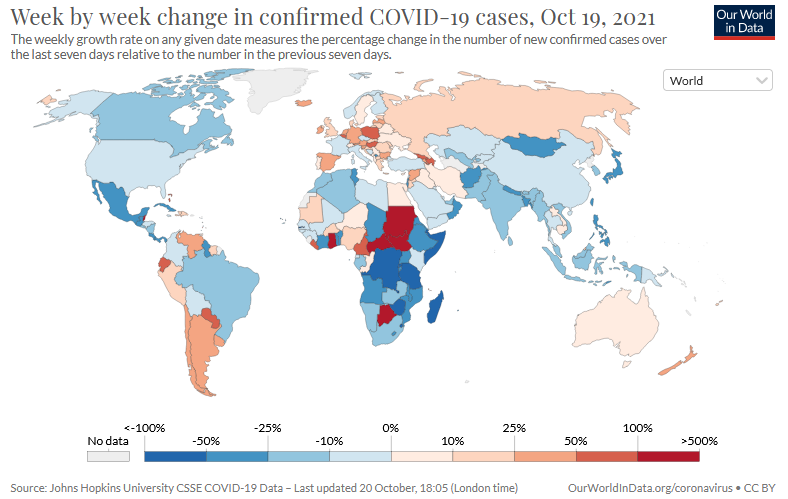
There’s a growing belief that we’re in the final throws of the covid pandemic but that’s not the case in Russia, where Putin today ordered everyone to stay home from work from Oct 30 to Nov 7. The rising cases in the UK are another worry.
The hope is that low vaccinations rates make Russia an outlier. Only 31% of people there are fully vaccinated. Markets are certainly acting like any further waves of covid and they will be in for a sherwd awakining. Look at the above map. It shows where cases are rising and falling. Keep an eye on central Europe. The new variant (A.23.1) with altered spike has emerged and potentially could start the next wave. Once again the world has let its guard down. all i can say is here we go….. AGAIN
US closes mostly higher amid earnings season
Major equities on Wall Street closed mostly higher on Wednesday following fresh record highs from Dow Jones as investors focused on earnings reports. Highly anticipated Tesla and IBM are scheduled for their releases after the markets close, while Verizon and Abbott Laboratories each earlier reported positive growth in revenue. Federal Reserve published its October’s Beige Book, saying most districts increased their economic activity at a modest to moderate rate, while other areas had a slower recovery due to “supply chain disruptions, labor shortages.” Treasury Secretary Janet Yellen also described the labor market as “very tight.” The Dow closed with 0.43% in the green led by UnitedHealth adding 2.52%, while S&P 500 gained 0.37% with Anthem jumping by 7.70%. The Nasdaq 100 dropped by 0.14% as Paypal Holdings lost 4.91% on reports of Pinterest acquisition. The euro advanced by 0.15% against the dollar exchanging hands for $1.16510 at 3:53 pm ET.