(Reuters) – Federal Reserve Bank of Atlanta President Raphael Bostic believes the Fed will pull back on its asset-buying campaign this year though he does not expect a decision in this month’s central bank meeting, he told the Wall Street Journal.”As strong as the data was coming in the early part of the summer, I was really very much leaning into advocating for an earlier start than what many may have expected” on the bond buying taper, Bostic told WSJ in an interview published on Thursday.
“The weaker data that we’ve seen more recently suggests to me that maybe there’s a chance for some play on this, but I still think that sometime this year is going to be appropriate (to slow the asset buying).”
Bostic, who does not currently hold a vote on the Federal Open Market Committee, does not expect there to be any call to pull back on asset buying at the Sept. 21-22 FOMC meeting, according to the report.
The microchip nightmare crippling auto factories globally is hitting Ford Motor Co.’s operations the hardest globally in terms of actual vehicles taken out of the production schedule, according to AutoForecast Solutions in Chester Springs, Pennsylvania. The company calculates factory-by-factory company announcements, shift production and work schedules in the U.S., Asia and Europe.
Ford stockpiling thousands of new F-150 pickups near Detroit Metro Airport
Ford is conducting final quality checks on thousands of early-production F-150 pickups that are stockpiled in lots around Metro Airport as dealers clamor for deliveries of America’s best-selling truck. Ford factory employees at the Dearborn Truck Plant have been working to meet an insatiable demand for the 2021 F-150. That meant Ford had to build trucks while the prototypes were still being driven as test models.Those trucks from the early build make up the stockpile of vehicles that are plain to see parked near the airport lately, and they are undergoing a final assessment, according to Ford. New F-150s coming out of the factory in recent weeks have been loaded directly with no delay onto truck haulers and trains to go to dealerships around the country, Ford said.
Ford F-150s parked at Worlds of Fun in Kansas City awaiting quality review
Ford needs to install seat belts and conduct software checks on early-production F-150 pickups parked in lots around the Kansas City Assembly Plant, as well as thousands in lots around metro Detroit, while some dealers await deliveries of America’s bestselling truck, Ford confirmed to the Free Press on Monday.
“As part of our commitment to delivering high-quality vehicles, we are conducting final quality inspections on trucks built before dealer shipments started last month to ensure they meet the quality expectations of our customers,” said Kelli Felker, Ford global manufacturing and labor communications manager. Nick Note ….. I would say its not a good year to by a car built peace meal in a parking lot. I’ll just wait on them to get overstocked again and give them away………..
Reuters) – Japan will extend emergency restrictions in Tokyo and other regions until the end of this month, while media reports suggested fully vaccinated residents in Australia’s Sydney might be freed from stay-at-home orders by the end of October.
DEATHS AND INFECTIONS
EUROPE
* Germany is extending its COVID-19 emergency aid for struggling companies by three months until the end of this year, the finance and economy ministries said.
* People will need to show a COVID-status certificate to enter bars, restaurants and fitness centres in Switzerland from Monday.
* About 2,000 Bulgarian restaurant and club owners, waiters, bartenders and gym instructors protested in the centre of the capital Sofia on Wednesday against newly imposed restrictions.
ASIA-PACIFIC
* Sydney’s cafes, restaurants and pubs are set to reopen in the second half of October after months of strict lockdown.
* Around a quarter of a million doses of the Pfizer-BioNTech vaccine bought from Spain will arrive in New Zealand this week.
* The Asian Youth Games, which were to be held in Shantou city in China’s southern Guangdong province in November, have been postponed to December 2022 due to the pandemic.
AMERICAS
* Dozens of Honduran migrants received vaccines in the southern Mexican city of Tapachula on Wednesday.
* Countries in the Americas should prioritize pregnant and lactating women in the distribution of COVID-19 shots, the Pan American Health Organization said.
MIDDLE EAST AND AFRICA
* South Africa has set a Nov. 1 date for municipal elections, after a court last week rejected a request to delay them until early next year to allow more time for COVID-19 vaccinations.
MEDICAL DEVELOPMENTS
* The U.S. Food and Drug Administration declined Humanigen’s request for emergency use authorization of its lenzilumab drug to treat newly hospitalized COVID-19 patients.
* Brazil’s federal health regulator said documents provided by a Sao Paulo biomedical centre attesting to the safety of over 12 million doses of the Coronavac vaccine were insufficient to ensure their safety.
* Novavax has initiated an early-stage study to test its combined flu and COVID-19 vaccine.
ECONOMIC IMPACT
* Asian shares dropped Thursday, while the dollar held firm, in line with a cautious global mood as investors worried about the combination of slowing global growth and the potential tapering of central bank stimulus. [MKTS/GLOB]
* China’s factory-gate inflation hit a 13-year high in August driven by soaring raw materials prices despite Beijing’s attempts to cool them.
* Several Federal Reserve policymakers have signalled that the U.S. central bank remains on track to trim its massive asset purchases this year.
* British employers are facing the most severe shortage of job candidates on record due to the post-lockdown surge in the economy and Brexit, a recruiters’ body said.
* Taiwan plans to issue “stimulus coupons” again to boost consumer spending by T$200 billion ($7.22 billion) and support its coronavirus-hit economy
Dallas Federal Reserve President Robert Kaplan said on Wednesday he cut his forecast for U.S. GDP growth this year due to the resurgence of COVID-19, but reiterated his support for starting to taper the Fed’s asset purchases in October as long as there is no fundamental change to the outlook. “Fear of infection is having an impact,” Kaplan said at a Dallas Fed Town Hall, forecasting slower hiring in September and a dent to demand in the third quarter, but no “prolonged” effect. This year the U.S. economy will probably grow 6%, he said, shy of the 6.5% pace he earlier forecast but so far not fundamentally different.
The U.S. Federal Reserve should go forward with a plan to trim its massive pandemic stimulus programme despite a slowdown in U.S. jobs growth last month, said James Bullard, the president of the St. Louis Federal Reserve Bank
“There is plenty of demand for workers and there are more job openings than there are unemployed workers,” Bullard said. Nick Note: 3 things:
1, The FED will taper because is has created bubbles in the bind markets, housing and the stock market…. the worst of all worlds
2. The FED is trapped inflation is embedded and inflationary expostulations are the highest i have ever see, They have no choice but to significantly raise rates
3. The two ton guerilla in the rooms is the corona19 virus Delta mutation. Its the untold story. Hospitals are filling up and the variant is out of control/ Its political and no one wants to speak the words lock down. SO the kiddies will go back to school and the third vaccines booster shot desperately needed will be delayed to long….. which means schools opening before children are vaccinate will become a national super spreader event…….
Sept 8 (Reuters) – The U.S. Federal Reserve should move forward with a plan to trim its massive pandemic stimulus programme despite a slowdown in job growth last month, St. Louis Federal Reserve Bank President James Bullard said in an interview with the Financial Times. Bullard dismissed concerns that the labour market recovery was faltering even as the U.S. economy created the fewest jobs in seven months in August after hiring in the leisure and hospitality sector stalled amid a resurgence in COVID-19 infections. “There is plenty of demand for workers and there are more job openings than there are unemployed workers,” Bullard said in the interview published on Wednesday. “If we can get the workers matched up and bring the pandemic under better control, it certainly looks like we’ll have a very strong labour market going into next year”, he told the newspaper. Bullard said in late August that he would like the central bank to start reducing its asset purchases soon and finish winding down those purchases by the first quarter of next year. “The big picture is that the taper will get going this year and will end sometime by the first half of next year”, he told the Financial Times.
Daily coronavirus cases are four times higher than they were following Labor Day weekend of last year with the number of daily deaths twice as high as they were this time in 2020, according to data from Johns Hopkins University.Since the global health crisis emerged in late 2019, the United States has recorded more than 40 million COVID-19 cases, including just 4 million in the last month alone.
Health officials noted the biggest difference between this year and last is the delta variant. They blamed the 316% increase over last year’s daily infections on the highly contagious COVID-19 mutation as well as a large number of Americans refusing to become vaccinated against the fast-spreading disease. According to data from Health and Human Services, hospitalization rates are also up 157% compared with Labor Day weekend 2020, leaving medical facilities packed to the brim and their staffs exhausted and overwhelmed. What’s more, intensive care units across several states are inching closer to full capacity, which could force doctors to make life-and-death decisions. “We are perilously close,” Dr. Anthony Fauci, the nation’s top infectious disease expert, told CNN. “You’re going to have to make some very tough choices.” Last year, coronavirus cases spiked across 31 states and the positivity rate surged in 25 of them only two weeks after the Labor Day holiday. The 2020 figures prompted U.S. Centers for Disease Control and Prevention Director Dr. Rochelle Walensky last week to warn unvaccinated Americans against traveling for the holiday weekend this year.
She also emphasized vaccinated people should wear their masks when required and that the high rate of virus transmission meant that it could be risky for them to travel as well.
Nationwide, only 53% of the total population is fully vaccinated, and just 62% of eligible Americans have received their jabs, leaving tens of millions at risk. Nick Note: As you know i got their first and declaierd an emergency. As the days go by we learn my early warning was correc to my sorrow. Two weeks from now infections will be soaring. that means i expect tow things. A stock market peek and a health crises the worst yet in the pandemic. Unforntunately the kiddies will be caks in school. This will be provent to be a tragic mistake. we have a solution see next story.
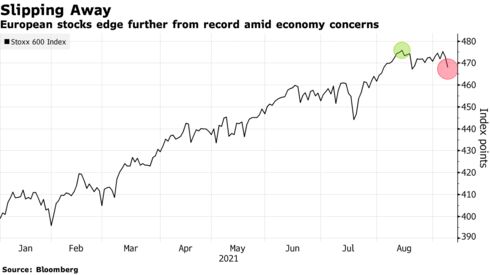
European shares dropped amid a blurred outlook for global growth, as investors await Thursday’s update from the European Central Bank. The Stoxx Europe 600 Index was down 1.1% as of 9:01 a.m. in London, trading at its lowest level since Aug. 19 as automakers, banks and industrials led losses. Miners and technology outperformed, but all sectors were lower. Volumes for Euro Stoxx 50 futures in the first hour of trading was double the 30-day average. Investment firm EQT AB fell 6.3% as an investor sold stock, part of a flurry of share sales on Tuesday that also included SoftwareOne Holding AG, automaker Stellantis NV and online retailer Asos Plc.
Europe’s main stock benchmark has struggled for traction after hitting an all-time high last month. While coronavirus vaccination programs are expected to continue to drive the economic reopening, disappointing economic data has distorted the recovery path just as interest rate-setters consider scaling back support. “A bit of a pull-back on the potentially slowing growth concerns is always likely,” Marija Veitmane, a multi-asset strategist at State Street Global Markets, said in written comments. The Delta Covid-19 variant has the potential to slow the global economic recovery, she added. Traders are now looking ahead to the European Central Bank’s policy update: “There will be a bit of sitting out, waiting to hear how much the ECB slows purchases,” Guy Foster, chief strategist at Brewin Dolphin, said in written comments. Some fund managers coming back from vacations may also be taking profits, Foster added. Governing Council member Robert Holzmann told Eurofi Magazine Wednesday that the ECB may normalize policy “sooner than most financial market experts expect.” The broader outlook for European equities is supported by the recent rebound in corporate profits, according to BlackRock. “Valuations remain attractive relative to history and look even more attractive than at the start of the year thanks to strong earnings,” strategists including Wei Li wrote in a report. Bankers’ views on global equities have turned slightly more negative, with firms including Morgan Stanley and Credit Suisse Group AG cautioning on the U.S. market. Both are more positive on Europe, however. Among individual shares, Sanofi slipped 1% after agreeing to buy immune-system therapies firm Kadmon Holdings Inc. for $1.9 billion. Airlines including EasyJet Plc and Ryanair Holdings Plc gained as the Telegraph newspaper reported that the U.K. may scrap its green and amber warning lists for foreign travel next month. Nick Note: The elephant in the room is this next wave of the pandemic. Driven by the more virulent Delta mutation and vaccines wearing off after 6 months. Foolish governments are caving in to mercantile interest. To their peril ignoring the health consequences. My belief is the resurgence of the plauge will devastate the economy and by extension the stock market.
Major stock markets on Wall Street closed mostly with losses on Tuesday, as the Nasdaq remained slightly in the green territory boosted by tech stocks’ surge. Earlier today, the White House requested from Congress to approve in total $20.4 billion in aid needed to negate the damage caused by Hurricane Ida as well as for the relocation of Afghans evacuated from Kabul. In business news, Microsoft announced the launch of its Microsoft Start app while Apple confirmed it would hold its annual event on September 14, where it will present new products. The Dow Jones sank 0.76% or 267 points at the closing bell, with 3M Co. plunging 4.53%. The S&P 500 fell 0.34%, as VF Corp. tumbled 5.73%. On the other hand, the Nasdaq 100 increased by 0.15%, with Match Group soaring 7.54%. The euro lost 0.27% against the dollar to sell for 1.18386 at 3:56 pm ET.
WASHINGTON/MILAN (Reuters) – World stock markets fell from record highs and U.S. shares were mixed on Tuesday as mounting worries over the slowing pace of economic recovery and the impact of the coronavirus Delta variant overtook investors’ hopes the Federal Reserve will delay tapering. Wall Street opened softer after Monday’s U.S. Labor Day holiday and the MSCI world equity index retreated from a record hit overnight, following seven consecutive days of gains to all-time highs. That followed gains during Asia’s trading hours on hopes of extra stimulus in Japan and strong China trade data. The Dow Jones Industrial Average fell 292.45 points, or 0.83 percent, to 35,076.64, the S&P 500 lost 19.29 points, or 0.43 percent, to 4,516.14 and the Nasdaq Composite dropped 8.90 points, or 0.06 percent, to 15,354.62 by 11:12 a.m. EDT (1512 GMT). European stocks retraced ahead of an ECB policy meeting on Thursday. The STOXX 600 benchmark was down 0.5% but just below its lifetime peak hit in August. “The combination of exorbitant expectations, nosebleed valuations and slowing macro environment make the go-forward reward/risk outlook less attractive,” said Jeffrey Carbone, managing director at Cornerstone Wealth in Huntersville, North Carolina. Data on Friday showed the U.S. economy created 235,000 jobs in August, the fewest in seven months as hiring in the leisure and hospitality sectors stalled, reducing expectations that the Fed will opt for an early tapering of its monthly bond purchases. The market took the surprisingly soft U.S. payrolls report on Friday “in stride, with the assumption that the Covid-19 Delta variant had an impact on economic activity in August,” Arthur Hogan, chief market strategist at brokerage National Holdings in New York, said in a market note. Speeches by a number of U.S. policymakers later this week will be closely watched for any indication about how the weak jobs report has impacted the Fed’s plans on tapering its bond purchases and keep its expansive policy for the near-term. The recent equity rally started after Fed Chair Jerome Powell’s dovish speech at the Jackson Hole Symposium in August. “Given that before Jackson Hole many FOMC members had come out in favor of tapering on a tight timetable, we’ll see if they confirm, or align with Powell’s more moderate message,” said Giuseppe Sersale, fund manager at Anthilia. Yields on U.S. Treasury bonds and inflation-protected securities rose on Tuesday, extending last week’s rise when data showing a jump in average wages confirmed price pressures were building in the world’s biggest economy. Japanese shares rallied further on hopes the ruling Liberal Democratic Party will offer additional economic stimulus and easily win an upcoming general election after Prime Minister Yoshihide Suga said he would quit.
“The mood is improving on hopes the government will take measures to support the economy and that the monetary environment will be kept accommodative,” said Wang Shenshen, senior strategist at Mizuho Securities.
A rout in bonds and shares of China Evergrande Group deepened on Tuesday after new credit downgrades on the country’s No. 2 developer.
The euro was last down 0.17 percent at $1.1848, while Europe’s broad FTSEurofirst 300 index dropped 0.47 percent to 1,821.34.
The ECB is seen debating a cut in stimulus, with analysts expecting purchases under its Pandemic Emergency Purchase Programme (PEPP) falling, possibly as low as 60 billion euros a month from the current 80 billion euros.
ING strategist Chris Turner said Friday’s soft U.S. jobs report and dovish comments last month by Powell have taken “some of the sting out of the dollar’s upside.” Nick Note: This market is still see armatures come in and buy on the dips.. I am seeing the pros lighten up,,,,, Soon we will begin operations..
Israel, once a front-runner in the global race to move on from COVID-19, is now one of the world’s biggest pandemic hot spots. The country that was once predicted to be the first to vaccinate its entire population had the highest per-capita caseload of anywhere in the week through Sept. 4, according to figures compiled by Johns Hopkins University. Its world-beating inoculation rate, meanwhile, has tumbled down the league table. The nation of 9 million became the test case for reopening society and the economy in April when much of Europe and the U.S. were still in some form of lockdown. Yet Israel now shows how the calculus is changing in places where progress was fastest. It’s no longer just about whether people get coronavirus, but also how badly they get it and ensuring that vaccines are still working as the highly infectious Delta variant threatens to undermine immunity. More recently, it has led the way when it comes to vaccinating children and rolling out a booster shot of the Pfizer-BioNTech vaccine after research suggested reduced efficacy over time. Around 100,000 Israelis are getting inoculated every day, the vast majority of them with a third shot. “If you are able to maintain life without lockdown, and to avoid very high numbers of hospitalizations and death, then this is what life with COVID looks like,” said Eyal Leshem, a professor specializing in infectious diseases at the Sheba Medical Center in Tel Ha-Shomer. Since April, Israel has fallen from first to 33rd in Bloomberg’s vaccine tracker of populations considered fully vaccinated. The program plateaued amid hesitancy from some in the Orthodox Jewish and Arab communities. About 61% of Israelis have been given two doses, lower than in European laggards earlier in the year such as France and Spain. Following the spread of the Delta variant over the summer, Israel has seen cases climb, reaching an all-time high of 11,316 daily cases on Sept. 2. The number of people falling seriously sick and being hospitalized, though, has risen less than it did during the last coronavirus wave, peaking at 751 in late August, compared with 1,183 in mid-January. The trend is now downward.
Infections jumped because of the prevalence of cases among the unvaccinated, especially children. There were also so-called breakthrough infections in those who have been vaccinated, and the drop in efficacy of vaccines.
That said, unvaccinated people account for more than 10 times as many serious cases as those who have received two doses, showing that even with immunity waning, shots are providing protection. For public health officials and politicians, the latest chapter of the pandemic is to concentrate on ensuring older people more at risk continue to be protected while cases are rising among children. The importance of that drive is heightened by the return of millions of children to schools last week, and the Jewish New Year this week. Epidemiologists say cases among the over 30s are already declining thanks to the boosters and restrictions on bars and restaurants to the fully vaccinated. The highest rate of new cases in recent weeks is among children under the age of 12, according to Ran Balicer, chair of the expert advisory panel to the government. There’s also a record level of testing. “Waning immunity is a real challenge that every country needs to prepare a contingency plan to tackle,” said Balicer, who is also chief innovation officer for Israeli health maintenance organization Clalit. The data coming from Israel in the coming weeks will allow the world to assess the efficacy of the booster shot program, he said. As of Sept. 6, at least 2.6 million people in Israel—around 28% of the population—have now had the booster shot of the Pfizer-BioNTech vaccine, according to the Israeli Health Ministry. That rises to at least 64% for people in age brackets over 60. Significantly, the booster shot is also available for anyone over 12 who was vaccinated at least five months ago.
The wildcard is the return of schools. That could change the transmission dynamics and expose all age groups to infection because of kids coming home with COVID-19, Balicer said.
The World Health Organization’s heat map puts Israel in the top five in the wider European region. The rolling data show areas with the highest seven-day infection rates are in Scotland, where 68% of the population are fully vaccinated. Cases surged after restrictions were lifted and then schools returned from their summer break in mid-August. “If we look back a year ago, we virtually had no protection other than a complete lockdown,” said Leshem. “Now, we have an open education system, fully open commerce, and despite over 50,000 cases a week, we are not seeing increases in the number of severe cases and hospitalization.”