March 19 (Reuters) – Investment flows into U.S. equity funds jumped to a five-week high in the week ended March 17, buoyed by optimism over a massive stimulus package and on expectations that the Federal Reserve’s monetary policy stance would remain dovish.
U.S. equity mutual funds pocketed a net inflow of $20.1 billion in the week, which marked a sixth straight week of net buying, data from Refinitiv Lipper showed.
The inflows were led by U.S. small cap funds and mid-cap funds, seeing net purchases of $3.6 billion and $2.1 billion respectively. On the other hand, large-cap funds had an inflow of just $251 million. Among sector funds, investors turned net buyers of tech funds this week, purchasing $832 million, as tech stocks appeared attractive at lower valuations after witnessing sharp selling in the prior weeks. Investors were sanguine ahead of a two-day Fed policy meeting at which the central bank signalled its intent to keep rates near zero until at least 2024, also predicting a fast economic recovery from the pandemic. However, U.S. stocks tumbled on Friday, with banks leading the way after the Fed let expire a temporary capital buffer relief put in place to ease a pandemic-driven stress in the funding mark. Meanwhile, investors bought $9.72 billion in U.S. bond funds in the week, compared with $1.32 billion in the preceding week. U.S. Taxable bond funds had an inflow of $7.9 billion, while U.S. municipal funds saw an inflow of $9.3 billion. Investors turned net buyers of U.S. High yield funds, buying $260 million, after dumping $5.5. billion in the last week. Nick Note: First i heard dueling banjos and then a flash of light ripped across my computer. and then the CFD’s coming off a 12700 low and shooting up to the sky in my dream. I am sorry i could not help myself…. The idea of a bunch of normal folks screwing wall street city slickers investment funds in the ass overwhelmed me!
Washington — The coronavirus pandemic inflicted a “cruel and uneven toll on lives and livelihoods” across the United States, head of the Federal Reserve Jerome Powell (pictured) told the Wall Street Journal on Friday. The official stated that the central bank and the government acted together to limit the long-term effects of the “unprecedented” downturn, with more than half of the initial job losses being recovered. The arrival of COVID-19 vaccines has also helped “brighten” the economic outlook, he added.
“But the recovery is far from complete, so at the Fed we will continue to provide the economy with the support that it needs for as long as it takes,” Powell concluded.
“The economic recovery remains uneven and far from complete, and the path ahead is highly uncertain,” Powell said in written testimony to the Senate Banking Committee. Powell’s comments are in contrast to the increasing optimism among many analysts that the economy will grow rapidly later this year. That outlook has also raised concerns about a potential surge in inflation and fueled a sharp increase in longer-term interest rates this year. Many economists say they think the Fed’s continued low rates, further government financial aid and progress in combating the viral pandemic could create a mini-economic boom as soon as this summer. “Mr. Powell presumably wants to try to persuade markets that a strengthening economy does not necessarily mean that rates have to rise,” Ian Shepherdson, chief economist with Pantheon Macroeconomics, told investors in a note. “Good luck with that when the post-Covid surge in activity become clear.” Financial markets fell modestly in morning trade, with the S&P 500 and Dow stock indexes both down less than 1% and the tech-heavy Nasdaq down 242 points, or 1.8%.Powell acknowledged the potential for a healthier economy. But he stressed the challenges caused by the pandemic, especially for unemployed Americans. Nick Note: do not let the hedge funds shit you. Rates are going no where and certainly not enough for the fed to take the pedal off the metal. Get ready for the next UP leg of the greatest bull market ever. Interest rates on the short side are as close to zero as you can get. And as long as you stay low, have a economic recover and happy checks out the ass. Its zoom zoom zoom. And you are going to love this next bit…. Stimulus is far from over…… Comrade!
(Bloomberg) — Nasdaq 100 futures climbed and Treasury yields fell, signaling a rebound may be in store for technology stocks after Thursday’s selloff sparked by rising inflation bets. Contracts on the S&P 500 and Dow Jones Industrial Average also edged higher after U.S. shares slid from a record. The yield on the 10-year Treasury benchmark slipped back below 1.7%, a threshold it hadn’t breached since January 2020, and the dollar was steady. WTI crude oil held above $60 a barrel after a 7% plunge. A calmer tone is ending a volatile week in which Federal Reserve Chair Jerome Powell fanned inflation fears by messaging he’s willing to run the economy hot to help it recover from the fallout of Covid-19, and he’s not unduly concerned by rising yields “Economic recovery is on its way and we have central banks around the world very committed to easy monetary policy,” said Jun Bei Liu, portfolio manager at Tribeca Investment Partners, who sees value stocks benefiting. “Fundamentals of the equity market are looking very strong.” Meanwhile, the Stoxx Europe 600 index declined, led by banks and retailers, while bond yields across the region retreated. China’s CSI 300 share gauge slumped as chilly U.S.-China talks soured the mood, while Japan’s Topix rallied and the Nikkei 225 sank after the Bank of Japan said it will focus purchases of exchange-traded funds on the former gauge. France announced a lockdown of areas including Paris to fight the pandemic, casting a cloud over Europe’s outlook amid an uneven vaccine roll out even as the European Central Bank signaled continued monetary support. Traders were bracing for quadruple witching Friday, a major expiration of options and futures contracts that can exacerbate swings in asset prices. Elsewhere, a number of European nations will start using AstraZeneca Plc’s Covid-19 vaccine again after Europe’s drug regulator declared it safe. These are some of the moves in markets as of 9:49 a.m. in London: S&P 500 futures added 0.3%, after the benchmark closed down 1.5%.Nasdaq 100 Index futures rose 0.7%. The index fell 3.1%. The Stoxx Europe 600 index dropped 0.3%.The MSCI Asia Pacific index fell 0.7%.The MSCI Emerging Markets index retreated 1%. The Bloomberg Dollar Spot Index dipped 0.1%.The euro slipped 0.1% to $1.1902.The yen was at 108.78 per dollar, up 0.1%.The British pound was little changed at $1.3926. BondsThe yield on 10-year Treasuries dipped two basis points to 1.69%.Germany’s 10-year yield fell four basis points to -0.305%.The U.K. 10-year yield dropped five basis points to 0.827%.
LONDON (Reuters) – Investors put a record $68.3 billion into equity funds in the week to March 17, even as a spike in government bond yields sent the high-flying Nasdaq index reeling, BofA data showed on Friday.
U.S. equity funds sucked in $53 billion as ultra-easy monetary policy continued to boost risk appetite.
BofA warned of tightening global financial conditions, however, with eight interest rate hikes across the world so far this year versus five cuts. Meanwhile, the U.S. Federal Reserve pledged to look past inflation and keep interest rates near 0% until at least 2024. Still, the yields on 10-year notes spiked on Thursday to 1.75%. That move sparked a massive sell-off on Wall Street with the tech-heavy Nasdaq 100 slumping 3.1%, wiping off more than $400 billion from company valuations in a single session. BofA said the “uber-dovish Fed backfired” with bond vigilantes moving quickly to try to bully the central bank into yield curve control – pinning down yields on bonds of a particular maturity.
Global equity funds have attracted $347 billion so far this year, matching record inflows seen for 2017 as a whole. On an annualised basis, this year’s inflows are a “breathtaking” $1.6 trillion, BofA said.
“We are in (the) midst of (the) strongest macro data of our lives,” BofA investment strategist Michael Hartnett wrote in a note to clients. Nick Note: I have been at this for a little while now. And I have studied every market theory that came along. From the Nifty Fifty to the Bricks to the FANG, high frequency trading and My favorite algorithms. I studies earnings and P/E and EVERY theory that has come a long to establish valuations. And as usual i have learned the more complicated the theory is and the more PHD mathematicians the more likely its total bullshit. If i can not write my trade rational on the back of a match book it will not work. What drives the stock market is very simple. If the suckers are buying for what ever fad rationale right or wrong usually wrong the stock market rallies. New blood feeding the bull their money. NO MATTER WHAT the market rises. Its really as simple as that. And when the money runs out down the market goes. It does not even need selling to go down. The rocket ship needs a constant supply of fuel (money) to keep the engine running. No fuel the rocket engine shuts down and you get the inevitable crash. It has nothing to do with inflation or interest rates. A stock market born again bull is not a bond buyer. He is not playing the game for a 3% return. I doubt most of you even know how to buy bonds or understand the auction process or the when issued markets. Never mind the bid to cover ration. In fact to be honest with each other your still scratching your ass trying to get my bond calculator working never mind my Strips calculator. If i put a gun to your head and asked you to calculate yield to maturity manually with a pencil and piece of paper you could not do it. AND you more informed then the average stock market buyer. Who as long as they have cash new age ha ha ha investor millennial. People do not do complicated. I am sure most of you do not understand bond yields, reverse bias or even how the bond markets works never mind calculating values in fractions like 32/100. The bond market is still dominated by sophisticated investors and is not a mass market. When i started in this business the stock and futures markets were populated by sophisticated investors. No More. The Ha ha “democratization” of the markets means that any dumb fuck can open a self directed account and lose his her its money! ITS have made the stock market little more then a casino or lottery. In fact its more convenient to buy stocks or futures using your smart phone then a lottery ticket. the masses can PRETEND they are investing when in fact they are gambling. So i say lets continue my lives work of taking money from stupid people no matter how prestigious their institution of PHD is.
(Reuters) – Federal Reserve Chair Jerome Powell is scheduled to speak Monday at a Bank for International Settlements conference on innovation in the digital age, the U.S. central bank said on Thursday. On Tuesday, Powell will testify before the House of Representatives Financial Services Committee, and on Wednesday he will testify before the Senate Banking Committee, on the Coronavirus Aid, Relief, and Economic Security Act, the Fed said. The appearances come after the Fed signaled Wednesday that it will hold rates at their current near-zero level through 2023, even as policymakers boosted their forecasts for economic growth and inflation. Nick Note: I want to be clear here. Hedge funds are short the US stock market and taking a assing. They are spinning the inflation HYPE like i have ever seen before. Everyone who know this game know that a reflating is a spot even reflecting prices adjusting and initial over demand as the supply pipelines fill again. THEIR IS NO INFLATION AND THEIR WILL NOT BE ANY. Their is no more bullish event for a stock market then a economic boom. PENT UP DEMAND and a record savings rate will create a post war kind of boom and stock market rally like never seen before. I hope you join me in the greatest rally ever…… Make no mistake this coming boom will end in the biggest bust ever.. they always do. .. And be warned it will come like a thief in the night!
(Reuters) – Wall Street ended sharply lower on Thursday, with the Nasdaq tumbling 3%, hit by rising Treasury yields and fresh worries about the coronavirus pandemic in Europe. Losses in U.S. stocks accelerated after France’s prime minister imposed a month-long lockdown on Paris and several other regions due to the health crisis. It was the Nasdaq’s steepest one-day drop since Feb. 25. The S&P 500 energy sector index tumbled 4.7% as oil prices fell, in part due to worries about rising COVID-19 cases in Europe. “That last hit was from news of the Paris lockdown. It wasn’t received that well,” said Joe Saluzzi, co-manager of trading at Themis Trading in Chatham, New Jersey. “Here in the United States, we anticipate this big reopening and the virus is looking good, but we are not looking outside of the U.S., and it’s not all good.” The Russell 1000 value index, which is heavily comprised of cyclical stocks such as financials and energy, lost 0.6%, while the Russell 1000 growth index, which includes technology stocks, dropped more than 2%. The yield on the benchmark 10-year Treasuries crossed 1.75% to hit a 14-month high a day after the Fed projected the strongest growth in nearly 40 years as the COVID-19 crisis winds down. The Fed also repeated its pledge to keep its target interest rate near zero for years to come.. “The Fed just saying they are not going to raise rates until 2023 really means nothing,” said Tim Ghriskey, chief investment strategist at Inverness Counsel in New York. “The Fed is on the sidelines, but if bond yields keep going up, that is what really hurts the economy.” Apple Inc and Amazon.com Inc both dropped more than 3%. Tech and other growth stocks are particularly sensitive to rising yields because their value rests heavily on earnings far into the future, which are discounted more deeply when bond yields rise. A recent $1.9 trillion spending stimulus sparked fears of rising inflation and contributed to the jump in longer-end Treasury yields. Underscoring the staggered recovery in the labor market, data showed the number of Americans filing for jobless benefits unexpectedly rose last week. A separate report indicated the Philly Fed business index jumped more than expected, to its highest level since 1973. The Dow Jones Industrial Average fell 0.46% to end at 32,862.3 points, while the S&P 500 lost 1.48% to 3,915.47. The Nasdaq Composite dropped 3.02% to 13,116.17. The S&P 500 and the Dow both closed at record highs on Wednesday. Accenture rose 1% after the IT consulting firm raised its full-year revenue forecast and reported second-quarter revenue above analysts’ estimates, as more businesses used its digital services to shift operations to the cloud. Dollar General Corp dropped 4.65% after the retailer forecast annual same-store sales and profit below estimates, indicating that a pandemic-fueled rush for lower-priced goods may be waning faster than expected. AMC Entertainment climbed more than 3% after the movie theater operator said it would have 98% of its U.S. locations open from Friday. Declining issues outnumbered advancing ones on the NYSE by a 3.69-to-1 ratio; on Nasdaq, a 3.42-to-1 ratio favored decliners. The S&P 500 posted 85 new 52-week highs and no new lows; the Nasdaq Composite recorded 213 new highs and 28 new lows. Volume on U.S. exchanges was 12.8 billion shares, compared with the 14.2 billion average for the full session over the last 20 trading days. Nick Note: Forget about it. Today’s market is nothing. Stocks are getting ready to roar back to significant new highs…
(Reuters) – The S&P 500 receded from a record high on Thursday while the Nasdaq shed more than 1% as a spike in U.S. bond yields accelerated a move out of growth stocks and into companies viewed as likely to outperform as the economy recovers. The Russell 1000 value index, which is heavily comprised of cyclical stocks such as financials and energy, added about 0.2% while the Russell 1000 growth index, which includes technology stocks, dropped about 1.4%. That rotation helped lift the Dow Jones Industrial Average to an intraday record high, led by UnitedHealth Group and Goldman Sachs Group, both up more than 2%. The yield on the benchmark 10-year Treasuries crossed 1.75% to hit a 14-month high a day after the Fed projected the strongest growth in nearly 40 years as the COVID-19 crisis winds down, and also repeated its pledge to keep its target interest rate near zero for years to come.. “The Fed just saying they are not going to raise rates until 2023 really means nothing,” said Tim Ghriskey, chief investment strategist at Inverness Counsel in New York. “The Fed is on the sidelines, but if bond yields keep going up, that is what really hurts the economy.” Apple Inc and Amazon.com Inc dropped more than 2%. Tech and other growth stocks are particularly sensitive to rising yields because their value rests heavily on earnings far into the future, which are discounted more deeply when bond yields rise. A recent $1.9 trillion spending stimulus sparked fears of rising inflation and contributed to the jump in longer-end Treasury yields. Underscoring the staggered recovery in the labor market, data showed the number of Americans filing for jobless benefits unexpectedly rose last week. A separate report indicated the Philly Fed business index jumped more than expected, to its highest level since 1973. In midafternoon trading on Thursday, the Dow Jones Industrial Average was up 0.49% at 33,176.67 points, while the S&P 500 lost 0.37% to 3,959.43. The Nasdaq Composite dropped 1.46% to 13,328.11. The S&P 500 financial sector index, sensitive to the economic outlook, rose almost 2%, while the industrial index climbed almost 1%. The technology index fell 2.3%. Accenture jumped about 1.9% after the IT consulting firm raised its full-year revenue forecast and reported second-quarter revenue above analysts’ estimates, as more businesses used its digital services to shift operations to the cloud. Dollar General Corp dropped more than 5% after the retailer forecast annual same-store sales and profit below estimates, indicating that a pandemic-fueled rush for lower-priced goods may be waning faster than expected. AMC Entertainment jumped almost 5% after the movie theater operator said it would have 98% of its U.S. locations open from Friday. Declining issues outnumbered advancing ones on the NYSE by a 1.69-to-1 ratio; on Nasdaq, a 1.51-to-1 ratio favored decliners. The S&P 500 posted 84 new 52-week highs and no new lows; the Nasdaq Composite recorded 208 new highs and 20 new lows.Nick Note: Let them try to tickle the dragons tail. This will end badly…… the FED is in firm control. Their is no inflation… Its a reflation and everyone of them end up in a stock market boom. We shall see what we shall see
(Reuters) – Automakers lifted the German DAX to a record high on Thursday, while broader European stocks inched towards all-time highs after the U.S. Federal Reserve vowed to keep interest rates low despite forecasting a surge in economic growth.
An index of euro zone’s top 50 companies gained 0.4%, surpassing its peak hit in February last year before the COVID-19 pandemic hammered financial markets.
Germany’s blue-chip DAX rose 0.9%, France’s CAC 40 was up 0.2%, while UK’s FTSE 100 slipped ahead of the Bank of England’s monetary policy decision due at 1200 GMT. The central bank is not expected to change its huge, crisis-fighting stimulus programme despite optimism about an economic recovery. The pan-European STOXX 600 rose 0.3%, but eased from early highs due to losses in utilities, chemical and food & beverage stocks. With the 10-year U.S. Treasury yield rising after the Fed decision, economically sensitive sectors such as automakers, banks and miners led the gains in Europe. A recent rise in government bond yields have stoked worries about a pickup in inflation as trillions in dollars of stimulus help global economies emerge from the pandemic shock. However, European stocks have benefited as a rise in yields sparked rotation into some of the cheaply valued sectors like bank and energy on hopes of a strong economic rebound. “We expect further upside for bond yields in response to sharp acceleration in global growth, rising inflation and reduced monetary policy accommodation,” said Milla Savova, European equity strategist at Bank of America Merrill Lynch. “In combination with our expectations for a euro area PMI rebound and rising oil price, this would imply around further 15% outperformance of value versus growth by late Q3.” Volkswagen jumped 3.4%, sealing its position as the most valuable company in Germany’s DAX after it overtook software maker SAP on Wednesday. Its shares have racked up a 28% gain so far this week and are on course to record the biggest weekly gain ever after it stepped up its switch to fully electric vehicles. Swiss lender Credit Suisse gained 1.7% after it said it was overhauling its asset management business amid regulatory investigations into its dealings with collapsed Greensill Capital. Telecoms equipment maker Nokia slipped 1.0% despite forecasting a pick up in profit margins to 10%-13% in 2023. Swiss online pharmacy chain Zur Rose fell 7.5% to the bottom of STOXX 600 after disappointing full-year results and outlook. Nick Note: The hedge funds are doing what they always do. using their enormous wealth advantage to take the markets away from their real value. They can only does this for a short time. But because most people get scared in the SHORT term they can succeed. The truth is year over year hedge funds are net losers.
(Bloomberg) — Federal Reserve Chair Jerome Powell and his colleagues continued to project near-zero interest rates at least through 2023 despite upgrading their U.S. economic outlook and the mounting inflation worries in financial markets.
The decision, which came on a volatile day for investors with Treasury yields surging ahead of the announcement, masked a growing number of officials who saw liftoff before then — though Powell stressed this remains a minority view.
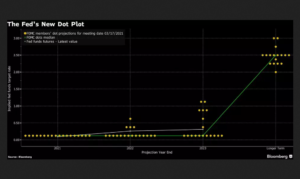
“The strong bulk of the committee is not showing a rate increase during this forecast period,” Powell told a virtual press conference Wednesday following a meeting of the Federal Open Market Committee, adding that the time to talk about reducing the central bank’s asset purchases was “not yet.” Seven of 18 officials predicted higher rates by the end of 2023 compared with five of 17 at the December gathering, showing a slightly larger group who see an earlier start than peers to the withdrawal of ultra-easy monetary policy, according to fresh quarterly Fed projections. “Indicators of economic activity and employment have turned up recently, although the sectors most adversely affected by the pandemic remain weak,” the FOMC said in its policy statement. “Inflation continues to run below 2%.”
The Fed expects that a bump in inflation this year will be short-lived. Officials saw their preferred measure of price pressures slowing to 2% next year following a spike to 2.4% in 2021, according to the projections. Excluding food and energy, inflation is forecast to hit 2.2% this year and fall to 2% in 2022.
Ten-year Treasury yields reversed their earlier rise as Powell spoke and U.S. stocks closed higher. Asked about the recent move up in yields, Powell pushed back against the idea the Fed should lean against the market, noting that the current stance of Fed policy, including its asset purchase program, was appropriate.Massive fiscal support and widening vaccinations that will help reopen the economy have buoyed investor expectations for rate increases and inflation, propelling Treasury yields higher as the central bank and federal government keep adding stimulus. The target range of the benchmark federal funds rate was kept at zero to 0.25%, where it’s been since last March. Wednesday’s FOMC decision was unanimous. “The Federal Reserve continues to hold the course, maintaining the glide path for both rates and asset purchases which it established last year, and does not appear to be close to altering its trajectory anytime soon.” U.S. central bankers left asset purchases unchanged at $120 billion a month and repeated that this pace would be maintained until “substantial further progress” is made on their employment and inflation goals. Powell told reporters that the Fed would signal well in advance when that threshold was on track to being achieved. Powell and his colleagues met as the economy continues to improve. Job gains picked up last month and President Joe Biden signed an additional $1.9 trillion of pandemic aid into law on March 11. Vaccinations continue apace, allowing states to start easing lockdown restrictions that could release a torrent of consumer spending. The economy remains far from the Fed’s goals, though. Even with 379,000 jobs added to payrolls in February, 9.5 million fewer Americans have jobs compared with a year ago and inflation remains well below the Fed’s 2% target. “This particular downturn was a direct hit on the part of the economy that employs many minorities,” Powell said. Still, prospects for stronger growth have ignited some concern about higher inflation, contributing to a rise in 10-year Treasury yields in recent weeks. Powell told lawmakers in testimony last month that the economy is still has a long way to go before there’s any risk of overheating. They also upgraded forecasts for economic growth and the labor market, with the median estimate for unemployment falling to 4.5% at the end of 2021 and 3.5% in 2023, while gross domestic product was seen expanding 6.5% this year, up from a prior projection of 4.2%. Christopher Waller, who joined the Board of Governors in late December, contributed projections for the first time this month. Nick Note: Did you think that pig we are fucking in the BlackJack trade is going to make it easy for us. Bottom line the markets will zoom with the raped pig squealing all the way!!
U.S. stocks erased earlier losses and jumped higher Wednesday after the Federal Reserve said it sees no interest rate hikes through 2023 and that it will let inflation run hotter than usual to ensure a full economic recover U.S. stocks erased earlier losses and jumped higher Wednesday after the Federal Reserve said it sees no interest rate hikes through 2023 and that it will let inflation run hotter than usual to ensure a full economic recovery. The Dow Jones Industrial Average gained 210 points. The S&P 500 rose 0.5%. The Nasdaq Composite wiped out losses to traded 0.8% higher. The tech-heavy benchmark fell 1.5% earlier in the session as growth stocks got hit by surging bond yields again. While the Fed expects benchmark interest rates to remain near zero for the next two years, the central bank upgraded their economic outlook to reflect expectations for a stronger recovery from the pandemic-triggered recession. Gross domestic product is expected to grow 6.5% in 2021 before cooling off in later years. Expectations for core inflation also moved higher, with the committee now looking for a 2.2% gain this year as measured by personal consumption expenditures. The central bank’s stated goal is to keep inflation at 2% over the long run. “It sounds like the perfect scenario for investors and the outlook and you’re seeing market response to this very optimistic view,” said Michael Arone, chief investment strategist at State Street Global Advisors. “Monetary policy is going to remain largely accommodative almost regardless of what happens with interest rates, inflation and asset prices.” Fed Chair Jerome Powell said in a press conference that the Fed would need to see a material and sustained move in inflation above 2% before considering changes to its current easy policy stance. “We do expect that we’ll begin to make faster progress on both labor markets and inflation as the year goes on because of the progress with the vaccines, because of the fiscal support that we’re getting,” Powell said. “We expect that to happen, but we’ll have to see it first.” The 10-year Treasury yield came off its high of the day following the central bank’s update, rising 2 basis points to 1.64%. Earlier in the session, the benchmark rate jumped to 1.689%, hitting a level unseen since late January 2020. Higher rates have been hurting growth-oriented companies particularly hard as they erode the value of future cash flows.
“With the 2023 median plot still hugging the floor, stocks and bonds are rising again,” said Anu Gaggar, senior global investment analyst at Commonwealth Financial Network. “This is like a Goldilocks market – strong economic growth, moderately higher inflation, rebounding earnings, and very easy monetary conditions.”
Rising interest rates have been an overhang for stocks in recent weeks, specifically the tech sector. The jump in yields has forced a shift into value stocks from growth, pushing the Dow Jones Industrial Average and S&P 500 to hover near record highs. Shares of Disney erased earlier losses and gained 0.8% after CEO Bob Chapek told CNBC that California’s two Disneyland theme parks will reopen on April 30. McDonald’s climbed 2% after Deutsche Bank upgraded the stock to buy from hold. Nick Note: The fed is running party central….. The only way they are raising rates if wrong again hedge funds capture their families and hold them hostage