The world’s top oil producers pulled off a historic deal to cut global petroleum output by nearly a 10th, putting an end to the devastating price war between Saudi Arabia and Russia. John Paisie, president of Stratas Advisors, discusses how the agreement will affect affect prices and demand. He speaks with Haidi Stroud-Watts and Shery Ahn on “Bloomberg Daybreak: Australia.” Nick Note: As we expected, so stated and traded!
GOP senators seek that Saudi oil cut begins ‘soon’
WASHINGTON (Reuters) – Republican U.S. senators from oil states who recently introduced legislation to remove American troops from Saudi Arabia said on Saturday they had spoken with three officials from the kingdom and urged them to take concrete action to cut crude output. United States senators Dan Sullivan, from Alaska, and Kevin Cramer, from North Dakota, both of the Republican Party, held a phone conversation with Saudi Arabia’s Minister of Energy Prince Abdulaziz bin Salman on Saturday, during which they urged that Riyadh begins reducing oil production “soon.” Saudi Arabia and Russia were close to finalizing a deal with other producers in the informal OPEC+ group to cut crude output by a record 10 million barrels per day (bpd), or about 10% of global output. Oil prices had fallen to 18-year lows as the coronavirus outbreak has closed down economies across the world and after Saudi Arabia and Russia boosted output in a race for market share. The call was led by Senators Dan Sullivan and Kevin Cramer, who introduced legislation in March to remove U.S. troops, Patriot missiles and THAAD defense systems from Saudi Arabia unless it cut output. There were 11 Republican senators on the nearly two-hour call, including Bill Cassidy, who introduced legislation last week to remove the U.S. troops in 30 days, a month faster than the previous legislation. While the bills are unlikely to pass, the senators have played an unusual role in raising pressure on longtime ally Saudi Arabia, as President Donald Trump, a fellow Republican, has been in talks with Crown Prince Mohammed bin Salman urging him to boost output. They spoke with Saudi Energy Minister Prince Abdulaziz bin Salman, Deputy Defense Minister Khalid bin Salman and the Saudi ambassador to the United States, Princess Reema bint Bandar bin Sultan. Sullivan, of Alaska, applauded Saudi Arabia’s taking part in the agreement to cut output, but said “actions speak louder than words.” “The Kingdom needs to take sustainable, concrete actions to significantly cut oil production, and it needs to do so soon,” Sullivan said. Saudi Arabia’s action to boost production during a pandemic was “inexcusable” and “won’t be forgotten,” said Cramer, of North Dakota.
The United States, the world’s top oil producer, is gradually cutting about 2 million bpd of output as reduced demand and low oil prices force some heavily leveraged producers into bankruptcy.
The push by Republican senators was a sign of how Congress could raise pressure on Saudi Arabia if it does not stick to the oil cut plan. If the kingdom does not cut output, pointed measures could be included later this year in must-pass legislation such as the annual defense policy bill. In January, the United States had 2,500 military personnel in Saudi Arabia. In October 2019, Washington deployed about 3,000 troops there at a time of heightened tensions with Iran. The Saudi embassy in Washington did not immediately respond to a request for comment. Nick Note: Their is a deal as been telling you for weeks. this is the Kabocha dance as goveremnt sells this to its citizens.
Internet Outage Map
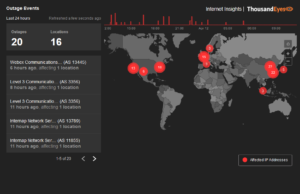
Verizon ISP canot keep up with demand
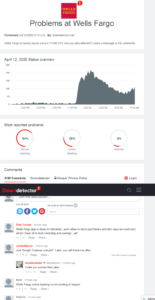
Well Fargo Online Banking OUT again
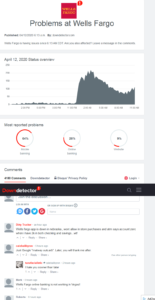
Nick Note: All the major online banking assholes are reporting problems… Funny how Fox, CNN and the others forget to tell you. Help is on the way!
Food Supplies Threatened!
American farmers are concerned. The coronavirus pandemic is posing a threat to their livelihoods, as it is for many others across the globe. But unlike some shelf-stable goods producers, farmers have very little flexibility. They’re on a strict planting and harvesting schedule and cannot ramp up or decrease production at will. “A peach [that] is good today is not good tomorrow. That’s how quick things ripen,” Chalmers Carr told CNN Business. Carr owns and operates Titan Farms in Ridge Spring, South Carolina, where he grows peaches on around 6,200 acres, in addition to bell peppers and broccoli. For blueberries and strawberries, he said, “if you leave them on the bush or the vine one extra day, they’re virtually worthless.” Even more forgiving crops, like bell peppers, have a short harvesting window of two to five days, Carr said. Peach farmers, among others, are concerned. April and May are critical planting and harvesting times for many US farmers. They need skilled laborers to work their fields, and a reliable supply chain to deliver their goods. And they don’t have any time to waste. If farmers can’t find enough workers or if their farming practices are disrupted because of the pandemic, Americans could have less or pricier food this summer. And because international farmers and their supply chains face similar problems, we could receive fewer food imports, potentially limiting supply and driving up prices. In recent weeks, many Americans got a scare when they walked into grocery stores and found empty shelves. Those shortages are caused by bottlenecks in the supply chain, not a lack of food, so grocery stores have been able to replenish their shelves fairly quickly. What happens over the next several months will determine whether those disruptions become more serious. Farmers are scrambling to solve problems as they arise, and it’s unlikely that we’ll run out of food. But this year and next, we may not see the bounty we’re accustomed to. As efforts to contain the coronavirus pandemic limit consular services, US farmers are worried they won’t be able to hire the international workers they rely on. “We are a sector that is very dependent upon guest workers coming into this country, particularly for the planting and harvesting of specialty crops [like] fresh fruits and vegetables,” said Chuck Conner, president and CEO of the National Council of Farmer Cooperatives. H-2A workers have been deemed essential by the government, and should be allowed to work in the United States. These workers don’t seem to be avoiding coming to the United States for fear of catching Covid-19 — the economic incentive is just too large to give up, Carr said. But workers may eventually decide it’s too risky to enter the United States. And if they do have a hard time getting in, it’s not clear that domestic labor will be able to fill in the gap. It might seem like there’s an obvious solution to the problem. US unemployment claims have reached unprecedented levels as businesses close their doors because of the pandemic. In the week ending March 21, initial jobless claims reached a seasonally adjusted 3.28 million — the largest number since the Department of Labor started keeping track of the claims in 1967. People currently seeking work could find it on farms. But most of the newly unemployed are not qualified. “It’s very skilled labor,” said Tom Stenzel, president and CEO of the United Fresh Produce Association. “If you’re a peach picker, you’re very different than a strawberry picker. And the ability to handle the volume and keep up with the pace — it’s a professional job.” Nick Note: in our planning and as elucidated in our reports (many going back 10 years or more) we see quarantines, panic, (Foreignfobia) infections, Embargoed imports and rising death rates drying up the labor pool of farm workers. Another great fear i have is they will lift quarantines prematurely. As we speak our sources inform us that feed lots and slaughter houses are seeing two things. One reduced demand as restaurants for the most part are closed. And workers are reported to be sick (fever and coughs) and not reporting to work. Its the same information we are getting from the pickers and dairy farmers. Its getting harder and harder to find labor. Americans siting home fat and sassy, well fed, well fucked and well entertained our not looking for work. And everyone Comrade Babushka gets a happy check. Our recommendation is to make sure you have a sufficient food supply. AND NOT THAT RIP OFF PRICED, FREEZE DRIED, SALTED TO DEATH, CHOCK FULL OF PRESERVATIVES SHIT! Use your freezers and buy long life foods like frozen meats, cheeses, beans, rice, pasta, rice and canned goods. follow our rules of rotate, rotate, rotate. First in First out.
Coronavirus found in air samples up to 13 feet from patients
Coronavirus spreads more than twice the 6ft social distancing gap demanded by government – and that isolating infected people at home is not a good strategy
- Chinese scientists examined two wards at Huoshenshan Hospital in Wuhan
- They found that aerosol transmission were concentrated upstream up to 13 feet
- Virus was also concentrated on surfaces like door handles and computer mice
Coronavirus sufferers can spread the infection 13 feet, twice the government’s social distancing rules, a study has found. Chinese scientists examined surface and air samples from both an intensive care unit and general Covid-19 ward at Huoshenshan Hospital in Wuhan, the city where the disease spawned before spilling across the map to become a global pandemic. Both wards housed a total of 24 patients between February 19 and March 2, when China was still in the grip of the deadly virus. The team observed so-called aerosol transmission – when the droplets of the virus are so fine they become suspended and remain airborne for several hours. Chinese scientists examined surface and air samples from both an intensive care unit and general Covid-19 ward at Huoshenshan Hospital in Wuhan in March This differs from cough or sneeze droplets that fall to the ground within seconds and linger on surfaces.
They found that virus-laden aerosols were mainly concentrated downstream from patients at up to 13 feet, though smaller quantities were found also observed upstream up to eight feet away.
It suggests that the government’s six-feet distancing guidance does not go far enough. However it remains unclear if these ultrafine particles are infectious and the World Health Organization has so far downplayed the risk. The Chinese team, from the Academy of Military Sciences in Beijing, also tested the concentration of the disease on surfaces. Their findings, published in the journal Emerging Infectious Diseases, were that the virus was most heavily concentrated on the floors of the wards, ‘perhaps because of gravity and air flow causing most virus droplets to float to the ground.’ High levels were also found on frequently touched surfaces like computer mice, trashcans, bed rails and door knobs. ‘Furthermore, half of the samples from the soles of the ICU medical staff shoes tested positive,’ the team wrote. ‘Therefore, the soles of medical staff shoes might function as carriers.’ They also offered advice that bucks most lockdown guidelines: ‘Our findings suggest that home isolation of persons with suspected Covid-19 might not be a good control strategy given the levels of environmental contamination.’ Because most citizens do not have access to personal protective equipment, the scientists believe confining the virus to households simply leads to cluster cases. Nick Note: I hate to be the bearer of bad news. The only solution is complete isolation completely away from people. And it gets worse. The particle size is under 6 micron, so do a google search on what it takes to filter out particles that small. Which means holy shit new plague batman smart people live and stupid people die.
Car sales in China soar 360% MoM in March
Car sales in China have surged over 360% in March compared to the previous month, the China Association of Automobile Manufacturers (CAAM) reported on Saturday, hinting on the market’s quick economic rebound in the second quarter of the year. On the other hand, a report released by CAAM showed that despite the monthly jump, passenger car sales in the Asian country still recorded a yearly decline of 48.4% due to the coronavirus-related lockdown. Meanwhile, American carmaker Tesla noted a record-high sales in the country during the same month, the Automobile Association recently revealed. Nick Note: Remember 1, 2 3 months base to peek to trough. China is our model. Once the masses are set free they will go GAG GAG crazy. Its called pent up demand. These are the reasons i insist the bottom has been put in our key markets. And why their will be a great big beautiful zoom Zoom ZOOOM!
Additional New Service Tracking the Internet
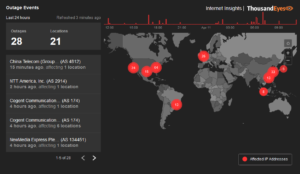
Nick Note: As you know we are staffing 24/7 and monitoring critical infrastructures. A lot of our data we have contracted for i cannot reproduce and disseminate. BUT I have decided to where i can to provide you with screenshots of some of the data we collect. I have monitored the things i am publishing for decades and as in the case of internet outages for over 10 years. I am alarmed about the growing disruptions. AND IT IS NOT NOT NOT simply the fact that the masses are home watching Netflicks and playing internet games. I am seeing real internet service and Financial institution service disruptions. The reason is a lot of their personnel are in quarantine and in the case of NYC the epic center they are sick. They are not equipped to operate from staffs hunkered down at home. It took me years to decentralize our infrastructure. Another problem is we are ALL experience problems getting spares. Thank GOD i stockpiled LNB’s, Receivers, Transmitters and what are know as Books. Because the spares are not be manufactured!
TD Ameritrade Problems Again…… RUN!
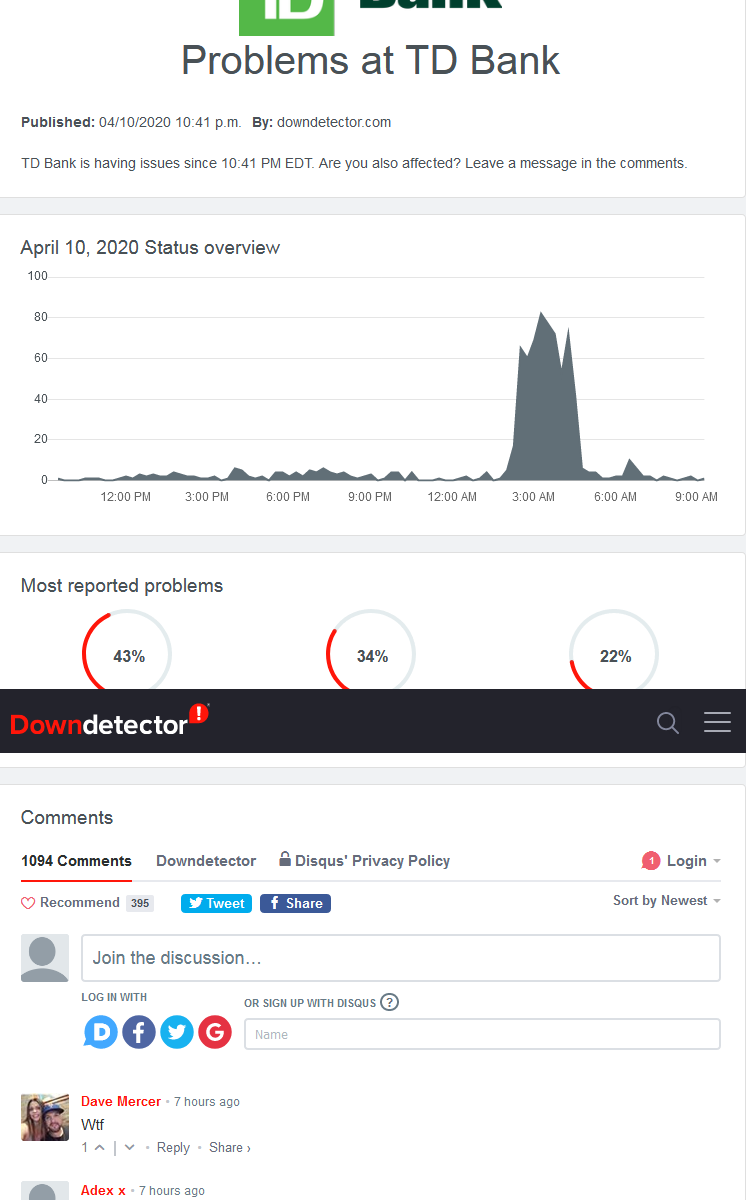
 Nick Note: I smell a bankruptcy here. RUN!! RUN!! RUN!!!! They are constantly having massive outages……… Usually when markets are making big move or when client redemptions soar… and they FUCK everyone with double margins in the middle if the night! read the tea leaves! Once again you have been warned! ARE YOU LISTENING?